
Guides · Tool reviews · Published November 21, 2026 · By Faizan Ahmad
No Sprinkler System? The 4 Best WiFi Hose Timers That Turn Any Faucet Into Automatic Watering
As an affiliate, YardSolver may earn a commission from qualifying purchases made through buttons on this page — it never changes the price you pay, and it never buys a place in these rankings.
A WiFi hose timer is a battery-powered valve that screws directly onto an ordinary outdoor faucet and opens and closes on a schedule you set from your phone — turning any tap into automatic watering with no trenches, no buried valves and no plumber. For renters, townhouse gardens, raised beds and pot collections, it is the whole irrigation system in one fitting. Add a hub, pair the app, and the timer waters at dawn while you are on holiday, skips when rain is forecast, and tells you if something goes wrong. It is also the natural front end for a drip setup: pair one of these timers with the lines in How to Set Up Drip Irrigation and a faucet becomes a full automatic drip system.
The four picks below cover the real range of needs: the best app, the most outlets, the longest range with leak alerts, and the budget two-zone option. What separates them is not whether they work — all four water on schedule — but how many areas one faucet can serve and how far that faucet is from your router.
The four picks, by faucet
Best app experience — Rachio Smart Hose Timer with WiFi Hub
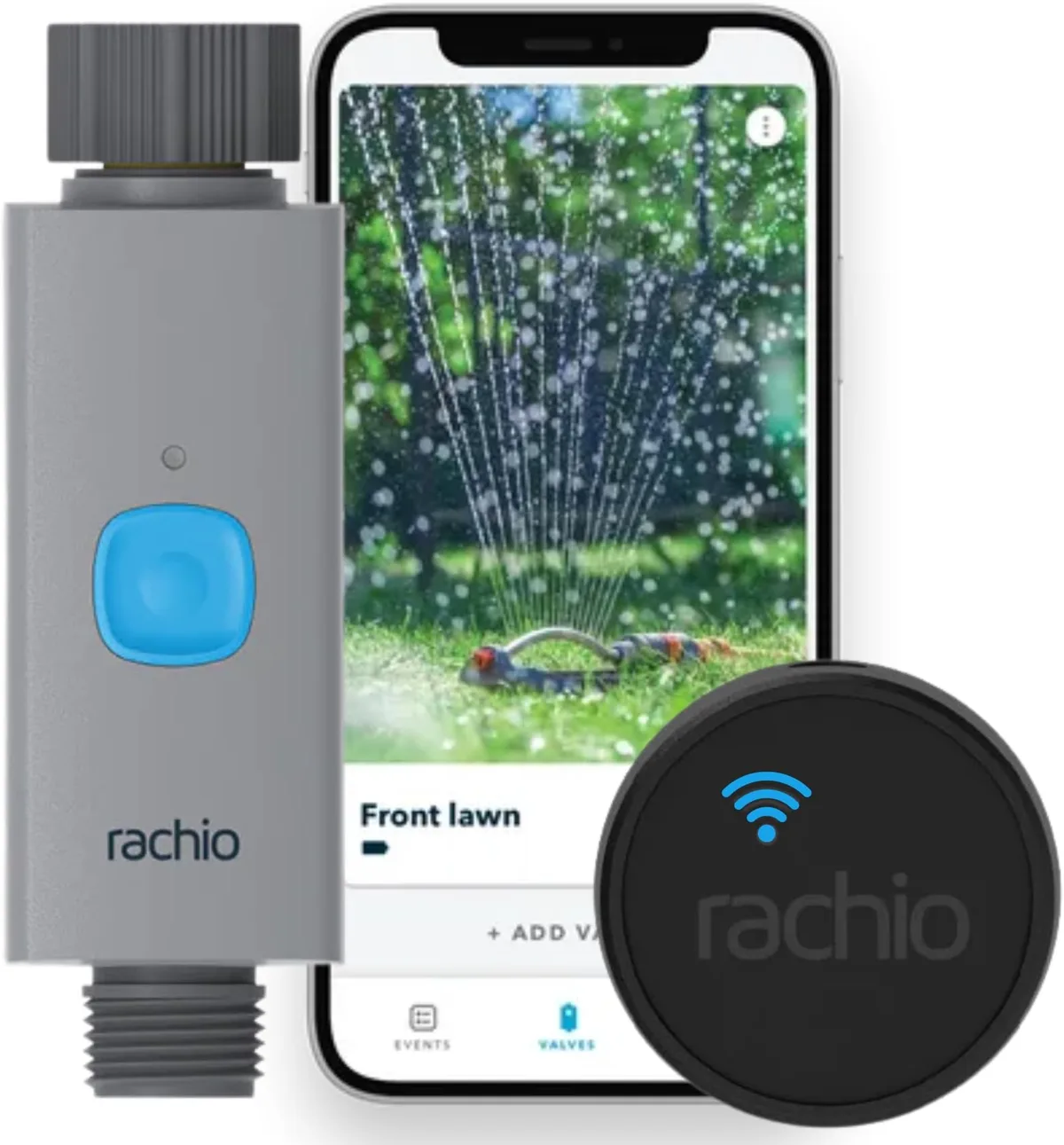
Rachio took the app and scheduling brain from its class-leading sprinkler controllers and shrank them into a single faucet valve. The kit pairs one brass-and-polymer valve with a small indoor WiFi hub; extra valves join the same hub when one area becomes three.
What is new and automated: The automation is the Rachio app itself: weather-aware scheduling that skips watering when rain is forecast, flexible programmes per valve, and the same zone thinking — soil, slope, exposure — that made the full-size controllers famous. Because the hub lives indoors near the router, the valve outside only needs to reach the hub, which makes connections more reliable than faucet-to-router WiFi.
Pros: the best app and smartest weather skipping in this category; expandable valve by valve on one hub; reliable hub-based connection; ideal first step into automatic watering.
Cons: one outlet per valve — watering four separate areas means buying four valves, so multi-area setups get expensive compared with a multi-port timer.
Best for: one or two high-value areas — a bed, a greenhouse, a pot collection — and anyone who values the app above all.
Check Price on Amazon — USCheck Price on Amazon — Canada
Buttons open a search for the Rachio Smart Hose Timer on each store, so you see today's price and the current models — we never print prices here because they change daily.
Most outlets from one faucet — Orbit B-hyve XD 4-Port Smart Hose Watering Timer with Wi-Fi Hub (24639)
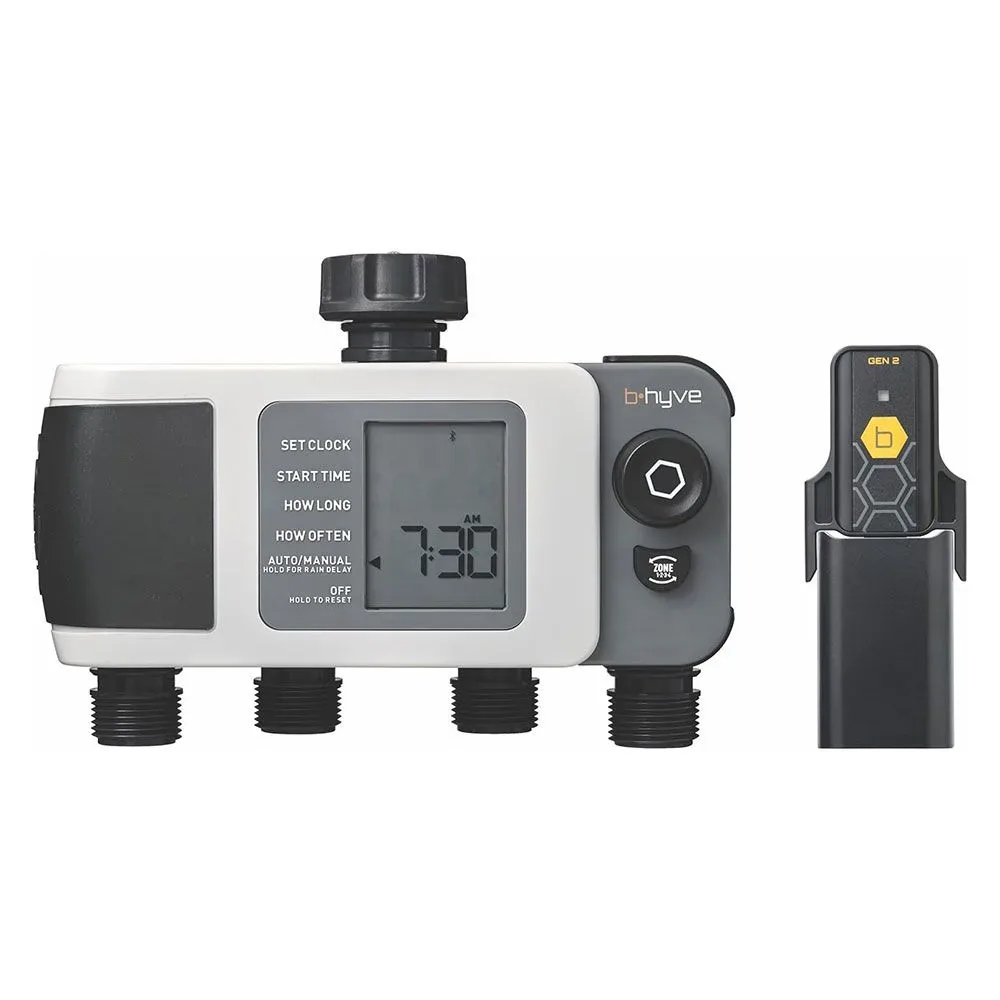
The B-hyve XD solves the one-faucet problem head-on: a single chunky unit on the tap with four independently programmed outlets, so the lawn soaker, the vegetable beds, the pots and the new hedge can each run on their own schedule from the same outdoor faucet.
What is new and automated: Each of the four ports is its own timer in the B-hyve app, with Orbit's WeatherSense adjusting and skipping watering based on local weather. Physical controls on the unit let you open any port by hand at the tap — the backup you want when your phone is indoors and your hands are muddy. A WiFi hub in the kit keeps the outdoor unit connected.
Pros: four independent zones from one faucet — unmatched here; on-device manual controls; weather-based adjustments; one purchase covers a whole small garden.
Cons: bulky on the tap, and the four zones share one faucet's pressure — run thirsty zones at different times rather than all at once, or flow drops everywhere.
Best for: small gardens with several distinct areas and exactly one usable outdoor faucet.
Check Price on Amazon — USCheck Price on Amazon — Canada
Buttons open a search for the Orbit B-hyve XD 4-Port on each store, so you see today's price and the current models — we never print prices here because they change daily.
Best range and leak alerts — LinkTap G2S Wireless Water Timer with Gateway
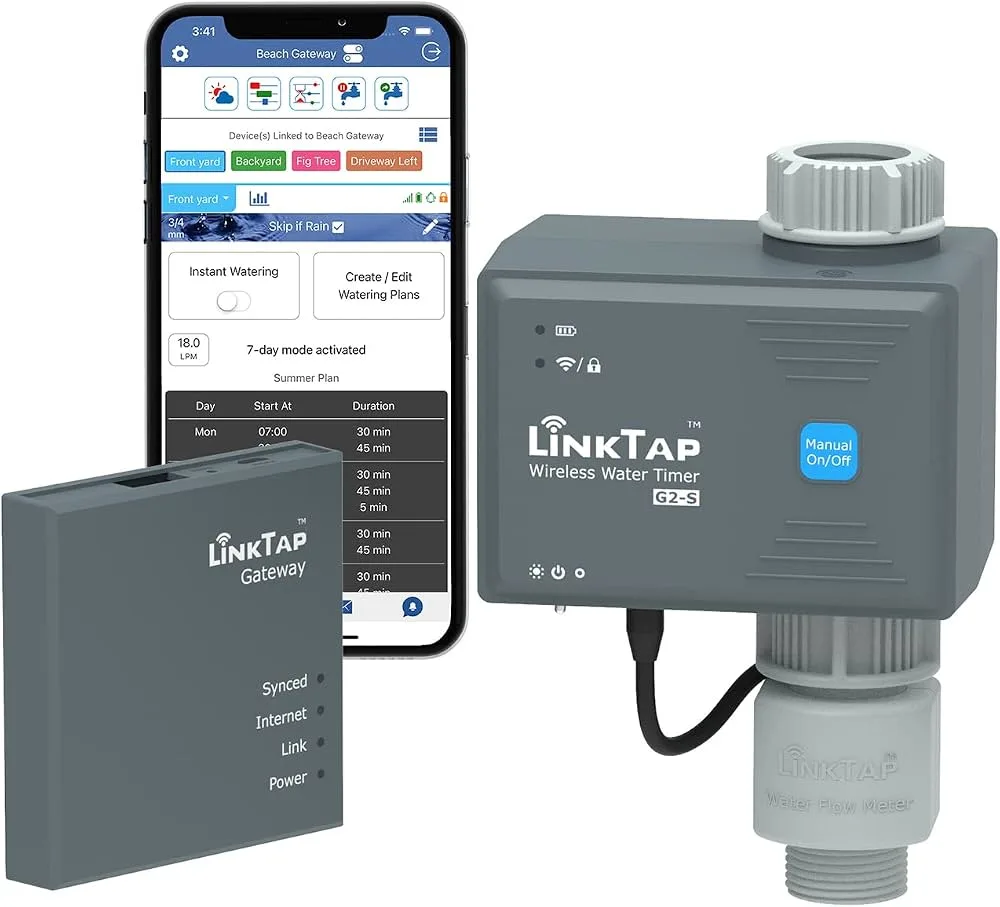
The LinkTap G2S is the engineer's pick: a timer built around long-range wireless and a built-in flow meter, designed for gardens where the faucet is a long way from the house and a burst hose can run unnoticed for a weekend.
What is new and automated: Instead of WiFi at the tap, the G2S talks to its gateway over a long-range radio link that reaches far beyond WiFi's practical outdoor range. The built-in flow meter measures every watering, and the system sends real-time fault alerts — leaks, blockages, unexpected flow, a valve that failed to close — to your phone. Automatic rain skipping, an IP66 weatherproof body and watering by volume (litres delivered, not just minutes) complete the most capable spec here.
Pros: the longest connection range by far; flow metering with genuine leak and fault alerts; water by volume for precise drip runs; seriously weatherproof.
Cons: the priciest pick here, and the gateway ecosystem is less familiar than the big US brands — you are buying capability over brand recognition.
Best for: large properties, distant faucets, and anyone who has ever come home to a burst hose connection.
Check Price on Amazon — USCheck Price on Amazon — Canada
Buttons open a search for the LinkTap G2S on each store, so you see today's price and the current models — we never print prices here because they change daily.
Best budget two-zone — RAINPOINT WiFi Water Timer 2 Zone with Brass Inlet
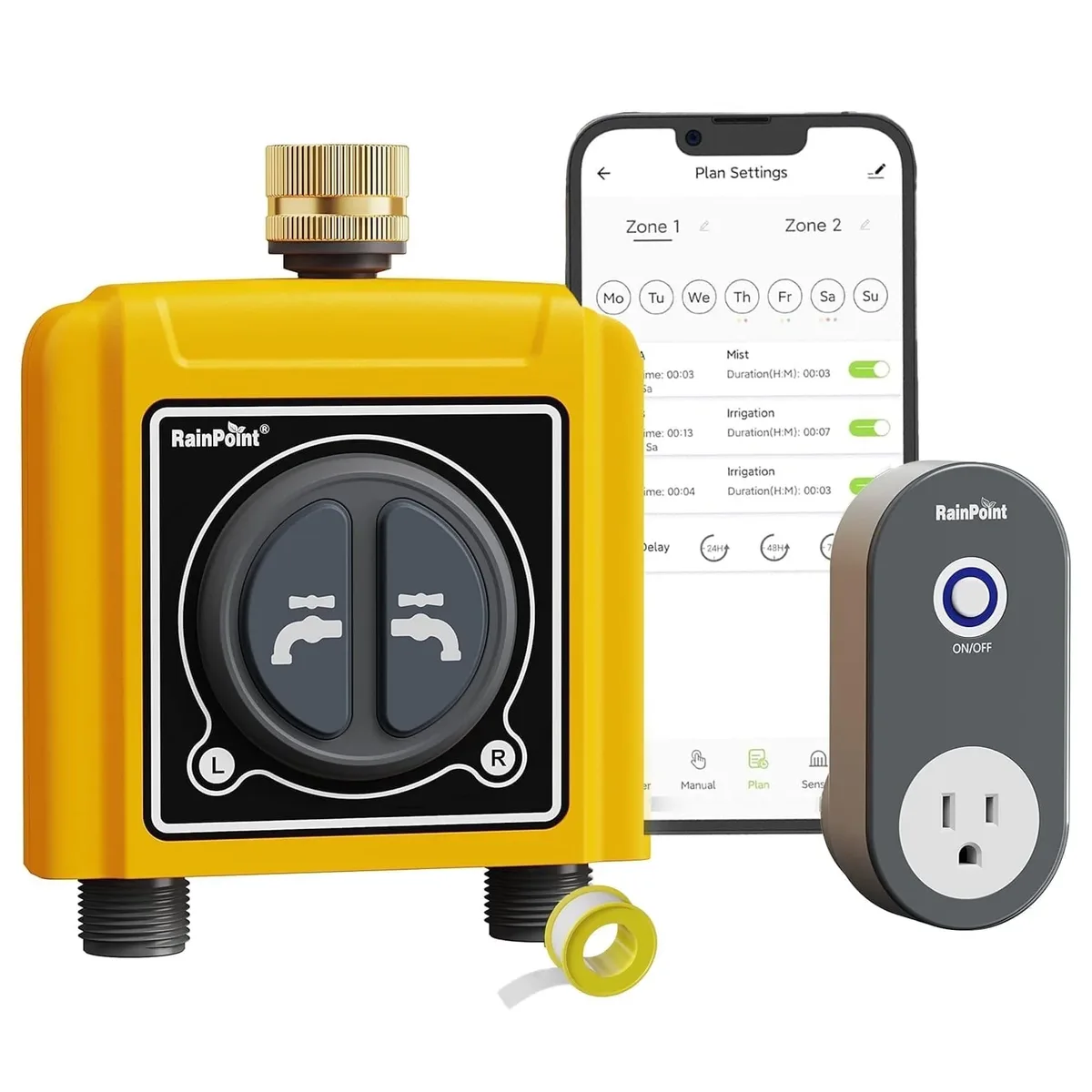
RAINPOINT's two-zone timer is the value route into app-controlled watering: two independently scheduled outlets on one tap, a metal brass inlet where cheaper timers use plastic, and app plus voice control through its WiFi hub.
What is new and automated: Beyond simple schedules, the system can water by weather, by quantity, or — with RAINPOINT's optional soil sensor — by actual soil moisture, which is a level of automation the budget end of this market rarely offers. Two zones cover the classic split (beds on one side, pots and lawn on the other) without paying for four ports you will not use.
Pros: two zones at a budget price; brass inlet resists the cracking that kills plastic threads; soil-moisture watering option; app and voice control included.
Cons: the app experience is rougher than Rachio's or Orbit's, and long-term brand support is less proven — the trade you make for the price.
Best for: two watering areas on a budget, especially as a first automatic timer.
Check Price on Amazon — USCheck Price on Amazon — Canada
Buttons open a search for the RAINPOINT WiFi Water Timer 2 Zone on each store, so you see today's price and the current models — we never print prices here because they change daily.
Side by side
| Pick | Outlets | Connection | Best for |
|---|---|---|---|
| Rachio Smart Hose Timer | 1 per valve, expandable | WiFi hub | Best app, one or two key areas |
| Orbit B-hyve XD 4-Port | 4 independent | WiFi hub | Many areas off a single faucet |
| LinkTap G2S | 1 per unit | Long-range wireless gateway | Distant faucets, leak alerts |
| RAINPOINT 2 Zone | 2 independent | WiFi hub | Two areas on a budget |
How to choose a WiFi hose timer
1. Count areas, not hoses. Each outlet waters one area on its own schedule. One bed and some pots might be a single area on a splitter; beds, pots and a lawn strip with different needs are three. That count decides between the single-valve Rachio, the two-zone RAINPOINT and the four-port Orbit.
2. Respect the pressure you have. All outlets on one faucet share its flow. A timer can sequence areas beautifully, but it cannot create pressure — plan drip and soaker runs at different times rather than simultaneously. The run-time maths for drip zones is worked out in Drip Irrigation Run Time by Plant.
3. Measure the distance to the faucet. Hub-based systems put the WiFi indoors, which solves most range problems. For genuinely distant taps — bottom-of-the-garden faucets, outbuildings — the LinkTap's long-range radio is the reliable answer, and its leak alerts matter most exactly where you cannot see the tap.
4. Plan for frost now. Every hose timer must come off the tap before hard frost: trapped water cracks valves that survive everything else. The autumn routine is in How to Winterize Drip Irrigation — drain, remove batteries if you store it long, and keep it indoors until spring.
The honest catch: a timer automates the tap, not the watering
A hose timer decides when water flows; it does not decide where the water lands. Screwed onto a faucet feeding a leaky hose end sprinkler, it automates waste on a schedule. The fix is distribution: drip lines and soakers sized to the beds, which is why these timers pair so well with the setup in How to Set Up Drip Irrigation. Also change or check the batteries before any long holiday, and confirm your faucet has a working backflow preventer, as many local codes require for hose connections.
Do those basics and this is the highest-value automation in the garden: holiday-proof watering for the price of a nice dinner out. More watering tools live on the Tools hub, and if your garden grows past what one faucet can serve, the full-system route is compared in Best Smart Sprinkler Controllers.
Keep going
Turn the timer into a real system: How to Set Up Drip Irrigation covers lines, emitters and layout from the faucet out.
More comparisons and the full watering shelf live on the Tools hub.
Questions people ask
Do WiFi hose timers work without an in-ground sprinkler system?
Yes — that is exactly what they are for. The timer screws onto a standard outdoor faucet and needs nothing else in the ground. Add hoses, soakers or a drip kit on the outlet side and you have automatic watering for beds, pots and lawns.
What happens if the WiFi drops while I am away?
The watering continues. Schedules are stored on the timer itself, so programmed runs happen with or without a connection; app control and weather adjustments resume when the hub reconnects. A power or WiFi outage costs you remote control, not your plants.
Can one hose timer water my whole garden?
One outlet waters one area at a time. Multi-port timers (the Orbit XD runs four areas) and multiple valves cover more, but every outlet shares the faucet's pressure — sequencing areas at different times works far better than running everything at once.
How long do hose timer batteries last?
Typically a full watering season or longer on one set, because the valves only draw power in short bursts to open and close. Check them before holidays and at the start of each season; a timer that dies in August usually just needs batteries.
Do I need to remove a hose timer in winter?
Yes. Water trapped inside the valve freezes and cracks the body — the most common way these timers die. Before the first hard frost, close the faucet, drain the timer, and store it indoors, following the same routine as the rest of the drip system.
Sources
Key facts on this page cross-checked against Rachio (official) — Smart Hose Timer hub system and weather-aware scheduling and Orbit B-hyve (official) — B-hyve XD four-port specifications and WeatherSense and LinkTap (official) — G2S wireless range, flow meter and fault alerts and Drip irrigation — Wikipedia — background on drip distribution paired with these timers.
Comments & ratings
No comments yet.
Be the first to share your experience.