
Guides · Soil & feeding · Published November 18, 2026 · By Faizan Ahmad
How Much Fertilizer Do I Need?
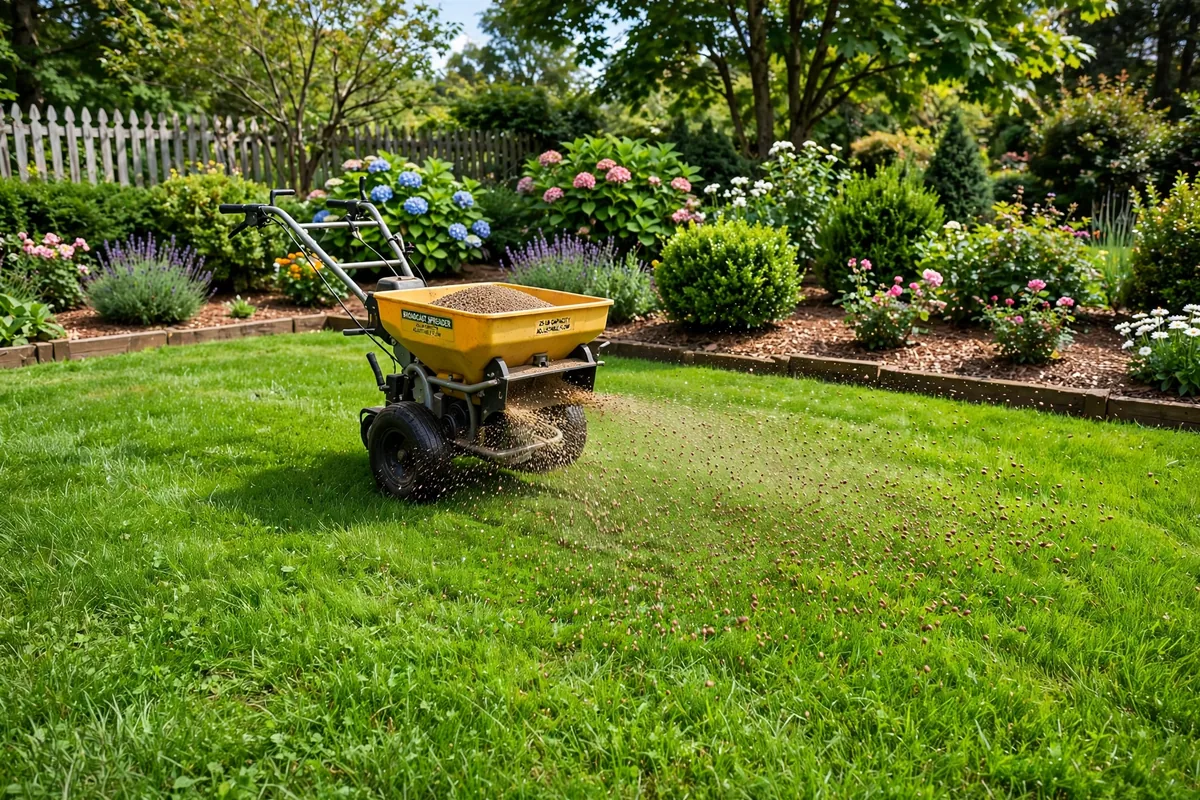
Fertilizer is the one garden job where the bag seems to argue with itself. One bag promises to cover 5,000 square feet, the bag beside it — the same weight — covers barely 1,500, and a neighbour swears you need twice what either of them says. They can all be telling the truth, because fertilizer is not really sold by the pound of product: it is dosed by the pound of actual nitrogen it delivers, and every bag delivers a different amount. That is exactly what our Fertilizer Calculator works from. This guide decodes the three numbers on the bag, shows the one formula underneath every coverage claim ever printed, and walks a real lawn through it twice — once with a weak bag and once with a strong one — so you can check any bag, any label and any store's advice against your own numbers.
The short answer, on one card
- The formula: nitrogen needed = target rate × (area ÷ 1,000); then product needed = nitrogen needed ÷ the bag's nitrogen fraction
- The standard lawn feeding is 1.0 lb of actual nitrogen per 1,000 sq ft — everything else is converting that into pounds of your product
- One bag, three numbers: 10-10-10 is 10% nitrogen, so it takes 10 lb of product to deliver 1 lb of nitrogen; 32-0-10 takes only about 3.1 lb
- The same lawn, two answers: a 2,000 sq ft lawn needs 20 lb of 10-10-10 — or 6.25 lb of 32-0-10 — for the identical feeding
- Bags round up, phosphorus and potassium ride along with whatever product amount the nitrogen maths sets — and the bag's own label rate always wins
Step 1 — Read the bag: one bag, three numbers
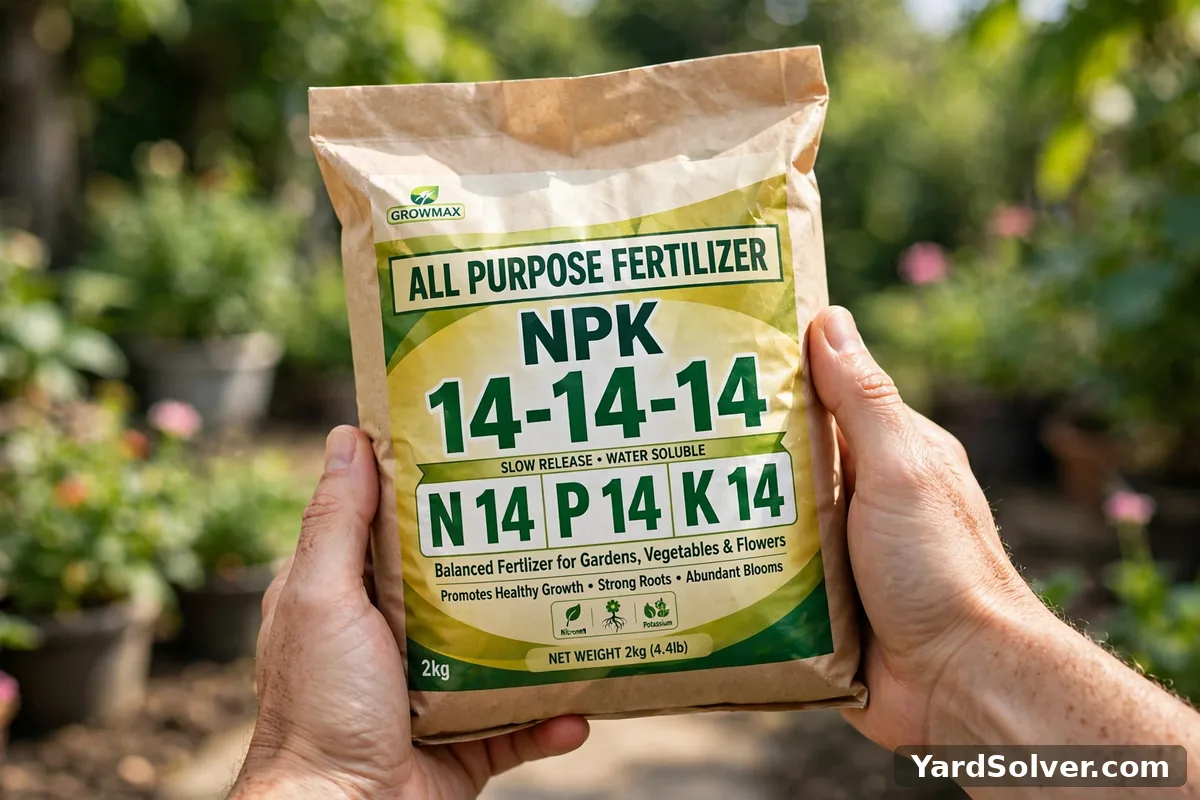
Every fertilizer bag carries three numbers separated by dashes — 10-10-10, 32-0-10, 5-10-10 — always in the same order, in every country and on every brand. They are percentages by weight. The first is nitrogen (N), the nutrient that makes grass and leaves grow and green up. The second is phosphorus, counted as P₂O₅, which supports roots, seedlings and flowering. The third is potassium, counted as K₂O, which underpins disease resistance and drought tolerance. So a 40 lb bag of 10-10-10 holds 4 lb of actual nitrogen, 4 lb of P₂O₅ and 4 lb of K₂O; the remaining 28 lb is carrier — the granule material that makes the nutrients spreadable. A 40 lb bag of 32-0-10, by contrast, holds 12.8 lb of nitrogen and no phosphorus at all. Same shelf, same bag weight, more than three times the feeding power in the nutrient a lawn actually runs on. That single fact explains every confusing coverage claim you have ever read: the strong bag covers more ground because each pound of it carries more nitrogen. Once you can read the three numbers, you can read any bag — the full tour of ratios, organic analyses and specialty blends lives in Fertilizer Numbers Explained, while this guide stays on the quantity question.
Step 2 — Measure the area, then choose lawn or garden
The calculator needs the area you will actually feed, so measure the lawn or bed itself — length × width for a rectangle, split an L-shape into two rectangles and add them, and leave out the patio, the driveway and the house footprint. Lot size is not lawn size: feeding the lot number instead of the grass number is the most common way people buy nearly double what they need. Then tell the Fertilizer Calculator — the real NPK method what you are feeding. The lawn choice starts you at the standard target of 1.0 lb of nitrogen per 1,000 sq ft, with lighter 0.5 lb and heavier 1.5 lb options. The vegetable garden choice starts hungrier, at 1.5 lb per 1,000 sq ft, because fruiting vegetables are heavy feeders — a common rule of thumb, best split across the season rather than dumped on in one pass. Either way, the target is a rate of nitrogen, never a rate of product: the whole point of the next step is that the product amount is derived from it, bag by bag. Finish by typing the three numbers from your bag — the calculator offers presets for the common analyses, or a custom NPK if yours is unusual — and the weight of one bag, and it returns the exact pounds to spread, the bags to buy rounded up, the share of the last bag you will actually use, and the phosphorus and potassium that feeding delivers along the way.
Step 3 — The NPK formula the calculator is doing
There are two lines of maths, and both fit on an envelope. Line one: nitrogen needed = target rate × (area ÷ 1,000). A 2,000 sq ft lawn at the standard 1.0 lb target needs 1.0 × 2 = 2 lb of actual nitrogen. Line two: product needed = nitrogen needed ÷ the bag's nitrogen fraction. The nitrogen fraction is just the first number as a decimal: 10-10-10 is 0.10, 32-0-10 is 0.32. So the same 2 lb of nitrogen takes 2 ÷ 0.10 = 20 lb of 10-10-10, or 2 ÷ 0.32 = 6.25 lb of 32-0-10. Nothing else is going on — not in this calculator, and not in the coverage printed on any bag. Check a label against it: a 12.5 lb bag of a 32% product holds 4 lb of nitrogen, which at roughly 0.8–1 lb per 1,000 sq ft covers about 4,000–5,000 sq ft — exactly the claim on the bag. The table below is line two pre-run at the standard target; it is worth a screenshot before any store trip.
| Fertilizer (N-P-K) | Nitrogen fraction | Product per 1,000 sq ft at 1 lb N | Typical use |
|---|---|---|---|
| 10-10-10 | 0.10 | 10 lb | Balanced, gardens and general feeding |
| 24-0-10 | 0.24 | About 4.2 lb | Lawn maintenance, no phosphorus |
| 32-0-10 | 0.32 | About 3.1 lb | Concentrated lawn food |
| 5-10-10 | 0.05 | 20 lb | Garden blend, gentle nitrogen, more P and K |
| 12-12-12 | 0.12 | About 8.3 lb | All-purpose balanced |
| 6-4-0 (organic) | 0.06 | About 16.7 lb | Slow-release organic lawn feed |
Read the table the way the calculator thinks: the nitrogen delivered is identical in every row — 1 lb per 1,000 sq ft — and only the carrier changes. That is also why comparing bags by price per bag misleads: the honest comparison is price per pound of nitrogen, and a cheap, weak bag is often the expensive way to buy it. Two more rules ride on the formula. Bags round up — you cannot buy 0.6 of a bag, and the calculator tells you what share of the last bag the job uses so the rest can be stored dry for next time. And P and K ride along: whatever product amount the nitrogen line sets also delivers that product's phosphorus and potassium percentages, which Step 5 shows on real numbers.
Step 4 — One lawn, two bags: the worked example
Here is the calculator's own example, done in full. The lawn is 50 ft × 40 ft = 2,000 sq ft. At the standard target of 1.0 lb of nitrogen per 1,000 sq ft, line one gives 2 lb of actual nitrogen. Now feed it two different ways. With balanced 10-10-10: 2 ÷ 0.10 = 20 lb of product — one 40 lb bag, half of it used, half kept dry for the next feeding. Because the product is 10% everything, that 20 lb also delivers 2 lb of P₂O₅ and 2 lb of K₂O along the way. With concentrated 32-0-10: 2 ÷ 0.32 = 6.25 lb of product — barely a sixth of the same 40 lb bag — delivering the identical 2 lb of nitrogen, no phosphorus at all, and about 0.6 lb of K₂O. Same lawn, same feeding, a third of the weight to carry and spread. Neither answer is wrong; they are the same prescription written in two strengths, like the same medicine in two tablet sizes. What would be wrong is spreading 20 lb of the 32-0-10 because "20 lb worked last time with the other bag" — that is 6.4 lb of nitrogen on a lawn that asked for 2, and Step 6 explains what that does to grass. Scale the example and the pattern holds: per acre (43,560 sq ft) the standard feeding needs about 43.6 lb of nitrogen, which is roughly 436 lb of 10-10-10 or about 136 lb of 32-0-10 — the per-acre and quarter-acre questions gardeners ask are just line one and line two with a bigger area.
Step 5 — Lawn vs garden, and why phosphorus rides along
The calculator's lawn-versus-garden choice matters because the two jobs run on different appetites. A lawn is a nitrogen crop: it is mowed, not harvested, and its colour and density answer almost entirely to the first number, which is why lawn targets are quoted in nitrogen alone and why so many lawn products carry a 0 in the middle. A vegetable garden is hungrier and broader — fruiting plants like a tomato pull nitrogen for leaves, phosphorus for roots and blossom, and potassium for fruit quality — so the garden target starts higher and a balanced analysis often makes sense there. But notice the trap built into balanced products: feeding a lawn 10-10-10 to hit a nitrogen target automatically applies just as much P₂O₅, feeding after feeding, year after year. Phosphorus, unlike nitrogen, barely moves or fades in soil — it accumulates. Many long-fed lawns already test high in phosphorus, and every extra pound is money spent on a nutrient the soil already owns, with the surplus prone to washing toward drains and waterways. The fix costs one soil test every few years: if phosphorus tests high, switch to a zero-middle-number product like 32-0-10 or 24-0-11 and let the nitrogen maths run without the passenger. If it tests low, the balanced bag earns its place. The calculator shows you the P₂O₅ and K₂O each feeding delivers precisely so this stops being invisible.
Step 6 — Spread it evenly, and respect the burn line
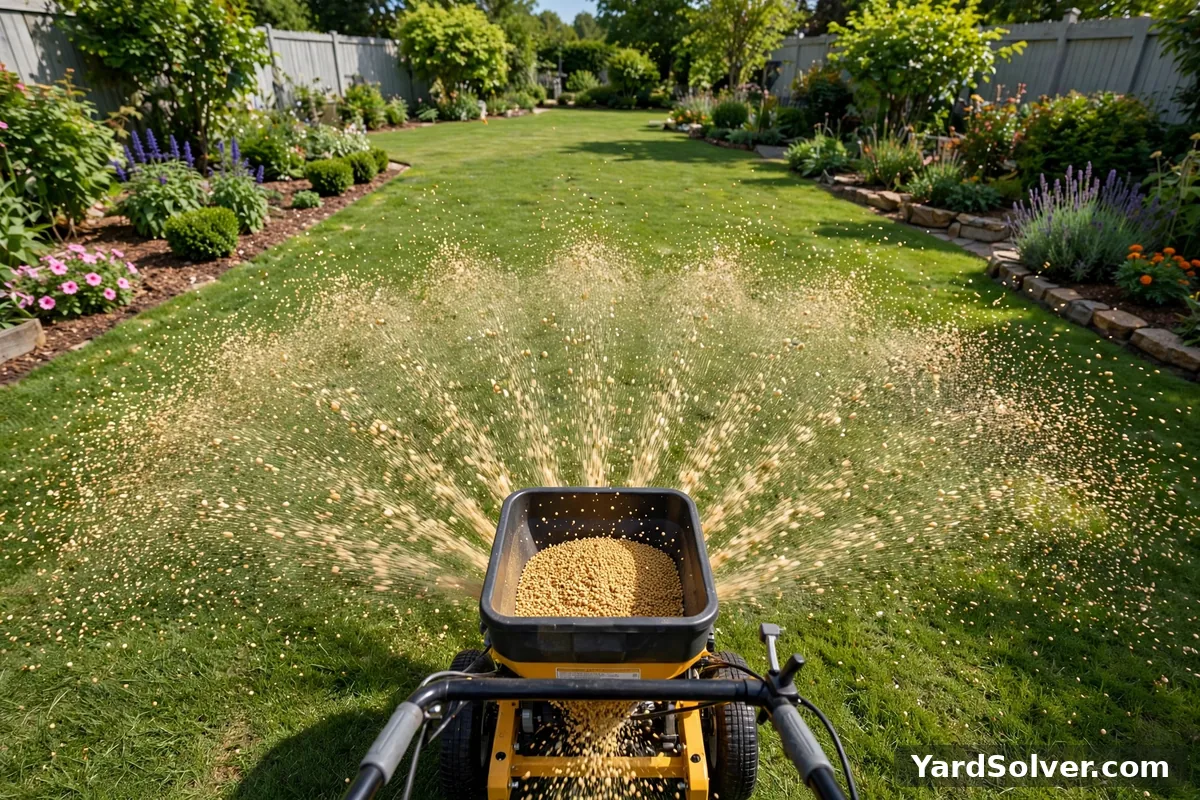
An exact amount spread badly is still the wrong amount in most places. Spreader dial numbers are a starting point, not a promise, because they differ by brand and by granule size — so calibrate with the test the pros use. Weigh out the product for a known test area of 1,000 sq ft (the table in Step 3 gives you the figure), spread that area, and weigh what is left: adjust the dial until what left the hopper matches the target. The forgiving alternative, and the one the calculator's method pairs with naturally, is the half-and-cross pattern: set the spreader to roughly half rate, spread half the total walking one direction, then spread the rest walking across it. Overlaps average out instead of doubling, and a missed stripe shows as a pale line you can still fix rather than a scorched one you cannot. Keep passes steady, shut the hopper at every turn and pause, and sweep any granules off paths and driveways back onto the lawn — granules on concrete feed nothing and wash straight to the drain. Finally, the burn line: fertilizer is a salt, and well past about 1 lb of nitrogen per 1,000 sq ft in a single feeding — or any rate doubled up in an overlap or a spill — it pulls water out of blades and roots and leaves straw-coloured scorch marks. More is not better; it is just burn with extra steps. Water lightly after spreading unless rain is on its way, and when the bag's label rate and any general rule disagree, the label wins.
What the calculator can't do
Honesty about the edges, so the number earns your trust. The calculator runs the nitrogen method exactly, but it cannot test your soil — it does not know whether your phosphorus is already high, your pH is locking nutrients away, or your soil is sand that leaches or clay that holds. A soil test every few years beats any general target, including the standard 1 lb used throughout this guide. It cannot calibrate your spreader, either: the half-and-cross pattern forgives a lot, but the weighed test in Step 6 is the real check. It assumes the area you typed is the area you will feed, so the measuring in Step 2 is yours to do honestly. And it cannot overrule your bag: label rates, local watering and fertilizer bylaws, and seasonal timing rules all sit above a general formula. What it does guarantee is the conversion itself, checked above against real bags: get the area, the three numbers and the target right, and the pounds and bags follow — no aisle guessing, and no second trip.
Keep going
Run your own lawn or beds through the Fertilizer Calculator, then read any bag with confidence using Fertilizer Numbers Explained. Feeding the vegetable patch? The tomato plant guide shows what the hungriest common crop actually pulls from the soil across a season.
Planning the whole season's feeding, planting and bed work in one place? The Garden Planner lays it out in a single calendar, so each feeding lands in its proper week instead of whenever the bag catches your eye.
Questions people ask
What do the three numbers on a fertilizer bag mean?
They are the N-P-K percentages by weight: nitrogen, phosphorus (counted as P₂O₅) and potassium (counted as K₂O). A 10-10-10 bag is 10% of each, so a 40 lb bag holds 4 lb of actual nitrogen. The first number drives almost every feeding calculation, because lawns and most garden feedings are dosed by nitrogen.
How much fertilizer do I need per 1,000 sq ft?
Divide your nitrogen target by the bag's nitrogen fraction. At the standard 1 lb of nitrogen per 1,000 sq ft: 10-10-10 takes 10 lb of product, 24-0-10 takes about 4.2 lb, 32-0-10 takes about 3.1 lb, and 5-10-10 takes 20 lb. The product weight changes with the bag; the 1 lb of nitrogen does not.
How much fertilizer do I need for 1/4 acre?
A quarter acre is 10,890 sq ft, so at the standard 1 lb of nitrogen per 1,000 sq ft it needs about 10.9 lb of actual nitrogen. With 10-10-10 that is about 109 lb of product — three 40 lb bags, with most of the third bag left over. With 32-0-10 it is only about 34 lb of product, less than one 40 lb bag.
Can I use garden fertilizer on my lawn?
Yes — plants read the numbers, not the picture on the bag. Match the same nitrogen target and a garden fertilizer feeds a lawn the same way. Just go easy on repeated phosphorus if a soil test shows your phosphorus is already high, and always follow the bag's own label rate.
What if my soil test says phosphorus is already high?
Choose a fertilizer with a 0 in the middle, such as 32-0-10 or 24-0-11, so you feed nitrogen and potassium without adding more phosphorus. Every feeding of a balanced product like 10-10-10 adds as much P₂O₅ as nitrogen, and phosphorus your soil does not need mostly stays put or washes toward waterways — a soil test every few years keeps you from paying for nutrients you already own.
Can too much fertilizer burn my lawn?
Yes. Fertilizer is a salt, and an overdose pulls water out of grass blades and roots, leaving scorched, straw-coloured stripes or patches — often exactly where the spreader overlapped or paused. Stick to about 1 lb of nitrogen per 1,000 sq ft per feeding, spread half the amount in each direction for even coverage, and water lightly afterwards. If you do over-apply in one spot, soak that spot deeply to dilute the salts.
Fertiliser amounts come from the label rate over your area — never from handfuls
A fertiliser bag states a rate — so much product per hundred square metres or per thousand square feet — because the nutrient dose per area is the whole point of the product. The amount to buy and spread is therefore your measured lawn or bed area multiplied by that label rate, and the measuring matters more than the brand: gardens guessed at half their true size are chronically under-fed, and gardens guessed double are scorched and wasteful in the same season.
Weigh the product for your spreader setting rather than trusting the dial's optimism, apply in two passes at half rate in opposite directions for even coverage, and water granular feed in unless rain is certain. More is not better with fertiliser — the excess cannot be stored by the plant, washes toward drains and waterways, and forces soft growth that pests and frost punish. A soil test every few years sets whether the feed is needed at all, and in what ratio.
Sources
Key facts on this page cross-checked against Fertilizer — Wikipedia — background on fertilisers and their application rates.
Related page
Read next: Fertilizer Numbers Explained: What NPK Means.
Comments & ratings
No comments yet.
Be the first to share your experience.