
Guides · Soil & feeding · Published November 22, 2026 · By Faizan Ahmad
How Much Organic Fertilizer Do I Need? Rates, Speeds & Honest Costs

Organic fertilizers ask a fairer question than "how much" — it is "how much, of which source, how far ahead of the crop". Two bags can both read 12-0-0 and deliver their nitrogen a season apart. Our Organic Fertilizer Calculator runs the nitrogen maths per source and shows the phosphorus and potassium riding along. This guide covers release speeds, the blend trap, and when organics are simply the wrong tool.
The short answer, on one card
- The maths is the same: product = N target ÷ (N% ÷ 100) — 1 lb of N takes 8.3 lb of blood meal, 40 lb of alfalfa
- Speed is the difference: blood meal releases in weeks, feather meal over a season — same 12-0-0 label
- Apply 2–3 weeks ahead: microbes, not dissolution, set the release schedule
- Blends bank phosphorus: a 5-5-5 fed for nitrogen delivers P crops never ordered
- Cold soil pauses everything: early spring crops may still need a small conventional starter
On this page
Step 1 — Same numbers, different calendars
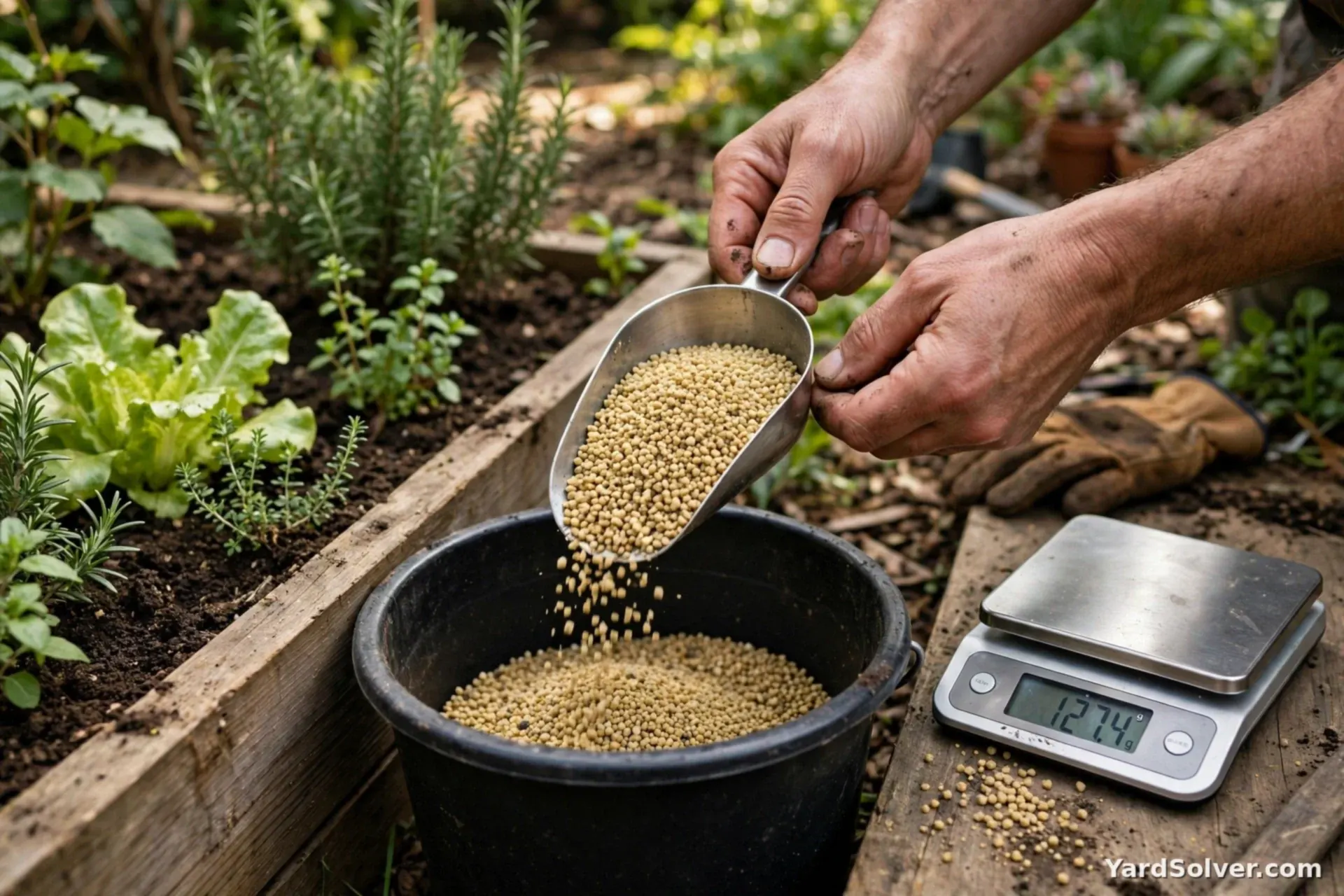
Synthetic nitrogen dissolves and is available in days. Organic nitrogen is protein and fibre: soil microbes must eat it first and excrete the nitrogen in plant-usable form, a process paced by temperature, moisture and the material’s toughness. Blood meal’s proteins are easy eating — release in two to six weeks. Feather meal is keratin, the stuff of hooves and hair, and microbes take a season over it. The guaranteed analysis on the bag describes content, not timing, and timing is half the product.
Practical translation: organic feeds go on ahead of demand — worked in two to three weeks before a hungry crop peaks — and they forgive generously, because a release metered by microbes rarely surges or burns. The gardener’s error is not the source but the calendar: feather meal applied to a starving June tomato is a September feed delivered to a June problem.
Step 2 — Sources by the pound
Product needed to deliver 1 lb of nitrogen per 1,000 sq ft, with release character. The calculator scales these to your area and target, and reports the P₂O₅ and K₂O each amount carries with it.
| Source | Analysis | Product for 1 lb of N | Release |
|---|---|---|---|
| Blood meal | 12-0-0 | 8.3 lb | Fast for an organic — weeks |
| Feather meal | 12-0-0 | 8.3 lb | Very slow — a full season |
| Fish meal | 10-6-2 | 10 lb | Moderate; carries real P and K |
| Soybean meal | 7-2-1 | 14.3 lb | Moderate — the balanced workhorse |
| Alfalfa meal | 2.5-0.5-2.5 | 40 lb | Slow and gentle; a soil feed as much as a crop feed |
| Kelp meal | 1-0-2 | 100 lb | A tonic — never a practical main N source |
| Typical blend | 5-5-5 | 20 lb | Moderate; delivers 1 lb each of P₂O₅ and K₂O too |
Your own numbers go into the Organic Fertilizer Calculator — pounds and bags for your source. Feeding with a synthetic or a single nutrient instead? The Nitrogen Calculator takes any percentage you can read off a bag.
Step 3 — The blend trap: phosphorus by stealth
A balanced organic blend fed to meet nitrogen delivers phosphorus in equal weight — and vegetable crops remove perhaps a fifth as much P as N in a harvest. Do the arithmetic across five seasons of blend-only feeding and the soil’s phosphorus climbs from sufficient to excessive while the gardener believes they are "feeding naturally". Excess P suppresses the mycorrhizal fungi roots trade with and is the nutrient waterways least forgive.
The escape is rotation among the nitrogen-only meals — blood, feather and soybean carry little or no P — with blends and fish meal used when a soil test actually calls for phosphorus too. It is the same ledger the manure guide keeps: every feed is three feeds, and the honest calculator shows all three numbers.
Step 4 — When organics are the wrong tool
Three situations argue for a small conventional feed instead. A crop showing nitrogen starvation now — pale, stalled, weeks behind — cannot wait for microbes; a modest soluble feed rescues it while the organic programme resumes for the next crop. Early spring in cold soil is the second: release nearly stops below about 10°C soil temperature, and transplants sit hungry in a bed that is rich on paper. The third is precision work — correcting a tested deficiency of one nutrient at a set rate is what the single-nutrient calculators exist for.
None of this indicts the organic approach; it locates it. Organics build the soil’s own nitrogen economy season over season, and gardens run on them for years test better and buffer stress better. The skill is matching the tool to the timescale of the problem — which is a compliment to both toolboxes, and the whole argument of this guide.
Questions people ask
Why is organic fertilizer so much more expensive per pound of nitrogen?
Because you are buying more than nitrogen: carbon for soil life, slow release, trace minerals and safety from burning. Compared purely as nitrogen it loses; compared as a soil programme it often wins. The calculator’s cost line uses standard fertilizer-bag pricing — specialist organic bags usually run higher, which the guide’s rotation advice helps contain.
Can I mix organic and synthetic fertilizers?
Yes — many extension programmes do exactly that: a small soluble starter at planting, organic feeds for the season’s base. The nutrients are chemically identical once released; only the delivery systems differ. Total the nitrogen from both so the crop is not double-fed.
Do organic meals attract animals?
Blood and fish meals can — dogs, raccoons and flies all read them as food. Work them into the top inch of soil and water in, rather than leaving them on the surface, and the problem mostly disappears. Alfalfa and soybean meals are far less interesting to wildlife.
How long do organic fertilizers keep in the bag?
Sealed and dry, a year or more with little loss — they are stable dry goods. Damp storage is the enemy: meals cake, mould and start releasing (and smelling) in the bag. Decant into a lidded bin if your shed leaks.
Is kelp meal worth it as a fertilizer?
As a nitrogen source, no — at 1% N it takes 100 lb to do blood meal’s 8 lb job. Kelp’s value is its potassium, trace minerals and growth compounds at tonic rates of a few pounds per bed. Buy it as a supplement and it earns its price; buy it as a feed and it cannot.
Sources
Key facts on this page cross-checked against Organic fertilizer — Wikipedia — background on organic fertilizer materials, analyses and release behaviour Soil Testing for Lawns — MU Extension — soil-test interpretation — reading the phosphorus ledger.
Related page
Read next: Fertilizer Numbers Explained: Read Any Bag in Seconds
Comments & ratings
No comments yet.
Be the first to share your experience.