
Guides · Indoor gardening · Published November 20, 2026 · By Faizan Ahmad
How to Care for African Violets: Light, Water and Blooms All Winter
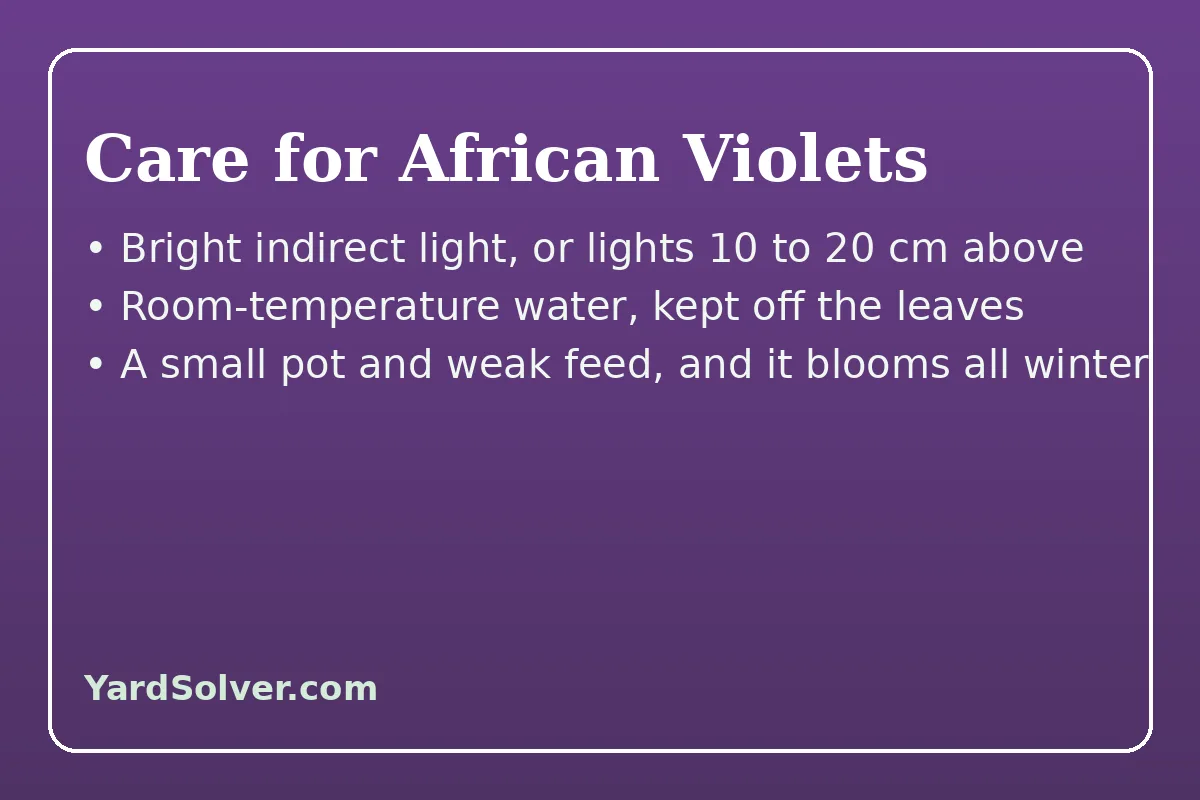
To care for an African violet, give it bright indirect light — a north or east window, or a lamp hung just 10–20 cm (4–8 in) above the leaves for 12–16 hours a day — keep it at ordinary room temperature between 18 and 27 °C (65–80 °F), water it with room-temperature water whenever the surface of the mix has just dried, keeping the water off its fuzzy leaves, grow it in a light soilless mix in a pot only about one-third as wide as the plant, and feed it little and often at quarter to half strength. That is the whole secret of the plant that flowers on windowsills while the garden outside sleeps. The African violet has an undeserved reputation for fussiness, and Iowa State University Extension's horticulturists dismantle it in one line: violets are most rewarding when their basic needs are met — the needs are few, they are simply non-negotiable. A violet is not a plant that wants variety; it is a plant that wants the same good week repeated fifty times, and it repays the routine with flowers in every month of the year, which no other common houseplant matches. This guide gives the full routine: the light that decides flowering, the watering rules built around the plant's one genuine vulnerability, the small-pot and weak-feed discipline, grooming and repotting, propagation from a single leaf, and the troubleshooting table that reads the plant's complaints in its leaves. It joins the winter windowsill shelf on this site — the Christmas cactus that will not bloom and the poinsettia kept past Christmas — plants whose whole value is colour in the dark months.
The short answer, on one card
Light: bright enough to cast a shadow but never direct sun; north or east windows are best, and under lamps the fixture sits 10–20 cm (4–8 in) above the plants for 12–16 hours a day. Water: evenly moist, never soggy; let the surface dry slightly, then water with room-temperature water from below (20–30 minutes in a saucer) or carefully at the soil line. Temperature: 18–27 °C (65–80 °F); below about 10 °C (50 °F) the leaves darken and turn watery, and above 29 °C (85 °F) growth and flowering slow. Pot: about one-third the diameter of the leaf spread, in a loose, porous, soilless mix. Feed: a balanced or violet fertiliser at quarter to half strength, regularly — too much grows leaves instead of flowers. Groom: pinch out spent flower stalks, ageing outer leaves and side suckers; one crown per pot.
Light: the decision that makes the flowers
Iowa State's guidance starts where every violet conversation should: proper light is essential for good bloom, and violets require more light than most gardeners first realise. The plant reports its light level in its own architecture, and learning to read it replaces all guesswork. Thin, dark blue-green leaves carried on long, reaching stalks are a plant short of light — it is stretching its solar panels toward the window and spending nothing on flowers. A tight, flat rosette of medium-green leaves, with flower stalks rising from the centre, is a plant whose light is right. Stunted growth with small, crinkled, yellowish leaves is the opposite excess: too much light, or sun scorching through glass. On a windowsill, north and east exposures are the extension standard — bright all day without the leaf-burning afternoon blast of a west window or the direct midday sun of an uncurtained south one. Winter is where lamps change the game entirely. Iowa State puts fluorescent or LED fixtures just 10–20 cm (4–8 in) above the plants — yes, that close — for 12–16 hours a day, and at that distance an ordinary shop light delivers what a December window cannot: enough light to initiate buds in the darkest month. The violet shelf and the seed shelf are natural partners, and the fixtures in grow lights for seedlings serve both, violets on one level and spring's seedlings on another. One discipline applies to both window and lamp: turn the pot a quarter every few days, so the rosette grows symmetrically instead of leaning into a comma shape toward the light.
Water: warm, from below, and never on the leaves
| What you see | What it means | What to do |
|---|---|---|
| Pale rings or spots on leaves | Cold water touched warm foliage | Water at room temperature, from below or at the soil line only |
| Yellowing leaves, drooping and mushy | Overwatering or poor drainage — root rot starting | Let the mix dry slightly, check drainage, repot out of soggy mix |
| No flowers, lush dark leaves on long stalks | Too little light, or too much feed | More light first; then check the feeding strength |
| Stunted, crinkled, yellowish leaves | Too much light or direct sun | Move back from the glass or filter with a sheer curtain |
| Leaves darkened and water-soaked after a cold night | Chilling — the plant sat against cold glass or in a draft | Move it off the sill on cold nights; damage will not reverse, new growth will cover it |
| Several crowns crowding one pot | Suckers have grown into side plants | Remove suckers or divide at repotting; one crown flowers best |
Watering is, in Iowa State's words, often the most difficult part of violet care — not because the plant drinks strangely, but because its leaves keep the receipts. The plant wants its mix evenly moist and well drained: too wet and the roots and crown rot, too dry and growth stunts and flowering stops. The surface test governs — water when the top of the mix has just dried, then water thoroughly. Two rules protect the foliage. First, temperature: cold water landing on warm leaves damages them quickly, leaving the pale rings and spots that gardeners mistake for disease, so violet water stands at room temperature, always — a jug kept beside the shelf is the traditional, sensible equipment. Second, placement: keep water off the leaves and crown entirely, which is why bottom watering is the extension-recommended default. Stand the pot in a shallow dish of room-temperature water for 20 to 30 minutes, let the mix draw up what it needs, then empty the dish — a violet never sits in water afterwards. Top watering is acceptable with a narrow spout, at the soil line, under the leaves. The quotable fact of this guide is the one that prevents the commonest injury: an African violet is not damaged by water — it is damaged by cold water on warm leaves, which is why the watering can matters as much as the watering. The Old Farmer's Almanac adds the housekeeping detail: the fuzzy leaves collect dust, and a soft dry brush restores them — never a wet cloth, for the same cold-water reason. Humidity helps quietly in the background: heated winter rooms run dry, and the pebble-tray and grouping methods in how to increase humidity for houseplants suit violets exactly.
The small pot, the light mix and the weak feed
Three disciplines run the violet's underground life, and all three run counter to the instincts of a kind gardener. The pot stays small — the long-standing rule, repeated by Penn State Extension, is a pot no wider than about one-third of the plant's diameter — because violets flower best slightly snug, and an oversized pot holds a volume of wet mix the roots cannot use, which is an invitation to rot. The mix stays light: a loose, porous, soilless blend, peat or coir with perlite and vermiculite, slightly acidic around pH 6.0–6.5, draining freely while holding even moisture; heavy garden soil and dense general composts both fail the roots' need for air. The feed stays weak and regular: Iowa State recommends a complete fertiliser at a low rate — a violet formula, or a balanced feed diluted to half or quarter strength — applied consistently rather than in occasional full-strength doses. The failure mode is precise and worth memorising: excessive fertilisation produces vigorous vegetative growth and poor flowering, a magnificent green plant that never blooms, and it is the second commonest cause of flowerless violets after low light. Salts accumulate in a small pot over months, so an occasional watering with plain water, run through from the top until it drains, flushes them. Repotting is an annual refresh rather than an enlargement: about once a year, or when the plant has grown a visible neck of bare stem, lift it, trim the oldest outer leaves, set it at its original depth in fresh mix in the same size pot — never bury the crown, which rots — and the plant resumes as if nothing happened, because almost nothing did.
Grooming, suckers and the one-crown rule
A violet in steady care asks for two minutes of grooming a week, and the jobs are all subtraction. Spent flower stalks come off at the base as each cluster finishes, because a plant holding dead stalks is a plant tidying nothing and inviting rot at the crown. The oldest outer leaves — the ones yellowing, softening or lying flat on the mix — are snapped off cleanly at the stem, which keeps the rosette symmetrical and the crown aired. The third job is the one beginners miss: suckers. A violet that develops side crowns between its leaves is dividing its energy among several growing points, and the result is a crowded, misshapen plant that flowers poorly in all of them. The show-grower's rule is one crown per pot: young suckers are teased out with a pencil point or a small blade while they are small, before they distort the rosette. Removed suckers with a few roots of their own can be potted — violets are generous that way — but a sucker left in place is a decision too, and the plant's flowering records it. Pests arrive on the winter shelf as they do everywhere indoors: Iowa State names spider mites and mealybugs, and prescribes the measured response — inspect regularly, rinse an affected plant thoroughly with room-temperature water, isolate it, and treat with insecticidal soap. The wider winter campaign is laid out in winter houseplant pests, and the violet shelf, warm and crowded and beloved, is exactly where that campaign matters most.
One leaf, many plants: propagation that feels like magic
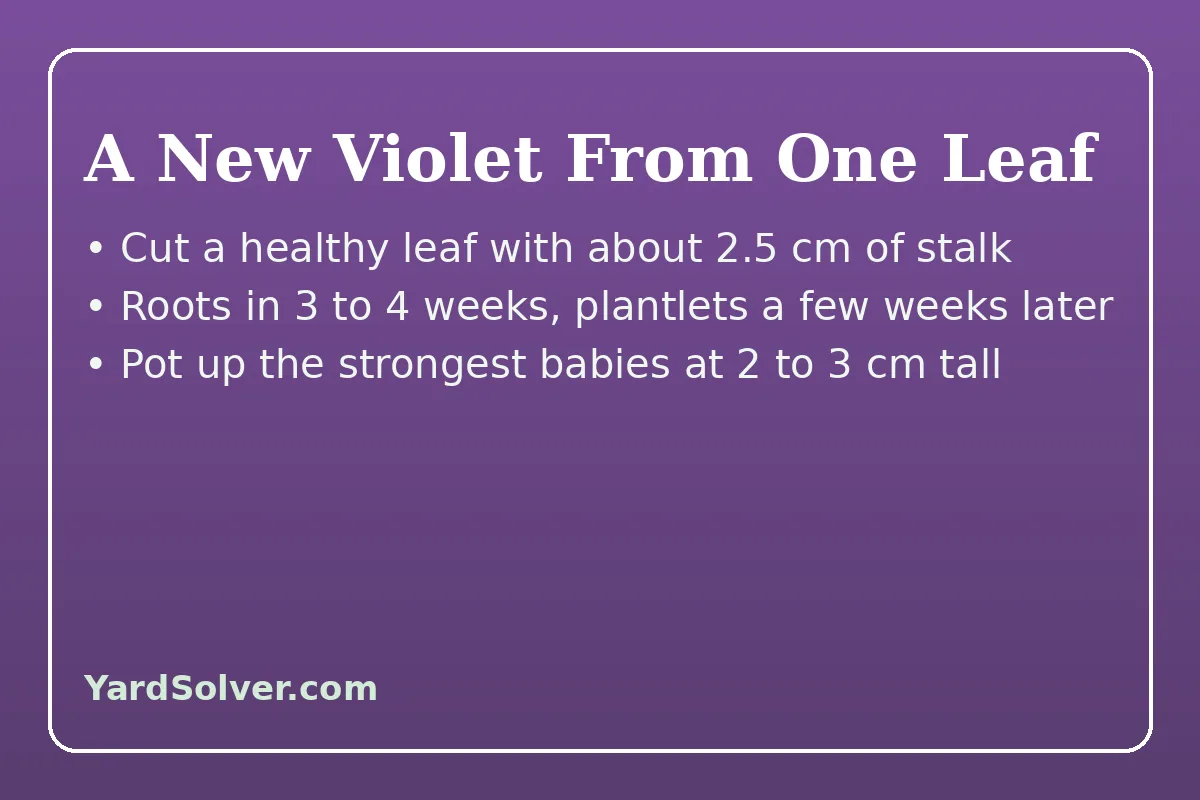
The violet's party trick is also its insurance policy: a whole plant from a single leaf. Iowa State's method is short enough to memorise. Choose a healthy, mature leaf — not the oldest outer ring, not the youngest centre — and cut it with about 2.5 cm (1 in) of stalk. Set the stalk at a slight angle into moist perlite or a very free-draining mix, firm it, and cover the pot with a clear dome or a loose plastic bag to hold the humidity. Roots form in about three to four weeks, and the first tiny plantlets appear at the stalk's base a few weeks after that. When the babies are 2–3 cm (about an inch) tall, with leaves of their own, the cluster is lifted, the plantlets are teased apart — a leaf usually produces several — and each goes into its own small pot of violet mix, watered in and kept humid for its first week. From leaf to a flowering young plant takes the better part of a year, which is why propagation is a winter-evening project rather than a quick fix; but the arithmetic is irresistible, and it is how violet collections, and violet friendships, actually grow. Keep the mother leaf's label with the babies — variety names are the first casualty of an unlabelled shelf. And keep one propagated spare of any violet you love: a plant that can be replaced from its own leaf is a plant you can never quite lose.
The violet shelf through the year: a rhythm, not a rescue
Pinned to the calendar, violet care in a cold-climate house runs like this. In the dark weeks of December and January, the shelf lives under its lamp on a timer — twelve to sixteen hours, the fixture a hand's breadth above the rosettes — and this is the season the plants flower hardest, because the light never shortens and the room temperature never swings; the weekly jobs are the saucer watering, the quarter-turns, and brushing dust from the leaves before it dulls them. February is repotting month for any plant that grew a neck over the year: fresh mix, the same pot, the oldest leaves stripped, and a fortnight of slightly raised humidity under a loose clear cover while the roots re-settle. Spring moves the shelf back to the east window as the natural light strengthens, with one vigilance — the first strong sun of March burns leaves through glass that was harmless in December, so the sheer curtain goes up before the plants ask for it. Summer is the quiet season: growth is fast, feeding stays weak and regular, and the shelf is checked for the mites that arrive with open windows, the inspection habit from winter houseplant pests run in reverse. In fall, one leaf per favourite variety goes into perlite, so the winter's gifts are homegrown. Written out like that, the year contains no emergencies — which is the point. Violets do not reward heroic intervention; they reward a small routine repeated without drama, and the gardener who keeps the routine finds, some February morning, that the shelf has been in flower for eleven straight months.
Keep going
Fix the other famous winter non-bloomer with Christmas Cactus Not Blooming, raise the dry winter air around all of them with How to Increase Humidity for Houseplants, and light the shelf properly with Grow Lights for Seedlings.
Sources
The care framework — bright indirect light bright enough to cast a shadow, north or east windows, temperatures of 60 to 80 F held steady away from drafts and heat sources, evenly moist soil in a lightweight well-draining mix, bottom watering for 20 to 30 minutes, fertiliser labelled for African violets or a general feed at half to quarter strength, overwatering named the biggest mistake, and leaf-cutting propagation with roots in three to four weeks — follows Iowa State University Extension and Outreach, African Violets Bring Winter Color Indoors with Proper Care. The diagnostic details — thin dark blue-green leaves on long petioles signal insufficient light, lights placed 4 to 8 inches above the plants for 12 to 16 hours a day, leaves darkening and turning water-soaked below 50 F and growth slowing above 85 F, cold water on leaves damaging them quickly, and no flowers being typically caused by low light, low temperatures or improper fertilisation — follow the same service's reference page, All About African Violets. The grooming details — keeping plants slightly pot-bound to encourage bloom, never planting deeper than before or burying the crown, and brushing dust from the fuzzy leaves with a soft dry brush — follow The Old Farmer's Almanac, African Violets: How to Care for African Violets.
Questions people ask
Why is my African violet not flowering?
Almost always light, temperature or feed. Extension guidance lists the three causes in that order: too little light (thin, dark leaves on long stalks), temperatures outside the comfortable 18-27 C (65-80 F) band, or too much fertiliser growing leaves at the flowers' expense. Fix light first — a north or east window, or a lamp 10-20 cm (4-8 in) above the plant for 12-16 hours a day.
How often should I water an African violet?
Whenever the surface of the mix has just dried — typically about weekly, but the test is the mix, not the calendar. Water thoroughly with room-temperature water, ideally from below for 20 to 30 minutes, then empty the saucer. The mix should stay evenly moist and never soggy.
Why does my violet have pale spots and rings on its leaves?
Cold water touched warm leaves. The damage happens quickly and is permanent on that leaf, though the plant outgrows it. Prevent it by keeping a jug of room-temperature water by the shelf and watering from below or carefully at the soil line so the foliage stays dry.
What size pot does an African violet need?
A small one: about one-third the diameter of the plant's leaf spread. Violets flower best slightly snug, and oversized pots hold wet mix the roots cannot use, which invites rot. Repot yearly into fresh mix, usually in the same size pot, and never bury the crown.
Can I grow an African violet from a single leaf?
Yes — it is the standard method. Cut a healthy leaf with about 2.5 cm (1 in) of stalk, set it in moist perlite or very free-draining mix under a clear cover, and roots form in three to four weeks, with plantlets following a few weeks later. Pot the babies up when they are 2-3 cm tall.
Where should an African violet sit in winter?
In the brightest indirect light you have — a north or east window, pulled a few centimetres back from cold glass on hard nights — or under a lamp on a timer. Keep it away from drafts, radiators and cold windowsills; steady warmth between 18 and 27 C (65-80 F) is what it is asking for.
Comments & ratings
No comments yet.
Be the first to share your experience.