
Guides · Garden planning · Published November 18, 2026 · By Faizan Ahmad
Plant Spacing, Worked Out: How Many Plants Fit Your Bed?
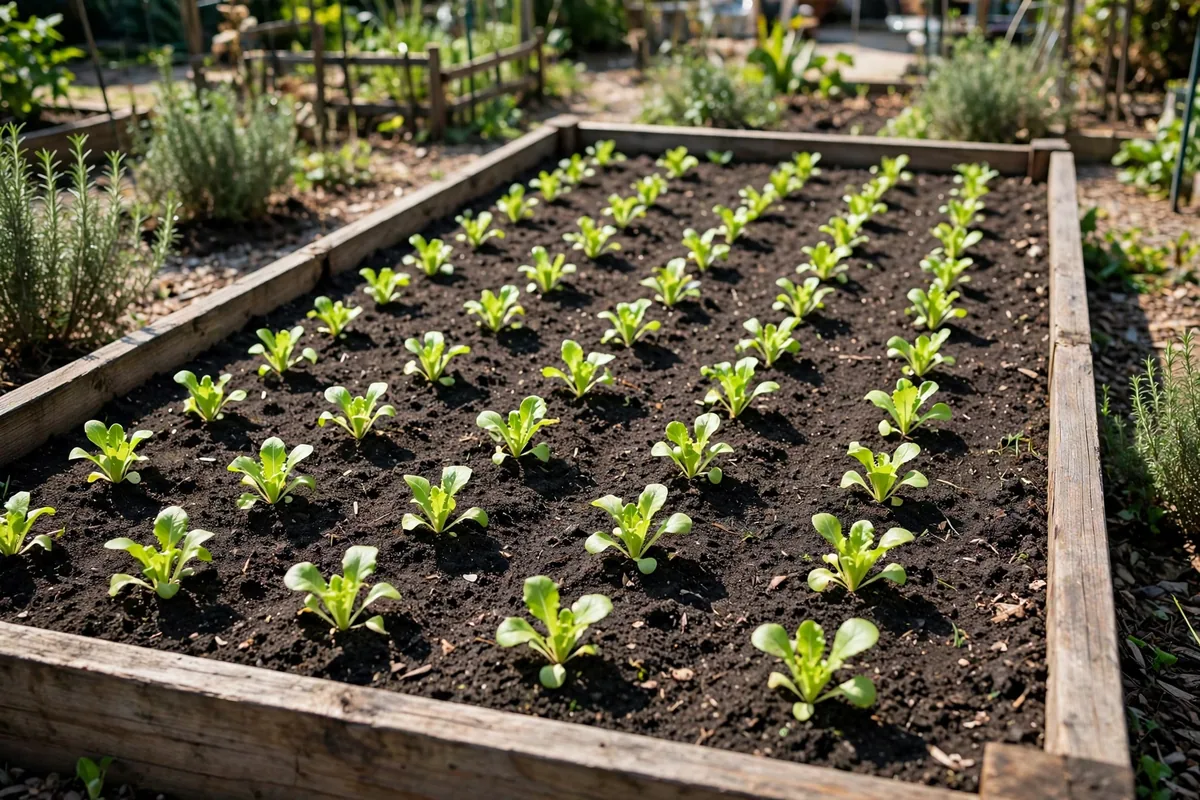
Every spring, the same two mistakes happen at the seedling table. One gardener comes home with a tray of tomatoes left over, because the bed filled up long before the tray emptied. Another stares at a half-empty bed of lettuce, because the plants they bought covered barely half the ground. Both guessed the count by eye — and plant counts are almost impossible to guess by eye, because spacing works in two directions at once. The fix is one short division done twice, and it is exactly what our Plant Spacing Calculator runs for you. This guide shows how the calculator works, the grid maths underneath it, and the one layout trick that changes the answer: staggering the rows, which fits about 15% more plants into the same bed at the same spacing. By the end you will be able to check any plant count — ours included — with a tape measure and thirty seconds of arithmetic.
The short answer, on one card
- The formula: plants per row = bed length ÷ spacing; rows = bed width ÷ spacing; total = the two multiplied together
- Staggered (triangular) rows fit about 15% more plants in the same bed at the same spacing — offset every second row by half a spacing
- Spacing is centre to centre at the plant's mature size — not the gap between leaves, and not the size of the seedling in your hand
- Doubling the spacing quarters the count: it halves the plants per row and halves the rows, and half × half = a quarter
- Edges and paths eat the grid: leave a few inches of working margin inside the frame, and count only the ground you will actually plant
Step 1 — Find the spacing first (it decides everything)
The calculator needs three numbers — bed length, bed width, and one spacing — and the spacing does almost all of the deciding, so it is worth getting from a real source rather than from memory. The first source is the one the grower printed for you: the seed packet or the plant tag. That number is the distance between plant centres when the plant is fully grown, chosen so the mature plant gets the light, air and root room it needs. Read it as centre to centre, not as clear soil between leaves: two lettuces at 12 inch spacing finish with their leaves just touching, which is exactly right. If the packet is long gone, the second source is our Plant Library, where every plant lists its spacing alongside its growing notes — the tomato plant page, for example, gives the 24–36 inches a tomato actually needs, a number that surprises everyone who has only seen the 6-inch seedling. The third source, for planning a whole mixed bed at the table, is the vegetable plant spacing chart, which puts the common crops side by side so you can see at a glance why a bed of carrots and a bed of squash are different sports entirely. One warning that matters more than precision: always use the mature spacing, even though the bed looks comically empty on planting day. A bed planted to seedling size is a bed that chokes itself by midsummer.
Step 2 — Run the calculator: what each input does
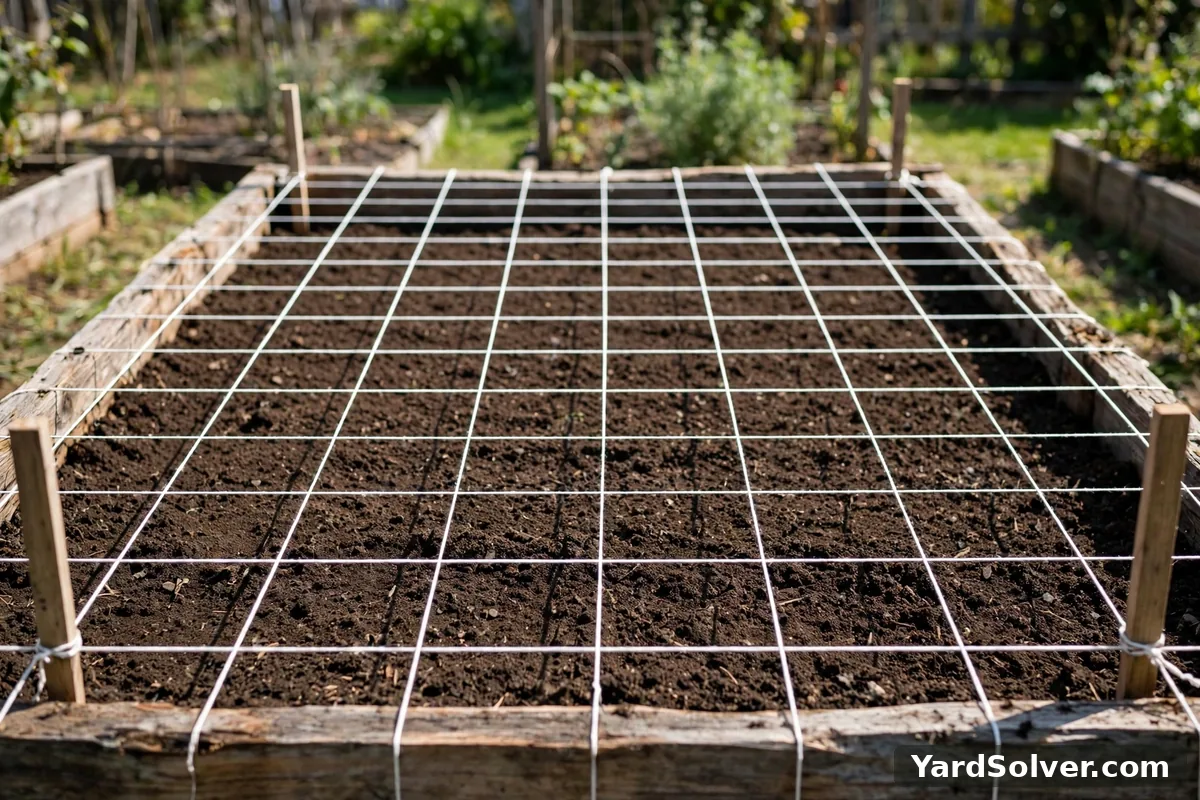
Open the Plant Spacing Calculator — plants per bed, straight and staggered and type in the bed's length and width, in feet or in metres — the unit switch converts everything behind the scenes, and the spacing can be entered in inches or centimetres to match your packet. The answer comes back in the form you actually shop with: plants per row × number of rows, the straight-grid total, and the staggered total beside it at about 15% more. That per-row breakdown is not decoration. It is the number you plant by — stretch a string line, mark each spot a spacing apart, and the row builds itself — and it is the number you check the total against when a bed is an awkward shape. Press the print button and you have a plant list: exactly how many seedlings to buy or seeds to start, in the layout you chose. Start a few extra seeds per position for crops with patchy germination and thin to the strongest; the calculator counts planting positions, and a position with no plant in it is a gap in the grid all season.
Step 3 — The maths the calculator is doing
There is no hidden model here — the calculator simply lays a grid of your spacing over the bed and counts it, and you can check every step on paper. Plants per row = bed length ÷ spacing. Rows = bed width ÷ spacing. Total = plants per row × rows. Both divisions round down, because you cannot plant a fraction of a seedling: a bed 50 inches wide at 12 inch spacing holds 4 rows, not 4.17, and the leftover 2 inches become part of your edge margin. In metric the same grid runs in centimetres — a 240 × 120 cm bed at 30 cm spacing is 8 per row × 4 rows, the identical bed in different units. The staggered figure is the straight total × about 1.15, rounded — an honest estimate rather than a pretended exact count, because real offset rows gain or lose a plant at the bed's edges depending on where the first row falls. Sanity-check the grid against a bed you can picture: a 10 × 10 ft plot at 12 inch spacing is 10 per row × 10 rows = 100 plants, exactly one plant per square foot. Hold that picture, because Step 4's table is built on it — and because it makes the two-directions lesson impossible to unsee: the count is a product of two divisions, so anything that changes the spacing changes the answer twice.
Step 4 — Square vs triangular: where the extra 15% comes from
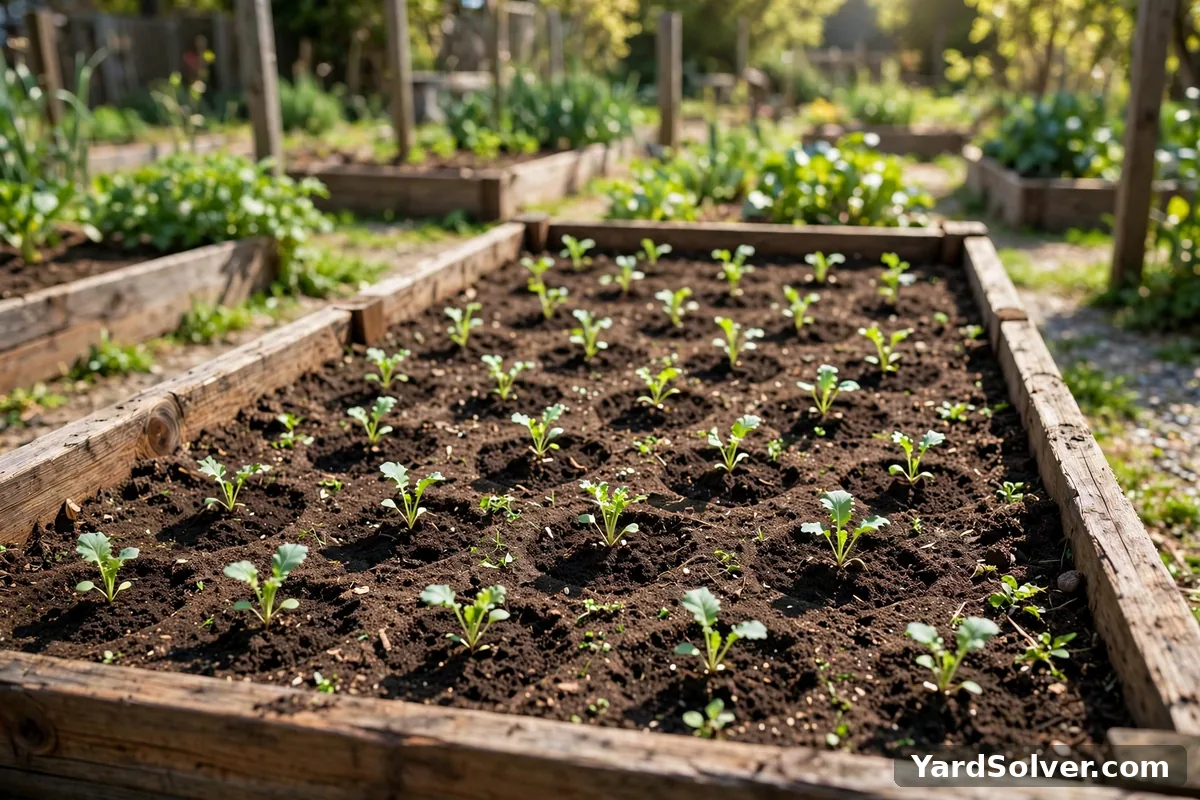
In a square grid, every plant sits on the corner of a square: four neighbours, each exactly one spacing away, with wasted pockets of soil in the middle of every square. Now shift every second row sideways by half a spacing, so each plant sits in the gap between two plants in the row beside it. That is the staggered, offset or triangular layout — the pattern of bricks in a wall. Each plant now has six neighbours at the full spacing distance, and because the plants nestle into the gaps, the rows themselves can sit closer together — about 0.87 of the spacing apart instead of the full spacing — while no two plants ever get closer than the packet allows. Same elbow room, less wasted ground: across a whole bed that geometry is worth roughly 15% more plants. The table below runs both layouts over the same 100 sq ft (a 10 × 10 ft bed), using the area maths — plants per bed = (120 ÷ spacing)² for the square grid, and about 1.15 times that staggered. Treat the staggered column as the calculator does: a close, honest estimate, not a promise to the last plant.
| Spacing | Square grid — plants per 100 sq ft | Staggered — plants per 100 sq ft | The staggered gain |
|---|---|---|---|
| 6 inches (15 cm) | 400 | about 460 | +60 plants |
| 12 inches (30 cm) | 100 | about 115 | +15 plants |
| 18 inches (45 cm) | about 44 | about 51 | +7 plants |
| 24 inches (60 cm) | 25 | about 29 | +4 plants |
Read the table the way the calculator thinks. The percentage never changes — staggering is always worth about 15% — but what 15% is worth changes completely with the spacing. At 6 inch spacing for leafy crops it is 60 extra plants in the same ground, a serious harvest. At 24 inch spacing for tomatoes it is 4 extra plants, and squeezing a fifth row of large, air-hungry plants into a bed is rarely worth the disease risk that comes with it. Stagger where the plants are small and the count is large; give the big plants their square grid and their airflow. Searches for a plant spacing calculator per square foot or in metric are really asking for this table — one plant per square foot at 12 inches, four at 6 inches, a quarter of a plant per square foot at 24 inches — and the calculator simply runs it for your bed instead of a standard hundred square feet.
Step 5 — One bed, two crops, worked start to finish
Here is the calculator's own worked example, done the way the calculator does it. The bed is a standard raised bed, 8 ft × 4 ft — 96 inches long, 48 inches wide. First, lettuce at 12 inch spacing. Along the length: 96 ÷ 12 = 8 plants per row. Across the width: 48 ÷ 12 = 4 rows. Total: 8 × 4 = 32 plants in straight rows. Stagger each row by half a spacing and the same bed, at the same 12 inches between plants, holds about 15% more: 32 × 1.15 ≈ 37 plants. Now tomatoes at 24 inch spacing, in the very same bed. Along the length: 96 ÷ 24 = 4 per row. Across the width: 48 ÷ 24 = 2 rows. Total: 4 × 2 = 8 plants. Put the two totals side by side and the lesson lands: the spacing doubled, from 12 to 24 inches, and the count did not halve — it quartered, from 32 to 8. That is the two-directions rule from Step 3 doing its work: doubling the spacing halves the plants per row and halves the rows, and half × half is a quarter. It is also why the spring mistakes in the introduction happen. A gardener who reasons "tomatoes need twice the room, so I need half as many" buys 16 tomato plants for a bed that holds 8 — and the other 8 spend the season in pots, waiting for ground that was never there. Type the numbers, see the answer, print the list: 32 lettuces, or about 37 staggered — and only 8 tomatoes.
Step 6 — Edges, paths, and why crowding quietly costs you the harvest
The grid the calculator draws uses the full bed, and three real-world adjustments decide how much of that grid you should actually plant. First, the edges. Plants at the very frame of a raised bed dry out faster, lean away from the boards, and are awkward to water and pick. Leave a few inches of working margin inside the frame — the rounding-down in Step 3 usually hands you some of that margin for free, and if keeping it costs a plant per row, the calculator's count minus that row's worth is the number to buy. Second, paths. The count is for planted ground only: a stepping-stone path through a wide bed, the strip you stand on to reach the middle, or the square where the compost bin sits are not planting positions, so measure the bed in the sections you will truly plant and run each section through the calculator, adding the plant counts — unlike bagged materials, there is no rounding saving here, just honest sections. Third, and most important, resist shrinking the spacing to beat the count. Crowding does not read as a problem in May, when the plants are small. It reads in July, when crowded plants are competing for the same light, water and food, shading each other's lower leaves, and holding a still, damp layer of air between them that mildew and blight move through like weather. Yield per plant falls faster than the plant count rises, so the crowded bed often harvests less in total than the properly spaced one — fewer, weaker plants would have been the honest description. A little closer than the packet, in rich soil with reliable watering, is a judgement call experienced gardeners make; a lot closer is just a smaller harvest with more disease, bought at full price. Gardeners asking how many raspberry plants, strawberry plants or blueberry bushes they need are running this same grid with bigger spacings and longer lives — a berry plant crowded in year one is still crowded, and much harder to move, in year five.
What the calculator can't do
Honesty about the edges, so the number earns your trust. The calculator assumes a flat rectangle planted on one spacing: a mixed bed — tomatoes at one end, lettuce at the other — needs a run per crop on its own section of the bed, not one run on an averaged spacing that suits neither. Its staggered figure is an estimate of about 15% more, not a surveyed count; on a small bed the offset rows may gain you three plants or five depending on where the first row starts, and the calculator will not pretend otherwise. It cannot choose the spacing for you — that judgement lives on the packet, the plant tag and the Plant Library, and a wrong spacing typed confidently gives a precisely wrong count. And it counts positions, not outcomes: it cannot allow for the seedling the slugs take in the first week, which is why starting or buying a small handful over the count — not a tray over — is the seasoned habit. What it does guarantee is the grid maths, checked above: get the bed size and the mature spacing right, choose square or staggered with your eyes open, and the plant count follows.
Soil for that bed comes before the plants go in — the Raised Bed Soil Calculator sizes the fill, and this calculator sizes the planting that sits on top of it.
Keep going
Run your own bed through the Plant Spacing Calculator, then look up each crop's spacing on the vegetable plant spacing chart before you buy. Berry beds and borders run on the same grid — the count changes, the maths does not.
Planning the whole season's planting, bed by bed? The Garden Planner lays out sowing, planting out and harvesting in one calendar, so each bed's plant list lands in the week the bed is actually ready for it.
Questions people ask
How many plants fit in a 4x8 bed?
It depends entirely on the spacing. At 12 inches for lettuce, an 8 × 4 ft bed holds 8 per row × 4 rows — 32 plants in straight rows, or about 37 staggered. At 24 inches for tomatoes, the same bed holds 4 per row × 2 rows — just 8 plants. Same bed, same soil, a fourfold difference from a single number.
Does staggering really fit more plants?
Yes — about 15% more in the same bed, at the same spacing. Offsetting every second row by half a spacing lets the rows sit closer together, because each plant nestles into the gap between two plants in the row beside it while keeping the same distance from every neighbour. On the 32-plant lettuce bed above, staggering gives about 37 plants. It is a real gain, not a doubling — if a plan only works with twice the plants, you need more ground, not tighter planting.
Where do I find the right spacing for a plant?
On the seed packet or the plant tag — that number is the distance between plant centres at maturity, not the gap between leaves. If the packet is lost, look the plant up in the Plant Library, where every plant lists its spacing, or check the vegetable spacing chart linked in this guide. Always use the mature spacing, even though the bed looks empty on planting day.
Why did doubling the spacing quarter the count?
Because spacing works in two directions at once. Doubling the spacing halves the plants per row and halves the number of rows, and the two halves multiply: half × half = a quarter. That is why the 8 × 4 ft bed drops from 32 lettuces at 12 inches to 8 tomatoes at 24 inches — and why guessing plant counts by eye goes wrong so often.
Can I space plants closer than the packet says?
A little, in rich soil with reliable watering — but crowded plants compete for light, water and food, shade each other, and hold damp air that invites mildew and other fungal disease. The packet spacing assumes you want healthy, productive plants, not just more of them. If you need more harvest from the same bed, staggering the rows for about 15% more is safer than shrinking the spacing itself.
Does the calculator count seeds or plants?
Plants — planting positions. For crops with uneven germination, sow a couple of extra seeds per position and thin to the strongest seedling, so the spacing you planned is the spacing you end up with. For bought seedlings and transplants, the calculator's count is simply the number to buy or to raise.
Spacing is a resource decision — each plant is buying light, air and root room
A spacing figure on a seed packet is not tidiness; it is the measured distance at which that plant can gather enough light, air movement and root run to mature without stealing from its neighbours — and both directions of error cost yield. Plant too close and the crop competes with itself: leaves shade leaves, still damp air breeds mildew, roots fight, and the harvest is many small plants instead of fewer full ones. Plant too far apart and the gardener wastes the bed's most limited resources — prepared soil, water and season — on empty ground that weeds will happily occupy instead.
The calculator's job is to turn a bed's real dimensions into an honest plant count in either system: rows, which suit cultivation and access, or a grid, which packs a raised bed efficiently — and to expose the classic planning error of buying or sowing for the area the gardener wishes they had. Intensive spacings assume the fertile, watered soil that can support them; on poor dry ground, wider spacing is not waste but realism. Leave access into the arithmetic: a bed you cannot reach the middle of will be planted at the spacing of your arms, whatever the chart says.
Sources
Key facts on this page cross-checked against Companion planting — Wikipedia — background on companion planting and how plants share space and Sowing — Wikipedia — background on sowing and plant spacing practice.
Related page
Read next: Vegetable Plant Spacing Chart: How Far Apart to Plant.
Comments & ratings
No comments yet.
Be the first to share your experience.