
Guides · Water and irrigation · Published November 18, 2026 · By Faizan Ahmad
How Much Water Does Your Roof Shed? The Rain Barrel Maths
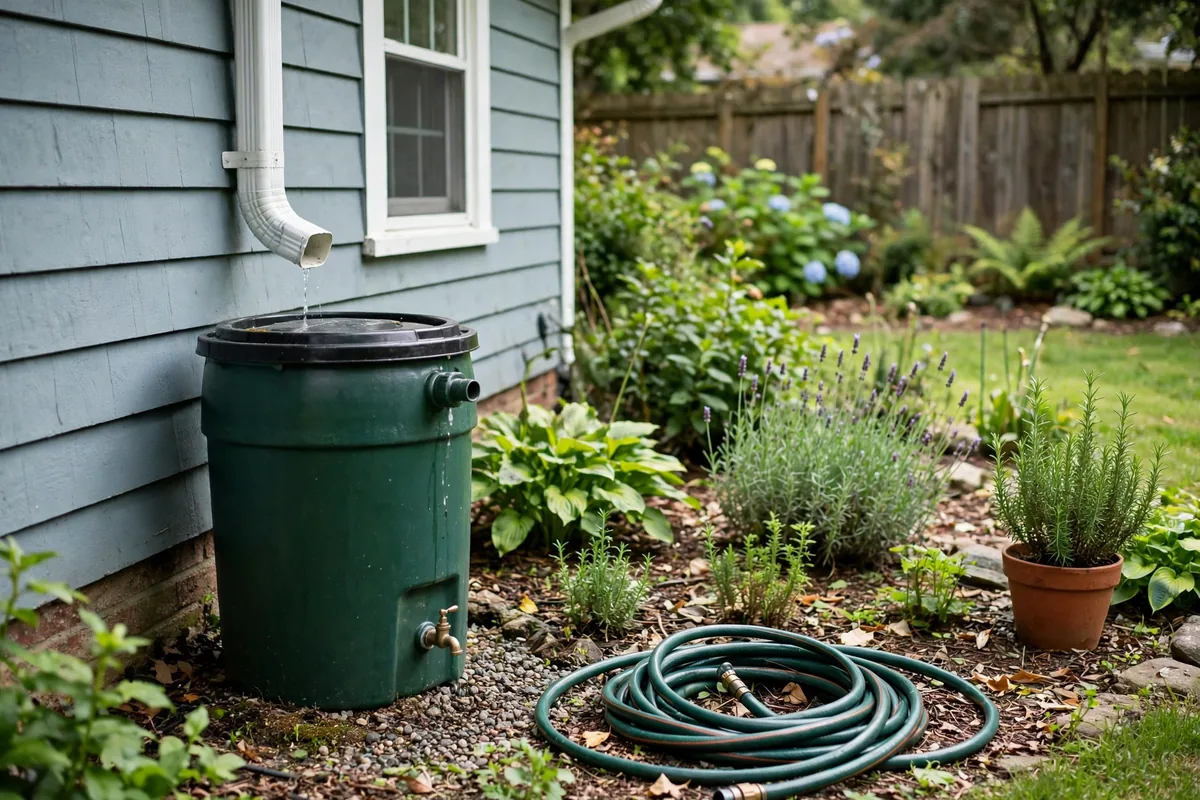
Almost everyone buys a rain barrel the same hopeful way: one barrel, one downspout, and a quiet assumption that it will catch the storm. Then the first real rain arrives, the barrel is full in minutes, and the rest of the storm pours out of the overflow while the gardener wonders what went wrong. Nothing went wrong — the roof simply out-produces the barrel by an order of magnitude, and the numbers prove it in one multiplication. That multiplication is exactly what our Rain Barrel Calculator runs for you. This guide shows how the calculator works, the maths underneath it, and the honest conclusion the maths leads to: a barrel is not a tank that swallows a storm, it is a buffer you draw down between rains — and sized that way, it works beautifully. By the end you will know how many gallons your own roof sheds, how fast a barrel really fills, and how much storage your watering habits actually call for.
The short answer, on one card
- The formula: gallons = roof area (sq ft) × rainfall (inches) × 0.623. Barrels = gallons ÷ 55, rounded up
- Every square foot of roof catches 0.623 gallons per inch of rain — 100 sq ft gives about 62 gallons in one inch
- The standard rain barrel is 55 gallons — and one fills from only about 88 sq ft of roof in a single inch of rain
- Use the roof's footprint — the area it covers seen from above — never the sloped surface. Rain falls vertically
- Size by your watering, not the storm: storage is a buffer between rains, and two linked 55 gallon barrels beat one giant barrel
Step 1 — Pick the downspout, then measure its roof section
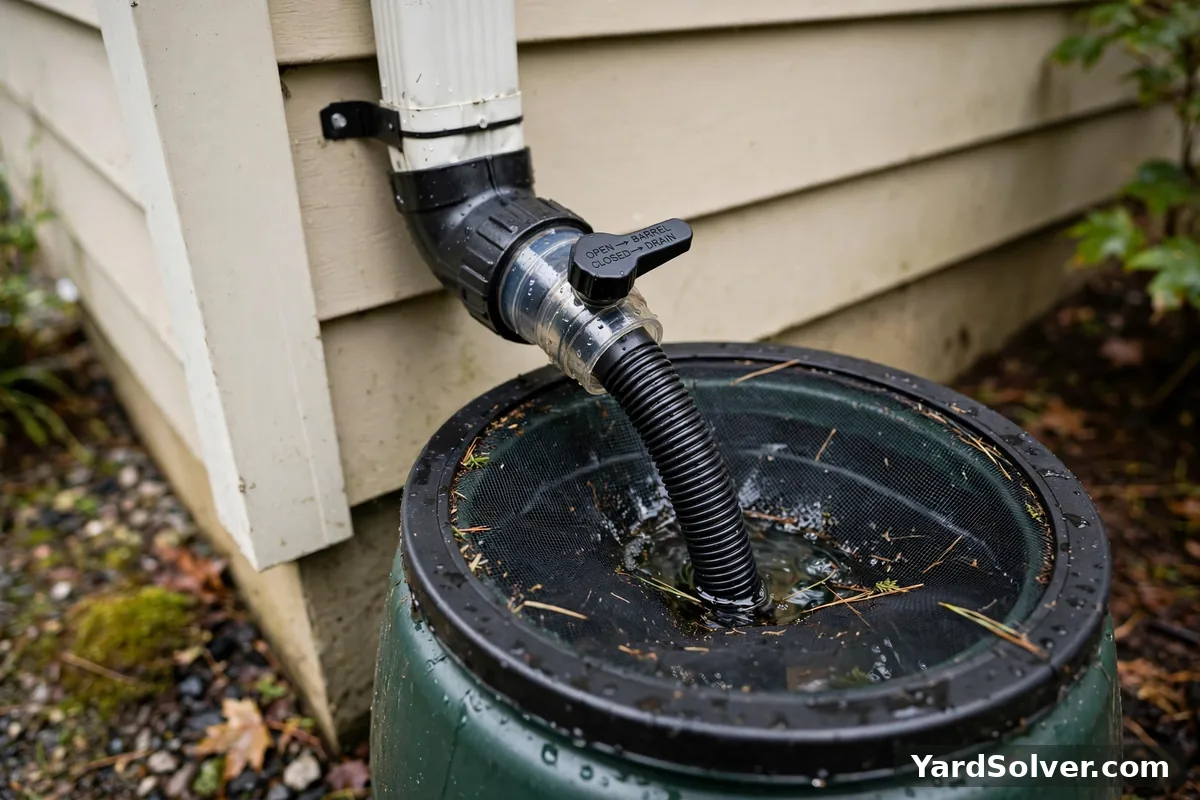
The calculator needs the roof area that actually drains to your barrel, and that is almost never the whole roof. Most homes collect from ONE downspout, and each downspout serves only part of the roof — one slope, one valley's worth, one section between ridges. So start at the downspout nearest your garden (hauling water is the chore that kills rain barrels, so the barrel belongs beside the beds it waters), then work out which part of the roof drains to it. Measure that section's length and width on the ground, or from the house's footprint: pace it, tape it, or take it from a satellite view. The one rule that matters: use the roof's footprint — the area it covers seen from above — not the sloped surface. Rain falls vertically, so a steep roof catches no more water than the flat shadow it casts; measuring up the slope overstates your harvest by 10 to 40 percent and is the most common sizing mistake there is. Include the eaves overhang in the footprint, since that edge catches rain too. A typical downspout section on a suburban home runs 300 to 600 square feet — hold that range in mind for the numbers ahead.
Step 2 — Run the calculator: what each input does
Open the Rain Barrel Calculator — roof gallons per inch and type in the length and width of your downspout's roof section, in feet or in metres — the unit switch converts everything behind the scenes. Next, the rainfall: 1 inch is the honest benchmark, a solid storm rather than a shower, and it is the figure every comparison in this guide uses. Then pick your country, Canada or the USA, so the barrel cost estimate uses a typical store-price range in your currency. The answer comes back in three parts: the gallons of runoff that rain sheds off your section, how many 55 gallon barrels it would take to catch every drop (rounded up, because you cannot buy a fraction of a barrel), and the quietly most useful number of all — how much roof fills one barrel in that rain, which tells you how fast your barrel will be full. Press the print button and you have the figures as a list. If the barrel count makes you blink, read on before you buy anything: Step 4 explains why that count is a measuring stick, not a shopping list. And if you are still choosing the barrel itself, What Size Rain Barrel Do I Need? walks through the sizes, materials and fittings in detail — this guide's job is the water maths that should come first.
Step 3 — The maths the calculator is doing
There is no hidden model here — the calculator runs the same runoff maths rainwater harvesters have used for decades, and you can check it on paper. The constant comes straight from geometry: an inch of water standing on one square foot is 144 cubic inches, and a US gallon is 231 cubic inches, so every square foot of roof catches 0.623 gallons per inch of rain. From there the whole tool is two lines: gallons = roof sq ft × inches of rain × 0.623, and barrels = gallons ÷ 55, rounded up. Sanity-check it against a roof you can picture: 100 sq ft × 1 inch × 0.623 = 62.3 gallons — a barrel and a bit, from a patch of roof the size of a parking space. The table below is the same maths pre-run for the roof sections real downspouts serve; it is worth a screenshot before you buy a barrel.
| Roof area to the downspout | Gallons in 1 inch of rain | 55 gal barrels to catch it all |
|---|---|---|
| 250 sq ft | 156 gallons | 3 barrels |
| 500 sq ft | 312 gallons | 6 barrels |
| 750 sq ft | 467 gallons | 9 barrels |
| 1,000 sq ft | 623 gallons | 12 barrels |
| 1,500 sq ft | 935 gallons | 17 barrels |
Read the table the way the calculator thinks: roof area is the lever, and it is a big one. Even the smallest section on the list — 250 square feet, a modest porch-and-kitchen slope — sheds nearly three barrels in a single inch. One honest adjustment: the table is the gross figure, and real capture runs a little lower after splash and first-flush losses — some rain bounces off the shingles, some wets the roof and evaporates, and a first-flush diverter deliberately throws the first dirty wash away. Planning guides typically assume you keep 75 to 90 percent of the gross. The calculator shows the gross number on purpose: it is the figure your overflow has to handle, and overflow, as the next step shows, is where rain barrels live or fail.
Step 4 — The honest mismatch: a buffer, not a tank
Here is the calculator page's own worked example, and it deserves a slow read. A 30 × 40 ft roof covers 1,200 sq ft. In 1 inch of rain it sheds 1,200 × 0.623 = about 748 gallons — that is 14 barrels' worth of 55 gallons, from one ordinary storm on one ordinary house. Nobody is lining up 14 barrels along the foundation, and nobody should. The example exists to break a false picture: the picture of the barrel as a tank that swallows the storm. A barrel cannot do that job, and judging it by that job is why so many barrels end up as mosquito farms behind the shed, full since April and never used. Judge it by its real job instead. A rain barrel is a buffer: it stores the water you will use between this rain and the next one. Its value is not the storm it catches — it is the watering cans it fills on the dry days after. A gardener who waters containers and a couple of beds every second day might draw 10 to 15 gallons a day; a full barrel is then four or five days of soft, warm, chlorine-free water that cost nothing and arrived without touching the tap. The storm will always be bigger than the barrel. The dry spell is the size that matters — and the dry spell is measured by your habits, which is exactly how the next step sizes the system.
Step 5 — The realistic version: one downspout, sized by your watering
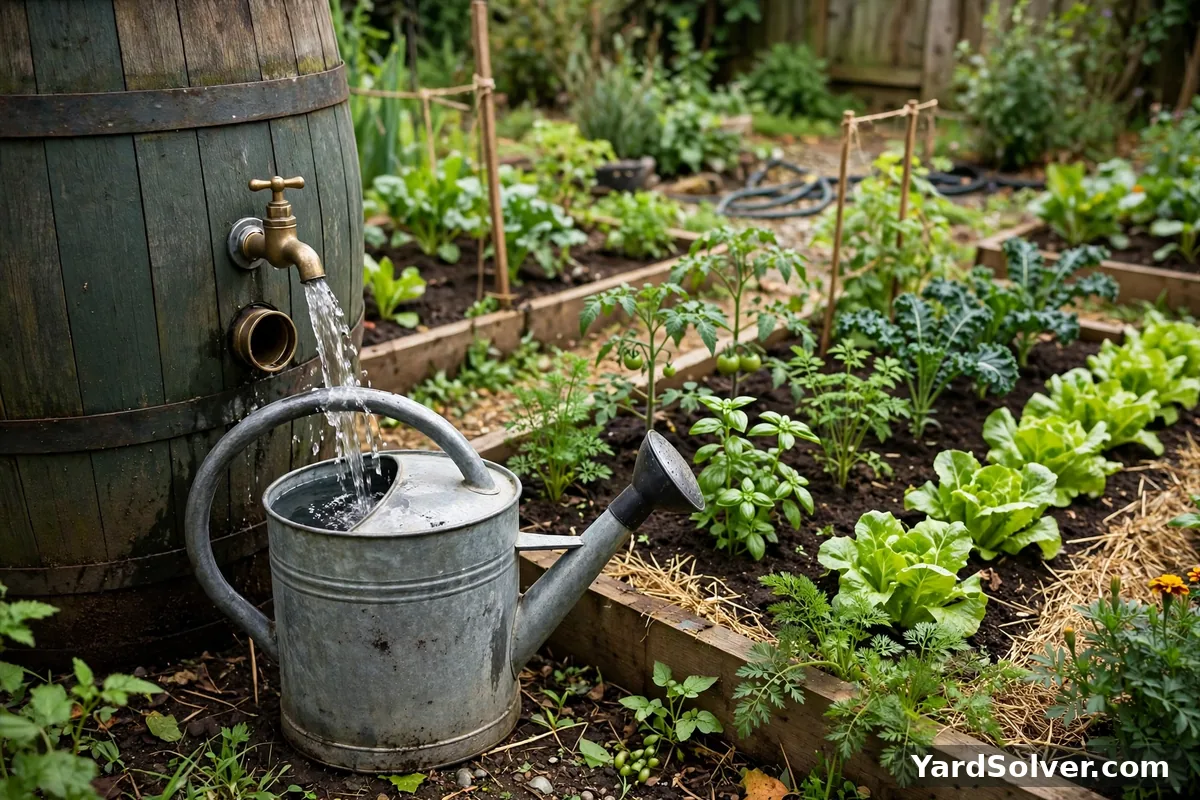
Now the same storm, told realistically. Your barrel hangs on one downspout serving a 500 sq ft section of that roof. One inch of rain sheds 500 × 0.623 = 311.5 gallons past that downspout — still nearly six barrels' worth. Turn the maths around and it gets sharper: your single 55 gallon barrel fills after 55 ÷ (500 × 0.623) = about 0.18 inches of rain over its section. Less than a fifth of an inch. In a one-inch storm the barrel is full in the opening minutes and roughly 256 gallons go down the overflow. That is not a failure to fix by shopping — it is the physics of every barrel on every house, and it settles the sizing question properly. Size your storage to your watering habits and your rainfall rhythm, not to the storm. Water a few containers in a rainy climate where storms return weekly? One barrel, drawn down regularly, is genuinely enough. Run a full vegetable garden through a summer where rain comes every two or three weeks? Then every stored gallon works for a living, and storage is worth growing — but grow it by linking a second barrel, not by hunting for one giant one. Two linked 55 gallon barrels give you 110 gallons in standard fittings, standard stands and standard prices; they fill in sequence, share one overflow, and if one ever cracks you still own a working system. A third can join the chain the same way when the garden grows into it.
Step 6 — Overflow, first flush, mosquitoes and winter: the four details that decide whether it works
Overflow routing comes first, because the overflow is the main event. Step 5's maths means most of every storm leaves through the overflow hose — so that hose is not an accessory, it is a downspout in its own right. A full barrel must send water AWAY from the foundation: run the overflow to the same discharge point the downspout used before the barrel arrived, or at minimum several feet downhill from the house, never pooling against the wall. Overflow dumped at the foundation trades a water-saving project for a damp-basement project. Second, the first flush. The first water off a roof carries dust, pollen, bird droppings and grit. A first-flush diverter — a short vertical pipe that fills with that first wash and seals, sending the rest of the storm to the barrel — keeps the barrel's water cleaner and its tap unsilted; the diverted volume is part of why real capture runs below the gross figure in Step 3. Third, mosquitoes. Every opening gets a fine screen — the inlet, the overflow, any vent — because a female mosquito needs only a week of standing water, and an unscreened barrel is a nursery that produces them by the hundred. Screen it, and use the water regularly; a barrel drawn down every few days never gives larvae their week. Fourth, winter. In any climate with hard freezes, water left in the barrel expands as it freezes and can crack the barrel and split the tap: drain it fully, disconnect it or switch the diverter to bypass, leave the tap open, and store it upside down or under cover. The full seasonal routine, step by step, is in How to Winterize a Rain Barrel.
What the calculator can't do
Honesty about the edges, so the number earns your trust. The calculator gives the gross runoff: it cannot know your roof's real losses — splash off steep shingles, a gutter that spills in cloudbursts, the first-flush volume you divert — which is why real capture runs a little lower, typically 75 to 90 percent of the figure shown. It cannot know your rainfall rhythm: the same barrel is a toy in a desert summer and a workhorse where storms return weekly, and only your local pattern says which. It cannot judge water quality — roof runoff is garden water, not drinking water, and roofs with treated shakes or heavy overhanging trees shed a dirtier wash than clean asphalt shingles. And its cost figures are typical store-price ranges for your country, not quotes. What it does guarantee is the runoff maths, checked above: get the footprint and the rainfall right, and the gallons follow — and with them, an honest picture of what a barrel can and cannot do for your garden.
New to collecting rainwater altogether? Rainwater Harvesting for Beginners covers placement, bases and the legal picture before you buy anything.
Keep going
Run your own roof section through the Rain Barrel Calculator, then choose the hardware with What Size Rain Barrel Do I Need? and keep it alive through winter with How to Winterize a Rain Barrel.
Planning the whole season's watering around the rain you catch? The Garden Planner lays out watering, feeding and planting in one calendar.
Questions people ask
What is the standard rain barrel size?
The standard rain barrel size is 55 gallons — the size of the common food-grade drum most barrels are made from. You will also see 50 and 65 gallon models, but 55 gallons is the size the calculator uses, and the size most diverter kits, stands and linking kits are built around.
How many gallons does 1 inch of rain give me?
It depends on the roof area draining to your downspout: gallons = square feet x 1 x 0.623. So 100 square feet gives about 62 gallons, 500 square feet gives about 312 gallons, and a full 1,200 square foot roof gives about 748 gallons in that single inch.
Why does my barrel overflow in every storm?
Because the roof out-produces the barrel. A single 55 gallon barrel fills from about 88 square feet of roof in 1 inch of rain, and most downspouts serve several hundred square feet — so the barrel is full in the first fraction of an inch and the rest must go down the overflow. That is normal, not a fault: draw the barrel down between rains and make sure the overflow runs well away from the foundation.
Can I link two barrels together?
Yes — linking is the normal way to grow storage. A connector hose joins the barrels near the top, or a linking kit joins them at the base, so the first barrel fills, then spills into the second, doubling storage to 110 gallons. Linked barrels share one overflow, which still needs routing away from the foundation, and both barrels must sit level at the same height.
What is a first-flush diverter, and do I need one?
A first-flush diverter is a short section of pipe that captures the first water off the roof — the wash that carries dust, pollen, bird droppings and grit — and sends it to drain instead of into the barrel. It then closes and the cleaner water flows in. You do not strictly need one for garden watering, but it keeps barrel water cleaner, slows sediment build-up and is worth fitting if the roof is dirty or overhung by trees.
Do I need to winterize my rain barrel?
In any climate with hard freezes, yes. Water expands as it freezes and can crack the barrel and split the tap. Before winter, drain the barrel fully, disconnect it from the downspout or set the diverter to winter bypass, leave the tap open, and store the barrel upside down or indoors. Reconnect it in spring after the last hard freeze.
A roof harvests surprising water — the calculator turns rainfall into a barrel decision
The arithmetic of rainwater surprises everyone the first time: a modest roof in a modest rain delivers hundreds of litres, because every millimetre of rain on every square metre of roof is a litre of water, minus what the gutters and first flush lose. The calculator exists to make that number concrete for a real roof and a real rainfall record, so the barrel bought matches the harvest available — a barrel far smaller than the roof's delivery overflows in every storm and teaches its owner that barrels 'don't work', while the same roof with storage matched to its area and a dry-spell plan becomes a serious water supply for the garden.
Sizing is a balance of two numbers: what the roof yields in a typical rain, and what the garden drinks in a typical dry week — the barrel only needs to bridge the second with the first, and in rainy climates a smaller barrel emptied often outperforms a cistern that never fills. First-flush diverters and leaf screens cost a little of the yield and buy clean storage; overflow must be planned to drain away from foundations, because a barrel that overflows against a wall is a damp problem with a lid. This guide's calculator works in whichever units the roof was measured in — the physics does not care.
Sources
Key facts on this page cross-checked against Rain barrel — Wikipedia — background on rain barrels and roof collection and Rainwater harvesting — Wikipedia — background on rainwater harvesting and yield calculations.
Related page
Read next: What Size Rain Barrel Do I Need? Size It by Downspout.
Comments & ratings
No comments yet.
Be the first to share your experience.