
Guides · Tool reviews · Published November 21, 2026 · By Faizan Ahmad
Scraps to Garden Feed in Hours? The 4 Best Electric Composters, Honestly Compared (Dryers vs Real Compost)
As an affiliate, YardSolver may earn a commission from qualifying purchases made through buttons on this page — it never changes the price you pay, and it never buys a place in these rankings.
Here is the honest fact this whole category is marketed around avoiding: most "electric composters" do not compost. The popular countertop machines dry and grind your scraps in a few hours into a sterile, shelf-stable pre-compost — genuinely useful, and far better than landfill, but it still has to finish breaking down in soil before it feeds plants the way finished compost does. Only the microbe-based machines run a living composting process indoors, trading hours for weeks. A dryer-style recycler typically cuts a full bucket of scraps down to roughly a fifth of its volume overnight; a microbe composter turns scraps into real compost you can sift and use. Both are worth owning — for different people. The four machines below are the best of each kind, labelled plainly so you know which you are buying.
If you already run an outdoor pile, How to Start Composting for Beginners and the greens-to-browns ratio guide cover the free route — this page is for the kitchen-counter problem: scraps, in winter, in apartments, without smell or fruit flies.
The 4 best electric composters, honestly compared
Best dryer-grinder for families — FoodCycler Eco 5 (by Vitamix)
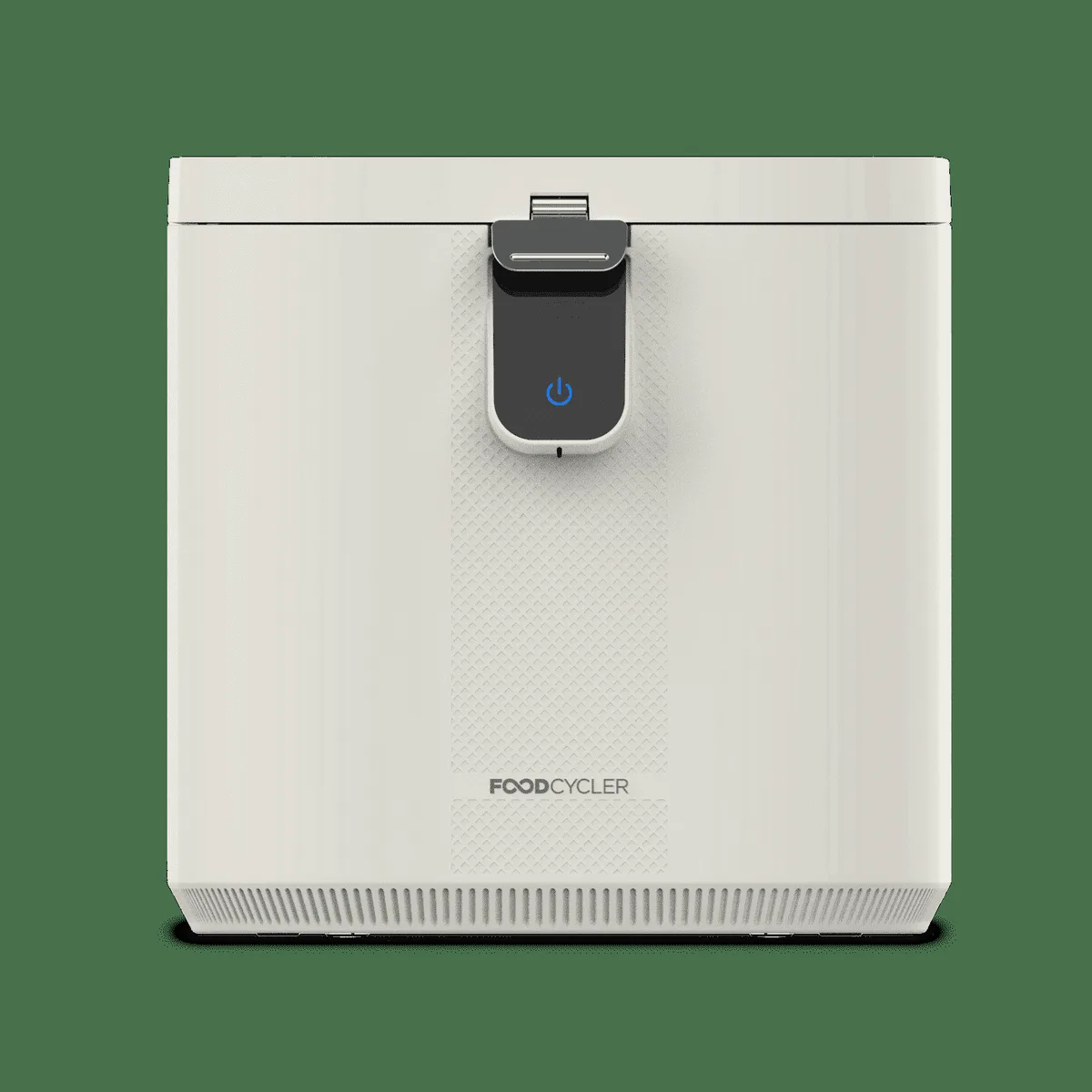
The Eco 5 is the big-bucket benchmark of the dryer-grinder class: a 5-litre bucket that takes a family day's scraps — bones of the small kind, vegetable peelings, leftovers — and runs a dry-and-grind cycle of roughly four to eight hours at the touch of one button. What comes out is a coarse, dry, odour-neutral crumble at a fraction of the original volume, ready to be worked into garden soil where it finishes its journey. It comes from the Vitamix side of the kitchen world, and it feels like it: simple controls, solid build, no app demanding your attention.
What's new/automated: one-button automated drying and grinding with carbon filtration — load it after dinner, empty it in the morning. Pros: the largest dryer bucket in this guide; genuinely simple to run; output keeps scraps out of landfill and feeds soil once buried. Cons: the output is a dried pre-compost that still needs soil time — it is not finished compost, whatever the box implies — and the carbon filters are a recurring consumable.
Who it suits: families who want scraps gone tonight and are happy letting the garden finish the composting.
Check Price on Amazon — USCheck Price on Amazon — Canada
Buttons open a search for the FoodCycler Eco 5 on each store, so you see today's price and the current models — we never print prices here because they change daily.
Fastest and smallest dryer — Lomi 3 Electric Food Recycler
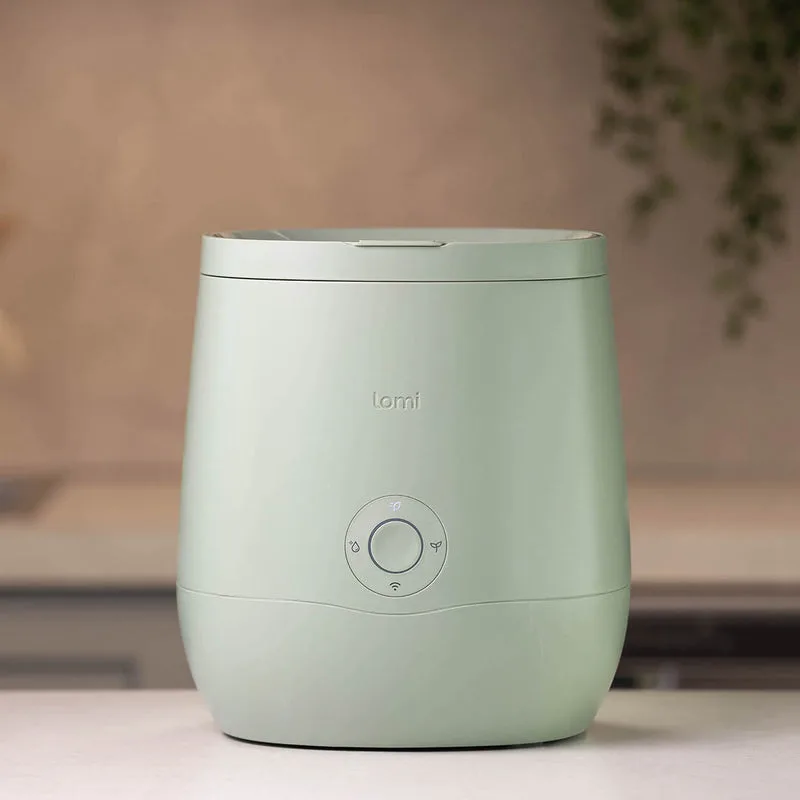
The Lomi 3 is the smallest, quickest machine in the dryer class — the one that fits the apartment counter the FoodCycler crowds. Its Express mode turns a load of scraps into dry grounds in roughly three to six hours, and its Grow mode runs cooler and longer, deliberately keeping more of the food's biology alive in the output for gardeners who plan to use it on soil. That second mode is Lomi quietly admitting the honest point of this whole guide: faster and hotter is tidier, slower and cooler is better feed.
What's new/automated: fully automatic cycles with a choice of Express or biology-friendlier Grow mode in the most compact footprint here. Pros: fastest cycles and smallest counter footprint in the guide; Grow mode is a real nod to gardeners; handsome enough to leave out. Cons: ongoing filter and pod costs are the highest here — price the consumables before you fall for the machine — and the bucket is sized for singles and couples, not family dinners.
Who it suits: small households and apartment gardeners who value speed and counter space.
Check Price on Amazon — USCheck Price on Amazon — Canada
Buttons open a search for the Lomi 3 on each store, so you see today's price and the current models — we never print prices here because they change daily.
Real compost, quietly — Reencle Prime Electric Composter
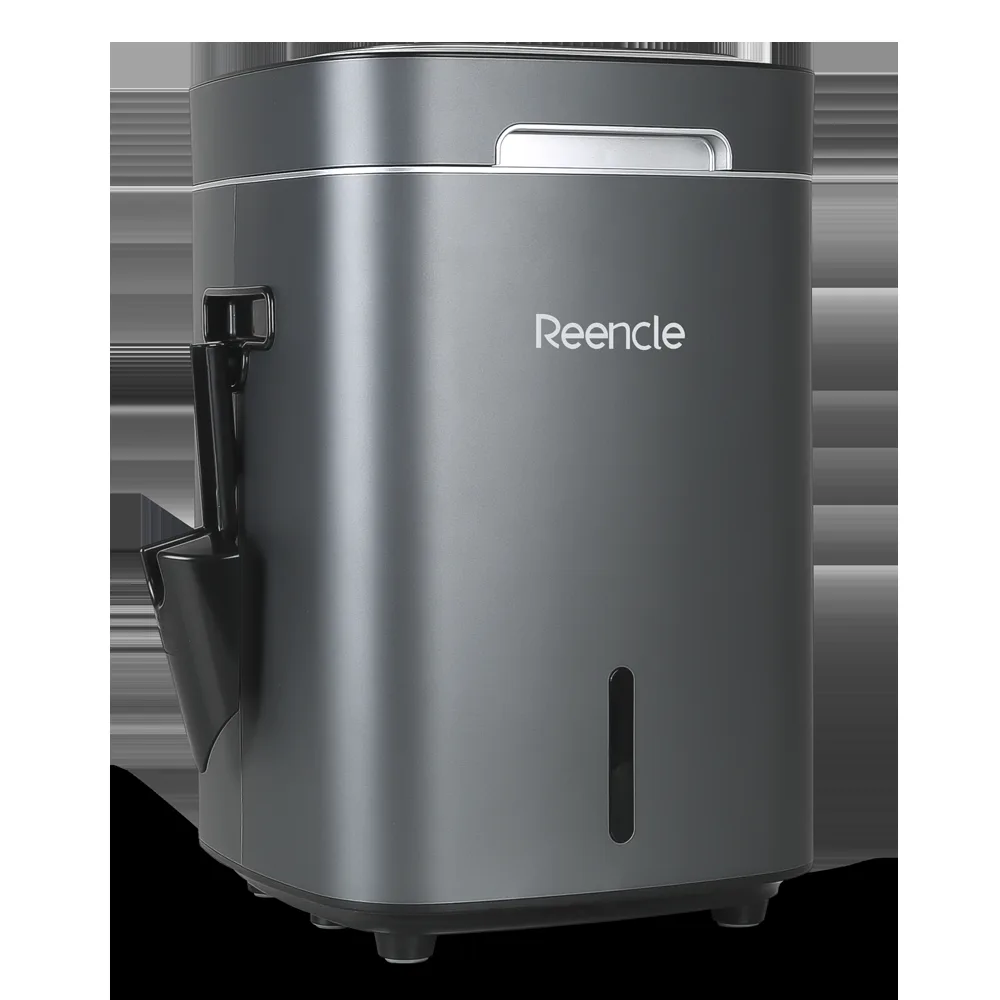
The Reencle Prime is a different species of machine: inside is a living microbe culture that digests scraps continuously, the way a healthy compost pile does, at a whisper of about 28 decibels. There is no cycle to run — you feed scraps in as you make them, the culture works around the clock, and every few weeks you scoop out genuine, finished compost. This is the only style of machine in the guide whose output you can put straight onto a bed, because it never stopped being composting in the first place.
What's new/automated: continuous microbial composting indoors — self-regulating temperature and near-silent operation, no batches, no filters to swap. Pros: real compost, not pre-compost; the quietest machine here; running costs are culture care rather than filter subscriptions. Cons: the highest effort to start — the culture needs setting up and settling in — and output takes weeks, not hours, so it rewards patience rather than tidiness.
Who it suits: actual gardeners who want finished compost from the kitchen, all winter, and will trade speed for truth.
Check Price on Amazon — USCheck Price on Amazon — Canada
Buttons open a search for the Reencle Prime on each store, so you see today's price and the current models — we never print prices here because they change daily.
Real compost at household scale — GEME Smart Electric Composter (19L)
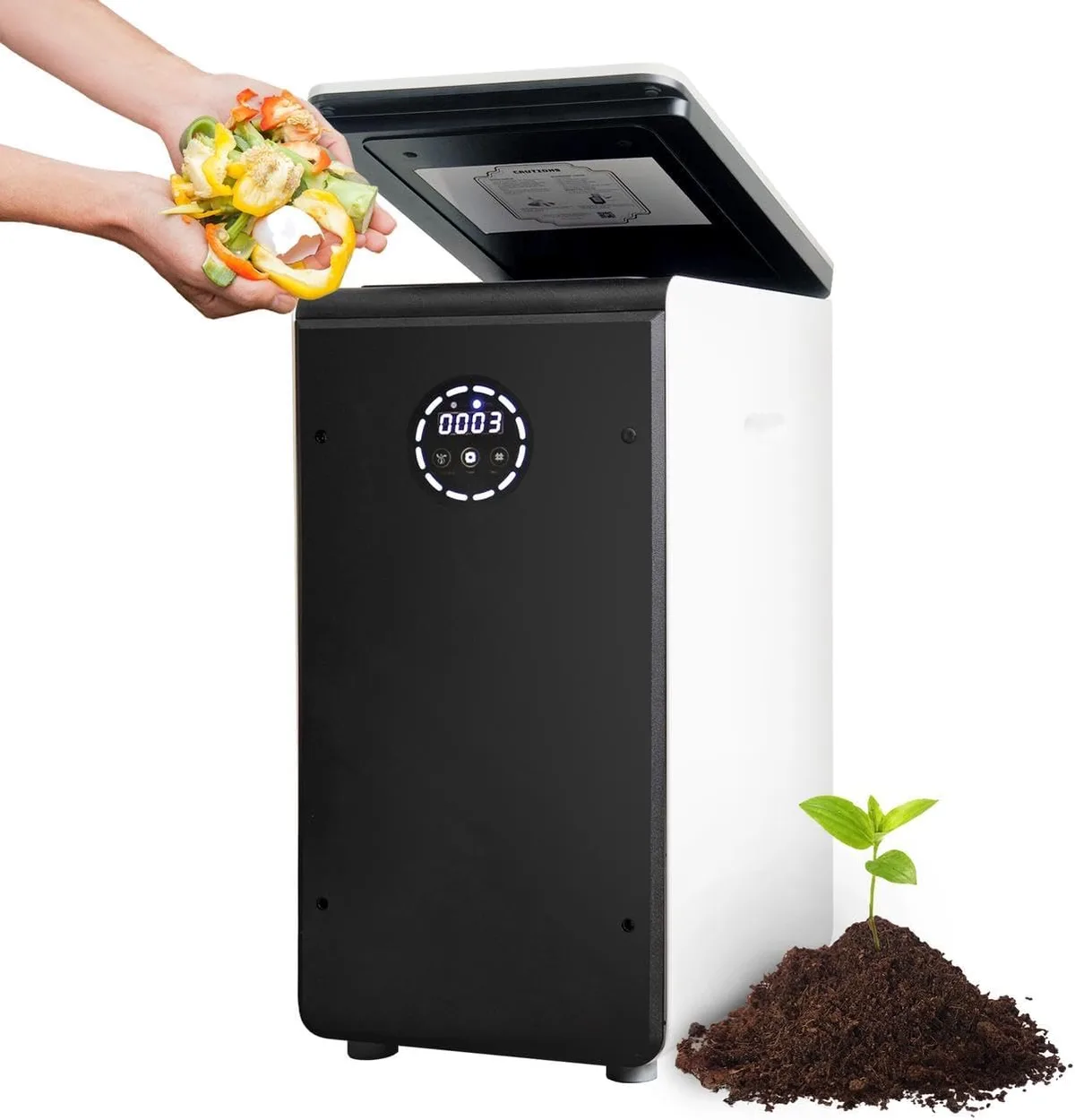
The GEME takes the microbe approach and scales it: a 19-litre chamber sized for big households that produce scraps like a small café. Like the Reencle it composts continuously with a living culture, and it is designed to need no filter changes — the microbes handle odour themselves when the chamber is fed sensibly. Feed scraps in at the top as the week goes, take finished compost out when the chamber has worked through them.
What's new/automated: a large continuous microbial chamber with no filter consumables — automation by ecosystem rather than by cycle timer. Pros: the biggest capacity in this guide; real compost output; no filter subscription hanging over it. Cons: a big countertop or under-counter footprint that small kitchens will resent, and a less established brand in North America, so long-term parts and support are a fair question to weigh.
Who it suits: large households and serious cooks who want the microbe method without running out of room.
Check Price on Amazon — USCheck Price on Amazon — Canada
Buttons open a search for the GEME 19L composter on each store, so you see today's price and the current models — we never print prices here because they change daily.
Side by side
| Machine | Type | How it runs | What comes out | Best for |
|---|---|---|---|---|
| FoodCycler Eco 5 | Dryer-grinder | 5L batch, ~4–8 hours | Dried pre-compost | Families, simple routine |
| Lomi 3 | Dryer-grinder | Small batch, ~3–6 hours Express | Dried grounds | Small kitchens, speed |
| Reencle Prime | Living microbe | Continuous, ~28 dB | Real compost in weeks | Gardeners wanting true compost |
| GEME 19L | Living microbe | Continuous, 19L chamber | Real compost | Big households |
How to choose: dryer or microbe?
Decide what you actually want out of the machine. If the goal is scraps gone — no smell, no flies, no landfill guilt — a dryer-grinder does it tonight, and the garden finishes the job in the soil. If the goal is finished compost you can sift onto a bed, only the microbe machines deliver it, and they ask for weeks and a little culture-keeping in return. Neither answer is the "green" one and the other fake; they are different tools sharing a marketing name.
Count the consumables before the features. Dryers eat carbon filters; Lomi adds pods; microbe machines eat a little of your attention. Over three years those running costs can rival the machine. The counter space is the other honest constraint — measure yours before falling for the 19-litre chamber.
Keep the outdoor pile in the picture. However good the counter machine is, leaves and prunings still need the pile, and finished compost volume for real beds comes from bulk. How Much Compost Do I Need? sizes that job, and the Compost Calculator works out the mix. More tool comparisons live on the Tools hub.
Keep going
The free route still matters: How to Start Composting for Beginners builds a pile that handles everything the counter machines cannot.
More comparisons and the full tool shelf live on the Tools hub.
Questions people ask
Do electric composters make real compost?
Most do not. Dryer-grinder machines (FoodCycler, Lomi) dehydrate and shred scraps in hours into a dried pre-compost that still has to finish breaking down in soil. Microbe machines (Reencle, GEME) run a living culture that digests scraps continuously and produces genuine compost, but over weeks rather than hours.
What do I do with the dried output from a FoodCycler or Lomi?
Treat it as a concentrated soil ingredient, not finished compost: mix it into garden soil or bury it in a bed and let soil life finish the job over the following weeks. Keep it worked into the soil rather than piled against plant stems, and use modest amounts per bed — a little goes a long way.
Do electric composters smell?
Dryer-grinders run sealed with carbon filters doing the odour work, so a running cycle smells very little; most of the smell arrives when you open the lid on a finished batch. Microbe composters smell earthy when the culture is healthy and fed a balanced diet — a sour smell means it has been overfed or fed too much of one thing.
What should not go into an electric composter?
Follow your maker's list first. As a rule, dryer-grinders struggle with large bones and large volumes of oil, while microbe cultures dislike heavy loads of citrus, onion, salty or very spicy food. None of these machines is built for yard waste — leaves, prunings and grass still belong in the outdoor pile.
Electric composter or outdoor compost pile — which is better?
They solve different problems. A pile is free, takes garden waste as well as kitchen scraps, and makes true compost in bulk — but it is outdoors, slower in winter, and no use to an apartment. An electric unit works year-round on a counter and shrinks scraps fast. Many gardeners run both: the machine handles winter kitchen scraps, the pile handles the garden.
Sources
Key facts on this page cross-checked against FoodCycler — Eco 5 capacity and cycle details — Lomi — Lomi 3 modes and cycle times — Reencle — Prime microbe system and noise figures — and US EPA — Composting at Home — what composting is and what finished compost requires.
Related page
Read next: How to Start Composting for Beginners: The Pile That Costs Nothing.
Comments & ratings
No comments yet.
Be the first to share your experience.