
Guides · Home projects · Published November 18, 2026 · By Faizan Ahmad
How Many Concrete Blocks Do I Need?
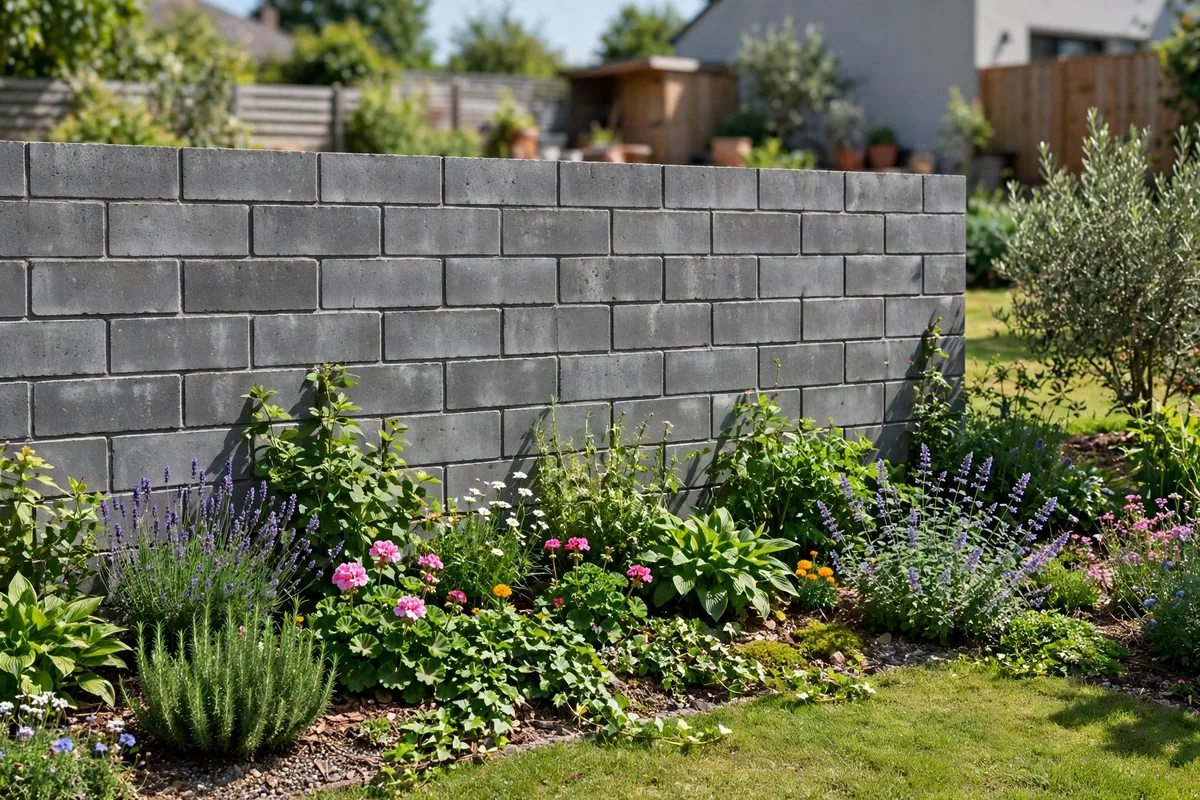
Concrete block looks deceptively simple to estimate: it is a wall, it is made of identical grey rectangles, so how hard can the count be? In practice people guess from the length alone, forget the height in courses, forget mortar, and end up either a pallet short on the last course or with a stack of leftover blocks nobody will take back. The real count runs on one friendly number — 1.125 — and it is exactly what our Concrete Block Calculator — blocks and mortar for any wall uses. This guide shows how the calculator works, the maths underneath it, and the honest edges: openings, corners, half blocks, mortar bags, and the things a block count does not include. By the end you will be able to check any yard's estimate against your own numbers in about a minute.
The short answer, on one card
- The 1.125 rule: blocks = wall area (sq ft) × 1.125. One standard block with its mortar joint covers 8 × 16 in = 0.889 sq ft
- The check: 9 blocks cover exactly 8 square feet of wall — if a count fails that check, it is wrong
- Add 5% for cuts and breakage, then round up to whole blocks
- Mortar: one 80 lb bag lays roughly 10 standard blocks with standard joints — bags = blocks ÷ 10, rounded up
- Subtract openings — doors and windows — from the measured area before you multiply
- Not included: rebar, grout fill and lintel blocks follow your design and are counted separately
Step 1 — Measure the wall, then take the openings out
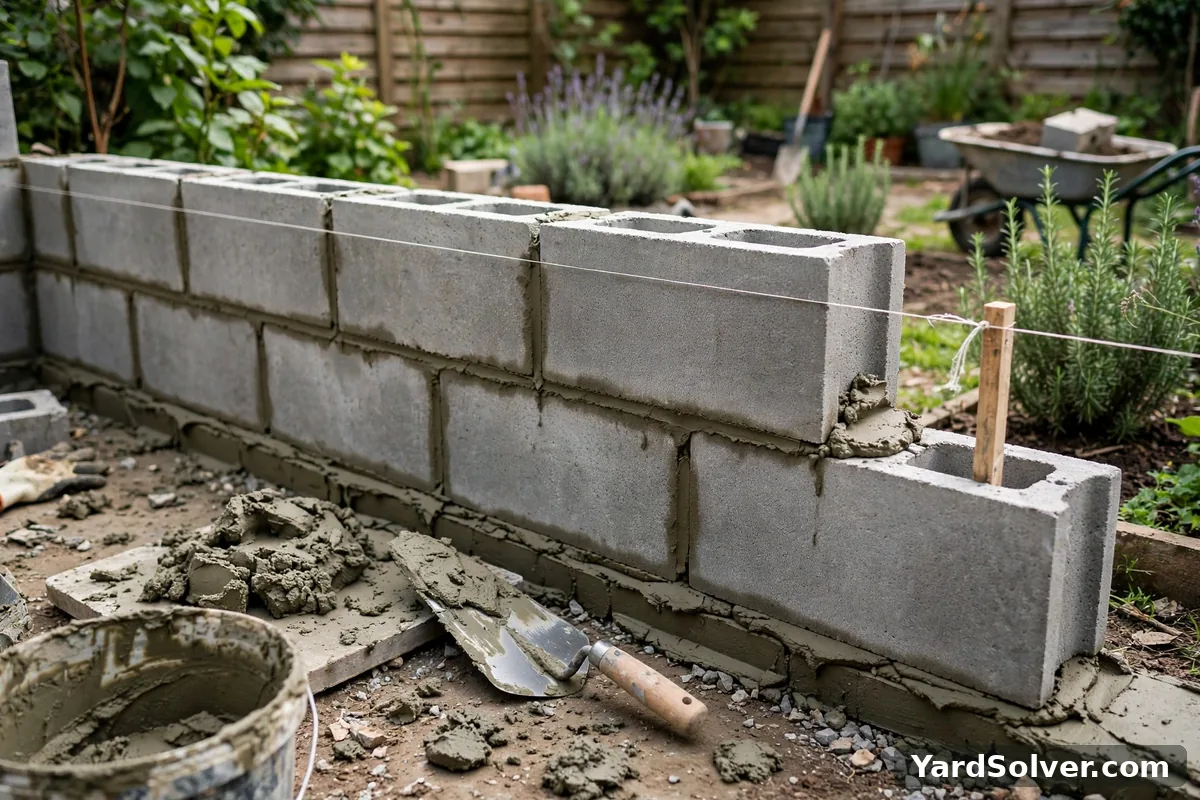
The calculator needs one number to start: the wall's area in square feet. Run a tape along the wall's length and multiply by its height — a 20 ft wall that stands 8 ft high is 160 sq ft, full stop. For a building with four walls, add the walls up first: a 10 × 12 ft shed has a 44 ft perimeter (10 + 12 + 10 + 12), so at 8 ft high its gross wall area is 44 × 8 = 352 sq ft before openings. Then do the step guessers skip: subtract every opening. Measure each door and window, multiply its width by its height, and take that area off the wall. A standard 3 × 7 ft shed door is 21 sq ft — at 1.125 blocks per square foot, leaving it in overstates the order by about 24 blocks plus their share of the waste allowance. Garages, gates in a boundary wall and window openings in a foundation all work the same way. One measuring tip that saves arguments later: block walls are built in 8-inch courses, so heights that land on a whole number of courses — 4 ft is 6 courses, 8 ft is 12 courses — waste nothing to trimming. If your design height falls between courses, round the plan to the nearest course before you count, not after the blocks arrive.
Step 2 — Run the calculator: what each input does
Open the Concrete Block Calculator and type in the wall length and height from Step 1, in feet or in metres — the unit switch converts behind the scenes, and the count is worked on the net area once you have left the openings out of your measurements, as the calculator page itself instructs. There is no block-size menu to get wrong, and that is deliberate: the calculator is built around the one standard unit almost every garden wall, foundation and shed in North America is laid with, the nominal 8 × 8 × 16 in block. The answer comes back as three things at once: the block count with the 5% waste allowance already included, the number of 80 lb mortar bags at roughly 10 blocks per bag, and an estimated cost range for your country, Canada or the USA — the country toggle matters because block and mortar prices differ across the border. Press the print button and that answer becomes a shopping list you can hand to the yard: blocks, mortar, and the note that rebar, grout and lintels are extra, so nobody at the counter mistakes the list for the whole build.
Step 3 — The maths: where 1.125 comes from
There is no hidden model here, and the number is worth understanding because it lets you sanity-check anyone's estimate, including ours. A standard block's laid face — the part you actually see in the finished wall — measures 8 inches high × 16 inches long = 128 square inches. A square foot is 144 square inches, so one block covers 128 ÷ 144 = 0.889 sq ft of wall. Turn that upside down and you get the rule: 1 ÷ 0.889 = 1.125 blocks per square foot. So the calculator's core line is simply blocks = wall area × 1.125, then × 1.05 for waste, rounded up. Here is the check that proves it without a calculator: 9 blocks × 0.889 sq ft = 8.0 sq ft. Nine blocks cover exactly eight square feet. Any estimate that does not respect that ratio — say, a quote of 100 blocks for 100 sq ft — is short before it starts, because 100 sq ft needs 112.5 blocks before waste, 119 with it.
One subtlety explains the block's odd real size. The block on the pallet is not 8 × 8 × 16 in at all: it is 7⅝ × 7⅝ × 15⅝ in — three-eighths of an inch smaller in every direction. That missing ⅜ in is the mortar joint. Lay the block with a standard ⅜ in joint and the unit plus its share of mortar occupies the full nominal 8 × 16 in face, which is why the tidy 1.125 maths works on real walls and why block walls are planned on an 8-inch module. It also means you should never count using the pallet dimensions alone and then add a separate allowance for joints — the joint is already inside the 1.125.
Mortar follows just as simply. With standard ⅜ in joints, one 80 lb bag of mortar mix lays roughly 10 standard blocks, so the calculator divides the final block count (waste included — you mortar the spares you break, too, in spirit) by 10 and rounds up. It is labelled a rule of thumb on the calculator page and it deserves the label: fat joints, a heavy hand with the trowel and mortar dropped and wasted on the board all pull the real yield down, while tight, practiced laying can stretch a bag further. Treat the bag count as a solid planning number, not a promise, and keep one spare bag unopened — unopened bags go back to the store; a wall stopped two courses short on a Sunday does not.
Step 4 — A whole wall, worked start to finish
Here is the calculator's own worked example, done slowly. Take a 20 ft × 8 ft wall — a long garden or boundary wall, or one side of a small building. Area: 20 × 8 = 160 sq ft. Blocks before waste: 160 × 1.125 = 180 blocks. Check it the 9-for-8 way: 160 ÷ 8 = 20 groups of eight square feet, 20 × 9 = 180 — the two routes agree, as they must. Add the 5% waste allowance: 180 × 1.05 = 189 blocks to order. Mortar: 189 ÷ 10 = 18.9, rounded up to 19 bags of 80 lb mortar mix. That is the complete order for the wall itself: 189 blocks, 19 bags. Everything else a structural wall may need — steel, grout, lintels over openings — is design-dependent and deliberately not in that number, as Step 6 explains.
Now the shed people actually search for. A 10 × 12 ft shed has four walls totalling 44 ft around; at 8 ft high that is 352 sq ft gross, which would be 396 blocks before waste and 416 to order if the walls were solid. They are not solid: take out one 3 × 7 ft door (21 sq ft) and the net area is 331 sq ft. Now the count is 331 × 1.125 = 372.4 blocks, plus 5% = 391 blocks, and mortar is 391 ÷ 10, rounded up to 40 bags. Notice what the openings step was worth: 25 fewer blocks and 2 fewer mortar bags than the solid-wall guess, from one minute with a tape. Add a window and the saving grows the same way — measure it, subtract it, then multiply.
| Wall | Area (sq ft) | Blocks before waste | Blocks to order (+5%) | Mortar (80 lb bags) |
|---|---|---|---|---|
| 10 × 4 ft garden wall | 40 | 45 | 48 | 5 |
| 20 × 4 ft garden wall | 80 | 90 | 95 | 10 |
| 20 × 8 ft wall | 160 | 180 | 189 | 19 |
| 24 × 8 ft wall | 192 | 216 | 227 | 23 |
| 10 × 12 ft shed, 4 walls at 8 ft, one 3 × 7 ft door taken out | 331 net (352 gross) | 372 | 391 | 40 |
Read the table the way the calculator thinks: every row is area × 1.125, × 1.05, rounded up, with mortar at a bag per 10 blocks. If your wall is not in the table, you do not need a new table — you need its area, and the two multiplications above.
Step 5 — Half blocks, corner blocks, and what the 5% really covers
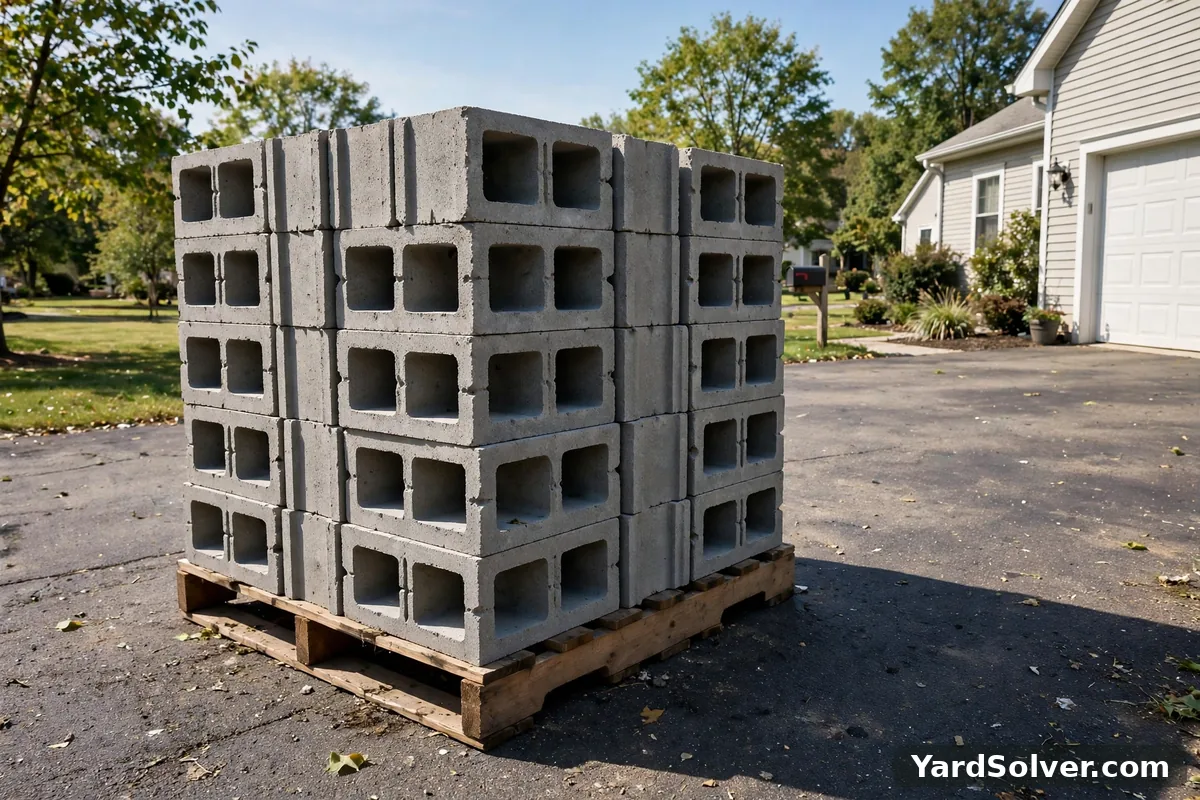
Real walls do not end neatly every 16 inches, and corners do not turn themselves, so first-time builders often assume they need a catalogue of special shapes. Mostly, they do not. Half blocks — the 8-inch pieces that start every second course so the vertical joints stagger, and that finish a wall to an exact length — are either bought as ready-made halves or cut on site from standard blocks. Corner blocks, with one finished end, make neater corners and ends, especially where the end will be seen, but a standard block cut or laid to the corner does the structural job on most garden and outbuilding work. The calculator's position, stated on its own page, is the practical one: corner and half blocks come out of the 5% waste allowance counted in your order. That is part of why the allowance exists — it is not purely a breakage fund. It covers the block that chips in the truck, the one that cracks under the chisel, and the ones deliberately cut into halves and corner pieces along the way.
That is also why block waste is only 5%, where brick work usually carries 10%. The units are big — one block does the work of roughly a dozen bricks — so there are far fewer units to handle, drop and cut per square foot of wall, joints are thicker and more forgiving, and a straight rectangular wall of full and half blocks involves very little trimming at all. Save the higher allowances for genuinely cut-heavy work: short walls with many openings, stepped walls on a slope, or a first wall laid by a complete beginner, where a few extra blocks are cheap tuition. For a plain rectangle, 5% is the trade's honest number, and it is the one in the calculator.
Step 6 — Foundations, garden walls, and what the count does not include
The same 1.125 count serves very different jobs, and it is worth being clear about which parts of each job it covers. For a foundation — a shed base wall, a garage or an extension — the block count and mortar bags are the wall itself, course by course from the footing up. What the count does not size is everything the design adds to that wall: vertical and horizontal rebar, the grout fill pumped or poured into the cores around that steel (a fully or partly grouted wall can take a surprising volume of grout, and it is calculated from the design, not from the block count), and lintel blocks — the U-shaped units that carry a beam of reinforced grout over doors and windows. The calculator says this plainly on its own page, and this guide repeats it because it is the most expensive misunderstanding in block work: 391 blocks and 40 bags build the shed's walls, but they are not the whole materials list for a reinforced foundation.
For a garden wall the picture is simpler and the count is usually the whole story above the footing: a freestanding 4 ft garden wall of standard blocks, mortared course on course, needs its blocks, its mortar, and a coping or cap to shed the weather — no rebar schedule, no grout fill, unless the wall is holding back soil. The moment a wall retains earth, even a low one, it stops being a plain block wall: drainage, a wider footing and often purpose-made units enter the design, and a low landscape block wall is better sized with the Retaining Wall Calculator — blocks and base gravel for low landscape walls, which counts the stepped-back courses and base material that this calculator does not. And if the project is really a skin of masonry rather than a structural block wall at all, the honest comparison is the Brick Calculator — bricks and mortar for a brick wall instead: smaller units, many more of them, a 10% waste habit, and a very different look for the same square footage. Choosing between block and brick before you count either is worth five minutes — the counts, costs and skills involved diverge fast.
What the calculator can't do
Honesty about the edges, so the number earns your trust. The calculator counts standard 8 × 8 × 16 in blocks only: if your design uses 6-inch or 12-inch-wide units, split-face or lightweight blocks, the face is usually still 8 × 16 in and the 1.125 count still holds — but confirm the face size before you lean on it, because a half-high unit changes everything. It cannot see your openings: the subtraction in Step 1 is yours to measure, and skipping it inflates a shed order by dozens of blocks. Its mortar figure is a site rule of thumb, roughly 10 blocks per 80 lb bag with standard joints, not a manufacturer's yield promise — thick joints and waste pull it lower. Its costs are typical store-price ranges for your country, not quotes. And it does not design anything: footings, reinforcement, grout, lintels, damp-proofing and local code requirements for a foundation or a retaining structure belong to your design and your local rules, not to a block count. What it does guarantee is the count itself, checked two ways above: measure the net area honestly, and the blocks and bags follow.
Keep going
Run your own wall through the Concrete Block Calculator for its exact count and cost range, compare a masonry skin with the Brick Calculator, and size a low landscape wall with the Retaining Wall Calculator.
Building the shed or the garden wall this spring? Put the footing pour, the block-laying weekends and the planting that softens the finished wall into the Garden Planner, so the project lands in one season-long calendar.
Questions people ask
How many concrete blocks are in a square foot?
1.125 blocks per square foot. One standard block with its mortar joint covers an 8 × 16 in face, which is 0.889 sq ft, so the count is wall area × 1.125 — and the quick check is that 9 blocks cover exactly 8 square feet of wall. Add 5% for cuts and breakage to get the number to order.
What size is a standard concrete block?
Nominally 8 × 8 × 16 inches. The actual block measures 7⅝ × 7⅝ × 15⅝ inches — ⅜ in smaller in each direction — and the mortar joint brings the laid size back up to the full 8 × 16 in face the 1.125 rule is based on.
How many blocks does one bag of mortar lay?
About 10 standard blocks per 80 lb bag of mortar mix with standard ⅜ in joints — a site rule of thumb, and the rate the calculator uses. Thick joints and waste pull the real yield lower, so the bag count is a planning estimate: blocks ÷ 10, rounded up.
Do I need special blocks for corners?
Not usually. Half blocks and corner blocks make corners, ends and staggered courses easier and neater, but standard blocks cut on site do the same job, and the calculator counts those cuts as coming out of the 5% waste allowance already included in your order.
How many concrete blocks do I need for a 10×12 shed?
For four walls at 8 ft high the gross area is 352 sq ft. Take out a 3 × 7 ft door (21 sq ft) for 331 sq ft net, then 331 × 1.125 = 372 blocks, plus 5% = 391 blocks to order, and about 40 bags of 80 lb mortar. Counted with no openings at all, the same shed would be 416 blocks.
Why is the waste allowance only 5% for block, but 10% for brick?
Because the units are so much bigger. One block covers as much wall as roughly a dozen bricks, so there are far fewer units to handle, drop and cut per square foot, and a straight block wall needs very little trimming beyond halves at the ends of courses. Brick's smaller units and tighter joints break and get cut more often, which is what its 10% allowance is for.
Block counts run on the nominal module — the block plus its joint is the unit of the wall
Concrete blocks are made to a module: the common block is manufactured slightly smaller than its nominal size so that, with a standard mortar joint, one block occupies a round figure of wall. Count by wall area divided by that module face — never by the block's raw face alone — and state openings honestly, because a doorway or window subtracts real blocks while its corners and lintel add cuts back.
Add five to ten percent for cuts, breakage and the course that must be ripped to a bond, keep a few spares of the same batch, and remember that half blocks and specials are ordered, not wished for, on the day. The calculator in this guide runs the module arithmetic for your wall; the tape measure you take to the actual plot, twice, is what makes its answer true.
Sources
Key facts on this page cross-checked against Concrete masonry unit — Wikipedia — background on concrete masonry units — blocks — and their modular sizes.
Related page
Read next: How Many Retaining Wall Blocks Do I Need? Courses, Caps & Base — How the Calculator Works.
Comments & ratings
No comments yet.
Be the first to share your experience.