
Guides · Patios and paths · Published November 18, 2026 · By Faizan Ahmad
How Many Pavers Do I Need?
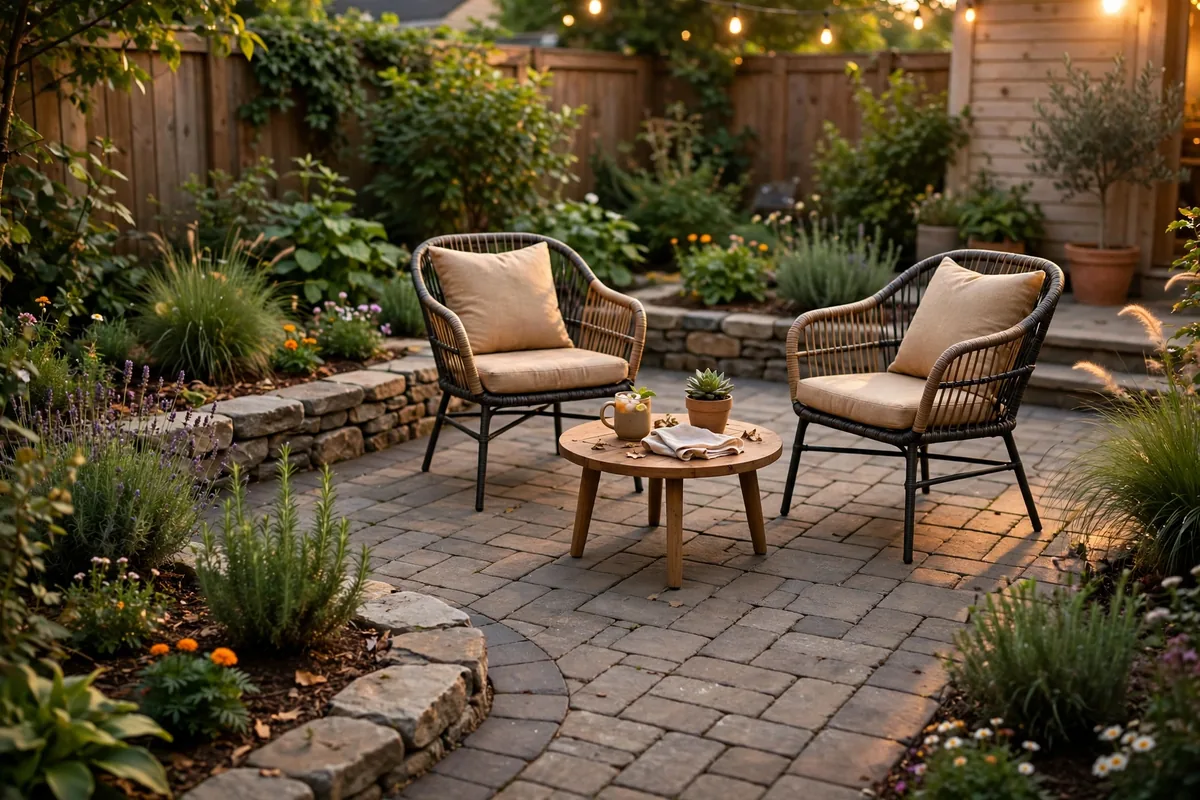
Most paver counts go wrong in the same quiet way: the count itself is right, and everything underneath it is forgotten. A patio is not one material — it is four stacked together. The pavers you see sit on an inch of bedding sand, which sits on four inches of compacted gravel, and the joints are finished with a sand of their own. Order only the pavers and the job stalls on day one with nothing to lay them on. That is why our Paver Calculator counts the whole build in one pass — pavers, base gravel and bedding sand together. This guide shows how the calculator works, the maths underneath each of its three answers, and one complete 12 × 12 patio worked from bare ground to a single order you can hand to a yard. By the end you will be able to check any supplier's pallet count against your own numbers.
The short answer, on one card
- The paver formula: patio area (sq ft) ÷ one paver's face area (sq ft), then add waste and round up
- Waste: 10% for a normal rectangle, 15% for curves and diagonal patterns such as herringbone, 5% for the simplest straight layouts
- Base gravel: area × 4 inches deep, in cubic yards — and in tons at about 1.4 tons per cubic yard. Driveways need about 6 inches instead
- Bedding sand: area × 1 inch deep, in cubic yards — a thin screeded layer, never a deep one
- Order base materials first: gravel and sand arrive and go down before a single paver is laid — pavers go down last
- Never on soil: pavers laid straight on dirt sink, heave with frost and weed up within a season or two
Step 1 — Measure the patio or path (and only the patio)
The calculator needs the area the pavers will actually cover, so measure the patio, path or driveway itself — not the lawn around it. Run a tape along the longest edge for the length and straight across for the width, and multiply: that is your square footage, the one number every later answer grows from. No long tape? A normal walking pace is roughly 2.5 feet, so pace both directions and multiply; paver ordering forgives a few inches because the waste allowance absorbs them. Three refinements matter more than precision. First, subtract what will not be paved: a planted island inside the patio, the step down from the door, the square where a fire pit or a hot tub will sit — on a small patio those can be a tenth of the area and a pallet's worth of pavers. Second, split an L-shaped or stepped patio into two rectangles, measure each, and add the areas before you run anything; the calculator takes one rectangle at a time, and adding areas first is always more accurate than guessing one big shape. Third, for a round patio or a circular fire-pit pad, measure the diameter and treat it as both the length and the width, then take 0.785 of the answer — a circle covers 0.785 of the square drawn around it. An 8 ft round pad works out to about 50 sq ft of paving, not the 64 sq ft of its bounding square.
Step 2 — Run the calculator: what each input does
Open the Paver Calculator — pavers, base gravel and bedding sand in one answer and type in the length and width from Step 1, in feet or in metres — the unit switch converts everything behind the scenes. Next, the paver size, and pick the size you are actually buying, because this one choice swings the count more than anything else on the page: a 4 × 8 in brick paver covers 0.22 sq ft, a 6 × 9 in covers 0.375 sq ft, a 12 × 12 in covers a full square foot, and a 24 × 24 in patio slab covers 4 sq ft. The same 144 sq ft patio is 648 brick pavers or 36 slabs before waste. Then the waste allowance: 5% for a simple rectangle in a straight pattern, the standard 10% for most patios, and 15% for curves, circles and diagonal patterns like herringbone, where every edge is a cut. Finally pick your country, Canada or the USA, so the cost estimate uses typical prices where you shop. The answer comes back as the whole build at once — the paver count with waste already included and rounded up to whole pavers, the base gravel in cubic yards and tons, the bedding sand in cubic yards, and an estimated paver cost. How those layers are actually built, layer by layer, is covered in How to Build a Paver Patio Base — this guide's job is the quantities, and the base guide's job is the method.
Step 3 — The maths the calculator is doing
There are three separate calculations here, and each one is simple enough to check on paper. Pavers = area ÷ one paver's face area, plus waste. A paver's face area is its length × width in inches, divided by 144 to turn square inches into square feet: a 6 × 9 in paver is 54 sq in, which is 0.375 sq ft, so it takes about 2.67 of them to cover one square foot. A 4 × 8 in brick takes 4.5 per square foot, and a 12 × 12 in takes exactly 1 — which is why searches for a "paver calculator by square foot" are really asking for that one division. The calculator divides your area by the face area, multiplies by one plus your waste percentage, and rounds up, because you cannot buy a fraction of a paver. Base gravel = area × 4 inches deep. In numbers: area (sq ft) × (4 ÷ 12) = cubic feet, divided by 27 for cubic yards, and multiplied by about 1.4 for tons, because a cubic yard of compacted crushed base weighs roughly 1.4 tons. Bedding sand = area × 1 inch deep, through the same conversion without the weight step: area × (1 ÷ 12) ÷ 27 = cubic yards. One honest note on spacing: the calculator counts pavers by their face area, the way the calculator on this site has always done it, rather than adding a joint width to every paver. The joints between dry-laid pavers are narrow — a few millimetres of sand — and the waste allowance covers the small difference on any real patio; what the spacing genuinely changes is how much jointing sand you sweep in at the end, covered in Step 6. The table below is the calculator's maths pre-run for the most popular paver, the 6 × 9 in at 0.375 sq ft, with the standard 10% waste — it is worth a screenshot before any ordering call.
| Patio size | Area | Pavers to order (6 × 9 in, +10%) | Base gravel, 4 in | Bedding sand, 1 in |
|---|---|---|---|---|
| 8 × 8 ft | 64 sq ft | 188 pavers | 0.79 cu yd (about 1.1 tons) | 0.20 cu yd |
| 10 × 10 ft | 100 sq ft | 294 pavers | 1.23 cu yd (about 1.7 tons) | 0.31 cu yd |
| 10 × 12 ft | 120 sq ft | 352 pavers | 1.48 cu yd (about 2.1 tons) | 0.37 cu yd |
| 12 × 12 ft | 144 sq ft | 423 pavers | 1.78 cu yd (about 2.5 tons) | 0.44 cu yd |
| 12 × 16 ft | 192 sq ft | 564 pavers | 2.37 cu yd (about 3.3 tons) | 0.59 cu yd |
| 16 × 16 ft | 256 sq ft | 751 pavers | 3.16 cu yd (about 4.4 tons) | 0.79 cu yd |
Read the table the way the calculator thinks: the base and sand columns grow in a straight line with area, because the layers are the same depth everywhere — but the paver column is hostage to paver size. Swap the 6 × 9 in paver for a 4 × 8 in brick and every count in that column roughly doubles, while the gravel and sand do not change by a single shovelful. Size is a design decision; the base is a structural one.
Step 4 — The base: why pavers never go straight on soil
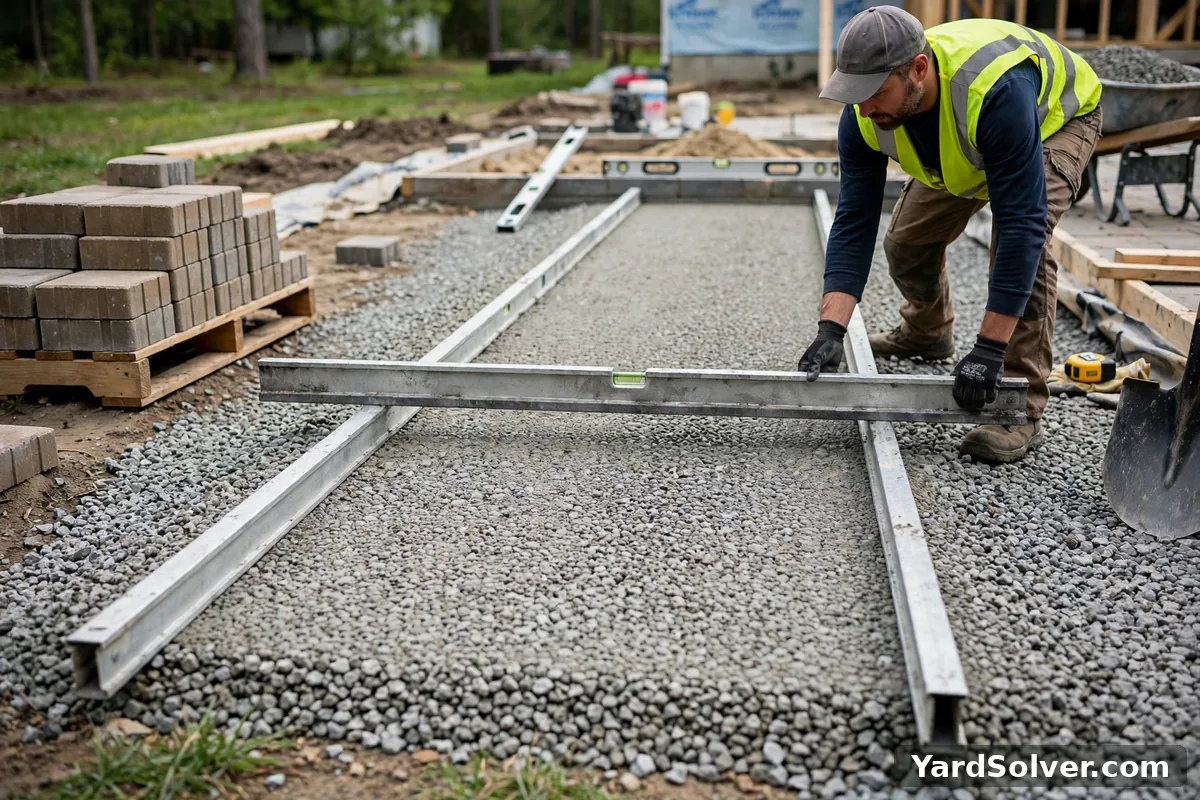
Every failed patio you have ever seen — the one with dips that hold puddles, edges that wander, weeds shouldering up through the joints — failed underneath, not on top. Soil is the reason. Bare soil swells when it is wet, shrinks when it dries, and heaves when it freezes, and a paver laid directly on it rides every one of those movements. Within a season or two the surface is uneven, and within a few winters it is a patchwork. The gravel base exists to break that connection. Four inches of crushed stone, spread in two layers and compacted after each one, does three jobs at once: it spreads the load of feet, furniture and footings across a wide area so nothing sinks at a point; it drains, giving water somewhere to go that is not up through your joints; and it gives the bedding sand a hard, flat, unmoving floor to be screeded on. Dig out about 7 inches in total for a patio — 4 inches of base, 1 inch of sand, and the paver's own thickness — and slope the dig very slightly away from the house so the finished surface sheds water instead of holding it. A driveway is the same build with more underneath: cars need about 6 inches of compacted base, so scale the calculator's gravel figure up by half — multiply the yards and tons by 1.5 — and keep everything else the same. If your project is gravel all the way down rather than a base under something, How Much Gravel Do I Need? works the same volume-to-tons maths for paths and driveways in full.
Step 5 — A 12 × 12 patio, worked start to finish
Here is the most-ordered patio in North America, done the way the calculator does it, as one complete order. The patio is 12 ft × 12 ft = 144 sq ft, and the paver is the popular 6 × 9 in, which covers 54 ÷ 144 = 0.375 sq ft each. Pavers first: 144 ÷ 0.375 = 384 pavers to cover the ground exactly. It is a plain rectangle, so the standard waste allowance applies: 384 × 1.10 = 422.4, rounded up to 423 pavers to order. Now the part most guides leave out. Base gravel at 4 inches deep: 144 × (4 ÷ 12) = 48 cubic feet, which is 48 ÷ 27 = 1.78 cubic yards, and at about 1.4 tons per cubic yard that is about 2.5 tons — order 2 cubic yards from the yard and you are covered with a little to spare for soft spots. Bedding sand at 1 inch deep: 144 × (1 ÷ 12) = 12 cubic feet, which is 12 ÷ 27 = 0.44 cubic yards — call it half a yard. That is the whole build on one ticket: 423 pavers, about 1.78 cubic yards (2.5 tons) of base gravel, and about 0.44 cubic yards of bedding sand, plus polymeric sand for the joints in Step 6. And the order of the order matters as much as the numbers: have the gravel delivered first and the sand with it, because the base goes down, gets compacted and gets screeded before a single paver leaves its pallet. Pavers delivered first just sit in the driveway getting in the way of the gravel truck. Put the delivery days in the Garden Planner in that sequence — dig and base one weekend, laying the next — and the project runs in the order the materials are used.
Step 6 — Laying, edges and the sand that locks it together
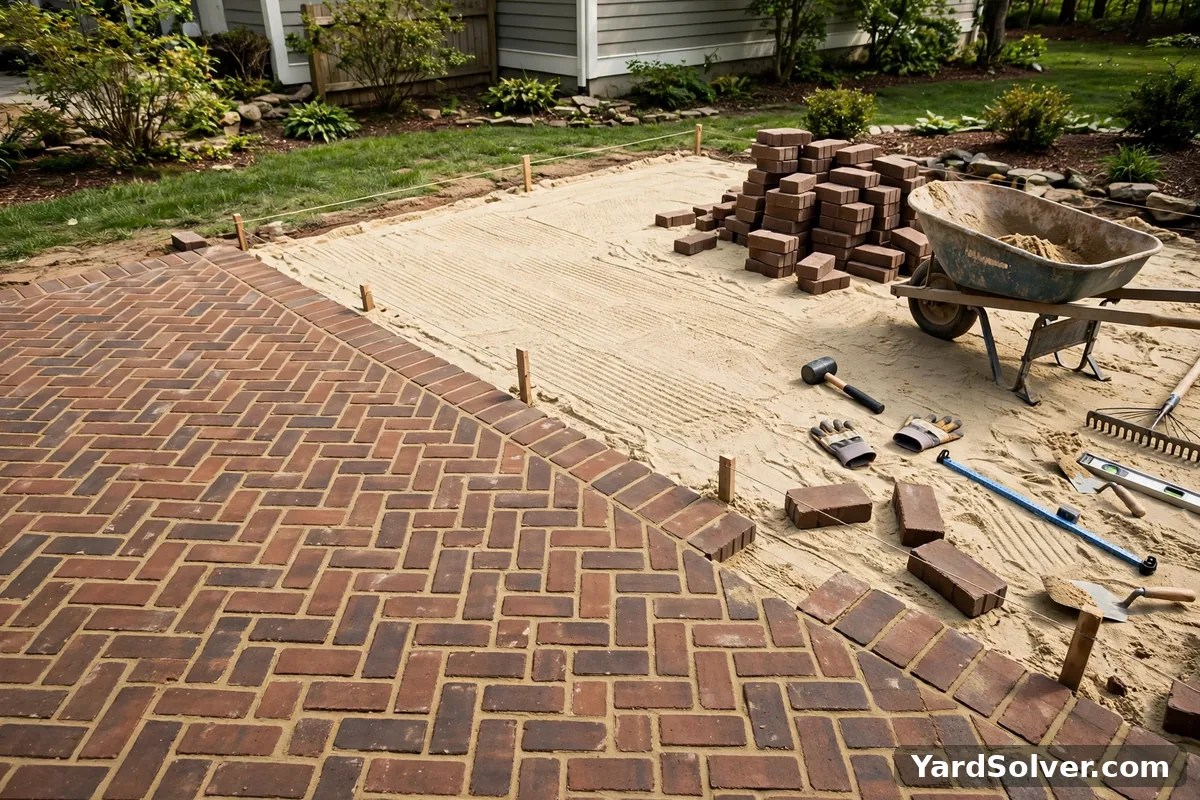
With the base compacted, the sand is screeded to exactly 1 inch — no thicker, because a deep sand bed is a soft bed and the pavers will rock and settle unevenly in it — and then left alone: do not walk on a screeded bed, lay from the finished side and work backwards. Lay the pavers tight in your pattern, starting from a corner or a straight edge, and cut the edge pieces last, once the field is down and you can measure every cut against the real gap. The pattern is not just decoration. A herringbone, like the one in the photo, interlocks in two directions and is the strongest choice for a driveway or a busy patio; a running bond is simpler and wastes less. That difference is precisely what the calculator's waste steps are pricing — 10% for the straight rectangle, 15% once the pattern turns diagonal or the edge curves. When the field is complete and the edge restraint is in — never skip it, because without something holding the border, the outside pavers creep outward and the whole field loosens — the last material arrives: polymeric sand for the joints. It is swept into the joints dry, the surface is compacted gently so it settles to the bottom of every joint, swept again to top up, and then misted lightly with water. The mist sets the polymer in the sand, and the joints harden into a flexible lock that holds the pavers together, sheds water, and blocks the weeds and ants that plain sand invites. Keep the two sands straight, because they are not interchangeable: coarse bedding sand goes underneath, as the bed; polymeric sand goes on top, in the joints only.
What the calculator can't do
Honesty about the edges, so the numbers earn your trust. The calculator assumes a flat rectangle at the standard depths: a patio dug into a slope needs its base built up on the low side, and soft or clay ground may want a deeper base or a layer of landscape fabric under the gravel to stop the base migrating into the soil — both add gravel the flat maths does not know about. It counts pavers by face area without adding a joint width to each one, as Step 3 explained; on very small pavers with unusually wide joints the true count can land a little under the estimate, and the waste allowance is what absorbs it. It cannot choose your paver: a thin patio slab and a thick driveway-rated paver can share the same face size and the same count while being entirely different products, and thickness is a strength decision, not a quantity one. And its cost figure is a typical store-price range for your country, not a quote — pallet pricing, delivery distance and a supplier's sale week move real prices a long way in both directions. What it does guarantee is the quantity maths, checked above in full: get the area, the paver size and the waste step right, and the pavers, gravel and sand all follow.
Pouring a slab instead of paving one? The Paver Calculator's sibling tools size the alternatives — and if the patio is one part of a bigger build, the base method in How to Build a Paver Patio Base covers excavation, fabric and compaction pass by pass.
Keep going
Run your own patio or path through the Paver Calculator, then build what it counts with How to Build a Paver Patio Base — excavation depth, compacted layers and screeding, step by step. Sizing the stone on its own for a path or driveway? How Much Gravel Do I Need? covers yards, tons and depths by job.
Planning the whole project — deliveries, digging weekend, laying weekend, planting around the edges? The Garden Planner lays the jobs out in one calendar so the gravel arrives before the pavers, not after them.
Questions people ask
How many pavers do I need for a 12x12 patio?
With the popular 6 x 9 inch paver (0.375 sq ft each), a 12 x 12 ft patio is 144 sq ft, so 144 divided by 0.375 is 384 pavers, plus 10 percent for cuts and breakage is 423 to order. The same patio also needs about 1.78 cubic yards of base gravel (about 2.5 tons) at 4 inches deep and about 0.44 cubic yards of bedding sand at 1 inch deep — the calculator returns all three numbers together.
How many pavers do I need for a 10x10 area?
A 10 x 10 ft area is 100 sq ft. With 6 x 9 inch pavers that is 100 divided by 0.375, about 267 pavers, or 294 to order once you add the standard 10 percent for cuts. With small 4 x 8 inch brick pavers (4.5 per square foot) the same area needs 450 pavers, or 495 to order. Paver size, not area, is what swings the count.
How deep should the base be?
About 4 inches of compacted gravel plus 1 inch of bedding sand for patios and paths. Driveways carry cars, so give them about 6 inches of base. Dig out roughly 7 inches in total for a patio — base, sand and the paver's own thickness — and slope the dig slightly away from the house so water runs off the finished surface.
Why add 5–15% extra pavers?
Edge pavers get cut to fit, and a few always chip or break. 10% covers a normal rectangle; curves and diagonal patterns waste more, so use 15%. A simple rectangle in a straight pattern can get away with 5 percent. Keep a handful of spares afterwards, too — matching a colour exactly years later is harder than storing a few pavers now.
Can I lay pavers straight on soil?
Not if you want them to stay flat. Without a compacted gravel base, pavers sink, heave with frost and grow weeds between them within a season or two. Soil moves with water and frost; the 4 inches of compacted gravel is what spreads the load, drains the water and gives the patio a surface that stays where you put it.
What sand goes between pavers?
Polymeric sand — it is swept into the joints dry, then misted with water so it sets and locks the pavers together while blocking weeds and ants. It is different from the coarse bedding sand under the pavers: bedding sand is a level 1 inch screeded layer the pavers sit on, while polymeric sand goes on top at the very end, into the joints only.
Paver counts are patio area divided by paver-plus-joint, with pattern waste on top
Pavers are counted like bricks, on their module: one paver plus its sand joint covers a known area, so the count is the patio or path area divided by that module, worked in the calculator above. Patterns then tax the count — running bond wastes little, herringbone and baskets waste more at every edge, and a curved boundary taxes most of all because nearly every perimeter paver is a cut.
Allow five percent for straight patterns and ten for diagonal or curved work, order the edge restraints and the jointing sand in the same calculation (a paver field without restrained edges walks apart), and keep a dozen spares under the bench: a stained or cracked paver lifts and swaps in minutes only if its twin from the same batch is waiting.
Sources
Key facts on this page cross-checked against Brick — Wikipedia — background on bricks and pavers and their modular laying.
Related page
Read next: Paver Patio Base Depth: Gravel & Sand Guide.
Comments & ratings
No comments yet.
Be the first to share your experience.