
Guides · Patios and paths · Published November 18, 2026 · By Faizan Ahmad
How Much Gravel Do I Need?
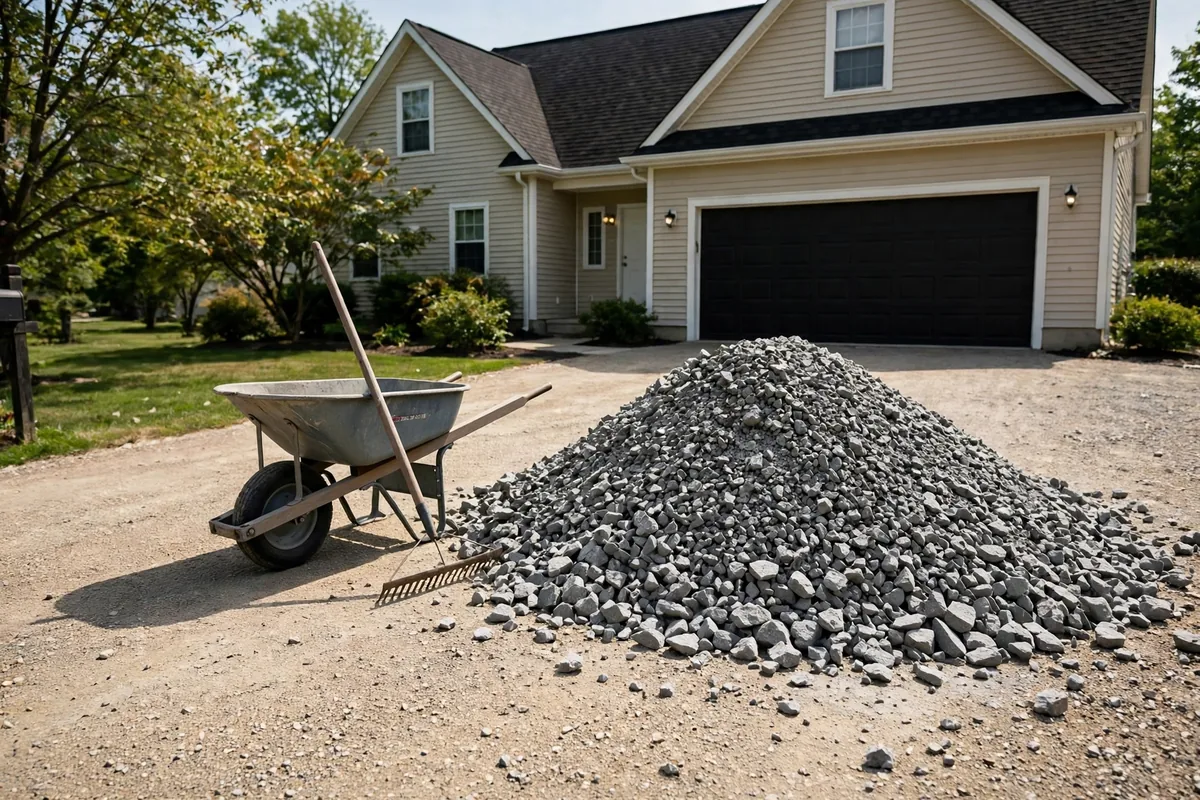
Gravel defeats more do-it-yourself estimates than any other yard material, and for one simple reason: it is the one material sold by weight. You plan a driveway in square feet and inches, the yard weighs its trucks in tons, and somewhere between those two systems a guessed order turns into either a second delivery fee or a leftover pile that sits on the lawn all summer. The bridge between the two is a single density figure, and it is exactly what our Gravel Calculator runs for you. This guide shows how the calculator works, the volume maths underneath it, the honest truth about converting cubic yards to tons, the right depth for each job, and a driveway worked end to end in both units — so you can check any yard's quote against your own numbers before the truck leaves.
The short answer, on one card
- The formula: length × width × depth = volume. Work in feet (depth in inches ÷ 12), then divide cubic feet by 27 for cubic yards
- The weight conversion: typical gravel weighs about 1.35 tons per cubic yard — the figure the calculator uses. One ton is about 0.74 cubic yards, roughly 20 cubic feet
- One ton covers about 80 sq ft at 3 inches deep; one cubic yard covers about 108 sq ft at the same depth
- Depth by job: paths 2–3 inches, a driveway base 4–6 inches of crushed rock compacted in layers, decorative cover just 2 inches
- Density is not fixed: published figures run about 1.3 to 1.5 tons per cubic yard depending on stone type and moisture — ask your yard which figure they use
- Order for the finished depth: a compacted base loses roughly 15–20% of its loose depth, so the loose pile must start deeper than the surface you want
Step 1 — Measure the area you will actually cover
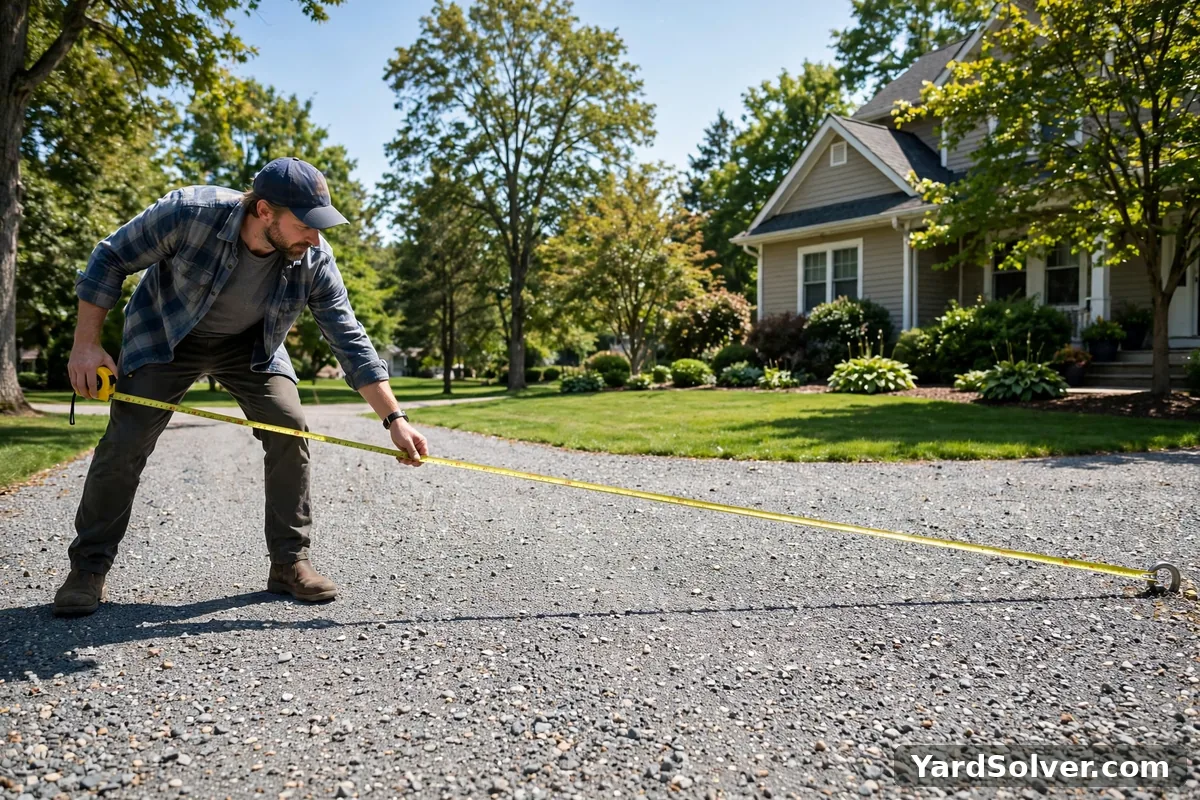
The calculator needs the area the stone will really cover, so measure the driveway, path or pad itself — not the whole front yard it sits in. Run a tape down the longest edge for the length and straight across for the width. No long tape? A normal walking pace is roughly 2.5 feet, so pace both directions and multiply; gravel ordering forgives a few inches, because you will round the order up anyway. Three refinements matter more than precision. First, subtract what will not be covered: the concrete apron at the garage door, a paved strip, the planting island in the middle of a turning area. Second, if the shape is irregular — a flared driveway mouth, an L-shaped path — split it into two rectangles, measure each, and add the areas before you do anything else. Third, if you are refreshing an existing driveway rather than starting from bare ground, note that honestly: a refresh only replaces the surface course, and Step 5 shows how much smaller that order is. Wavy edges? Measure the widest and longest points and treat the shape as that rectangle; the small surplus covers the curves.
Step 2 — Run the calculator: what each input does
Open the Gravel Calculator — cubic yards, tons and bags and type in the length and width from Step 1, in feet and inches or in metres and centimetres — the unit switch converts everything behind the scenes. Next, the depth, and this is the input to think about rather than guess: 2–3 inches for a path, 4–6 inches for a driveway base, 2 inches for a decorative cover. Step 4 explains the reasoning job by job. Then pick your country, Canada or the USA, so the cost side of the answer uses typical prices and the units your local yard actually sells in. The answer comes back in both systems at once — cubic yards for volume, tons for weight, plus bags for small jobs and an estimated cost range. That double answer is deliberate, and it is the heart of this guide: the yard will weigh your load in tons, but the hole you are filling is measured in yards, so you need both numbers in front of you when you order. Press the print button and you have the order written down in the yard's own language.
Step 3 — The maths: volume first, then the weight conversion
The volume half is exact, and you can check it on paper. Cubic feet = length (ft) × width (ft) × depth (inches) ÷ 12. The ÷ 12 turns inches of depth into feet so all three dimensions match. Divide cubic feet by 27 and you have cubic yards — a cubic yard is a 3 ft × 3 ft × 3 ft cube. So far, so certain. The weight half is where gravel parts company with every other material on this site, because stone is sold by the ton and tons depend on density. The calculator converts with about 1.35 tons per cubic yard for typical gravel — roughly 2,700 lb in every yard-sized cube. Run the conversion backwards and 1 ton ≈ 0.74 cubic yards ≈ 20 cubic feet, covering about 80 sq ft at 3 inches deep. Now the honest part, because this figure is an estimate in a way the volume maths is not: published densities for gravel run from about 1.3 to 1.5 tons per cubic yard. Dense graded base — crushed stone blended with fines so it packs tight — sits at the heavy end. Round pea gravel, with air gaps between smooth stones, sits at the light end. A load weighed after rain carries water weight too. That is why a "yard" from one supplier can weigh noticeably more or less than a yard from another, why the calculator shows you both units instead of hiding one, and why the smartest question you can ask a yard is which density figure their quote is built on. The coverage table below is the calculator's maths pre-run at its 1.35 figure; it is worth a screenshot before any ordering call.
| Depth | 1 ton covers | 1 cubic yard covers |
|---|---|---|
| 2 inches (5 cm) | about 120 sq ft | about 162 sq ft |
| 3 inches (7.5 cm) | about 80 sq ft | about 108 sq ft |
| 4 inches (10 cm) | about 60 sq ft | about 81 sq ft |
| 6 inches (15 cm) | about 40 sq ft | about 54 sq ft |
Read the table the way the calculator thinks: depth is the lever. The same ton of gravel covers 120 square feet at 2 inches and only 40 at 6 inches — a threefold difference from one decision — which is why "how much gravel" can never be answered from area alone, and why a quote given without asking your depth is a quote you should not accept.
Step 4 — Depth by job, and the stone that stays put
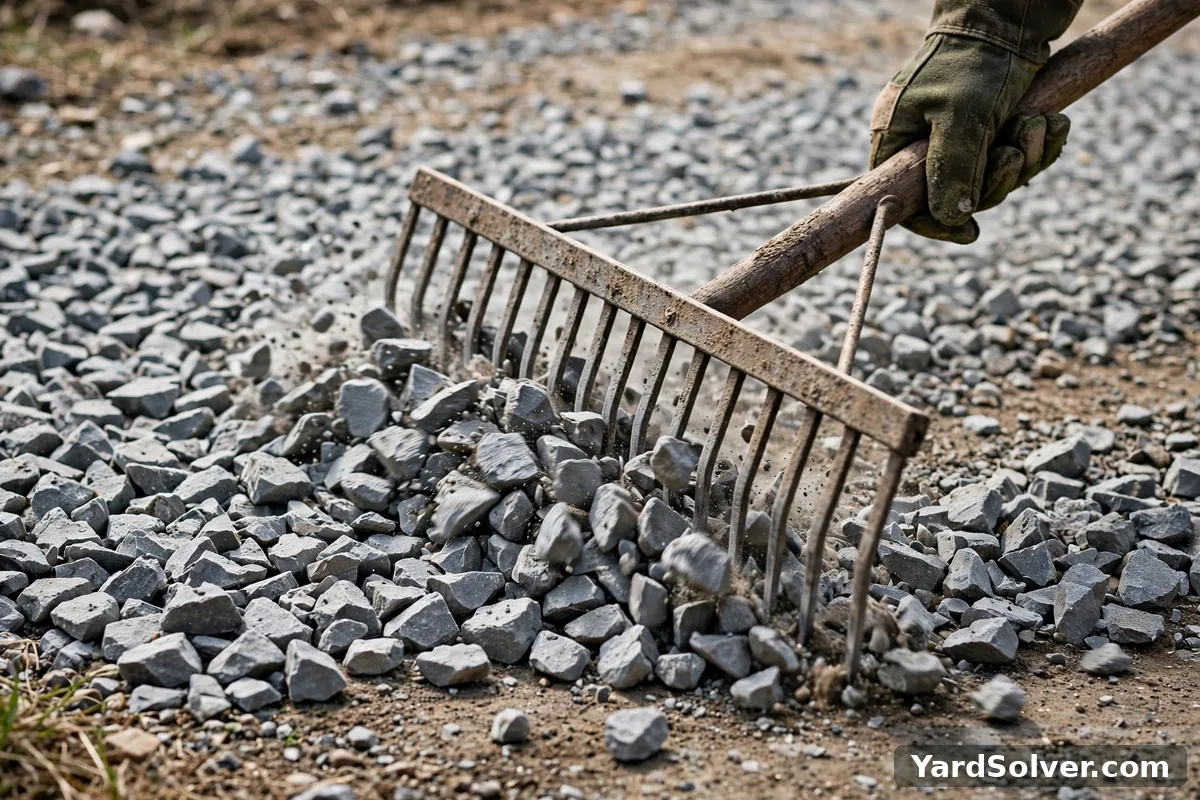
Depth is not a preference; each job has a working range. Paths that only carry feet do their job at 2–3 inches — enough to cover the ground and cushion the step, not so deep that walking feels like a beach. A driveway base is the serious case: 4–6 inches of crushed rock, compacted in layers, never dumped and compacted in one lift. Each layer of about 2 inches gets raked level and run over with a plate compactor before the next goes down, because a deep loose layer simply pushes aside under a tyre instead of packing. Decorative cover — stone over landscape fabric around plantings or along a foundation — needs only 2 inches: its job is to hide the fabric and shed water, and extra depth buys nothing. The stone matters as much as the depth. For driveways the calculator's recommendation, and every yard's, is 3/4 inch crushed stone with fines: angular pieces with a share of stone dust that nest together and lock under compaction into something close to a solid surface. Round pea gravel does the opposite — smooth stones roll over each other, migrate to the edges, and rut under tyres within a season, however deep you lay it. Save pea gravel for decorative areas nobody drives on. Building the base under pavers rather than a gravel surface? The same compacted-layers logic applies, layer by layer, in How to Build a Paver Patio Base.
Step 5 — A 12 × 20 driveway, worked start to finish
Here is the most common gravel job in North America, done the way the calculator does it. The driveway is 12 ft × 20 ft = 240 sq ft, the base underneath is sound, and it needs a fresh surface course of 3 inches. Volume first: 240 × 0.25 ft = 60 cubic feet. Convert to yards: 60 ÷ 27 = 2.22 cubic yards. Convert to weight at the calculator's figure: 2.22 × 1.35 = 3.0 tons. That is the refresh order — three tons, delivered, raked over the old base, done in a morning. Now contrast it with building the very same driveway from scratch. A proper build is a 4-inch compacted base plus a 2-inch surface course — 6 inches total. Volume: 240 × 0.5 ft = 120 cubic feet. Yards: 120 ÷ 27 = 4.44 cubic yards. Weight: 4.44 × 1.35 ≈ 6.0 tons. Exactly double the refresh, and the reason is structural, not arithmetic: a refresh only replaces the wearing surface, while a new build has to create the load-bearing base as well. It is also why two neighbours with identical driveways can honestly get quotes two tons apart — one yard assumed a refresh, the other a rebuild. Put the delivery day in the Garden Planner with the compactor rental beside it; stone sitting in a pile while the compactor goes back is the classic way this job stalls.
Step 6 — Ordering: tons at the yard, yards on the ground
Order with both of your numbers in hand and the conversation changes. The yard sells by the ton because its trucks cross a scale — weight is what they can prove and what they pay to haul. You think in cubic yards because volume is what fills your measured area. Neither side is wrong; the density figure is the exchange rate between them, and as Step 3 explained, that rate floats between about 1.3 and 1.5 depending on the stone. So before you compare two quotes, ask each yard one question: which tons-per-yard figure are you using? A cheaper quote built on 1.3 can deliver noticeably less stone than a fair quote built on 1.45. Two more ordering rules. First, order for the finished, compacted depth: loose gravel compacted into a base loses roughly 15–20% of its loose depth, so a base you want to finish at 5 inches must be ordered as if it were deeper, or laid loose at about 6 inches and compacted down. A loose decorative layer barely compacts, so it needs little extra. Second, mind the delivery maths: for anything under about half a ton — a small path, a stepping-stone surround — bagged stone from the store usually beats a delivery fee, while above a ton or so a bulk load is almost always the cheaper route per yard. And when the truck arrives, have the tarp spot chosen in advance: three tons is a bigger, heavier pile than most people picture, and it does not move twice willingly.
What the calculator can't do
Honesty about the edges, so the number earns your trust. The calculator assumes a flat rectangle spread to an even depth: a sloped driveway needs a little more stone on the low side, and hand-raking is never perfectly even, which is part of what rounding the order up is for. It cannot know your stone: it converts at 1.35 tons per cubic yard, and if your yard's dense base actually runs at 1.5, your delivered volume will come out roughly a tenth light — the fix is the Step 6 question, asked before you pay, not after. It cannot judge what is under the surface: gravel spread over soft, wet clay will keep sinking into it season after season no matter how accurately you sized the first load, and that is a drainage and fabric problem, not a quantity problem. And its cost figures are typical price ranges for your country, not quotes — delivery distance moves real prices more than the stone itself. What it does guarantee is the volume maths, checked above: get the area, the finished depth and the shape right, and the yards follow exactly. Only the tons carry an estimate, and now you know why.
Laying something on top of the gravel, or holding it back? The Sand Calculator sizes the bedding layer that goes under pavers once the base is in, and the Retaining Wall Calculator works out the drainage gravel that belongs behind a wall — the other place crushed stone quietly does structural work.
Keep going
Run your own driveway or path through the Gravel Calculator, then build the base it sits on properly with How to Build a Paver Patio Base — compacted layers, the right stone, and the depths that keep a surface flat.
Planning the whole project — delivery day, compactor rental, edging and planting around it? The Garden Planner lays the jobs out in one calendar so the stone arrives after the prep, not before it.
Questions people ask
How many tons of gravel do I need for a 12x20 driveway?
It depends on whether you are refreshing the surface or building from scratch. Adding 3 inches over an existing base — 240 square feet at 0.25 feet deep — is 60 cubic feet, or 2.22 cubic yards, which comes to about 3.0 tons at the calculator's rate of 1.35 tons per cubic yard. Building the same driveway from scratch at 6 inches total (a 4-inch base plus a 2-inch surface) doubles it, to about 4.44 cubic yards and 6.0 tons.
Why does the yard sell by the ton but quote me cubic yards?
Because the two ends of the job are measured differently. Trucks are weighed on a scale, so the yard charges by weight — the ton. What you actually spread on the ground is volume, so plans and calculators work in cubic yards. A density figure bridges the two — about 1.35 tons per cubic yard for typical gravel — and because that figure varies with stone type and moisture, the same volume can weigh noticeably more or less from one supplier to the next. Ask your yard which figure they use before you compare quotes.
What does #57 stone mean?
It is a standard gradation name for crushed stone, not a brand. Number 57 stone is a mix of angular crushed pieces roughly 3/4 inch across — the common size for driveway surfaces and drainage work, because the pieces lock together yet still let water pass through. It comes up constantly in searches for this calculator because it is the default choice for most home driveways.
How much gravel do I need for a 100 square foot path?
At 3 inches deep, a 100 square foot path needs 25 cubic feet of gravel — about 0.93 cubic yards, or about 1.25 tons at 1.35 tons per cubic yard. At 2 inches deep it falls to about 0.62 cubic yards (0.83 tons), and at 4 inches it rises to about 1.23 cubic yards (1.67 tons). Depth, not area, is what moves the order most.
Should I order extra gravel for compaction?
Yes, for any base layer that will be compacted. Loose crushed stone loses roughly 15 to 20 percent of its loose depth under a plate compactor, so order for the finished, compacted depth you want — or add that allowance on top of the loose figure. A loose decorative layer that will never be compacted needs little extra beyond a small allowance for uneven ground and spillage.
Gravel is area times depth, sold by weight — the conversion is the part everyone gets wrong
Gravel is laid by volume but sold by the tonne or yard, so the real question is the conversion: measure the area, choose the depth — around 50 millimetres over a membrane for paths and drives once the sub-base is counted separately — and the volume converts to weight at roughly one and a half tonnes per cubic metre for typical aggregates. Ordering by area alone, the common shortcut, is why one driveway in three runs a strip short or ends with a surplus pile colonised by weeds.
Count the sub-base and the decorative layer as separate orders with separate depths, compact each in layers rather than tipping the full depth at once, and allow about ten percent for settling and spillage. A bulk bag or loose load beats small bags beyond a tonne or so, and the surplus question answers itself: gravel kept in a corner is edging, drainage and path repair for years, while a shortage on laying day costs a second delivery fee.
Sources
Key facts on this page cross-checked against Gravel — Wikipedia — background on gravel, its grades and its uses and Aggregate (geology) — Wikipedia — background on geological aggregate — the material sold as gravel and crushed stone.
Related page
Read next: How Much Sand Do I Need? Yards, Tons & 50 lb Bags — How the Calculator Works.
Comments & ratings
No comments yet.
Be the first to share your experience.