
Guides · Soil & feeding · Published November 17, 2026 · By Faizan Ahmad
How Much Mulch Do I Need?
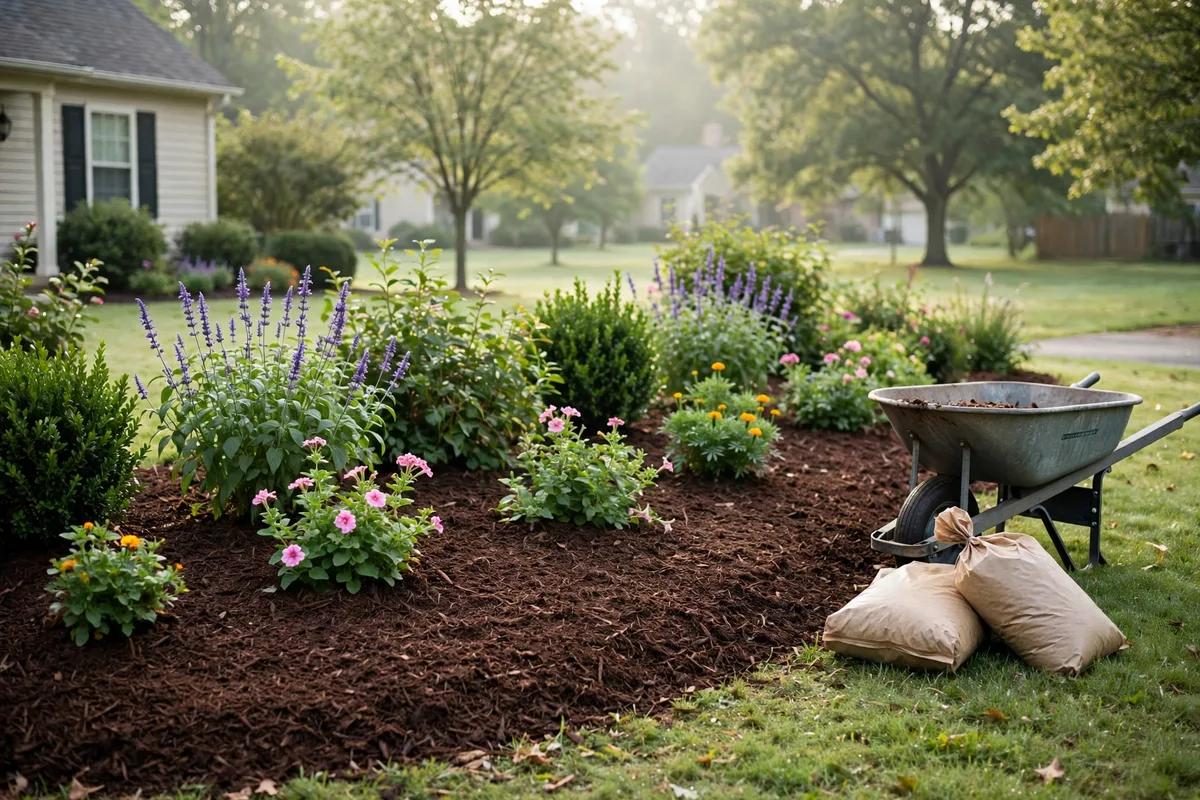
Almost everyone buys mulch the same wrong way: standing in the store aisle, picturing the bed, and guessing a number of bags. The guess is nearly always short — beds swallow far more mulch than they look like they should — so the job ends with a second trip, or a layer spread too thin to do any good. The fix is one multiplication, and it is exactly what our Mulch Calculator runs for you. This guide shows how the calculator works, the maths underneath it, and how to handle the cases a simple rectangle does not cover: tree rings, odd shapes, mulch already in the bed, and the point where a bulk delivery beats bags. By the end you will be able to check any store's advice against your own numbers.
The short answer, on one card
- The formula: area (sq ft) × depth (inches) ÷ 12 = cubic feet. Divide by 27 for cubic yards, or by the bag size for bags
- One cubic yard is 27 cubic feet — about 14 bags of the standard 2-cubic-foot size — and covers about 108 sq ft at 3 inches deep
- One 2-cubic-foot bag covers about 8 sq ft at 3 inches, 12 sq ft at 2 inches, 6 sq ft at 4 inches
- Depth is the lever: going from 2 to 4 inches doubles the mulch. Most beds want 2–3 inches finished
- Add about 10% for settling and uneven ground — and subtract whatever mulch is already in the bed
Step 1 — Measure the bed (and only the bed)
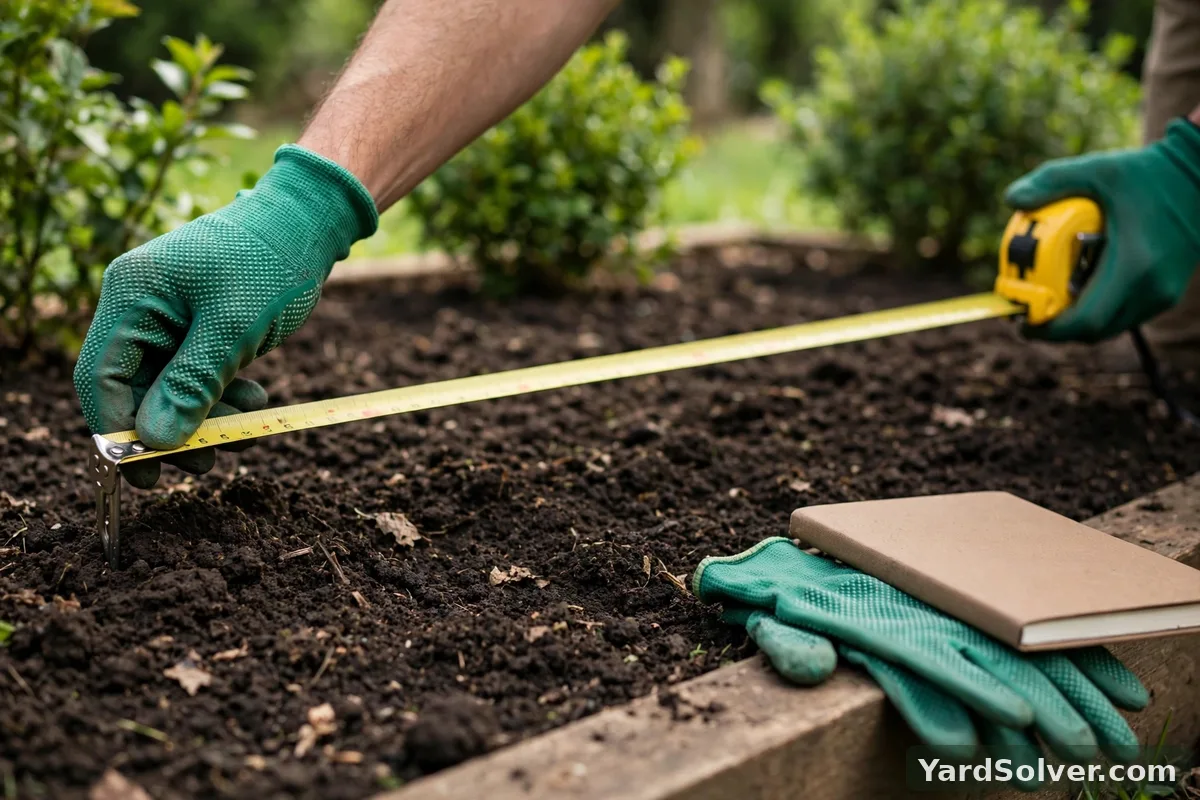
The calculator needs the area you will actually cover, so measure the bed itself — not the lawn around it, and not the planting pockets inside it. Run a tape along the longest edge for the length and across for the width. No tape? A normal walking pace is roughly 2.5 feet, so pace the bed and multiply; the answer only needs to be honest, not surveyed. Two refinements matter more than precision. First, subtract what will not be mulched: a stepping-stone path through the bed, a big rock, the square metre of patio that overlaps the corner. On a small bed those can be a tenth of the area. Second, if you are topping up rather than starting bare, push a ruler or a finger into the existing mulch and note what is left — Step 5 shows why that number goes into the calculator instead of the full target depth. Wavy edges? Measure the widest and longest points and treat the bed as that rectangle; the 10% allowance in Step 3 absorbs the curves.
Step 2 — Run the calculator: what each input does
Open the Mulch Calculator — bags and bulk by depth and type in the length and width from Step 1, in feet and inches or in metres and centimetres — the unit switch converts everything behind the scenes. Next, the depth: 2–3 inches for most beds, 3–4 around trees and shrubs (the full reasoning by material and plant lives in How Deep Should Mulch Be? — this guide's job is the quantity, not the depth rules). Then pick your country, Canada or the USA. That toggle is not decoration: bag sizes and typical store prices differ between the two countries, so the calculator divides your volume by the bag size actually sold near you and prices the answer with a typical range for your country instead of a number in a currency you do not use. The answer comes back in three units at once — cubic feet (the raw volume), bags rounded up to whole bags (you cannot buy 12.4 bags), and cubic yards for a bulk order — with an estimated cost range. Press the print button and you have a shopping list: exactly what to buy, in the unit the store sells it in.
Step 3 — The maths the calculator is doing
There is no hidden model here — the calculator runs the same volume maths a landscape yard runs, and you can check it on paper. Cubic feet = length (ft) × width (ft) × depth (inches) ÷ 12. The ÷ 12 simply turns inches of depth into feet so all three dimensions match. From cubic feet, two conversions finish the job: ÷ 27 = cubic yards (a cubic yard is a 3 ft × 3 ft × 3 ft cube), and ÷ bag size, rounded up = bags. In metric the calculator measures the bed in square metres, takes the depth in centimetres, and converts the resulting volume into the same cubic feet, yards and bags. Sanity-check it against a bed you can picture: 20 ft × 4 ft at 3 inches deep is 80 × 0.25 = 20 cubic feet — 10 bags of 2 cubic feet, or 0.74 cubic yards. The coverage table below is the same maths pre-run; it is worth a screenshot before any store trip.
| Depth | 1 cubic yard covers | 1 bag (2 cu ft) covers | Bags per 100 sq ft |
|---|---|---|---|
| 1 inch (2.5 cm) | 324 sq ft | 24 sq ft | 5 bags |
| 2 inches (5 cm) | 162 sq ft | 12 sq ft | 9 bags |
| 3 inches (7.5 cm) | 108 sq ft | 8 sq ft | 13 bags |
| 4 inches (10 cm) | 81 sq ft | 6 sq ft | 17 bags |
Read the table the way the calculator thinks: depth is the lever. The same 100 sq ft bed needs 9 bags at 2 inches and 17 at 4 — nearly double — which is why "how much mulch" can never be answered from area alone, and why a bag's cheerful "covers up to 12 square feet" claim quietly assumes the thinnest useful depth.
Step 4 — Circles, tree rings and odd shapes
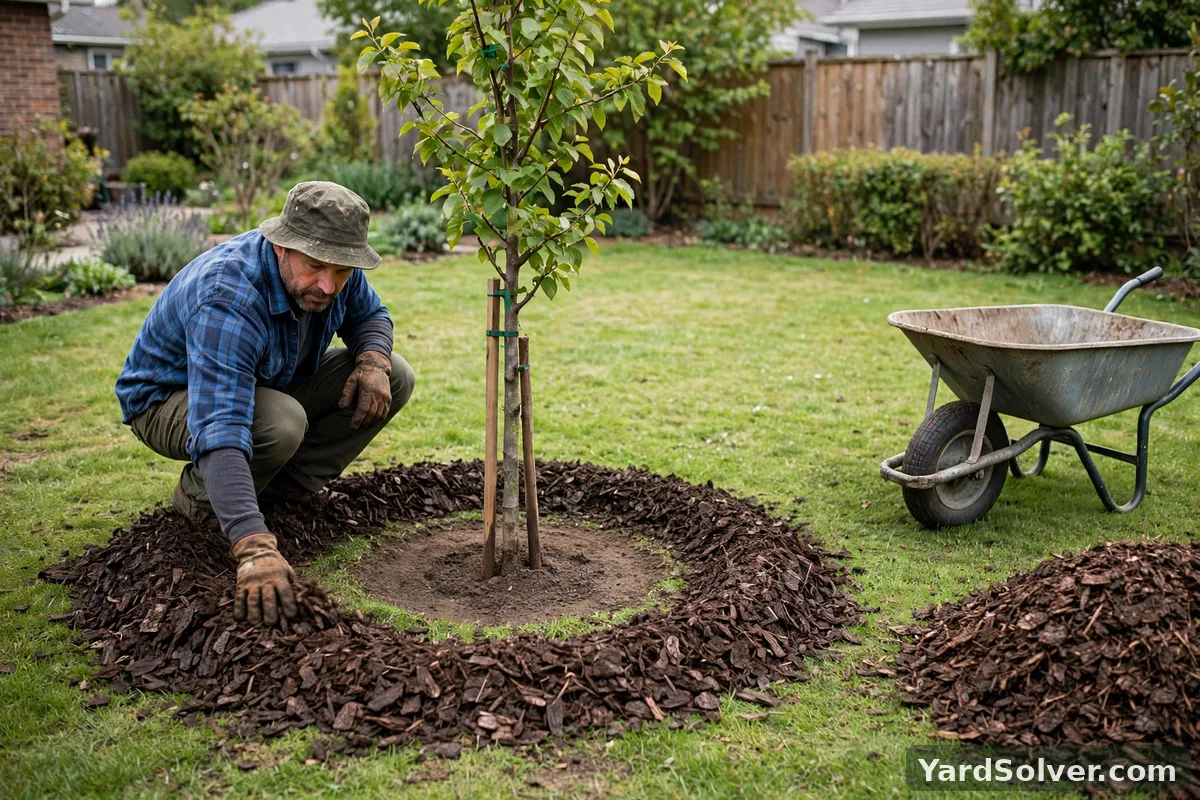
The calculator takes rectangles; gardens are full of circles. The bridge is one constant: a circle covers 0.785 of the square drawn around it (that is π ÷ 4). So for a round bed or a tree ring, enter the diameter as both the length and the width, run the calculator, then take 0.785 of the answer. A 6 ft tree ring at 3 inches: the square around it needs 6 × 6 × 0.25 = 9 cubic feet; the ring itself needs 9 × 0.785 ≈ 7.1 cubic feet — 4 bags. (Leave the bare gap around the trunk, as in the photo — mulch against bark invites rot, and the gap means the true area is a whisker less than the full circle anyway.) For an L-shaped or stepped bed, split it into two or three rectangles, run each through the calculator, and — this is the part that saves money — add the cubic feet first, then convert to bags once. Rounding up per area wastes a bag almost every time; Step 5 shows the saving on a real yard. Kidney-shaped beds: measure the bounding rectangle and take about 0.7 of it; the allowance covers the rest.
Step 5 — A whole yard, worked start to finish
Here is one complete front yard, done the way the calculator does it. Bed A, the foundation bed: 12 ft × 3 ft, bare soil, target 3 inches → 36 × 0.25 = 9 cubic feet. Bed B, the strawberry bed: 8 ft × 4 ft, but it still holds about 1 inch of last year's shredded leaves and only needs a 2-inch finished depth, so the depth to buy is 1 inch, not 2 → 32 × (1 ÷ 12) ≈ 2.7 cubic feet. Notice what just happened: measuring the old mulch cut this bed's order by two thirds. The tree ring from Step 4: 7.1 cubic feet. Now add volumes before bags: 9 + 2.7 + 7.1 = 18.8 cubic feet → 10 bags of 2 cubic feet, or 0.70 cubic yards in bulk. Run each area separately and round each time and you would buy 5 + 2 + 4 = 11 bags — the add-first habit is worth a bag on almost every multi-bed yard. Add the 10% settling allowance and the honest order is 11 bags, still under the one-yard line, so bags win this round. Put the mulching morning in the Garden Planner right after a weeding session — mulch spread over weeds is a blanket for them, not a cure.
Step 6 — Bags or bulk? The one-yard rule
The calculator's answer straddles both worlds on purpose, because the break-even is a real number: one cubic yard ≈ 14 bags. Below roughly half a yard, bags win — no delivery fee, no pile on the driveway, no waste, and bags carry into a back garden far more easily than a wheelbarrow relay. At a yard or more, a bulk delivery usually costs less than the same volume bagged, even after the delivery fee — compare the calculator's bag-cost range against a local yard's per-yard price plus delivery and the answer is rarely close. Two honest caveats. A bulk yard is a bigger pile than most people picture, about a full pickup bed, so choose the tarp spot before the truck arrives. And bulk quality varies more than bagged: you want shredded bark or wood that smells like a forest floor, not a sour, steaming, vinegar-smelling load, which is unfinished and should air before it touches a bed. Which material in the first place — bark, straw, shredded leaves, stone — is a different decision, covered in Types of Mulch.
What the calculator can't do
Honesty about the edges, so the number earns your trust. The calculator assumes a flat rectangle spread to an even depth: a sloped bed needs a little more (measure along the slope, not across the map), and hand-spreading is never perfectly even, which is part of what the 10% allowance is for. It cannot measure your existing mulch — that ruler-push in Step 1 is yours to do, and skipping it is the single most common cause of doubling an order. It cannot judge the mulch itself: a cheap bag of mostly dust and a good bag of shredded bark hold the same 2 cubic feet on the label and behave very differently on the bed. And its cost figures are typical store-price ranges for your country, not quotes — your store's sale week can beat them, and a remote delivery fee can bury them. What it does guarantee is the volume maths, checked above: get the area, the added depth and the shape factor right, and the bag count follows.
Filling a brand-new bed before it gets mulched? Soil comes first — the Raised Bed Soil Calculator sizes the fill, and this calculator sizes the blanket on top.
Keep going
Run your own beds through the Mulch Calculator, then choose the depth with How Deep Should Mulch Be? and the material with Types of Mulch. Free mulch you may already own: What to Do With Fallen Leaves turns the fall pile into shredded bed mulch.
Planning the whole season's bed work? The Garden Planner lays out mulching, feeding and planting in one calendar.
This calculator exists because of a pattern we kept seeing — why YardSolver wants gardeners to stop guessing and stop overbuying tells the story.
Questions people ask
How many bags of mulch do I need for 100 square feet?
At the standard 3 inches deep, 100 square feet needs 25 cubic feet of mulch — 13 bags of the standard 2-cubic-foot size. At 2 inches it drops to 9 bags, and at 4 inches it rises to 17 bags. Depth moves the answer more than any other number, which is why the calculator asks for it before anything else.
How do I work out mulch for a round bed or a tree ring?
Enter the circle's diameter as both the length and the width in the calculator, then take 0.785 of the answer — that is the circle's share of the square around it (π divided by 4). Example: a 6 ft tree ring at 3 inches deep works out as a 6 × 6 ft square needing 9 cubic feet; 9 × 0.785 is about 7.1 cubic feet, so 4 bags of 2 cubic feet.
Should I subtract the mulch already in the bed?
Yes. Push a ruler into the existing mulch and measure what is left. If 1.5 inches remain and you want a finished 3 inches, enter 1.5 inches as the depth — the calculator then prices only the mulch you actually need to add. Skipping this step is the most common reason people come home with twice the mulch they needed.
Why does the mulch calculator ask which country I am in?
The volume maths is identical everywhere, but bag sizes and typical store prices differ between Canada and the USA. Telling the calculator your country lets it round your volume into the bags actually sold near you and show a realistic cost range for them, instead of a bag count in a size your store does not stock.
How much extra mulch should I buy for settling?
Fresh mulch settles by roughly a quarter of its fluff in the first few weeks. The calculator's straight maths plus about 10 percent extra covers settling and uneven ground for most beds — one bag over is cheaper than a second trip to the store, and leftover mulch keeps fine in the bag for the annual top-up.
Mulch is area times depth, and bags hide the arithmetic — convert to volume first
A bag of mulch states a volume, and a bed needs a volume: area multiplied by the intended depth. Two to four inches is the working range for most beds, so a modest bed at three inches consumes more bags than almost every gardener expects — which is why the honest sequence is measure, choose depth, convert to cubic feet or yards, and only then compare bag and bulk prices. Beyond a yard or so, a bulk delivery is usually cheaper and always less plastic.
Allow for settling — loose mulch compacts by roughly a quarter in its first weeks — and keep the layer pulled back from stems and trunks whatever the total. If the calculation says more than the budget allows, mulch the most visible and weediest beds at full depth rather than spreading the whole garden thin: a shallow layer everywhere suppresses nothing, while a proper depth somewhere actually ends the weeding there.
Sources
Key facts on this page cross-checked against Mulch — Wikipedia — background on mulch, its materials and its functions.
Related page
Read next: How Deep Should Mulch Be? Depths by Plant & Amount.
Comments & ratings
No comments yet.
Be the first to share your experience.