
Guides · Soil & feeding · Published November 18, 2026 · By Faizan Ahmad
How Much Topsoil Do I Need?
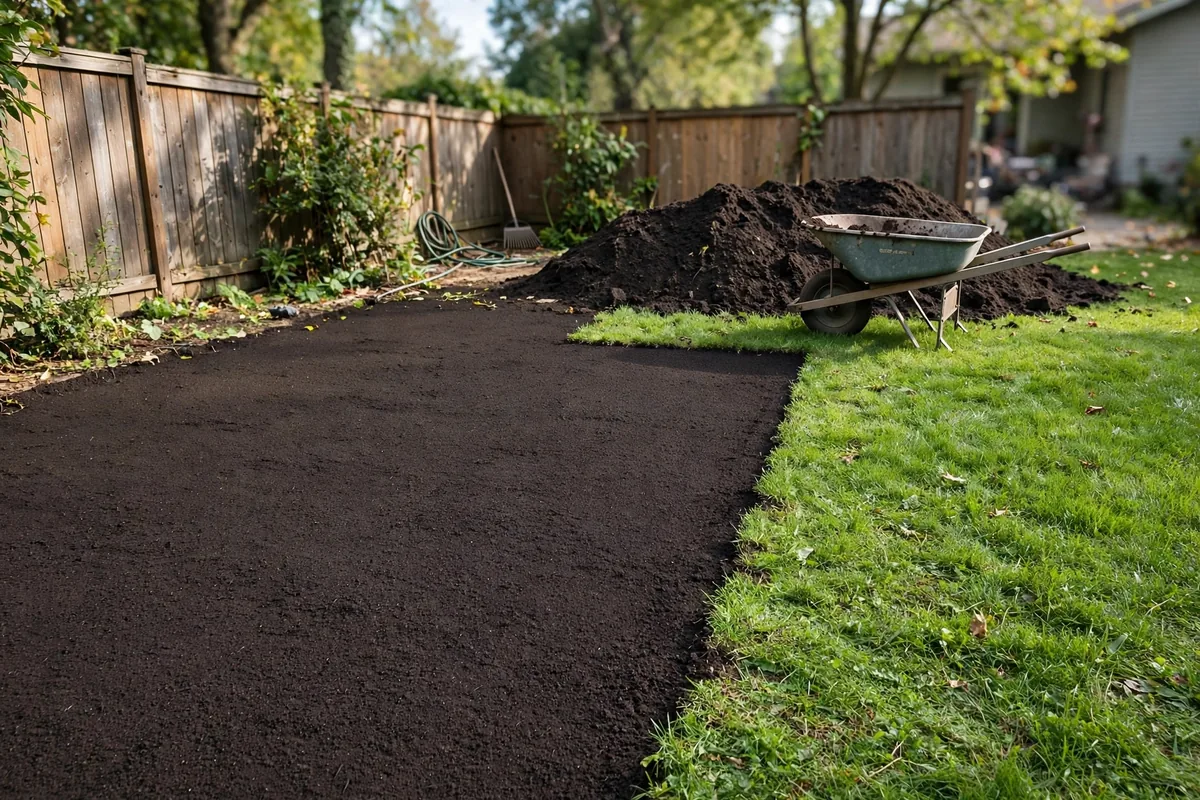
Topsoil looks simple — it is just dirt, ordered by the yard or the bag — and it is the easiest garden material to get badly wrong. Order for the deepest point of a dip and you pay for a mountain you then have to hide; order for the average and forget that loose soil settles, and the low spot quietly sinks back after the first good rain. The other trap is that "topsoil for the lawn" is really two different jobs wearing one name: filling a low corner several inches deep, and dusting a quarter inch over the whole lawn before overseeding. On the same patch of grass those two jobs differ by more than ten times. Our Topsoil Calculator runs the volume for either job in seconds; this guide shows the maths it uses, how to measure the depth honestly, and the settling allowance that decides whether a levelled lawn stays level.
The short answer, on one card
- The formula: volume = length × width × depth — shown by the calculator in cubic feet, cubic yards and your country's bag sizes
- Two jobs, two maths: levelling fills inches deep; top-dressing is only ¼–½ inch — the same lawn can need 15× more soil for one than the other
- Depths that work: new lawn 4–6 inches, top-dressing an existing lawn ¼–½ inch, filling and levelling = the depth you actually need to fill
- One cubic yard (27 cubic feet) covers about 81 sq ft at 4 inches, 162 sq ft at 2 inches — and weighs about a ton (2,000–2,300 lb, by moisture)
- The settling rule: loose topsoil firms down roughly 20–25%, so order for the settled depth, not the spread depth
Step 1 — Measure the area, and the depth honestly
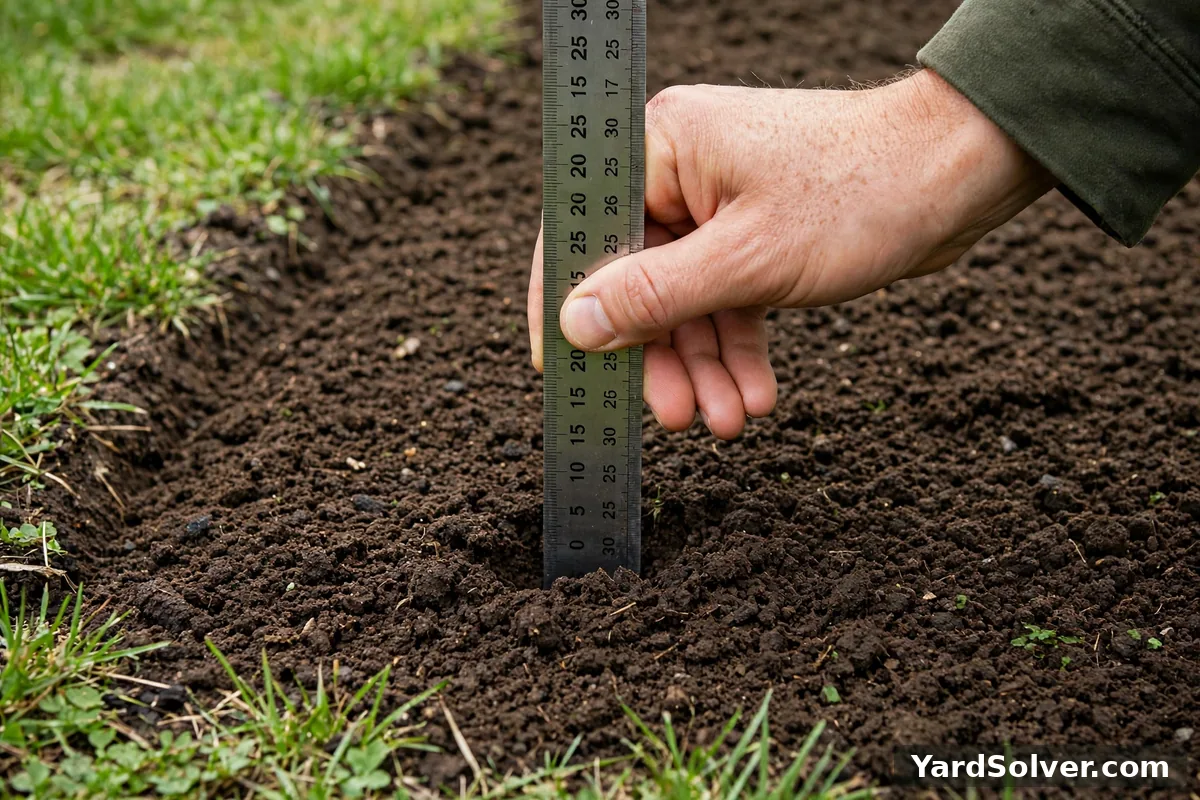
Area first: length times width of the patch you will actually cover, in feet. A rectangle is easy; an L-shaped corner splits into two rectangles measured separately and added. Depth is where topsoil orders go wrong, because a low spot is almost never a flat-bottomed hole — it is a wedge. It fades out to nothing at the high edge and reaches its deepest only at one corner. The honest number for a wedge is the average depth: a dip that runs from 0 inches at the top edge to 6 inches at the bottom averages 3 inches, and 3 inches is what goes into the calculator. Use the deepest point instead and you double the order. Push a ruler or a marked stick into the dip in four or five places, write the readings down, and average them — thirty seconds of honesty that routinely saves a full cubic yard. For a brand-new lawn the depth is a choice rather than a measurement: 4–6 inches of topsoil over the subsoil is the working range, thinner only where the soil underneath is already decent. For top-dressing, the depth is fixed by the job itself — a quarter to half an inch, no more, because grass has to grow up through it.
Step 2 — Run the calculator: what each input does
Open the Topsoil Calculator — cubic yards and bags and enter the length, the width and the depth from Step 1 — the average depth, not the deepest reading. The calculator multiplies the three together and returns the same volume three ways at once: cubic feet (the raw number everything else comes from), cubic yards (the unit bulk yards sell in), and bags in your country's sizes. That last conversion matters more than it looks: in Canada the standard bag is 25 litres, about 0.88 cubic feet, so the calculator's own example of 200 cubic feet works out to roughly 227 bags of 25 L — a number that instantly tells you whether you are in bag territory or bulk territory. Read the answer as a floor, not the final order: Step 6 adds the settling allowance on top of it, because the calculator sizes the finished, firmed-down layer — and soil does not arrive firmed down.
Step 3 — The maths the calculator is doing
The whole calculation is one multiplication with two conversions. Volume = length × width × depth, with the depth turned into feet first (inches ÷ 12), gives cubic feet. Divide cubic feet by 27 for cubic yards; divide by the bag size for bags. That is all of it — and it produces the coverage numbers worth memorising before any store trip: one cubic yard covers about 81 sq ft at 4 inches and about 162 sq ft at 2 inches. The table below runs the same maths across the depths topsoil is actually used at, and adds the bag counts that make bulk-versus-bags decisions obvious.
| Depth | 1 cubic yard covers | Best for |
|---|---|---|
| ¼ inch (0.6 cm) | ≈1,296 sq ft | Top-dressing before overseeding |
| ½ inch (1.3 cm) | ≈648 sq ft | Heavy top-dressing, light levelling dust |
| 2 inches (5 cm) | ≈162 sq ft | Shallow fills, refreshing tired beds |
| 4 inches (10 cm) | ≈81 sq ft | New lawn base, serious levelling |
| 6 inches (15 cm) | ≈54 sq ft | Deep new-lawn base over poor subsoil |
And the bag maths, from the same 27 cubic feet: one cubic yard ≈ 27 bags of 1 cubic foot, or ≈ 31 bags of 25 litres. Keep that pair of numbers in your head at the store — the moment an order passes two yards, you are looking at sixty-plus bags, and the bulk conversation in Step 6 stops being optional. One more weight warning from the same maths: a cubic yard of topsoil weighs about a ton — 2,000 to 2,300 lb depending on how wet it is — so "I'll just pick up three yards in the trailer" is a load-rating question, not a shopping decision.
Step 4 — The two jobs: deep fill vs top-dressing
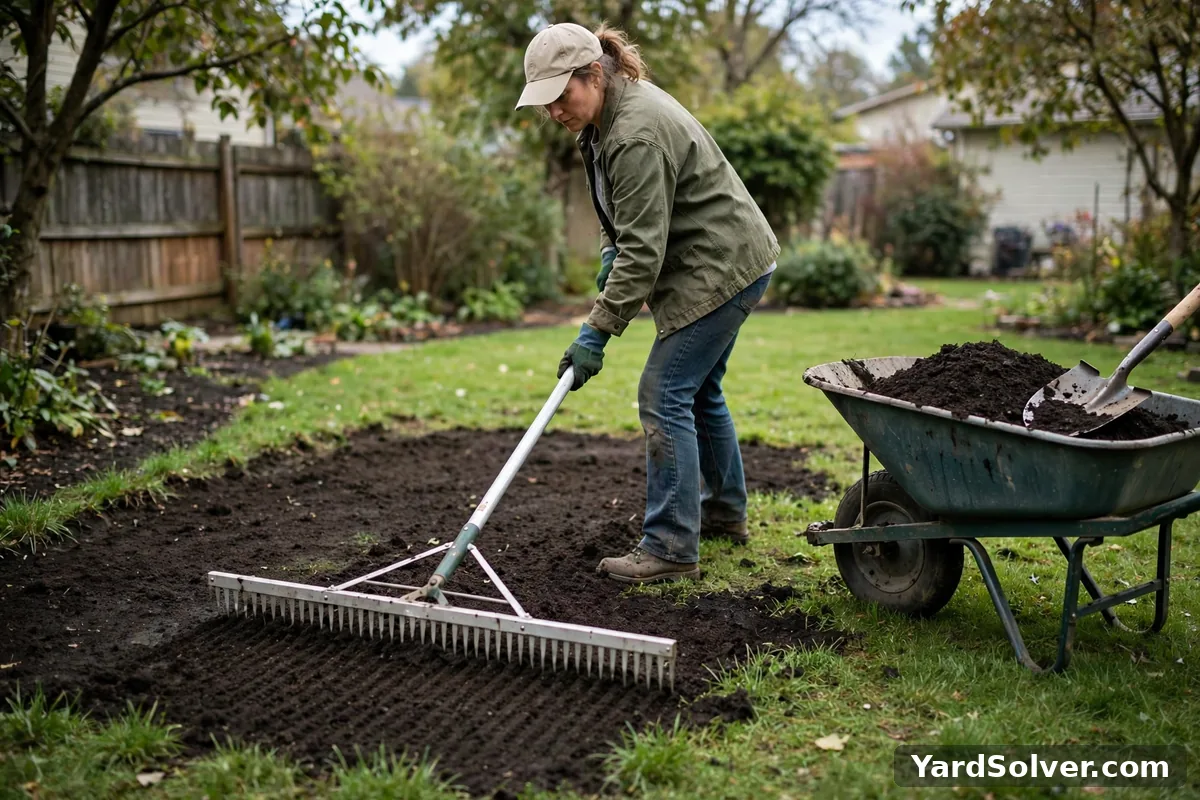
Here is the distinction this whole guide turns on. Deep fill is the levelling job: soil placed inches deep into dips and hollows so the finished surface runs flat. It is measured by the average depth of the hole, it settles hard, and it is ordered by the cubic yard. The full technique — string lines, screeding, working in lifts — lives in How to Level a Lawn; this guide's job is sizing what that technique consumes. Top-dressing is the opposite scale of job: a quarter to half an inch spread over an existing lawn, usually right before overseeding, to smooth micro-bumps, cover seed and feed the soil surface. The grass must poke through it within days, so it can never be deep — and at a quarter inch, a cubic yard stretches across nearly 1,300 sq ft. Put the two side by side on one lawn and the gap is startling: levelling a corner at an average of 3 inches takes twelve times the soil of top-dressing the same area at a quarter inch, before settling is even counted. Most "how much topsoil" confusion online comes from pages quietly answering one job while the reader is doing the other. Decide which job you are doing first; the calculator happily runs either, but only one of them is yours.
Step 5 — A low lawn corner, worked start to finish
One real corner, done exactly the way the calculator does it. The low corner of a lawn measures 25 ft × 20 ft = 500 sq ft. It dips from 0 at the high edge to 6 inches at the low edge, so the honest fill depth is the average: 3 inches. Volume: 500 × 0.25 ft = 125 cubic feet, and 125 ÷ 27 = 4.63 cubic yards — that is the soil in its finished, settled state, sitting level in the corner. Now the part nobody budgets for. Loose topsoil spread today firms down roughly 20–25% as it settles and rains in, so you order for the settled depth: 125 × 1.25 ≈ 156 cubic feet ≈ 5.8 cubic yards — order 6 cubic yards. Skip that allowance and the corner finishes about an inch low, holding water exactly where you just "fixed" it. Now the contrast, same 500 sq ft, other job: a quarter-inch top-dressing is 500 × (0.25 ÷ 12) = 10.4 cubic feet ≈ 0.39 cubic yards — about 12 bags of 25 L. Same lawn, two jobs, a 15× difference between the 6-yard levelling order and the 12-bag dusting. If a neighbour's advice or a store estimate lands wildly far from your number, this ten-to-fifteen-times gap between the two jobs is almost always why.
Step 6 — Bags or bulk, and the settling rule
The break-even is written in the Step 3 bag counts: a cubic yard is about 27 one-cubic-foot bags or 31 bags of 25 L. Top-dressing jobs and small fills — anything under roughly half a yard — belong in bags: no delivery fee, no pile on the driveway, and bags carry round the back of the house without a wheelbarrow relay. Past a yard, bulk wins on price almost every time, and past two yards it wins on sanity too — sixty bags is a full afternoon of slitting and shaking before any soil gets spread. Whichever way you buy, apply the settling rule to the calculator's answer before you order: multiply the volume by about 1.25 for a levelling fill, so the soil you spread stands roughly a quarter proud and firms down to the level you actually wanted. Top-dressing is the exception — at a quarter inch there is almost nothing to settle, and the straight calculator number stands. Two delivery notes for bulk: a cubic yard weighs about a ton, so the truck needs a spot it can reach without crossing soft lawn, and a tarp down first turns cleanup from an hour into ten minutes. Put the delivery day in the Garden Planner with the levelling work right behind it — a topsoil pile left for weeks grows weeds and washes in the rain.
What the calculator can't do
Honesty about the edges, so the number earns your trust. The calculator assumes an even depth across a measured area: it cannot see that your dip is a wedge — that average-depth judgement in Step 1 is yours, and using the deepest point instead is the single most common cause of doubling an order. It cannot judge the soil itself: screened topsoil with some compost in it and cheap fill-heavy "topsoil" hold the same cubic yard on the ticket and behave very differently on the lawn, so look at the load or open one bag before the rest follows. It does not price delivery, which on small bulk orders can cost more than the soil. And its settling allowance is a planning figure, not a promise — very loose, dry soil settles toward the top of the 20–25% range, moist screened soil toward the bottom. What it does guarantee is the volume maths, checked in Step 3 and Step 5: get the area, the average depth and the right job right, and the yardage follows.
Working the soil rather than just covering with it? The Compost Calculator sizes the organic matter to mix in for feeding, and for a raised bed the Raised Bed Soil Calculator works out the full fill volume — topsoil, compost and all — before you order anything.
Keep going
Run your own patch through the Topsoil Calculator, then work the fill with How to Level a Lawn and feed the finished surface using the Compost Calculator.
Planning the whole season's lawn and bed work? The Garden Planner lays out levelling, feeding and planting in one calendar.
Questions people ask
How much topsoil do I need to level a lawn?
Measure the dip's average depth, not its deepest point — a low spot that tapers from nothing at the high edge to 6 inches at the low edge averages 3 inches. Run that average through the calculator, then add about 25 percent for settling. On our worked 500 sq ft corner (25 ft by 20 ft, averaging 3 inches) that is 125 cubic feet of settled soil, about 156 cubic feet loose — order 6 cubic yards.
How much topsoil for top-dressing 1,000 sq ft?
At a quarter inch deep, 1,000 sq ft needs 1,000 x 0.25 divided by 12 = about 20.8 cubic feet, which is 0.77 cubic yards — roughly 21 bags of 1 cubic foot, or about 24 bags of 25 litres. Top-dressing is a dusting, not a fill, which is why the number is so much smaller than a levelling job on the same lawn.
Why did my levelled lawn sink again after rain?
Settling. Loose spread topsoil is full of air gaps; rain and its own weight firm it down by roughly 20 to 25 percent in the first weeks, so a spot filled flush can sit low again. Order for the settled depth — add about 25 percent to the calculator's volume — or plan a light second pass over the same spot once the first load has firmed.
How many bags of topsoil are in a cubic yard?
About 27 bags of 1 cubic foot, or about 31 bags of 25 litres — a cubic yard is 27 cubic feet and a 25-litre bag holds about 0.88 cubic feet. That is why past a yard or two, a bulk delivery almost always beats bags: you stop paying for the bagging, and the wheelbarrow trips drop from dozens to a handful.
Should topsoil go down before sod?
Yes — topsoil goes down first. Level it, firm it, and rake it smooth, then lay the sod the same day it arrives so it roots into moist, settled soil instead of drying out on a pallet. Sod laid over an unlevelled base copies every dip underneath it, and fixing bumps afterwards means lifting the sod again.
Topsoil is a volume over an area — depth decides whether it is a dressing or a rebuild
Topsoil jobs split into two kinds with very different depths: a levelling dressing over an existing lawn or bed may need only an inch or two, while building a new bed or regrading a hollow takes four to six inches or more. Multiply the area by that honest depth and the volume — and therefore the tonnes or yards to order — follows; the commonest failure is ordering a dressing's worth for a rebuild's job and spreading it thinner and thinner until it does neither.
Screened topsoil costs more and earns it where seed or turf will sit directly on it; as-dug soil suits deep fills beneath a screened cap. Allow around ten percent for compaction once it is raked, rolled or rained on, and never work or traffic wet topsoil — the structure you are paying for is destroyed in an afternoon of muddy boots and takes seasons of roots and worms to rebuild.
Sources
Key facts on this page cross-checked against Topsoil — Wikipedia — background on topsoil and its role in the soil profile and Soil — Wikipedia — background on soil and its composition.
Related page
Read next: How Much Soil Do I Need for a Raised Bed? Bags, Yards & the Mix — How the Calculator Works.
Comments & ratings
No comments yet.
Be the first to share your experience.