
Guides · Indoor gardening · Published November 20, 2026 · By Faizan Ahmad
How to Care for a Jade Plant: Sun, Sparse Water and a Plant for Decades
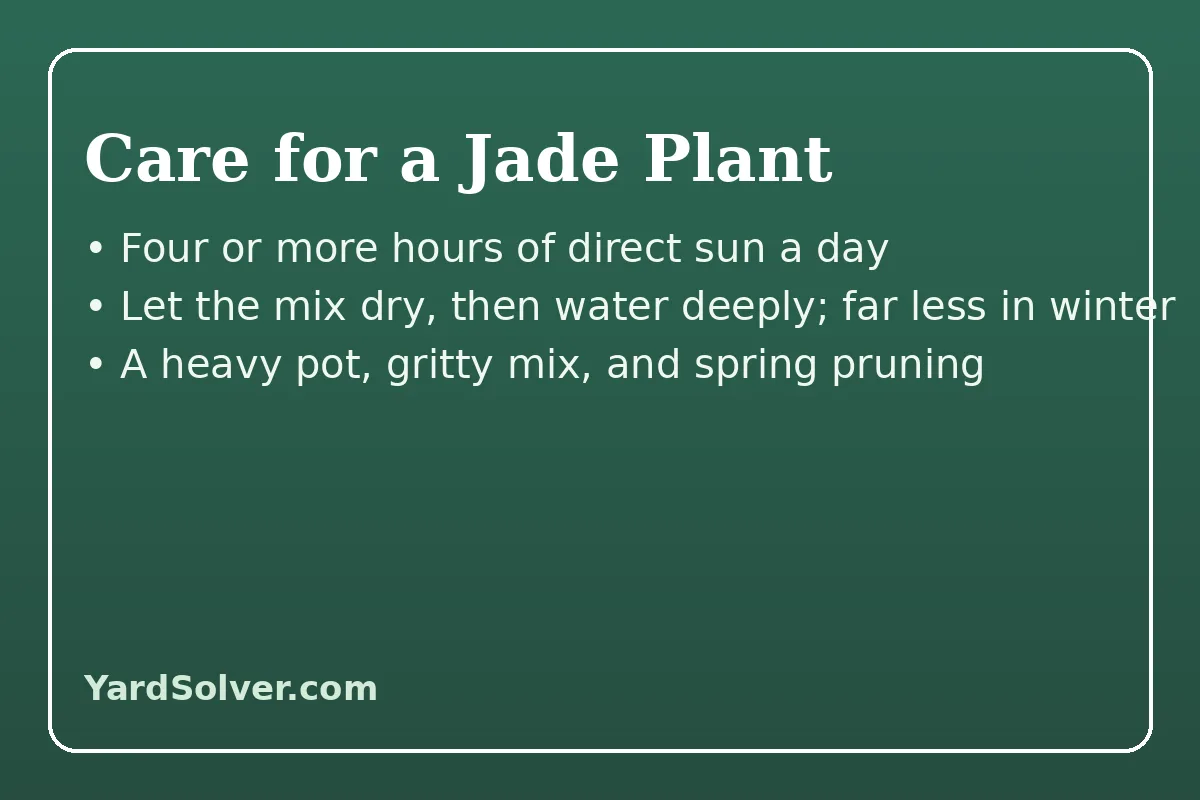
To care for a jade plant, give it four or more hours of direct sun a day in a high-porosity cactus or succulent mix in a heavy pot with drainage, let the soil dry out between deep waterings — and keep it distinctly drier through its semi-dormant winter — feed it lightly only while it grows, prune it in spring by cutting stems back to a side branch, and repot it every two to three years or when it grows top-heavy, as new growth starts. The jade plant, Crassula ovata, is the houseplant most likely to outlive its first owner: a succulent shrub from South Africa that stores water in its leaves, stems and roots, grows slowly into a miniature tree with a thick woody trunk, and — as University of Wisconsin–Madison Extension notes — can be grown for many years, reaching five feet indoors under kind conditions. Its care failures are almost never exotic. Penn State Extension's profile and Wisconsin's agree on the same short list of killers: too little sun, and water given as if it were a fern. This guide works through the sun and the red leaf-edge that reports it, the seasonal watering rhythm — the one place the extension sources honestly differ, reconciled here — soil and the heavy-pot rule, pruning and the trunk it builds, propagation from a single leaf, the cool dry fall treatment that coaxes winter flowers from a mature plant, and the troubleshooting table. It takes its place on the shelf with the other succulents of this series, aloe vera and the snake plant, and under the general discipline of houseplant winter care.
The short answer, on one card
Light: four or more hours of direct sun daily — a south window — or the brightest indirect light you have; leaves tinge red at the edges when the light is right. Water: deeply, once the soil has dried; liberally in spring and summer growth, sparingly in winter when the plant is semi-dormant; never let it sit in water. Mix: a porous cactus or succulent mix, standard potting mix sharpened with perlite or sharp sand. Pot: heavy, with drainage — the plant is top-heavy by design. Feed: lightly, in the growing season only. Prune: spring, back to a lateral branch; pinch tips for bushiness. Repot: every 2–3 years as growth starts. Safety: toxic to cats, dogs and horses.
Sun first: the red edge is the report card
| What you see | What it means | What to do |
|---|---|---|
| Leaves deep green, stems drooping, long gaps between leaf pairs | Too little light | Move to direct sun gradually; prune the stretched growth in spring |
| Leaves dropping while the mix is wet | Overwatering — roots failing in soggy mix | Stop, dry the plant out, check for stem rot at the base |
| Leaves wrinkling and thinning while the mix is dry | Genuinely thirsty — the reserves are being spent | Water deeply once, drain, and resume the dry-then-drink rhythm |
| Leaves scorched pale after a sudden move outdoors | Sunburn from an unacclimatised move | Move plants out gradually over a week or two, into shade first |
| White cottony clusters where leaves meet stems | Mealybugs, the jade's signature pest | Dab each with alcohol on a swab; isolate and repeat weekly |
| Whole plant tipping or pot lifting | Top-heavy and root-bound — success, not failure | Repot into a heavier pot as growth starts; prune to balance |
Wisconsin's light prescription is the sunniest in the houseplant canon: jade does best with four or more hours of direct sun a day, though it will survive in bright indirect light. Penn State quantifies the indoor version — a south-facing window, thriving on those same four-plus hours — and both sources hand the gardener a built-in light meter: the leaves themselves. In sufficient light, the smooth, glossy, egg-shaped leaves carry red edges and tints; in insufficient light they stay plain deep green, the stems soften and droop, and the pairs of leaves space themselves further apart as the plant stretches toward the glass. Read the edge before you read any advice, including this guide's: a red-rimmed jade in a south window is a plant whose light account is paid. Where no window qualifies, Penn State's remedy is full-spectrum artificial light kept close to the plant — the shelf rig of grow lights for seedlings — run about twelve hours and, importantly, turned off after that, because jade, like the kalanchoe of this series, keeps its accounts by the night as well as the day. Two movement rules protect the foliage you have grown. Rotate the pot a quarter every week or two so the little tree grows symmetrically rather than leaning out of its pot toward the light. And acclimatise any move — indoors to outdoors in spring, or from a dim room to a sunny sill — gradually over a week or more, because leaves grown in shade sunburn in the direct sun the species loves, a paradox every succulent keeper learns once. The quotable fact of this guide belongs to the timescale: a jade plant is not a purchase, it is an inheritance in progress — the cutting rooted on a sill this winter is, with sun and dry spells, the small tree someone will move house with in thirty years.
Watering by season: where the experts honestly differ
Watering is where jade guidance must be written carefully, because the extension sources differ in emphasis and a good guide should say so rather than invent a false precision. Wisconsin's rule: the soil should be allowed to dry out between deep waterings; plants can be watered liberally during active growth in spring and summer but should dry slightly between waterings and never sit in water; in winter, semi-dormant, watering is restricted and the soil stays on the dry side — with the warning that overwatering causes leaf drop and stem rot. Clemson Extension's phrasing leans a touch wetter for the growing season — keep the soil moist but never wet — and NC State's profile lands on the same rhythm in fewer words: water in moderation when the soil is dry, and reduce watering from fall to late winter. Reconciled into one practice, the rhythm that satisfies every source is this: in spring and summer, water deeply as soon as the mix has dried through — the top few centimetres dry and the pot noticeably lighter — then drain completely. In fall, lengthen the intervals as growth slows. In winter, water sparingly and rarely, enough to keep the leaves from wrinkling, because a cool, resting, slow-drinking plant in wet mix is the rot scenario in full. The leaf is the gauge that settles arguments: plump and glossy means the reserves are full and the watering can stays on the shelf; wrinkled and thinning on a dry pot means water today. A jade that drops leaves from a wet pot is not thirsty — it is drowning, and the correct response is the opposite of the instinctive one. Temperature frames the whole rhythm: Clemson gives 18–24 °C (65–75 °F) by day and 10–13 °C (50–55 °F) at night as the preferred band, Wisconsin notes the plant tolerates a wide range and even light frost, and every source agrees on the hard line — freezing kills it, so it comes indoors before the first frost and stays off cold glass and out of drafts through winter, the standard protections of bringing plants indoors for winter.
The heavy pot, the gritty mix, and repotting rarely
Jade's hardware rules all serve the same physics: a water-storing plant in a fast-draining mix, in a pot heavy enough to hold it upright. The mix, per Wisconsin, is a well-drained, high-porosity blend designed for succulents or cacti, or a standard potting mix with extra perlite or sharp sand worked through it; Clemson's home recipe runs to coarse sand with sterilised soil and peat. What matters is the behaviour — water poured on runs through in seconds — because a mix that holds a sponge of moisture against a succulent's roots through winter is a slow sentence of rot. The pot needs a drainage hole, and it needs weight: jade grows top-heavy as a matter of design, all that stored water riding above the rim, and Penn State's preference for clay or terracotta — porous, quick-drying — doubles as ballast. A plastic pot of dry succulent mix under a mature jade is a plant waiting for a cat, a curtain or a careless elbow to tip it. Repotting is the rarest chore on this plant's calendar. Wisconsin notes that individual plants grow happily root-bound for many years, and sets the working interval at every two to three years, or when the plant becomes top-heavy and prone to tipping — the best moment being as new growth starts in spring. Repotting into the same size pot is a legitimate move: prune the roots, cut back the stems to hold the shape and encourage a thick main trunk, repot into fresh mix, and water sparingly until the plant is established in its refreshed home. Feeding is correspondingly modest — lightly, during growth, at intervals of a couple of months or a dilute feed more often per Wisconsin, every three to four months by Clemson's slower schedule — and nothing at all in winter. Jade is a plant that evolved on poor hillsides; the gardener's restraint is not neglect but fidelity to the habitat.
Pruning, propagation, and coaxing out the winter flowers
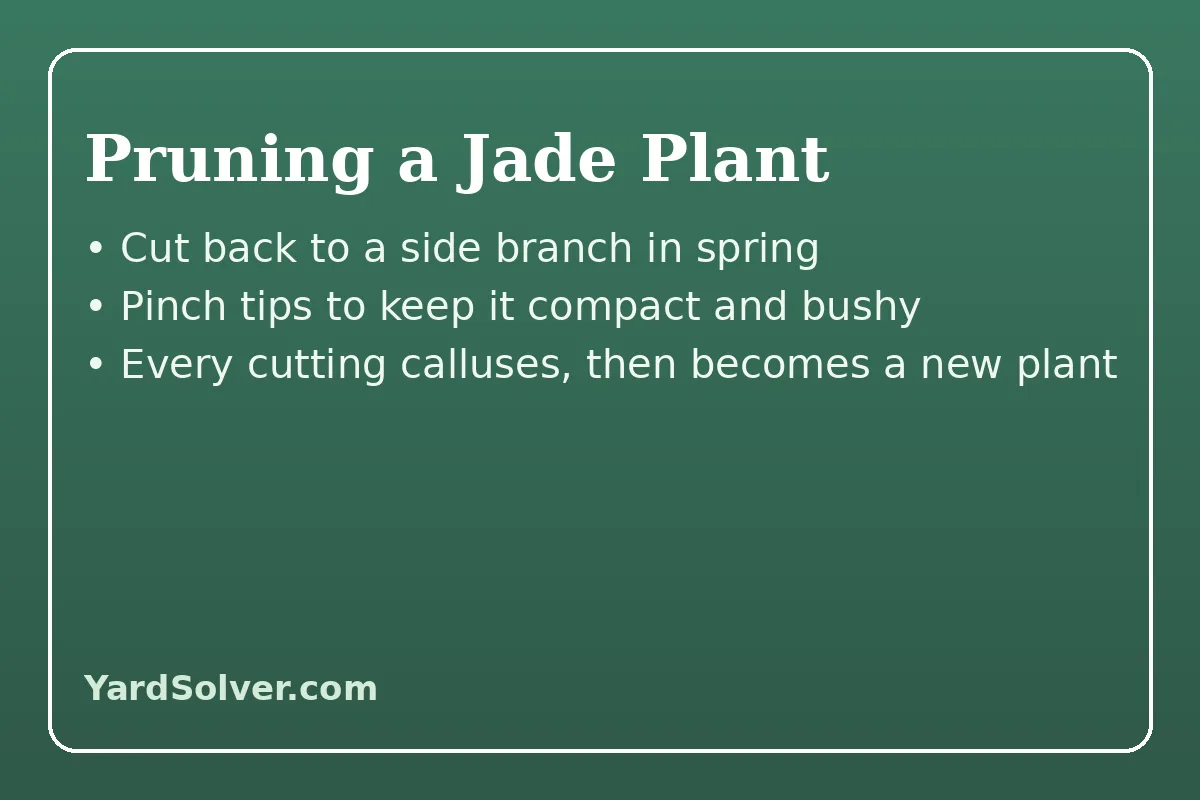
Pruning is how a jade becomes a tree instead of a thicket, and the extension method is consistent: prune in spring, cutting stems back to a side branch or just above a ring, which keeps the plant compact and vigorous and, over years, builds the thick trunk that makes an old jade look like a bonsai that escaped. Penn State adds the fine tool — pinching the soft stem tips an eighth of an inch above a leaf pair — which forces branching and bushiness exactly where the pinch lands. Cuttings from pruning are never waste: a stem cutting allowed to callus for a few days, or even a single leaf laid on mix, roots and becomes a new plant, which is why old jades have descendants in a dozen households. Let the cut surface dry before potting, set it in gritty mix, water sparingly, and patience does the rest — propagation is the plant's own insurance policy, and a rooted cutting should stand beside every mature jade you value. Then the flowers, the guide's closing prize. A mature jade, Wisconsin explains, produces tight clusters of small white or pink star-shaped flowers in response to long nights, and the encouragement recipe is a small, deliberate hardship in fall: withhold water, keep the plant cool — around 13 °C (55 °F), especially at night — and give it no supplemental light, so the naturally shortening days trigger flower initiation; several weeks of that cold, dry, dark treatment, followed by a return to regular watering, should result in flowering. It is the same night-counting family as the kalanchoe's rebloom and the Christmas cactus's buds, run at the temperature end of the dial. Not every plant obliges every year, and a young jade will not oblige at all — flowering is a mature plant's privilege — but a jade that blooms on a January sill, white stars over red-rimmed leaves, is the winter houseplant collection's highest honour, and it is earned entirely in October. The one caution that travels with the species closes the care list: jade is toxic to cats, dogs and horses, so in pet households it lives on the high sill it prefers anyway, out of grazing reach, dropping the occasional leaf where only the broom will find it.
The jade through the year: a keeper's calendar
Assembled across the seasons, jade care in a northern house runs on a rhythm so slow it can be written on one card and kept for a decade. Winter is the rest: the plant sits in its sunniest window, watered sparingly every few weeks, un-fed and un-pruned, its leaves plump on stored water — and, if it is mature and last fall's cold, dry, dark treatment took, flowering in the year's darkest weeks. Spring is the working season and the only busy one: growth resumes, watering steps up to the dry-then-drink rhythm, the year's one repotting (if due) and all structural pruning happen now, cuttings are taken and callused, and the plant begins its gradual move outdoors — shade first, then lengthening sun — once nights are reliably mild. Summer is the growth bank: outdoors in full sun with rain doing most of the watering, the plant thickens its trunk, reddens its leaf edges and stores the water and energy that winter will spend; feeding, if it happens at all, happens here, lightly. Fall is the discipline: the plant comes in before the first frost, washed and inspected under the routine in bringing plants indoors for winter, watering tapers, feeding stops, and — for a mature plant whose owner wants flowers — the cool, dry, lampless weeks begin. Nothing in the calendar is urgent, and that is the species' gift to its keeper: a jade forgives a forgotten fortnight that would kill a fern, asks its questions in seasons rather than days, and repays the slowest care in the house with the longest life in it.
Keep going
Grow its shelf companions with How to Grow Aloe Vera and How to Grow Snake Plants Indoors, and run the season for all of them with Houseplant Winter Care.
Sources
The care framework — an easy succulent storing water in leaves, stems and roots; four or more hours of direct sun a day with survival in bright indirect light; red-edged leaves in sufficient light; well-drained, high-porosity succulent mixes with added perlite or sharp sand; soil allowed to dry between deep waterings, liberal watering in active growth, restricted watering in the semi-dormant winter, and overwatering causing leaf drop and stem rot; repotting every two to three years or when top-heavy, at the start of new growth, with root and stem pruning to build a thick trunk; and winter flowers triggered by fall water-withholding, cool nights around 55 F and no supplemental light — follows University of Wisconsin–Madison Extension, Wisconsin Horticulture, Jade Plant, Crassula ovata. The indoor specifics — a south-facing window with four or more hours of sun, terracotta pots preferred, cactus and succulent mix, watering only when the soil is completely dry, spring pruning just above a ring or lateral branch, and tip-pinching for bushiness — follow Penn State Extension, Jade Plant, a No Fuss Houseplant. The temperature band and moderation rule — average to cool indoor temperatures, watering in moderation when the soil is dry and reducing it from fall to late winter, and leaf fall and root rot from overwatering — follow the North Carolina Extension Gardener Plant Toolbox, Lucky Plant, Crassula ovata.
Questions people ask
How often should I water a jade plant?
When the soil has dried out — then deeply, and drain it fully. In spring and summer growth that may be every week or two in a sunny spot; in winter, when the plant is semi-dormant, water sparingly and far less often, only enough to stop the leaves wrinkling. Never let it sit in water: overwatering causes leaf drop and stem rot.
How much light does a jade plant need?
Four or more hours of direct sun a day is the target — a south-facing window indoors. It survives in bright indirect light but grows droopy and plain green. The plant reports its light itself: leaves edged or tinged with red mean the light is sufficient.
Why is my jade plant dropping leaves?
Check the mix first. Leaves dropping from a wet pot means overwatering and failing roots — dry the plant out and check the stem base for rot. Leaves wrinkling and dropping from a bone-dry pot means genuine thirst. The same symptom has opposite causes, and the soil, not the leaves, tells you which.
When and how should I prune a jade plant?
In spring, as growth starts. Cut stems back to a side branch or just above a ring to keep the plant compact and build a thick trunk, and pinch soft stem tips to force bushy branching. Let pruned cuttings callus for a few days and pot them — every cutting is a new plant.
How big does a jade plant get, and how long does it live?
Slowly, and for a very long time. Indoors it can reach about 1.5 m (5 ft) over many years, growing into a small tree with a woody trunk, and plants are commonly kept for decades and handed on. It tolerates being root-bound for years; repot every two to three years or when it becomes top-heavy.
Can a jade plant flower indoors?
Yes — a mature plant can, in winter. In fall, withhold water, keep it cool (around 13 C / 55 F, especially at night) and give it no extra light, so the shortening days trigger buds. After several weeks of that cold, dry, dark treatment, resume normal watering and the star-shaped white or pink clusters should follow.
Comments & ratings
No comments yet.
Be the first to share your experience.