
Guides · Indoor gardening · Published November 20, 2026 · By Faizan Ahmad
How to Care for Kalanchoe: Winter Blooms and How to Make It Rebloom
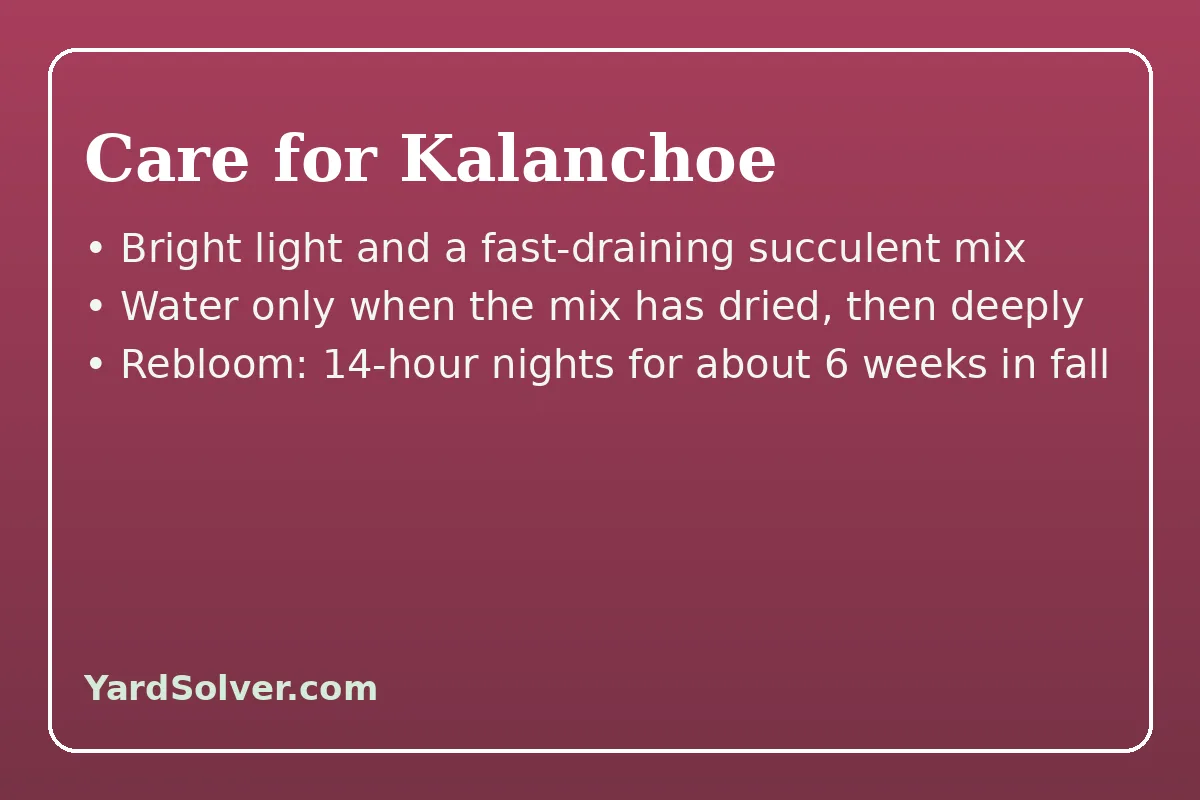
To care for a kalanchoe, give it bright light in a fast-draining succulent mix, let the soil dry between waterings and then water deeply, keep it near 21 °C (70 °F) by day and about 16 °C (60 °F) at night, deadhead its spent flower clusters and cut back tall growth after flowering — and to make it bloom again, give it 14 hours of complete, unbroken darkness every night for about six weeks in the fall, with bright light for the remaining ten hours. The florist's kalanchoe is the winter gift plant that gets thrown away in March, and University of Missouri Extension horticulturist David Trinklein makes the case against the bin in one breath: few plants can boast such colourful, long-lasting flowers and attractive foliage the rest of the year. The plant underneath the flowers is a true succulent from Madagascar — thick leaves behind a waxy cuticle, built to store water and endure drought — which is why its care inverts the usual houseplant instincts: less water, more light, and a flowering trigger that has nothing to do with feeding and everything to do with the length of the night. This guide covers the everyday care that keeps the plant handsome between blooms, the after-flowering routine, the short-day rebloom method in full (the same family of trick as the poinsettia and the Christmas cactus), propagation from cuttings, and the one safety fact that must travel with the plant: it is toxic to pets. It joins the winter flowering shelf beside the Christmas cactus that will not bloom and the poinsettia kept past Christmas — three gift plants, three different bargains, all of them keepable.
The short answer, on one card
Light: bright — a sunny south or west window indoors; spindly growth means it wants more. Water: let the mix dry, then water thoroughly and drain; the fleshy leaves are the reservoir, and soggy mix is the enemy. Temperature: about 21 °C (70 °F) days and 16 °C (60 °F) nights; sustained heat above 24 °C (75 °F) delays flowering. Mix: a well-drained, well-aerated succulent mix in a pot with a drainage hole. Feed: a houseplant fertiliser per label while actively growing; sparingly during flower induction. Rebloom: from mid-September for Christmas flowers (or any fall start for January blooms), 14 hours of total darkness nightly for about six weeks — no light leaks at all — then normal care; flowers follow in about six weeks. Safety: toxic to dogs and cats; keep out of reach.
A succulent first, a flower second
| What you see | What it means | What to do |
|---|---|---|
| Tall, spindly stems with wide gaps between leaves | Too little light | Move to your brightest window; cut back after flowering |
| Soft, yellowing leaves and a mushy stem base | Overwatering — rot setting in | Stop watering, check drainage, take healthy cuttings as insurance |
| Handsome green plant that never flowers | Its nights are too short or broken by lamplight | Run the 14-hour darkness routine for six weeks in fall |
| Flower buds form, then dry up and drop | Heat during induction, or a move mid-routine | Keep nights cool and the plant in one place until buds show |
| White cottony tufts in leaf joints | Mealybugs | Dab with alcohol on a swab; isolate; see the winter pest guide |
| Wrinkled, thinning leaves | Genuinely thirsty — the one easy diagnosis | Water deeply once, drain, and resume the dry-then-drink rhythm |
Everything about kalanchoe care gets easier once the plant is filed correctly: not as a flowering annual but as a succulent that happens to flower spectacularly. Missouri Extension describes the machinery — fleshy leaves covered with a thick cuticle that prevents water loss — and draws the watering conclusion directly: because the plant stores its own water, allow the growing medium to dry before watering. That single sentence, obeyed, prevents the genus's main cause of death, the root and stem rot that follows kindly, frequent watering in a heavy mix. The mix itself should be the succulent standard: a well-drained, well-aerated blend — Clemson Extension's suggested recipe runs about 60 percent peat-based mix to 40 percent perlite — in a pot with a drainage hole, terracotta preferred for the same breathing, drying reasons as every plant in this winter series. Light is the second term: Missouri notes kalanchoe enjoys bright light and a well-drained medium, and that plants grow spindly under low light, so the sunny window is not a treat but a requirement; in summer the plant can live outdoors in light shade or indirect sun once frost danger has passed, which is where it builds the strong growth that fall's darkness will convert into buds. Temperature is the quiet third term, and Missouri gives the figures: nights around 16 °C (60 °F) and days around 21 °C (70 °F) suit it best, and temperatures above about 24 °C (75 °F) tend to delay or reduce flowering — a kalanchoe parked above a radiator is being un-bloomed by kindness. The Old Farmer's Almanac adds the beginner's reassurance: anyone who has kept succulents alive will find kalanchoe no trouble, provided the light is enough and the soil never stays soggy. File it with the succulents, not the geraniums, and the plant mostly keeps itself.
After flowering: the routine that sets up next winter
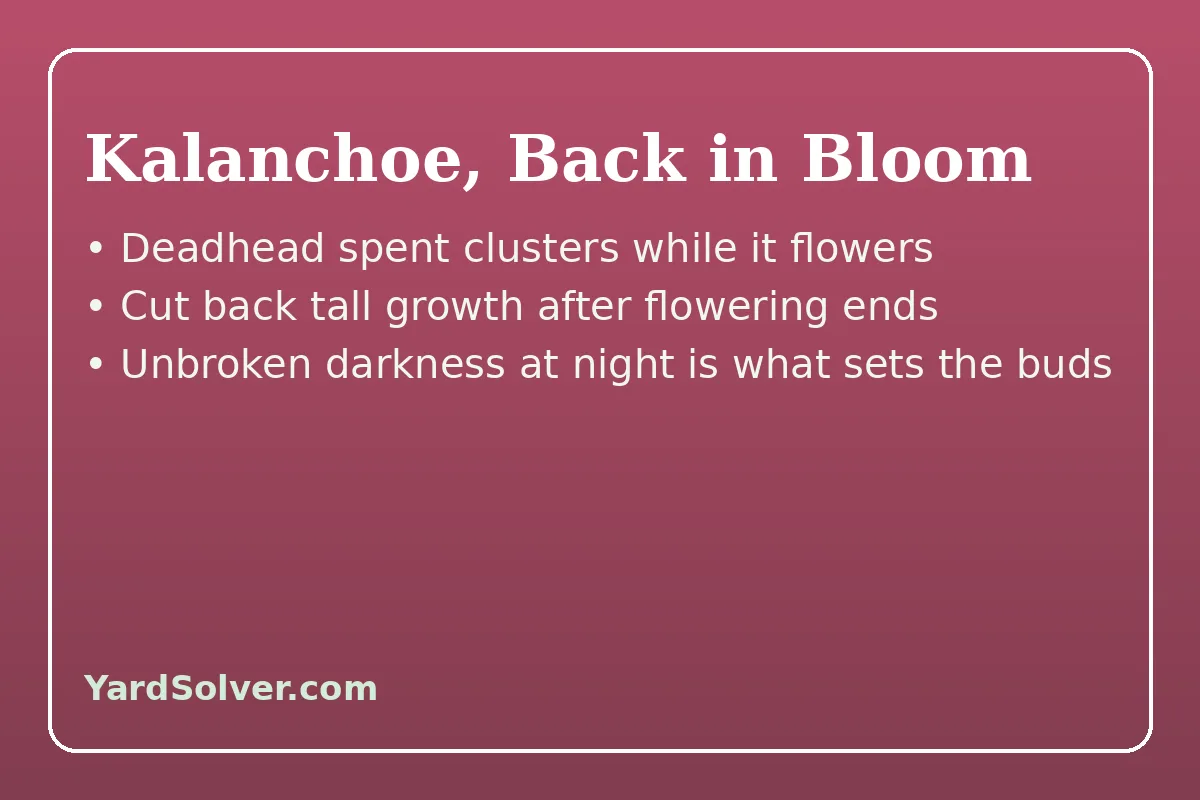
The weeks after the flowers fade decide whether this plant is a keeper, and the extension routine is short, physical and unsentimental. First, deadhead as you go: NC State Extension advises removing spent flower clusters during bloom to encourage more flowers, because a cluster left to wither is energy spent on seed the plant will never be allowed to make. When flowering ends entirely, Clemson's sequence takes over: cut back tall growth and the old flower stems — Missouri quantifies the cut as reducing leggy plants to about half their height — and repot into a slightly larger pot of fresh fast-draining mix, one size up and no more, since an oversized pot holds wet mix a succulent's roots cannot police. Then grow the plant on, hard, through the bright months: outdoors in light shade after frost if you have it, or on the sunniest sill if you do not, watered on the dry-then-drink rhythm and fed every two to three weeks with a houseplant fertiliser at label strength while it is actively growing, as Missouri prescribes. Summer is when the plant earns its winter: every strong new stem grown in June is a stem that can carry a flower cluster in January. Do not pinch and fuss it through summer — growth is the point — but do keep it turned so it grows evenly, and watch for the mealybugs that favour succulent leaf joints, dealt with in winter houseplant pests. One honest expectation belongs here: a second-year kalanchoe is a bigger, woodier, less doll-like plant than the florist's original, and its flowers come in the plant's own season rather than the greenhouse's. Most keepers find the trade fair. The plant that returns to bloom in January, on a sill it has occupied all year, is worth several anonymous replacements — and it cost nothing but darkness.
The rebloom method: six weeks of long nights
Here is the heart of the guide, and it is a piece of plant physiology worth understanding rather than merely obeying. Kalanchoe is a short-day plant: like the poinsettia, it forms flower buds only when its nights pass a critical length, uninterrupted. Missouri Extension gives the working prescription in full. For Christmas blooming, start the short-day treatment around the middle of September, once the plant is back indoors: a dark period of 14 hours produces the most blooms, the plant must not be exposed to any light at all during that darkness, it needs light for the remaining ten hours of the day, feeding and watering run sparingly through the induction, and the plants should bloom in about six weeks. NC State's profile confirms the arithmetic from the other side — total darkness for 14 hours a day for at least six weeks in fall and winter, alongside six to eight hours of bright light a day — and Clemson adds the practical methods: keep the plant in a room where no lights are turned on during the natural dark hours, or put it in a closet each late afternoon and carry it back to high light every morning. A cardboard box slipped over the plant on a timer-keeper's schedule does the same work. The quotable fact of this guide is the one that explains a thousand handsome, flowerless plants: a kalanchoe does not fail to bloom for lack of food or love — it fails because a living-room lamp keeps telling it the nights are still short, and the plant believes the lamp, not the calendar. Every evening light leak — the lamp in its corner, the hallway light through a doorway — resets the night's count, which is why the spare-room and closet methods outperform good intentions in the family room. Start the routine in early October without a holiday deadline and the natural version runs itself: the season supplies nights of 14 to 16 hours, the buds set in about six weeks, and flowers open around January, roughly twelve weeks from the start. Once buds are visible above the leaves, Clemson notes, day length no longer matters and the plant can come back to the bright sill for its display. Heat is the one saboteur left: keep the inducting plant cool, because temperatures above about 27 °C (80 °F) during the long nights can delay flowering even when the darkness is perfect.
Cuttings, safety and the year's calendar
Kalanchoe propagation is the easiest on the winter shelf, and Missouri's method is a paragraph: take stem-tip cuttings 5–8 cm (2–3 in) long — from stems whose flowers you have removed first — set them in a free-draining mix, and expect roots within two to three weeks. A leaf laid on mix will also root and plantlet in time, more slowly. Cuttings are the plant's renewal system: a keeper kalanchoe grows woody and leggy over the years, and the standard practice is to root fresh cuttings from the best stems every year or two and retire the tired parent to the compost without ceremony, keeping the variety and the habit while resetting the plant's shape. Take cuttings in spring, when growth is vigorous, and they will be flowering-size plants by the following winter. The safety paragraph is short and non-negotiable: most kalanchoe species contain cardiac glycosides and are toxic to many animals, including dogs and cats, and the plant should be kept out of their reach — a high sill or a room pets do not enter — as Missouri and the Almanac both warn. It is a windowsill plant, not a floor plant, in a pet household. The year, assembled, runs like this: flowers from the holidays into late winter on the bright cool sill; deadheading, the cut-back and the one-size repot as bloom ends; a bright summer of growth and fortnightly feeding, outdoors in light shade if possible; the move indoors before frost; six weeks of 14-hour nights from fall, in a dark spare room or by the closet routine, with sparing water and no feed; buds by late fall; and the plant back on the display sill, flowering as the year turns — the full cycle of a gift plant that became a houseplant, which is the only transformation this guide is really about.
Choosing a plant in the shop: what December's pot promises
Most kalanchoes enter a house as a December purchase or gift, and two minutes of selection at the shelf decides whether the plant is a keeper or a fortnight's decoration. Buy buds, not blooms: a plant carrying tight clusters of coloured buds over open flowers will flower at home for weeks longer than one already in full display, whose best days happened under the grower's lights. Read the leaves before the flowers — they should be thick, glossy and unmarked, held on short, sturdy stems; a plant already stretching on thin stems in the shop's dim corner is telling you its light history, and it will not un-stretch. Check the leaf joints and the undersides for the white cotton of mealybug, and the mix surface for fungus gnats, because a gift plant should not import the winter pest campaign into a clean collection. At home, the first week is a quarantine and an acclimatisation at once: the brightest sill, no repotting while it flowers (the florist's pot and mix are adequate for one bloom cycle), watering on the dry-then-drink rhythm from the start, and deadheading begun the day the first cluster fades. The plant that gets that first week right has effectively already been adopted — the cut-back, the summer of growth and the fall of long nights in the sections above are simply the paperwork. Judged this way, the supermarket kalanchoe is the best-value flowering plant of the winter: a few dollars for two months of flowers now, and — for the price of a dark spare room next fall — the same show again next year, on a plant that knows your windowsill by name.
Keep going
Compare the other night-counting gift plants with Christmas Cactus Not Blooming and Poinsettia Care After Christmas, and give it company from Best Low-Light Indoor Plants.
Sources
The care and rebloom framework — bright light and a well-drained growing medium, spindly growth under low light, night temperatures around 60 F and days around 70 F with heat above 75 F delaying flowering, allowing the medium to dry before watering because the fleshy leaves store water, fertilising while actively growing, cutting leggy plants back to about half their height after flowering, short-day treatment from mid-September with a 14-hour dark period and no light exposure during it, sparing feed and water during induction, bloom in about six weeks, propagation by 2 to 3 inch stem-tip cuttings rooting in two to three weeks, and toxicity to dogs and cats from cardiac glycosides — follows University of Missouri Extension, Have Yourself a Merry Little Kalanchoe. The supporting details — kalanchoe as a low-maintenance succulent needing light and non-soggy soil, repotting one pot size up into well-draining mix, and the autumn darkness routine of about 14 hours a day for 4 to 6 weeks prompting buds for January bloom — follow The Old Farmer's Almanac, Kalanchoe Plant Care.
Questions people ask
How do I get my kalanchoe to bloom again?
Give it long nights. Kalanchoe is a short-day plant: it needs 14 hours of complete, unbroken darkness every night for about six weeks in fall, with bright light for the other ten hours. Keep it in a room where lamps are never switched on at night, or closet it each late afternoon and return it each morning. Flowers follow in about six weeks.
How often should I water a kalanchoe?
Only when the mix has dried — then water deeply and let it drain fully. Kalanchoe is a succulent whose fleshy leaves store water, so it tolerates dry spells easily and rots in constantly wet soil. In winter that rhythm often means watering every two to three weeks; in summer growth, more often.
Why is my kalanchoe leggy and not flowering?
Two separate shortages: light and darkness. Legginess means too little light — move it to your brightest window and cut it back after flowering. No flowers on a healthy plant almost always means its nights are broken by lamplight; run the six-week, 14-hour darkness routine in fall.
What do I do with a kalanchoe after it flowers?
Deadhead spent clusters as they fade, then cut back tall growth and old flower stems (leggy plants can come down by half), repot one size up into fresh fast-draining mix, and grow it on in bright light through summer with regular feeding. That summer growth is what carries next winter's buds.
Is kalanchoe toxic to pets?
Yes. Most kalanchoe species contain cardiac glycosides that are toxic to dogs and cats, among other animals. Keep the plant on a high sill or in a room pets do not enter, and sweep up fallen leaves and petals.
What temperature does kalanchoe like?
About 21 C (70 F) by day and 16 C (60 F) at night. Cool nights suit it and help flowers last; sustained temperatures above about 24 C (75 F) delay or reduce flowering, and heat above about 27 C (80 F) during the fall darkness routine can stall bud formation entirely.
Comments & ratings
No comments yet.
Be the first to share your experience.