
Guides · Houseplants · Published November 20, 2026 · By Faizan Ahmad
12 Best Low-Light Indoor Plants That Actually Survive Dark Winter Rooms
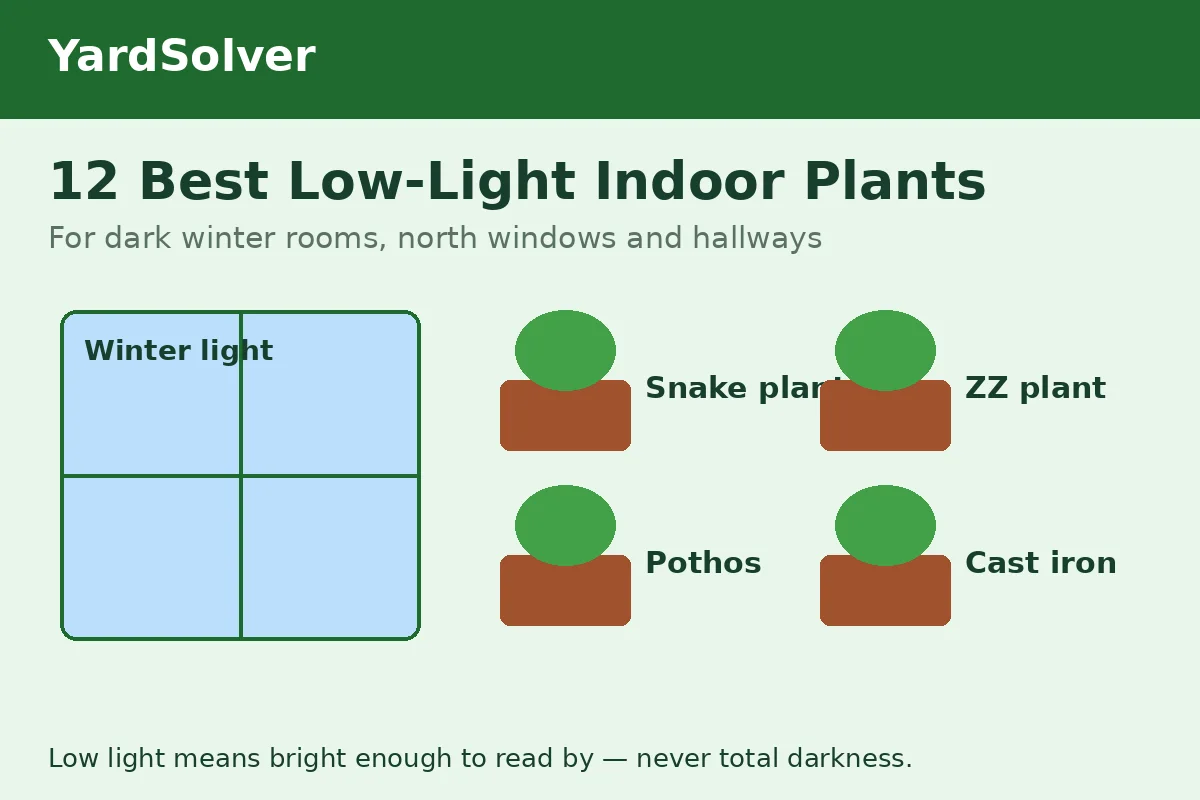
The indoor plants that genuinely survive low light are a short, proven list — snake plant, ZZ plant, cast iron plant, Chinese evergreen, pothos and heartleaf philodendron lead it — because "low light" has a real definition: roughly 25–75 foot-candles, the light 8 feet or more from a window, in a north-facing room or a hallway. Every plant below is chosen against that definition, for the homes that need it most in November and December: Canadian and northern-US rooms where a winter afternoon is dim by 4 p.m. This is a selection guide — which plants to buy for a dark spot. Keeping the plants you already own healthy through winter is the companion job in Houseplant Winter Care.
The short answer, on one card
Darkest corners: cast iron plant, ZZ plant, snake plant. Shelves and hanging pots: pothos, heartleaf philodendron. Pet-safe picks: spider plant, parlor palm, peperomia. One rule above all: low light means bright enough to read by — no houseplant lives in total darkness, and in a truly windowless room a small grow light beats a third doomed plant. In low light, water far less than you think: slow growth means slow drinking, and overwatering — not darkness — kills most low-light plants.
What "low light" actually means (measure it before you shop)
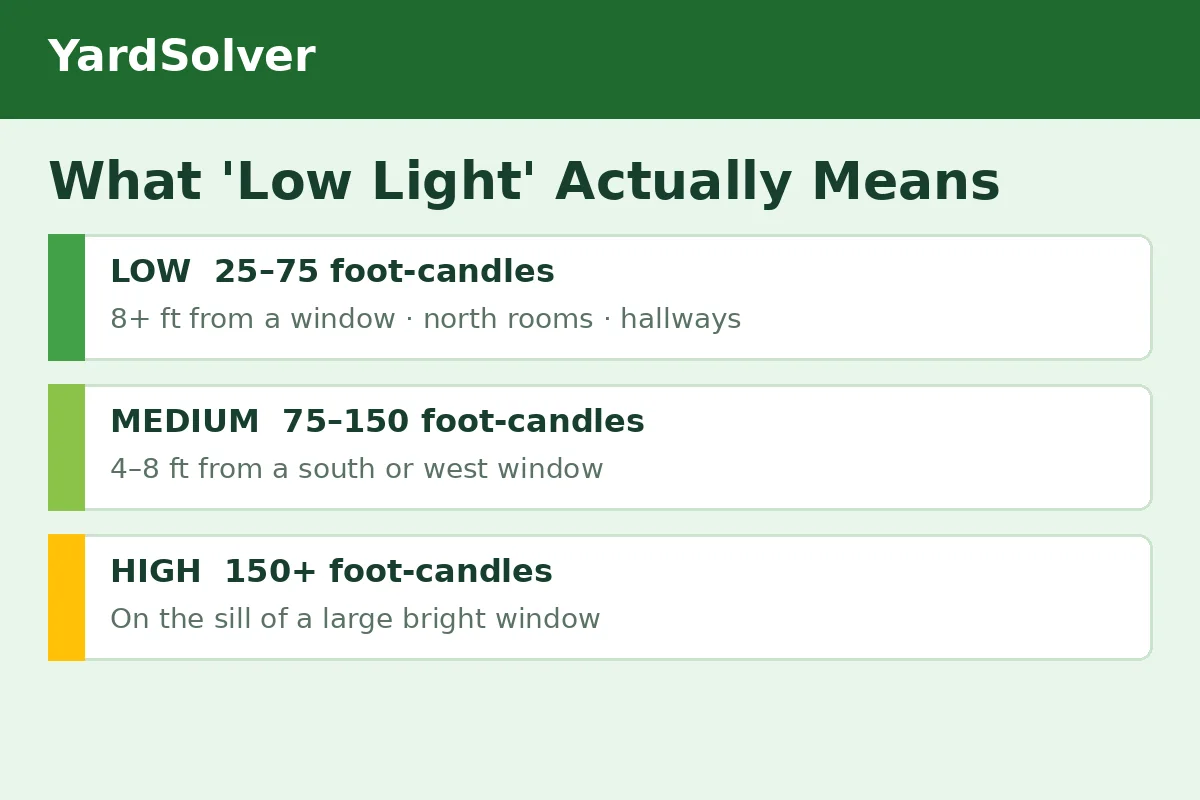
Extension light categories, measured in foot-candles, turn a vague label into a number you can check with a free phone light-meter app at leaf height, at midday, on a cloudy day — winter's honest reading. Low light is 25–75 foot-candles to maintain a plant; medium is 75–150; high is 150 and up. Light falls off brutally with distance: a pot on the sill can receive ten times the light of the same pot two metres into the room. That is why the same plant "thrives in low light" for one owner and fades for another — they were never in the same light.
| Spot in a winter home | Light level | Buy from the list |
|---|---|---|
| Beside a north-facing window | Low–medium, steady | Any of the 12; cast iron and pothos shine here |
| Bright room, 2–3 m from the window | Low | Snake plant, ZZ plant, Chinese evergreen, dracaena |
| Hallway or corner with ambient daylight | Low, the real test | Cast iron plant, ZZ plant, snake plant only |
| Bathroom with a small frosted window | Low + humidity | Peace lily, pothos, philodendron, bird's nest fern types |
| Windowless room | Below low — not enough | No plant long-term; add a grow light or rotate plants monthly |
The 12 best low-light indoor plants
1. Snake plant (Dracaena trifasciata) — the benchmark
University extension sources rate the snake plant among the most low-light-tolerant houseplants grown, and long-term interior trials keep it attractive for about a year even at very low light. Thick upright leaves store water, so winter watering can stretch to every 4–6 weeks. Its one killer is kindness: wet soil in a dark corner rots it. Full care is in our snake plant guide and watering guide; the plant page is Snake Plant. Toxic to pets.
2. ZZ plant (Zamioculcas zamiifolia) — the office survivor
The ZZ stores water in chunky underground rhizomes — built-in tanks — which is why it tolerates both dim corners and forgotten watering, and why extension notes record it growing even under fluorescent office light. Growth in low light is slow and glossy rather than leggy, so it keeps its looks. Water every 3–4 weeks in winter, less if the rhizomes are plump. See ZZ Plant. Toxic to pets.
3. Cast iron plant (Aspidistra elatior) — for the darkest corner you own
Victorian parlours were gas-lit and smoky, and this is the plant that survived them. The cast iron plant tolerates the lowest light on this list, shrugs off cool rooms and neglect, and asks only for patience — it grows slowly in every condition. If a hallway defeats everything else, it is this or a grow light. Pet-safe.
4. Chinese evergreen (Aglaonema) — colour where colour should not grow
Patterned silver-green leaves that hold up in low-to-medium light where most variegated plants revert to plain green. Choose darker-leaved varieties for the dimmest spots; the pale pink cultivars need noticeably more light. It wilts visibly when thirsty and recovers fast — a built-in watering gauge. Toxic to pets.
5. Pothos (Epipremnum aureum) — the trailing shelf plant
Nearly indestructible, fast even in modest light, and free to multiply: one plant becomes many with the method in How to Propagate Pothos. In dim light the golden variegation fades toward green and growth slows — surviving rather than thriving — but on a shelf 2 metres from a window it still looks good all winter. See Pothos. Toxic to pets.
6. Heartleaf philodendron (Philodendron hederaceum) — pothos's twin, slightly tougher
Everything said for pothos, with a touch more shade tolerance and smaller, heart-shaped leaves that suit hanging pots. Interior trials group it with the plants that stay attractive longest at very low light. See Philodendron. Toxic to pets.
7. Dracaena (corn plant & dragon tree) — the tall floor plant for a dim corner
When the corner needs height, dracaena is the low-light answer where a fiddle-leaf fig would fail. Trials at very low light kept dracaena attractive the longest of the common houseplants tested. Keep it on the dry side in winter; brown tips usually mean overwatering or fluoride-heavy water, not darkness. Toxic to pets.
8. Peace lily (Spathiphyllum) — the one that flowers in low light
The only reliable winter flower on this list, and happiest with the humidity of a bathroom with a frosted window. It droops dramatically when dry and recovers within hours of watering — theatre, not crisis. It prefers medium light and merely tolerates low, so give it your brightest low-light spot. See Peace Lily. Toxic to pets.
9. Parlor palm (Chamaedorea elegans) — pet-safe and graceful
The classic Victorian parlour palm: soft fronds, slow growth, genuine low-light tolerance and a non-toxic rating that makes it the default tall plant for homes with cats and dogs. Keep the soil lightly moist rather than bone dry — it is the exception to this list's drought-built majority.
10. Spider plant (Chlorophytum comosum) — pet-safe, and it makes free plants
Arching striped leaves and a fountain of baby plantlets you can pot up for gifts. It prefers medium light and survives low, growing plainer and slower; a monthly rotation to a brighter spot keeps it full. Non-toxic and famously forgiving. See Spider Plant.
11. Peperomia — the small desk plant that is safe around pets
Compact, sculptural leaves in a dozen textures, happy on a desk away from the window under ordinary room light, and non-toxic. Water sparingly — its semi-succulent leaves store a reserve, and winter rot is again the main risk.
12. Prayer plant (Maranta) — the borderline beauty
Listed honestly as low-to-medium: the patterned leaves that fold up at night need your brightest low-light spot and the humidity help in our humidity guide. In return it is pet-safe and the most decorative plant that can honestly be sold for a dim room. If it pales and stretches, it is asking for the grow light, not more water.
Plants sold as "low light" that will disappoint you
Three popular plants are marketed into dark corners they cannot survive. Fiddle-leaf fig (plant page) needs high light and drops leaves in protest at a dim room. Monstera (plant page) tolerates medium light but in low light produces small, un-split leaves on long bare stems. Succulents and jade plants are desert plants: a dark winter room gives them stretched, pale growth and rot. Save all three for the windowsill — the 12 above are the corner plants.
Winter care rules for low-light plants
Low light rewrites the care card. Water less: a plant making little food drinks little; check soil, never the calendar, and expect intervals of 3–6 weeks in a dim winter room. Feed almost never: a few times a year is plenty, and none in mid-winter — see the feeding rule in Houseplant Winter Care. Dust the leaves monthly: dust taxes the little light there is. Rotate: a monthly swap between a bright spot and the dim spot rebuilds a plant's reserves, the extension-recommended trick for permanent low-light positions. Watch for pests: stressed, dusty, dry-air plants invite the cast of Winter Houseplant Pests. And learn the distress signal: long bare stems with small, widely spaced leaves mean the plant is reaching for light it cannot find — move it or light it, because no watering schedule fixes darkness.
Keep going
Already own houseplants that are struggling? Start with Houseplant Winter Care, then go deep on the Snake Plant, browse the Plant Library, and add winter humidity with How to Increase Humidity for Houseplants. Seeding under lights instead? See Grow Lights for Seedlings.
Sources
Light categories in foot-candles and the long-term low-light trial results (dracaena, cast iron plant, Chinese evergreen, philodendron and snake plant at 15–20 foot-candles) follow the NC State Extension Gardener Handbook's houseplant light research, summarised at LeafCheck — Low Light Indoor Plants. The 25–75 foot-candle working definition of low light and placement guidance follow PlantAtlas — Low Light House Plants: The Foot-Candle Guide. Pet-safety ratings reflect the ASPCA toxic and non-toxic plant listings as commonly summarised by extension services.
Questions people ask
Can any houseplant live with no light at all?
No. Every plant photosynthesises, and low light still means 25–75 foot-candles — bright enough to read by. A truly windowless room defeats even a snake plant within months. The honest fixes are a small full-spectrum grow light on a timer, or rotating two plants monthly between the dark spot and a bright window so each rebuilds its reserves.
What is the best low-light plant for a dark hallway?
The cast iron plant, followed closely by the ZZ plant and snake plant. These three tolerate the lowest light of any common houseplants — the cast iron plant famously survived gas-lit Victorian parlours — and all three forgive the irregular watering hallways tend to get.
Which low-light indoor plants are safe for cats and dogs?
Spider plant, parlor palm, peperomia, cast iron plant and prayer plant are the pet-safe picks on this list. Snake plant, ZZ plant, pothos, philodendron, Chinese evergreen, dracaena and peace lily are all toxic if chewed, so place them out of reach or choose from the safe five.
Why is my low-light plant getting leggy and pale?
It is reaching for light it cannot find: stems stretch, leaves shrink and space out, and variegation fades to plain green. That is a light problem, not a water or food problem. Move the plant closer to the window, rotate it monthly with a brighter spot, or add a grow light — and expect new growth, not the stretched stems, to show the improvement.
How often should I water indoor plants in low light in winter?
Far less than in summer — commonly every 3–6 weeks for the drought-built plants on this list. Low light means slow growth and slow drinking, while the soil stays wet much longer. Always test the soil first: most of these plants want it dry through the top half of the pot before water, and overwatering kills more low-light plants than darkness ever does.
Do low-light plants need fertilizer?
Very little. A plant in low light grows slowly and uses little food, so feeding a few times a year in the growing season is enough, and none is needed in mid-winter. Excess fertilizer in a resting plant builds up as salts and scorches roots — pale growth in a dark room is a light shortage, not hunger.
Comments & ratings
No comments yet.
Be the first to share your experience.