
Guides · Soil & feeding · Published November 20, 2026 · By Faizan Ahmad
How to Choose the Right Fertilizer for Your Lawn and Garden (Without Guessing)
Choose fertilizer in this order: test the soil first, name the one job you want done, then pick the product type and form that do that job — in that order, never the other way round. Most fertilizer disappointment comes from reversing it: a bag is bought because it was on offer, then applied everywhere, so the lawn gets phosphorus it never needed, the tomatoes get nitrogen that grows leaves instead of fruit, and the one bed that actually needed potassium gets none. This guide is the decision itself — which fertilizer, for which goal, in which form, and when. Two companion pages handle the neighbouring questions so this one stays a buying decision: Fertilizer Numbers Explained decodes the three numbers on the bag, and How Much Fertilizer Do I Need? plus the Fertilizer Calculator work out the amount once you have chosen.
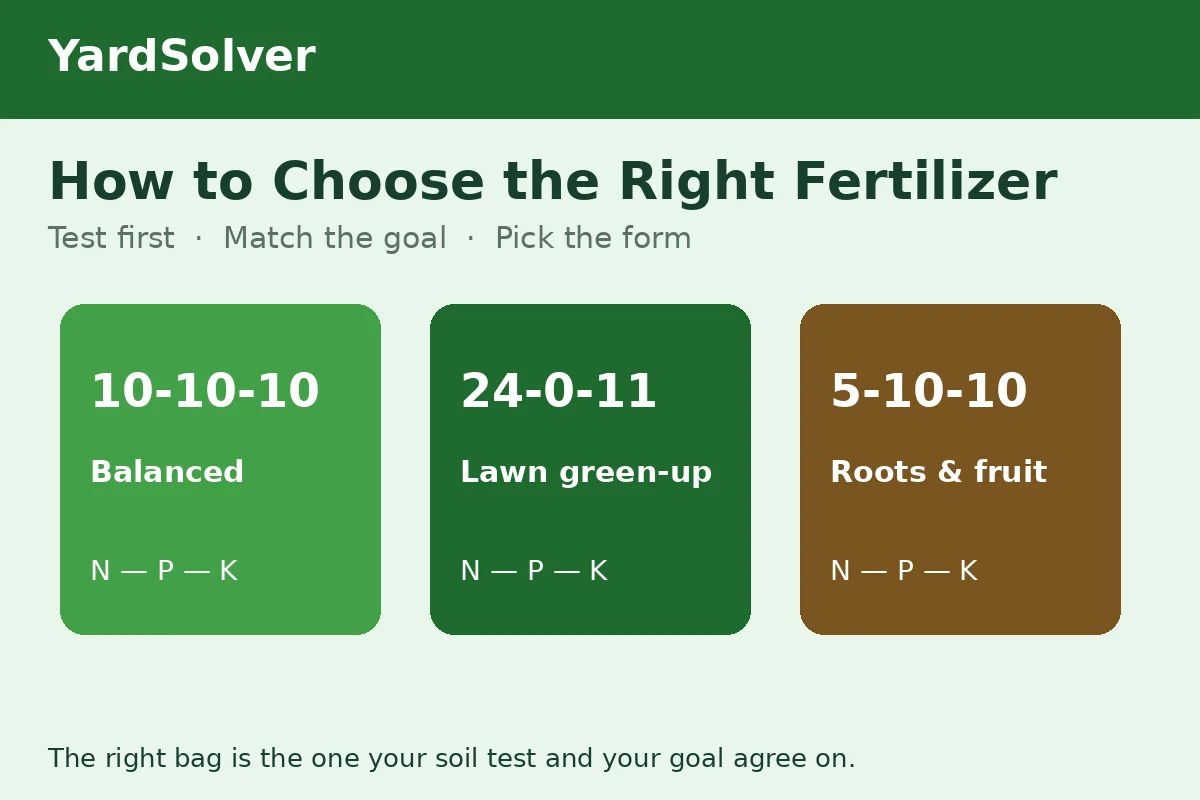
The short answer, on one card
Step 1: get a soil test (about $20 through an extension lab) — it tells you what is already there. Step 2: pick by goal: green growth wants nitrogen, flowers and fruit want phosphorus and potassium, soil health wants organic matter. Step 3: pick the form: granular for slow, even feeding; liquid for a fast, short rescue; organic for building soil season over season. Step 4: apply in active growth, never to frozen or dormant ground. If you skip every other step, keep Step 1 — a fertilizer chosen without a soil test is a guess with a price tag.
Step 1 — Test the soil before you buy anything
A soil test is the cheapest decision in gardening. University extension guidance is blunt about it: begin safe fertilization with a soil test, because the test reports the phosphorus and potassium already in your soil and the pH that decides whether plants can use any of it. Nitrogen is not usefully tested — it moves too fast — so the test's real job is to stop you buying the two nutrients your soil may already hold in surplus, and to flag a pH problem that no fertilizer can fix. Sample 15–20 cm (6 inches) deep from eight to ten spots, mix, and send about a pint; our step-by-step is in How to Test Your Garden Soil. Test every 2–3 years on sandy soil and every 3–4 years on clay or established beds. Fall is an excellent time: results arrive over winter, lime (which needs months to work) can go on before spring, and your 2027 fertilizer order becomes a list instead of a hunch. If the test shows pH is the problem, fix that first with lowering or raising soil pH — fertilizer poured into the wrong pH is money locked in the soil where roots cannot reach it.
One quotable rule follows from every extension recommendation: phosphorus should only be added when a soil test shows it is low. Lawns and beds fed "balanced" fertilizer for years commonly test high or excessive in phosphorus, and the excess does not sit harmlessly — it washes toward drains and waterways. The test is what turns "balanced" from a habit into a decision.
Step 2 — Name the goal, then match the type
Plants do not want "fertilizer"; they want a specific nutrient for a specific job. Nitrogen drives leaf and stem growth. Phosphorus supports roots, flowers and fruit set. Potassium underwrites overall toughness — disease resistance, drought tolerance and winter hardiness. Choose by the job in front of you:
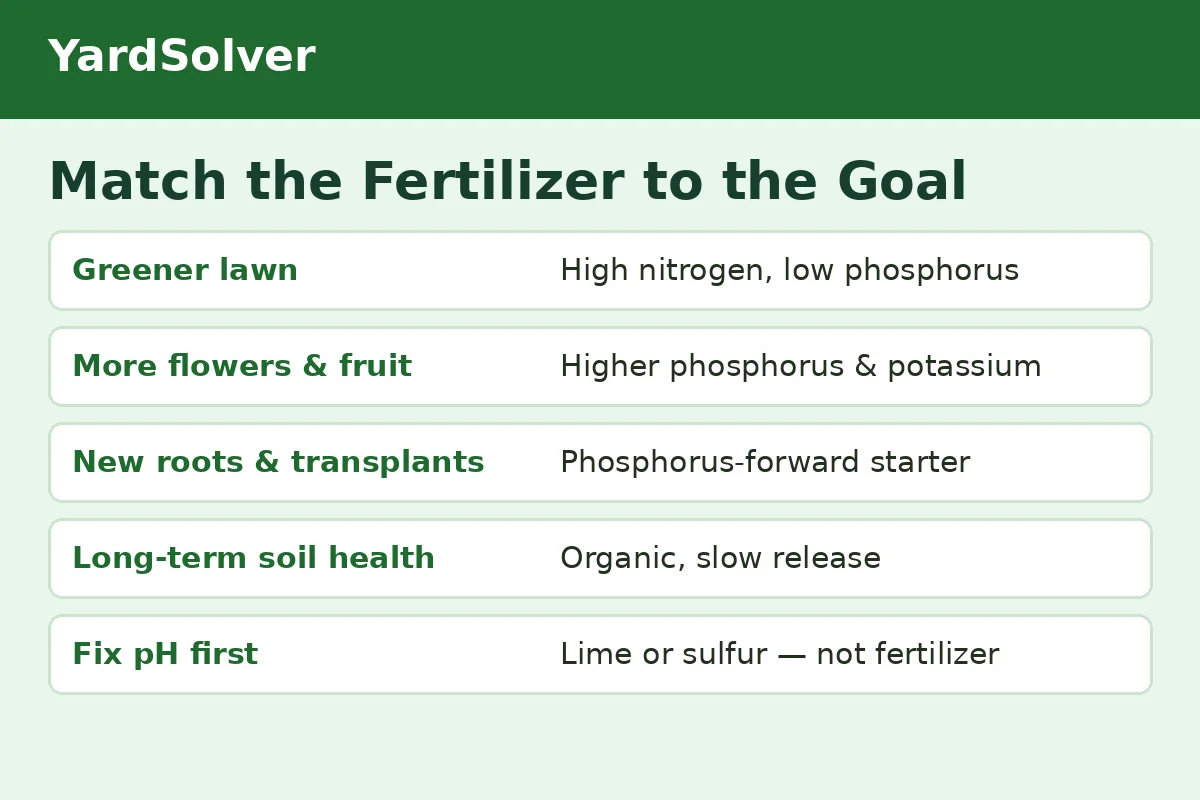
| Your goal | Choose this type | Typical analysis | Watch out for |
|---|---|---|---|
| Greener, thicker lawn | High-nitrogen, low- or no-phosphorus lawn feed | 24-0-11, 21-0-0 | Fast green-up feeds burn if over-applied; slow-release is safer |
| More flowers | "Bloom" feed, phosphorus-forward | 10-20-10 style ratios | Only if soil phosphorus is not already high |
| Better tomatoes & fruiting vegetables | Balanced-to-potassium feed, steady supply | 5-10-10, tomato feeds | Too much nitrogen = huge plants, few fruit |
| New lawn, transplants, seedlings | Starter fertilizer, phosphorus available at the roots | Starter blends | Keep off foliage; water in well |
| Leafy greens & sweet corn | Nitrogen-forward feed, split doses | High first number | Side-dress mid-season rather than one heavy dose |
| Building tired soil over seasons | Organic fertilizer plus compost | 3-4-3, 5-3-3 style | Slow: weeks to months to release; plan a season ahead |
| Quick rescue of a pale, hungry plant | Liquid or soluble feed | Water-soluble blends | Effect lasts days to weeks — a rescue, not a programme |
Extension lawn guidance makes the same point with a ratio: without a soil test, a roughly 3-1-2 nitrogen-phosphorus-potassium pattern (for example 15-5-10) is the traditional fallback for lawns — and the same guidance warns that even that fallback can add phosphorus a lawn does not need, which is exactly why the test in Step 1 outranks every table, including this one.
Step 3 — Pick the form: granular, liquid, or organic meals
Granular (dry) fertilizer
The default for lawns and beds. Spread, water in, done. Slow-release (coated) granular feeds over 6–10 weeks and is the forgiving choice for beginners because a small measuring error does not scorch. Fast-release granular is cheaper per unit of nutrient and easier to overdo — the white-granule overdose is the classic route to fertilizer burn.
Liquid and soluble feeds
Fastest to the plant — hours to days — and shortest-lived. Best for containers (where every watering washes nutrients out), for seedlings, and for a visible rescue. Worst value as a whole-garden programme: you will be re-applying every week or two through the season.
Organic fertilizers and meals
Compost, manure, blood meal, bone meal, kelp and alfalfa release nutrients only as soil microbes break them down — weeks to months, and only while soil is warm enough for microbes to work. Concentrations are low (often 1–6% nitrogen versus 10–46% in synthetics), so you apply more material, but you are also feeding soil structure, water-holding and biology with every dose. The honest summary used by growers on both sides: organic feeds the soil that feeds the plant; synthetic feeds the plant directly. A mature garden usually ends up using both — organic matter as the base, a targeted synthetic or mineral feed when a test shows a specific gap.
Step 4 — Time it to growth, not to the calendar in the shop
Fertilizer only works on a plant that is growing. Lawns take their main feeds in spring and early fall (the fall feed matters most for cold-climate lawns going into a Canadian or northern-US winter). Vegetables are fed at planting and again at the growth stage the crop demands — fruiting crops when flowers appear, leafy crops mid-growth. Trees and shrubs need far less than garden-centre labels imply, and mature specimens often need none. Never fertilize frozen ground, dormant lawns in mid-winter, or drought-stressed plants before watering: nutrients sit unused, salts concentrate, and the first heavy rain carries the money into the storm drain. Winter itself has one fertilizer job, and it is Step 1 again — test now, so the spring purchase is exact. When spring comes, amounts come from the Fertilizer Calculator, not from the back of the bag alone.
The five choosing mistakes that waste the most money
1. Buying "balanced" by habit. A 10-10-10 applied yearly to soil already rich in phosphorus builds a surplus problem while the plant still lacks the one nutrient it needed. 2. More is better. Double fertilizer is not double growth; it is burnt roots, soft pest-prone growth and runoff. 3. One bag for everything. The lawn, the roses and the tomatoes have three different jobs (Step 2). 4. Feeding a pH problem. Yellowing in high-pH soil is often locked-out iron, not missing fertilizer. 5. Skipping compost. No bag replaces organic matter: if your soil program has no compost in it, start with composting for beginners and the greens-to-browns ratio, then let fertilizer do only the topping-up it is good at.
Keep going
Chosen your type? Work out the exact amount with the Fertilizer Calculator and How Much Fertilizer Do I Need?. Still unsure what the numbers promise, read Fertilizer Numbers Explained; worried you have already overdone it, see Fertilizer Burn.
Sources
Soil-test-first method, sampling depth and the pH 5.5–7.0 availability ranges follow the University of Delaware Cooperative Extension, Fertilizer Basics. The 3-1-2 lawn ratio fallback and the warning against untested phosphorus follow Texas A&M AgriLife Extension lawn guidance, summarised in This Old House — Essential Nutrients for Your Lawn and Garden. Organic-versus-synthetic release speeds and concentrations reflect standard extension comparisons of the two families.
Questions people ask
What is the best fertilizer for a beginner to buy?
A slow-release granular feed matched to one job — a high-nitrogen lawn feed for grass, or a balanced vegetable feed for beds — bought after a soil test. Slow-release forgives small measuring errors that fast-release feeds punish with burnt roots, and a single-goal product beats an all-purpose bag applied everywhere by habit.
Is organic or synthetic fertilizer better?
Neither, outright — they do different jobs. Organic fertilizers release slowly as microbes break them down, build soil structure and biology, and run at low concentrations (often 1–6% nitrogen). Synthetics are concentrated, precise and fast, but add nothing to the soil itself. Most good gardens use organic matter as the base and a targeted feed for a tested gap.
Can I use the same fertilizer on my lawn and my vegetables?
You can, but it is rarely the right choice. Lawns mostly need nitrogen; fruiting vegetables need phosphorus and potassium as well, and excess nitrogen grows leaves instead of fruit. Two smaller, goal-matched products outperform one bag used everywhere.
Do I really need a soil test before fertilizing?
For phosphorus and potassium, yes — those are the nutrients gardeners most often add when the soil already has plenty, and only a test can tell you. Extension labs typically charge about $20 and the results also give you pH, which decides whether any fertilizer can work at all. Nitrogen is managed by rate and timing instead, since it moves too quickly to test usefully.
When should I buy and apply fertilizer?
Test in fall or early spring, buy once you have the results, and apply when plants are actively growing — spring and early fall for lawns, at planting and key growth stages for vegetables. Never apply to frozen ground or dormant plants: the nutrients cannot be used and are easily washed away.
Does fertilizer go bad in storage?
Dry granular fertilizer keeps for years if stored dry and sealed; it may cake but does not lose its analysis. Liquid concentrates also keep well away from freezing. The bigger winter job is not storage — it is using the quiet season to soil-test so next year's purchase is exact.
Comments & ratings
No comments yet.
Be the first to share your experience.