
Guides · Water & irrigation · Published November 22, 2026 · By Faizan Ahmad
How to Plan Drip Irrigation: Emitters, Flow Rates and Run Times
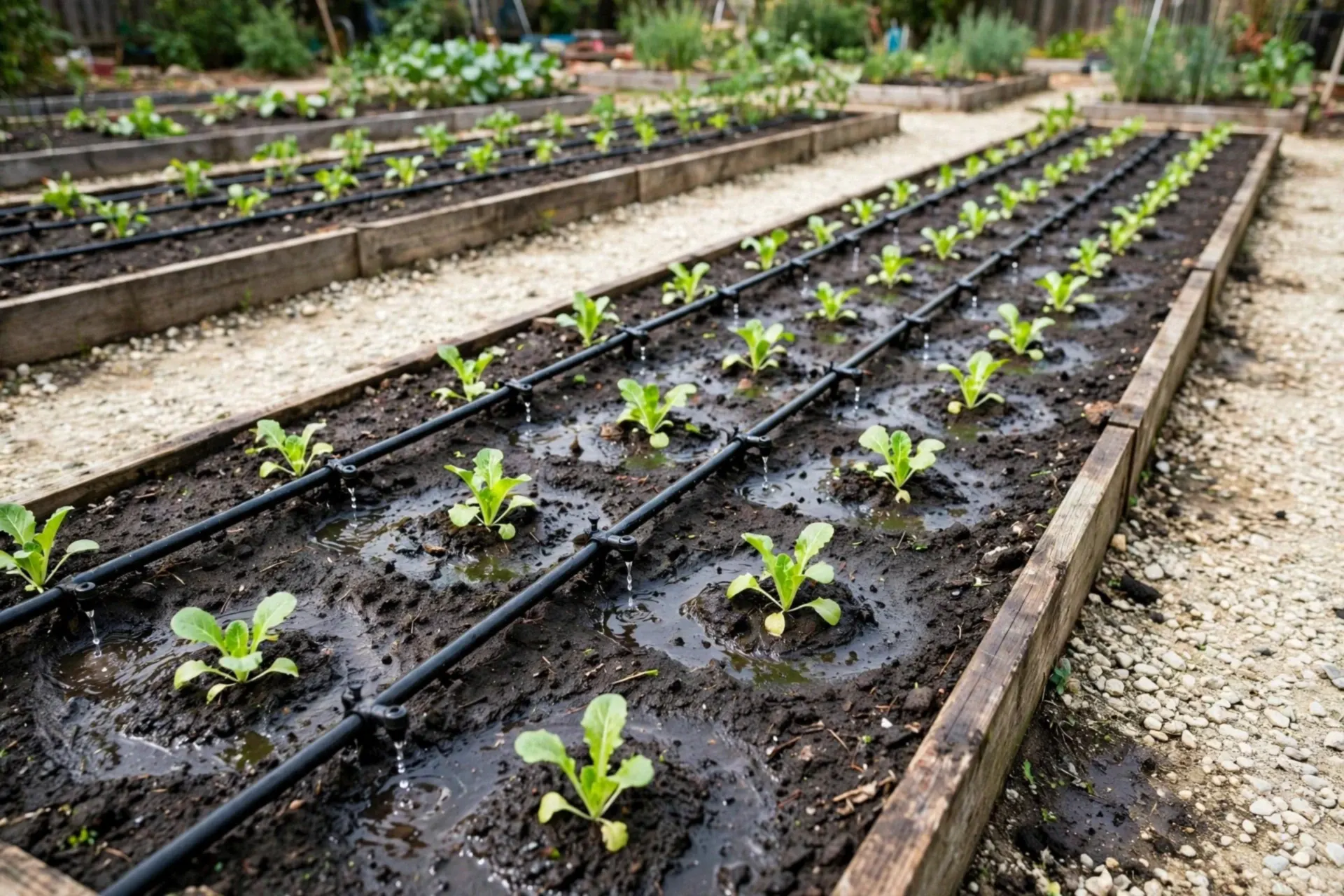
A drip system is planned with three sums, and most disappointing systems skipped the second one. Count the emitters, total the flow they draw, and divide the water you intend to apply by that flow to get the run time — our Drip Irrigation Calculator runs all three and checks the mainline limit for you. This guide works the method for individual plants and for drip-line rows, and ends with the jug test that verifies the plan against real pressure.
The short answer, on one card
- Emitters: plants × emitters per plant, or line length ÷ spacing (+1)
- Zone flow: emitters × emitter rate — keep one zone under ~200 gal/hr on a ½-inch mainline
- Run time: gallons to apply ÷ zone flow — 20 gal at 40 gal/hr is 30 minutes
- Two emitters per plant, one each side of the stem — one wets a column, not a root zone
- Verify with the jug test: time the far emitter into a measuring jug and adjust run time to real flow
Step 1 — Count emitters the way the water sees them
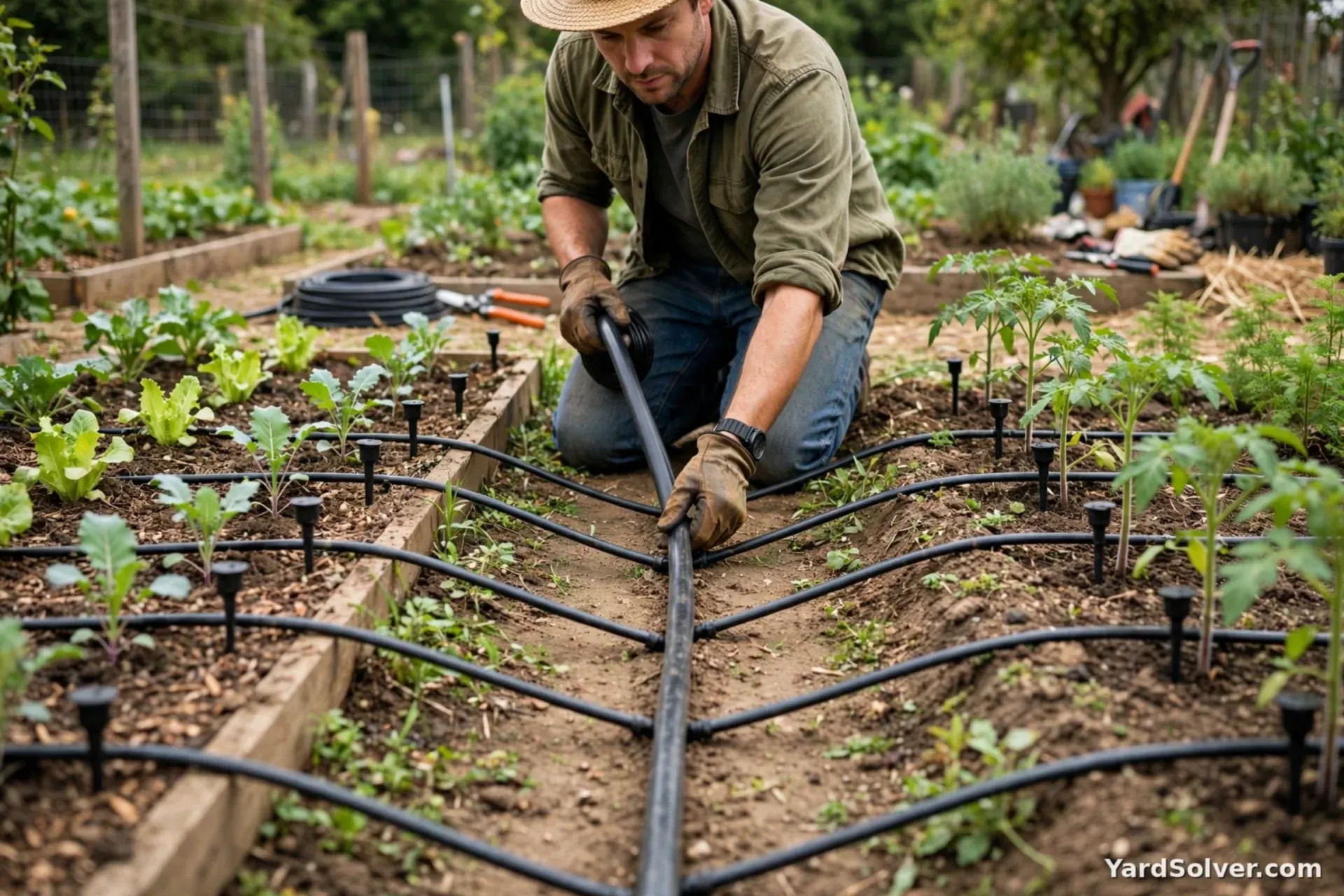
Every emitter is a tap the zone must feed, so the plan starts by counting them. For planted crops the count is plants × emitters per plant — and the per-plant number deserves thought: one emitter wets a narrow column of soil directly beneath it, while a root zone is a disc. Two emitters, one each side of the stem a few inches out, wet a disc a vegetable actually occupies; shrubs take a ring of two to four, and trees a ring that migrates outward as the canopy grows.
For drip line in beds, the count is built into the product: emitters moulded every 6, 9, 12, 18 or 24 inches. Line length ÷ spacing, plus one for the emitter at the start, is the count — a 50 ft line at 12-inch spacing is 51 emitters, whether you planned for them or not. Spacing follows soil: sandy soil spreads water sideways poorly, so choose 6–12 inches; clay spreads it wide, so 18–24 inches still wets the row.
Step 2 — Zone flow and the 200 gal/hr ceiling
Multiply emitters by their rated flow and you have the zone’s demand. Compare it with what the pipe can carry: a standard ½-inch drip mainline tops out around 200 gal/hr before friction losses starve the far end of the line. The table shows how quickly ordinary layouts reach the ceiling.
| Layout | Emitters | At 1 gal/hr each | Verdict |
|---|---|---|---|
| 12 pots, 1 emitter each | 12 | 12 gal/hr | One zone, easily |
| 20 tomatoes, 2 each | 40 | 40 gal/hr | One zone |
| 50 ft line at 12 in spacing | 51 | 51 gal/hr | One zone |
| 4 × 50 ft lines at 12 in | 204 | 204 gal/hr | Split into 2 zones |
| 100 shrubs, 2 each at 2 gal/hr | 200 | 400 gal/hr | Split into 2–3 zones |
Over the ceiling, the fix is zoning — splitting the layout into groups that run one after another — not a bigger pump on the same small pipe. Run your own layout through the Drip Irrigation Calculator — emitters, flow and run time, which counts the zones for you.
Step 3 — Run time from a water target, not a guess
Run time is a division, not a tradition: gallons to apply ÷ zone flow. The target comes first — a gallon per tomato per session, or half an inch over the bed (an inch over a square foot is 0.623 gallons, the conversion the calculator uses). Twenty gallons through a 40 gal/hr zone is 30 minutes; 62 gallons through 51 gal/hr of drip line is about 73. Gardeners who "run the drip for an hour" without the division are watering by folklore, and their beds show it.
How much water the crop actually wants per week is the companion question, answered by crop, growth stage, temperature and soil in the Watering Schedule Calculator. Bring its per-session depth or per-plant figure back to the drip plan and the two pages together size the whole system: demand first, then hardware, then minutes.
Step 4 — The jug test: verify the plan against pressure

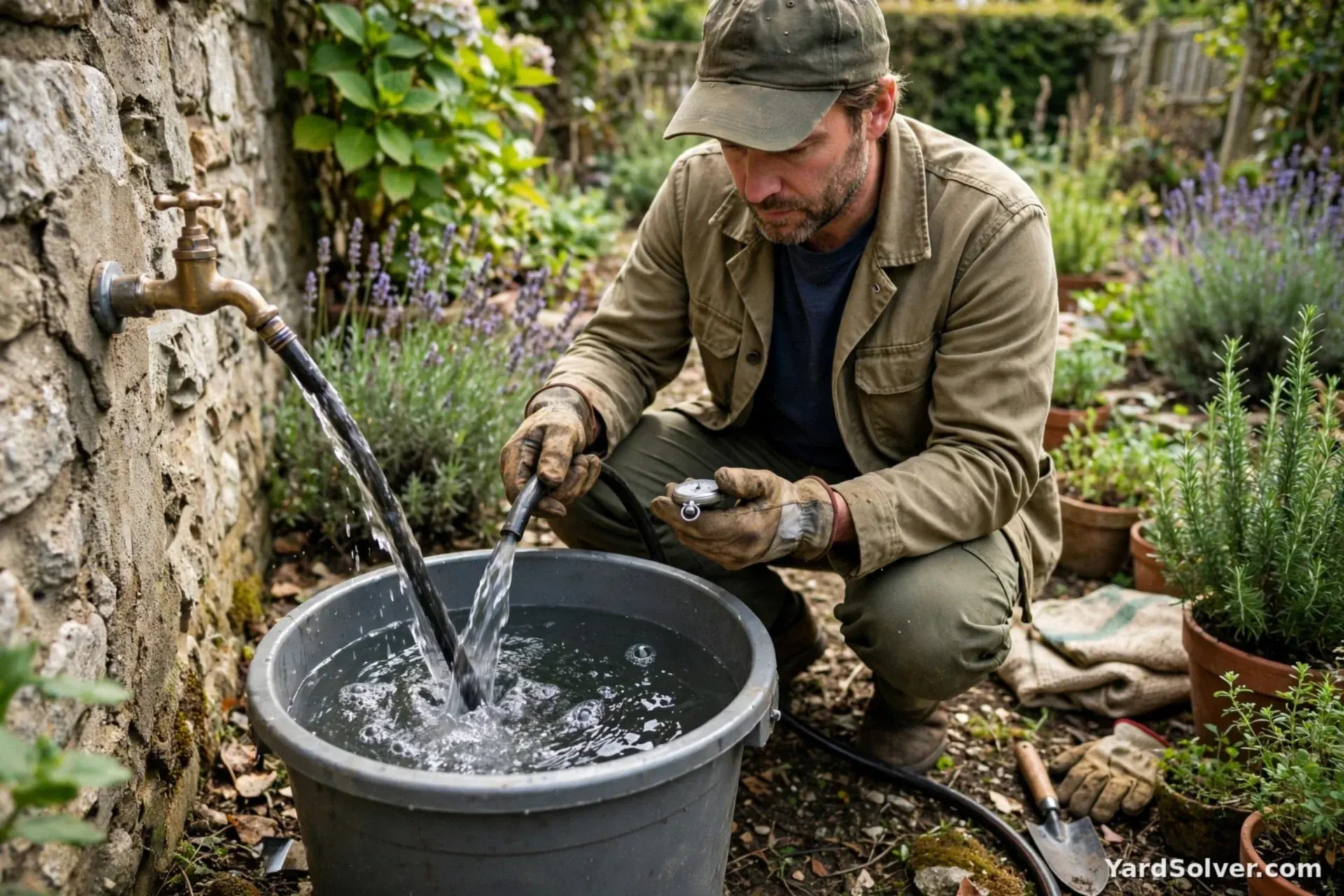
Emitter ratings are printed at a standard pressure (usually 25 psi), and real gardens deliver less at the end of a long line. The verification takes two minutes: put a measuring jug under the first emitter and then the last, run each for one minute, and compare. If the last emitter is more than about 10% slower, the plan’s minutes belong to the slow end — lengthen run time by the same proportion, or shorten runs and split the zone until the ends agree.
Then mulch over the lines and stop touching them. Drip under mulch loses almost nothing to evaporation, the emitters stay put, and the system you verified in spring is still the system in August. Flush the line ends at the season’s start and end — the whole maintenance burden of drip, honestly stated, is about twenty minutes a year.
Questions people ask
How long should I run my drip system?
As long as the division says: gallons you intend to apply ÷ zone flow. For many vegetable zones that lands between 30 and 90 minutes per session. A fixed 'one hour' habit over-waters small zones and starves big ones — compute it once for your layout and write the number on the timer.
Can I mix 0.5 and 2 gal/hr emitters on one zone?
You can, and designers do — to give big plants more water in the same run time. Just count the flow honestly (each emitter at its own rate) and remember the plants share the clock: the mix sets relative doses, the run time sets the total.
Why are the plants at the end of my line always thirstier?
Friction. Every foot of pipe and every emitter upstream costs pressure, and emitters are pressure-sensitive. The usual causes are a zone over the ~200 gal/hr mainline limit or laterals run too long — the jug test shows it, and zoning fixes it.
Drip or soaker hose?
Drip line with moulded emitters delivers a known rate per emitter and can be planned exactly, as this guide does. Soaker hose weeps unevenly along its length and cannot be rated — pleasant for a shrub border, unplannable for a vegetable system.
What pressure does a drip system need?
Most drip components are built for about 15–30 psi, far below household pressure, which is why the header assembly includes a pressure regulator. Skipping the regulator is the classic cause of blown fittings and misting emitters.
Sources
Key facts on this page cross-checked against Drip Irrigation for Home Gardens — Colorado State University Extension — extension guidance on drip layout, emitter selection and scheduling for home gardens Drip irrigation — Wikipedia — background on drip systems, components and water efficiency.
Related page
Read next: How to Set Up Drip Irrigation: The Full Installation Walkthrough
Comments & ratings
No comments yet.
Be the first to share your experience.