
Guides · Vegetable Growing · Published November 22, 2026 · By Faizan Ahmad
How to Support Tomato Plants: Stakes vs Cages vs Florida Weave
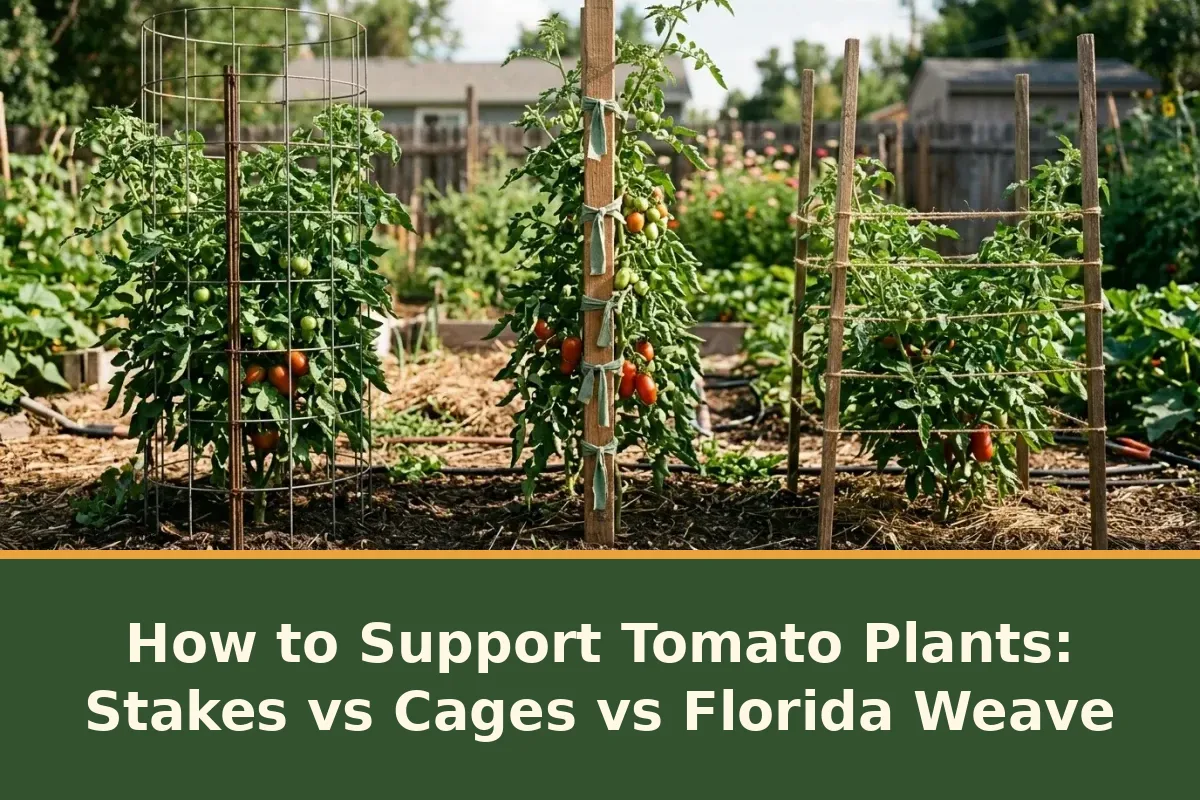
Support tomato plants on the day you transplant them, and match the method to the plant: determinate (bush) tomatoes suit a sturdy cage or short stake, indeterminate (vining) tomatoes need a tall stake, a heavy 5-foot cage or a Florida weave with tall posts, and rows of plants are cheapest on the weave. Supported tomatoes keep fruit off the soil, dry faster after rain, suffer less disease and are far easier to pick. This guide compares tomato stakes vs cages vs the Florida weave on cost, effort and plant type, then covers installation timing, spacing and tying technique.
Tomato support at a glance
- Every tomato plant needs support — even bush varieties. Unsupported plants lose fruit to rot, slugs and soil-borne disease.
- Determinate (bush) plants stop at 3–5 ft and suit a sturdy cage or a short stake.
- Indeterminate (vining) plants grow 6–10 ft until frost and need a tall stake, a heavy cage or a weave with tall posts.
- Install at transplant time. A stake driven in later tears through roots; a sprawling plant cannot be forced into a cage without snapping stems.
- The cheapest method per plant is the Florida weave for rows; the least weekly work is a good cage; the best airflow and smallest footprint is a single stake.
Step 1 — Why support is not optional
A tomato plant left to sprawl puts its fruit on the soil, and fruit on soil rots, splits after rain, and gets eaten by slugs and insects. The foliage mat underneath stays wet for hours after every rain or watering, and wet foliage is where the leaf diseases — early blight, septoria leaf spot, and the spores that start worse — establish first. Supported plants dry faster, and that single difference slows disease more than most sprays do.
Support also changes the fruit itself. Trusses held off the ground colour evenly, stay clean, and are visible at picking size instead of being found a week late under a leaf. Picking is faster, pruning is possible, and the plant's energy goes into fruit you actually harvest. The full growing method around the support — soil, watering, feeding — is in How to Grow Tomatoes, and the plant's own page is Tomato in the Plant Library.
Step 2 — Match the support to the plant type
The seed packet word that decides everything is determinate or indeterminate. Determinate (bush) tomatoes grow to a set height of about 3–5 ft, flower over a short window, and set most of their fruit at once — they need modest, wide support and no pruning. Indeterminate (vining or cordon) tomatoes keep growing until frost kills them, commonly reaching 6–10 ft, and crop continuously — they need tall, strong support and, on a stake, regular tying and side-shoot removal (see How to Prune Tomato Plants).
The most common support failure in home gardens is a mismatch: a vigorous indeterminate variety in a small cone cage. By midsummer the plant outweighs the cage, the cage leans or collapses, and the fruit ends up on the ground anyway — the worst of both methods. Read the packet before you buy the support, not after.
Step 3 — The three methods, compared honestly
| Method | Typical cost per plant | Weekly effort | Best for | Watch out for |
|---|---|---|---|---|
| Single stake | Lowest — one stake and ties | High — tie in every 8–12 in of growth, prune to 1–2 stems | Indeterminates in small spaces; windy sites; best airflow | Skipped tying for two weeks means a snapped or sprawling stem |
| Cage | Moderate — cheap cone cages fail; heavy-gauge or homemade mesh cages cost more but last years | Lowest — guide stems back inside occasionally, no pruning needed | Determinates of any size; indeterminates only in a tall (5 ft+), wide cage | Standard cone cages are too small for indeterminates; anchor cages against wind |
| Florida weave | Lowest per plant in a row — stakes every 1–2 plants plus twine | Moderate — add one twine level every 6–8 in of growth | Rows of determinate or compact plants; anyone growing 6+ plants | Tall indeterminates outgrow standard weave stakes; needs a straight row |
Single stake. Use a stake 6–8 ft long for indeterminates (4–5 ft for determinates), driven 12–18 in into the ground, 3–4 in from the stem, at planting. Tie the main stem loosely every 8–12 in with soft twine, cloth strips or plant tape in a figure-of-eight, so the tie — not the stem — takes the rubbing. Prune staked indeterminates to one or two main stems or the plant becomes too heavy for its ties.
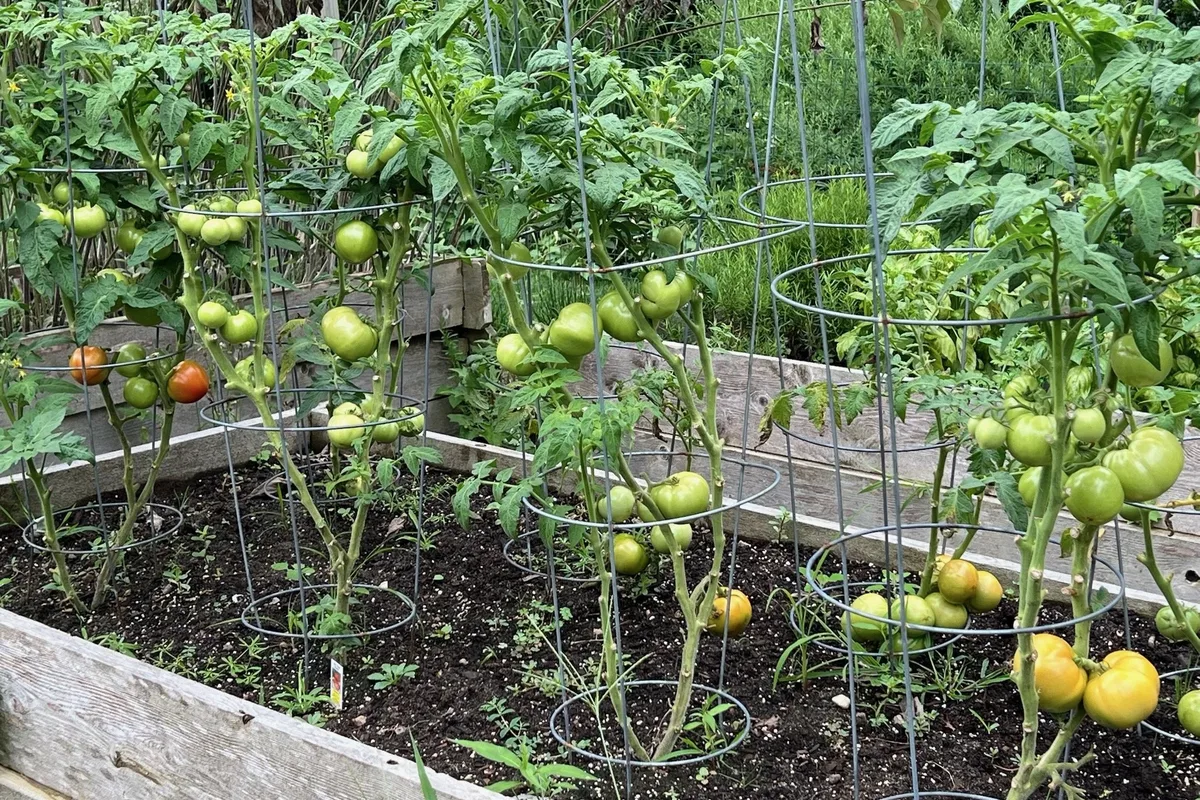
Cage. Set the cage over the plant on planting day and anchor it the same day with a stake or pins — a loaded cage catches wind like a sail. The cone cages sold everywhere suit determinate and patio tomatoes only. For indeterminates, the proven homemade version is a cylinder of concrete reinforcing wire about 5 ft tall and 18–24 in across, with mesh wide enough (about 6 in) to reach through at harvest. Caged plants are usually left unpruned, and the extra foliage usefully shades fruit in hot climates.
Florida weave (stake-and-weave). Plant in a straight row. Drive a strong stake at each end and one between every one or two plants — 4–5 ft stakes for determinates, taller for indeterminates. When plants are about a foot tall, tie non-stretch twine to an end stake 8–10 in above the soil, run it along one side of the row wrapping once around each stake, then return along the other side so the plants are sandwiched between the two strands. Add a new level every 6–8 in of growth, keeping the twine snug. No individual tying, no pruning required, and a whole row takes minutes per level.
Step 4 — Install on transplant day, every time
The best time to install any tomato support is the day you transplant — not when the plant "looks like it needs it." Three things go wrong when you wait. A stake driven beside an established plant spears through the root ball you spent weeks growing. A cage lowered over a sprawling plant snaps stems and tears leaves on the way down. And a plant that has flopped and rooted its posture rarely stands straight again, however good the support.
Spacing is set on the same day, and the support method changes it: staked, pruned plants can sit 18–24 in apart, caged plants need 24–36 in, and weave rows run 18–24 in in the row with the stakes carrying the structure. The full spacing table for tomatoes alongside every other vegetable is the Vegetable Plant Spacing Chart. While you are planning the bed, the Tomato Companion Planting Chart shows what to plant in the gaps — basil and marigolds earn their space beside supported tomatoes.
Step 5 — Tying technique and the mistakes that undo it
Tie soft, tie loose, tie often. Use materials that will not cut a stem as it thickens: soft twine, torn cloth strips, plant tape or reusable clips. Loop the tie around the stake first, cross it into a figure-of-eight, and loop the stem inside the second circle with room to spare — a stem can double in thickness in a fortnight, and a tight tie becomes a tourniquet. Add ties little and often: every 8–12 in of new growth on stakes, one new twine level every 6–8 in on the weave, and a weekly walk past cages to tuck escaping stems back inside.
The five common mistakes. (1) Installing late — covered above, and the most expensive of the five. (2) Buying cone cages for indeterminate varieties. (3) Tying with wire, thin string or twist ties that slice stems. (4) Never anchoring a cage, then losing plant and cage together in the first summer storm. (5) Letting a staked plant keep every side shoot, so one stem's support ends up carrying five stems' weight. Mistake five is a pruning question, and How to Prune Tomato Plants covers exactly which shoots come off and which stay.
Keep going
Support is one part of the tomato system. The rest lives in How to Grow Tomatoes, the Tomato plant page (sowing, spacing, feeding and harvest in one place), How to Prune Tomato Plants and the Tomato Companion Planting Chart. For bed layout, the Vegetable Plant Spacing Chart gives in-row and between-row distances for every common vegetable.
Questions people ask
When should I stake my tomato plants?
On the day you transplant them. Driving a stake in later tears through established roots, and lowering a cage over a sprawling plant breaks stems. Supports installed at planting cost nothing extra and the plant simply grows into them.
Are stakes or cages better for tomatoes?
It depends on the plant and on you. Cages need the least weekly work and suit determinate (bush) tomatoes best. Stakes give the best airflow and the smallest footprint but demand weekly tying and pruning to one or two stems, which suits indeterminate varieties in small spaces. For rows of plants, the Florida weave is cheaper than either per plant.
What is the Florida weave for tomatoes?
A row support system: stakes are driven at the ends of a straight row and between every one or two plants, then non-stretch twine is run along one side of the row and back along the other, sandwiching the plants between the two strands. A new twine level is added every 6–8 inches of growth. It supports many plants quickly with no individual tying.
How tall should a tomato stake be?
6–8 feet for indeterminate (vining) varieties, driven 12–18 inches into the ground so 5–6 feet stand above it; 4–5 feet is enough for determinate (bush) varieties, which stop growing at 3–5 feet.
Why are my tomato cages falling over?
Because a loaded cage catches wind like a sail and most cages are never anchored. Drive a stake or use landscape pins at the cage base on the day you install it. Falling cages are also a sizing symptom: an indeterminate plant that has outgrown a small cone cage will take it over — replace it with a tall, heavy-gauge or homemade mesh cage.
Do determinate tomatoes need support?
Yes. Determinate plants are shorter, but they set most of their fruit in a short window and the loaded branches pull the plant down. Fruit resting on soil rots and attracts slugs. A sturdy cage or a short stake keeps the whole crop off the ground.
The one-line version
Every experienced tomato grower converges on the same habit: the support goes in with the plant, sized for the plant the packet promised — not the seedling in front of you. A 6-inch transplant of an indeterminate variety is a 7-foot plant carrying kilos of fruit by August, and it will test whatever you gave it. Choose the method that fits your type and your Tuesdays — cages if you want the least weekly work, a stake if you will actually tie weekly, the weave if you grow in rows — and the support question never needs asking again.
Sources
Support methods, stake depths and spacing cross-checked against university extension guidance: University of Minnesota Extension — Growing tomatoes in home gardens (staking and caging at planting, determinate vs indeterminate habits) and extension recommendations on the stake-and-weave (Florida weave) system for row plantings, including twine levels added as plants grow. Cage dimensions for the homemade reinforcing-wire cage follow the long-standing extension pattern of a roughly 5 ft tall, 18–24 in diameter cylinder.
Related page
Read next: Tomato — How to Grow, Space, Feed and Harvest.
Comments & ratings
No comments yet.
Be the first to share your experience.