
Guides · Growing Wisdom · Companion Planting · Published November 22, 2026 · By Faizan Ahmad
Tomato Companion Planting Chart
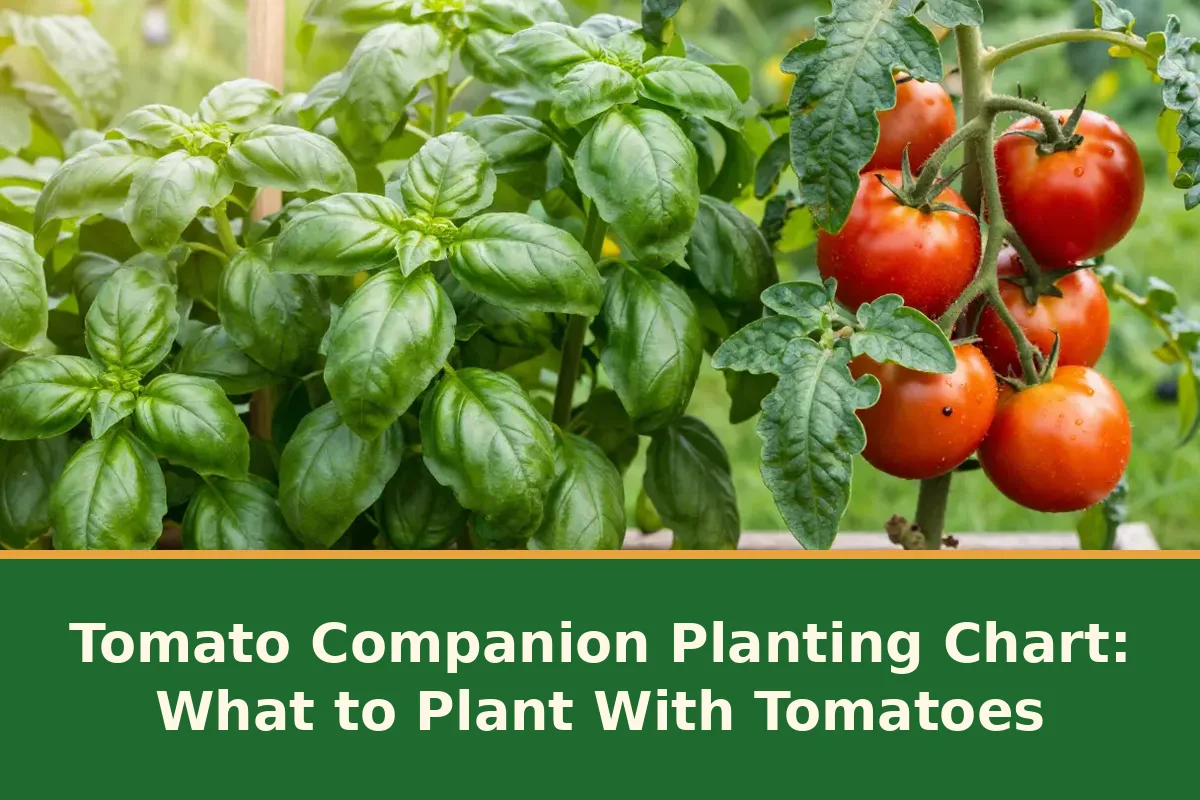
The best companions for tomatoes are basil and French marigold — the two with research behind them — followed by an understory of lettuce, radish, carrots, onions and parsley that uses the bed without crowding it. The neighbours to keep away are potatoes (shared blight), corn (shared fruitworm), fennel and the cabbage family. This chart gives every pairing with its job and its evidence level, because companion planting advice mixes proven effects with century-old tradition, and it helps to know which is which.
Tomato companions at a glance
- Plant with tomatoes: basil, French marigold, lettuce, radish, carrots, onions, garlic, chives, parsley — the extension chart's own list.
- Keep away: potatoes (shared blight), corn (shared fruitworm), fennel (inhibits growth), black walnut (juglone), and the cabbage family (heavy competition).
- The honest evidence line: basil and marigold reduced thrips on tomatoes in some field and greenhouse studies (University of Minnesota Extension); most other pairings are sound tradition, not proven science — West Virginia University Extension calls companion planting "not an exact science."
- The rule that outranks the chart: no companion fixes crowding. Keep the lower 8–12 inches of the tomato stem clear for airflow and watering.
Step 1 — Start with the two companions that earn their place
If you plant only two things beside your tomatoes, plant these. Basil is the classic pairing with actual research behind it: University of Minnesota Extension notes that basil and marigolds reduced thrips on tomatoes in some field and greenhouse studies, and basil may help tomato growth. Basil also wants exactly what tomatoes want — sun, warmth, steady water — so the pairing never fights over care. Plant it 12–18 inches from the stem, and pinch it often so it stays a compact herb rather than a broad competitor. French marigold (Tagetes patula, the compact kind) is the second: planted at the same time as the tomatoes — not weeks later — it has evidence for slowing whitefly build-up, its roots are the traditional answer to root-knot nematodes in warm soils, and its flowers feed the hoverflies and parasitic wasps that police aphids for free. One marigold per tomato, or a loose border along the row.
Step 2 — Fill the understory with quick, shallow crops
A young tomato leaves most of its bed empty for the first six weeks, and casts welcome shade later. Both phases are plantable. The extension companion chart for tomatoes lists lettuce, parsley, chives and onions alongside basil and marigolds, and the logic is the same for the whole understory group: shallow roots, small appetites, harvested before they can compete. Lettuce and radish sown at transplant time are eaten just as the tomato canopy closes — and the lettuce is better for the tomato's July shade, which delays its bolting. Carrots are the traditional slow understory: they occupy a different soil layer entirely and come out over a long window. Garlic and onions plant in a defined row at the bed edge (garlic goes in the autumn before, and lifts before peak tomato growth). None of these is magic; all of them are free food from square feet that would otherwise grow weeds — which is the understory's real job, since living mulch shades the soil and cuts the mud-splash that spreads tomato leaf diseases.
| Companion | The job it does | Evidence |
|---|---|---|
| Basil | Pest confusion (thrips), possible growth boost, same water needs | Extension-supported |
| French marigold | Slows whitefly, feeds beneficial insects, traditional nematode help | Extension-supported |
| Lettuce & radish | Fast early harvest, living mulch, uses tomato shade in July | Extension chart |
| Carrots | Different soil layer, long harvest window | Traditional |
| Onions, garlic, chives | Narrow footprint, edge-of-bed crops, strong-scent tradition | Extension chart |
| Parsley | Edible understory; flowers feed beneficial insects | Extension chart |
| Borage & nasturtium | Pollinator magnet; nasturtium as an aphid trap crop | Traditional |
| Bush beans | Modest nitrogen contribution, compact habit | Traditional — keep a gap; tomatoes are heavy feeders already |
Step 3 — Keep the bad neighbours genuinely away
The avoid list matters more than the plant list, because its reasons are mechanical, not mystical. Potatoes head it: they are tomatoes' close family and share late blight, the disease that can take both crops in a wet fortnight — extension charts say keep them apart, and rotation law says never follow one with the other (see the full companion planting chart for the whole family's rules). Corn shares the tomato fruitworm (the same caterpillar, wearing its corn-earworm hat) and casts moving shade. Fennel exudes compounds that inhibit the growth of most vegetables — it gets a pot of its own, far away, or no place at all. Black walnut is the immovable one: its juglone poisons tomatoes outright, so tomatoes never go within the tree's drip line. The cabbage family rounds out the list as heavy-feeding competition that wants the same rich bed and, in several extension charts, is simply listed against tomatoes. Peppers and eggplant are the judgement call: same family, same diseases — experienced growers separate them from tomatoes by a bed or two rather than interplanting them.
| Keep away | Why |
|---|---|
| Potatoes | Same family, shared late blight — the one rule with no exceptions |
| Corn | Shared fruitworm/earworm pest; moving shade |
| Fennel | Growth-inhibiting compounds; plant it alone, in a pot |
| Black walnut trees | Juglone in roots and leaves is toxic to tomatoes |
| Cabbage family | Heavy-feeding competition; listed against tomatoes in extension charts |
| Mature dill | Traditional caution — young dill is fine, flowering dill is said to inhibit |
Step 4 — Lay it out so the companions never become the problem
Companion planting fails in real gardens for one boring reason: crowding. A tomato's worst enemy is still, humid air, and a basil bush or marigold mat pressed against the stem creates exactly that. So: companions sit 12–18 inches from the stem, the lower 8–12 inches of stem stays bare and reachable for watering and pruning (the pruning method is in How to Prune Tomato Plants), and anything that starts shading the tomato's own lower leaves gets cut back or pulled — the companion serves the tomato, never the reverse. The working layout for a standard bed: tomatoes down the centre at full spacing, basil alternating with marigolds along both edges, lettuce or radish in the gaps for the first six weeks only, carrots in a single line on the shadier side, alliums at the bed's end. In containers, one tomato plus one basil is the whole system — do not crowd a pot further.
Step 5 — Keep expectations honest, and do the things that matter more
End with the truth the chart-sellers skip: companions help at the margins. Basil may trim your thrips; marigolds may slow whitefly; the understory will definitely feed you and shade the soil. But the tomato harvest is decided by the unglamorous four — full sun, real spacing, consistent water at the roots (which is also the blossom-end-rot defence; see Blossom End Rot on Tomatoes), and rotation out of last year's nightshade ground. Do those, and companion planting is a genuine bonus layered on a sound garden. Skip them, and no arrangement of basil will save the crop. Plant the chart, by all means — just know which column of it is evidence and which is tradition, and garden accordingly. For the same treatment across every crop, work through Companion Planting Basics before spring.
Keep going
The full charts: Companion planting chart · Companion planting basics
Tomato care: How to grow tomatoes · How to prune tomato plants · Blossom end rot on tomatoes
The plant page: Tomato
Questions people ask
What is the best companion plant for tomatoes?
Basil — it is the pairing with research behind it (basil reduced thrips on tomatoes in studies noted by University of Minnesota Extension), it shares tomatoes' love of sun and steady water, and it is a harvest in itself. French marigold, planted at transplant time, is the close second.
What should you not plant next to tomatoes?
Potatoes above all — same family, shared late blight. Then corn (shared fruitworm), fennel (growth-inhibiting), the cabbage family (heavy competition), and never tomatoes within reach of a black walnut tree, whose juglone poisons them.
Do marigolds really help tomatoes?
Partly, and honestly. French marigolds planted from the start have evidence for slowing whitefly build-up, their flowers feed beneficial insects, and their roots are the traditional remedy for root-knot nematodes. They are not a cure for an established infestation, and they do nothing if planted late or left to crowd the stem.
Can I plant peppers next to tomatoes?
You can, but most experienced growers don't interplant them: peppers and tomatoes are the same family and share diseases, so a problem in one is a problem in both. A bed apart is the safer layout; basil suits both.
Why this chart labels its own evidence
Companion planting charts are the most copied, least checked pages in gardening — lists of "friends" and "enemies" reproduced for a century with the confidence of physics and the evidence of folklore. Some of it is real: the basil-and-thrips work is published, the potato blight rule is plant pathology, juglone is chemistry. Some of it is harmless tradition that at worst fills a bed with useful herbs. And some of it — the pairings that promise flavour changes and pest-proof gardens — has never survived a controlled trial.
This chart separates the three, because the distinction changes how you garden. Follow the evidence rows strictly, plant the tradition rows cheerfully (they are good crops in good places), and spend the effort you save on the things trials prove matter: spacing, water and rotation. That is companion planting grown up — a useful tool at its real size.
Sources
Evidence labels follow the University of Minnesota Extension's review of companion-planting research as compiled by HarvestMath — Companion Planting Chart (extension-sourced), including the WVU Extension caution that companion planting is not an exact science, and the extension chart row for tomatoes (plant with basil, parsley, chives, onions, marigolds, lettuce; avoid the cabbage family and potatoes). Placement and spacing practice follows Garden Insider — Tomato Companion Plants.
Related page
Read next: Companion Planting Chart: Every Vegetable's Friends and Enemies.
Comments & ratings
No comments yet.
Be the first to share your experience.