
Guides · Garden planning · Published November 18, 2026 · By Faizan Ahmad
How Many Hours of Sun Does Your Bed Really Get?
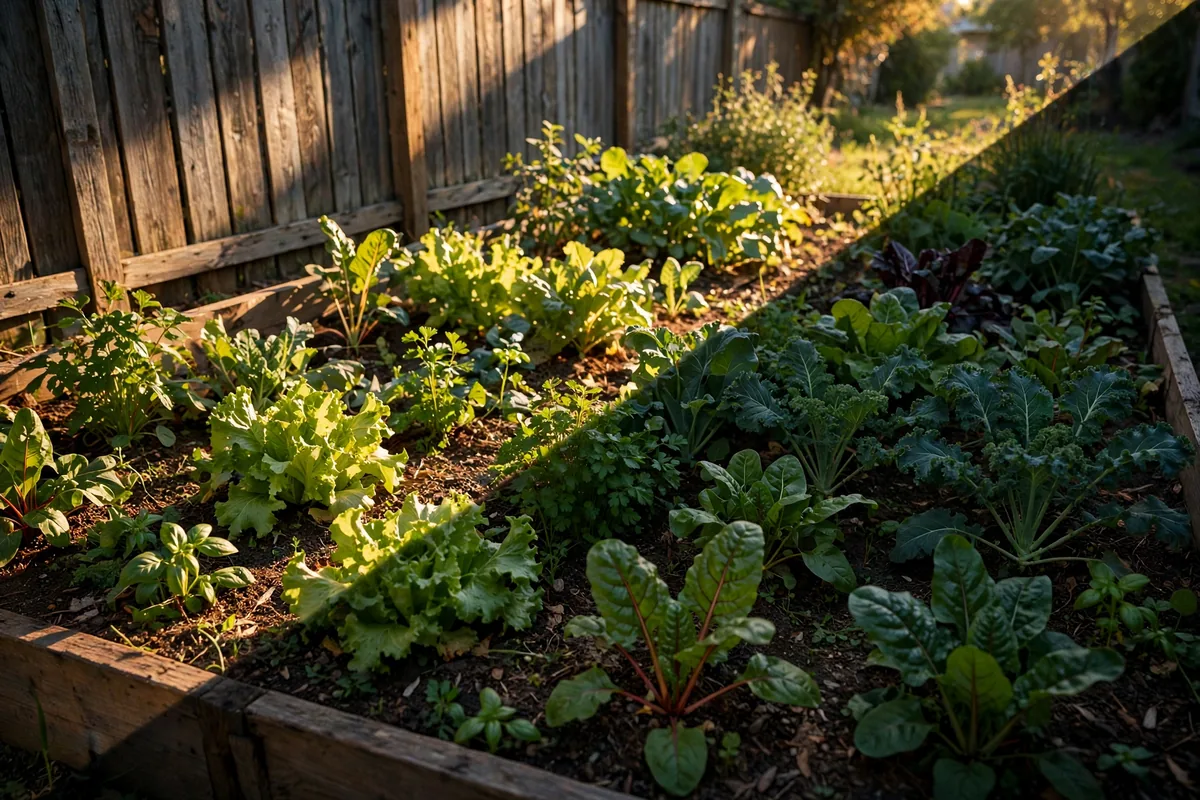
Stand in your garden at noon in June and the bed against the fence looks like the sunniest spot you own. Stand there in December and the same bed may not see direct sun all day. Nothing has moved — the fence, the bed and you are all in the same place — but the sun has changed its route, and the garden has changed with it. That is why "how much sun does this bed get?" has no single answer, and why our Sun & Shadow Calculator asks for a date before it gives you a number. This guide shows how the calculator works, the solar maths underneath it, and how to read its answer: the hours of direct sun your bed really gets, season by season, and the vegetables that suit that light. The headline lesson is worth saying up front: light is a season, not a property of the bed.
The short answer, on one card
- The bands gardeners use: full sun is 6 or more hours of direct sun; part sun / part shade is 3–6 hours; full shade is under 3 hours — the standard convention plant labels follow
- The shadow rule: shadow length = obstacle height ÷ tan(sun's height). At a 45° sun the shadow is exactly as long as the obstacle is tall; lower sun, longer shadow
- Same fence, two gardens: a 6 ft fence throws a midday shadow of about 3.5 ft on June 21 and about 26 ft on December 21 in Edmonton
- Check both solstices — the longest day and the shortest day — before you build a bed or plant anything permanent
- Times are solar time: solar noon is 12:00, so your clock can read up to an hour or so different
Step 1 — Walk the bed before you touch the calculator
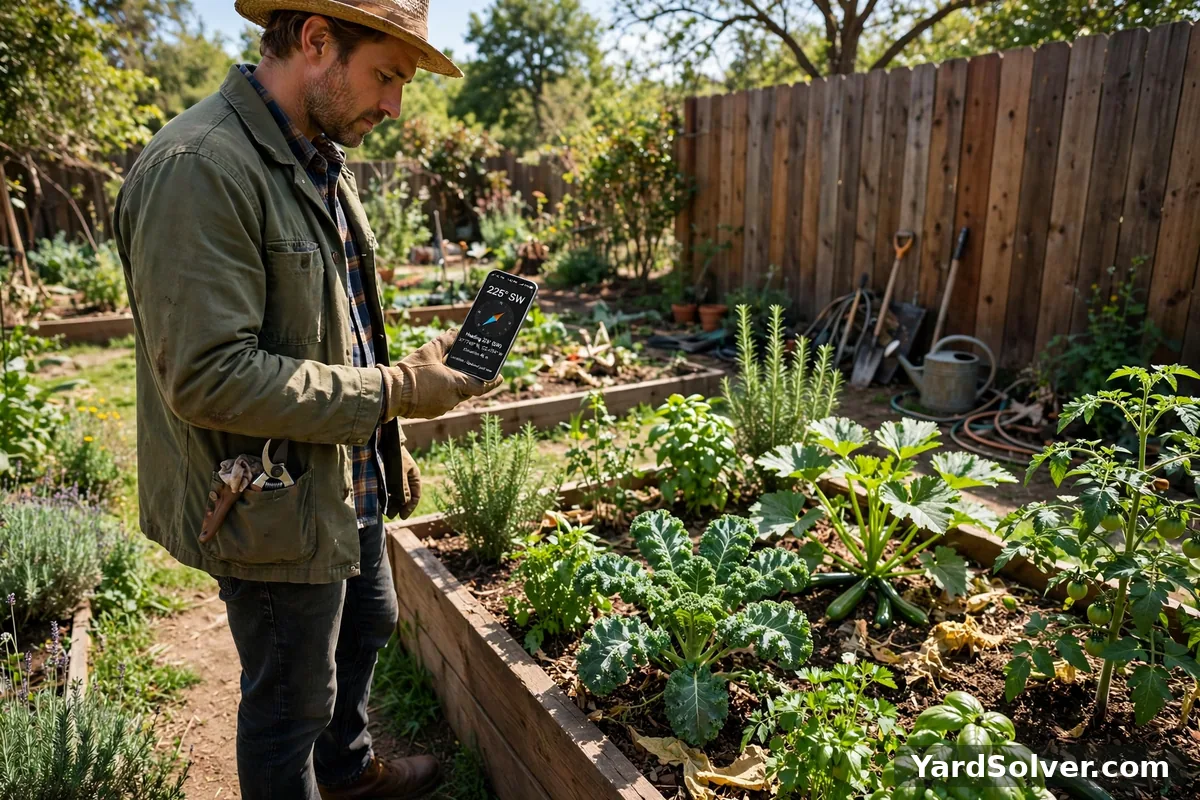
The calculator is only as honest as the obstacles you feed it, so start outside. Stand in the middle of the bed and turn slowly: what stands around it — a fence, a tree, the house, a shed wall — and in which direction? A phone compass answers the direction question in seconds, and direction is not a detail. In the northern hemisphere, an obstacle to the south of the bed stands in front of the strong midday sun and costs real hours; the same fence to the north costs almost nothing, because the sun is never over there. (South of the equator, read that in reverse.) Then measure each obstacle honestly, which is easier than it sounds. Pace the distance out — a normal walking pace is roughly 2.5 feet. For height, use the person rule the calculator itself suggests: a person is about 5.5 ft, so a standard fence is a bit taller than a person, and a two-storey house is about four people. A tall tree is the one awkward case; the shadow method in the questions at the end of this guide sizes it with nothing but a sunny day and a tape.
Step 2 — Run the calculator: what each input does
Open the Sun & Shadow Calculator — sun hours per bed and work top to bottom. First, your city, which quietly sets your latitude — the list runs from Edmonton and Toronto through London, Berlin and Sydney — or choose "type my own latitude" and enter it yourself (north is positive, south of the equator negative). Latitude is the only thing the sun itself cares about: it fixes how high the sun can climb and how long the day can be. Next, the date. Type any date, or use the preset buttons: today, the spring equinox (Mar 20), the longest day (Jun 21), the fall equinox (Sep 22) and the shortest day (Dec 21). Then which way the bed faces — the open side of the bed, if it sits against the house. Facing is drawn on the shadow map and printed in your summary because it helps you picture the bed, but by itself it neither adds nor removes sun. Finally, up to three obstacles: for each one, what it is (fence, tree, house, or wall / shed), its height, its distance from the bed, and its direction from the bed, in feet or metres. The answer comes back as three things at once: the hours of direct sun the bed gets on that date, a shadow map you can drag through the day, and the vegetables that suit that light. Press the print button and the summary is yours to keep.
Step 3 — The maths the calculator is doing
There is no guesswork hidden in the tool — it runs the standard solar maths weather services use. For your latitude and date it works out the sun's position with the NOAA solar equations, then plots the sun's height above the horizon and its compass direction every 10 minutes from sunrise to sunset. At each of those steps, every obstacle gets one test with two halves. Is the sun currently in the obstacle's direction? And is the obstacle's shadow long enough to reach the bed? Shadow length is one division: obstacle height ÷ tan(sun's height). If the shadow reaches, those 10 minutes count as shade; if not, they count as direct sun, and the day's sun minutes are added up into the hours you see. Try the division once by hand so the table below feels real: with the sun at 30°, a 6 ft fence throws 6 ÷ tan(30°) ≈ 10.4 ft of shadow — a bed 10 ft behind that fence is just shaded at that moment, and a bed 12 ft behind it is still in sun. The whole calculator is that one test, repeated across the day and across the seasons.
| Sun's height | Shadow of a 6 ft fence | Shadow vs the fence itself |
|---|---|---|
| 60° — Edmonton midday, June 21 | About 3.5 ft | About 0.6× as long |
| 45° | 6 ft | Exactly as long as it is tall |
| 30° | About 10.4 ft | About 1.7× as long |
| 20° | About 16.5 ft | About 2.7× as long |
| 13° — Edmonton midday, December 21 | About 26 ft | About 4.3× as long |
Read the table the way the seasons feel: the shadow does not grow gently as the sun drops — it runs away. Halving the sun's height from 60° to 30° triples the shadow, and by the time the sun is down at winter levels the same fence covers a strip of garden more than four times its own height. That one fact explains most "my bed was sunny when I planted it" disappointments.
Step 4 — One fence, two gardens: the worked example
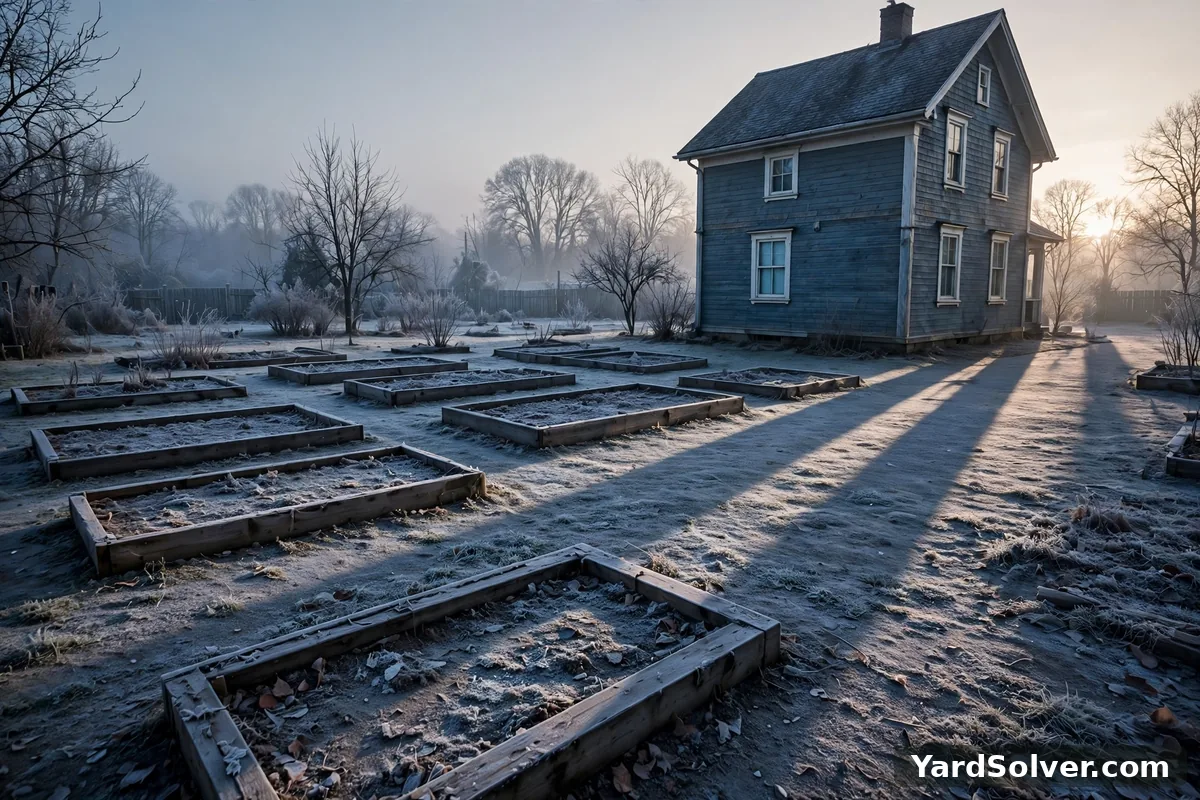
Here is the calculator's own example, slowed down. A standard 6 ft fence stands 10 ft south of a bed in Edmonton. Run the bed on June 21: the sun climbs to about 60°, the fence's midday shadow is only about 3.5 ft long — far short of the 10 ft gap — and even in the lower morning and evening hours the sun is coming from the east and west, around the fence's ends rather than over it. The bed keeps almost all of its roughly 17 hours of daylight. Now change nothing but the date. On December 21 Edmonton gets only about seven and a half hours of daylight to begin with, the sun never climbs above about 13°, and the same fence throws a midday shadow of about 26 ft — more than two and a half times the distance to the bed. The shadow covers the bed at midday, and because the winter sun stays low all day, it covers it for most of the short day around midday too. The bed gets almost no direct sun at all. Same fence, same bed, same gardener — a completely different garden. The practical moral is not "winter is dark", which you knew. It is that a bed's light rating belongs to a date: judge a summer cropping bed by its June number, and judge anything you hope to grow into the autumn — or overwinter — by its equinox and December numbers.
Step 5 — Reading the answer: the light bands and what to plant
The calculator's hours only become useful when you set them against the bands every plant label uses. The standard convention is: full sun, 6 or more hours of direct sun; part sun / part shade, 3 to 6 hours; full shade, under 3 hours. Fruiting vegetables — tomatoes, peppers, squash — are the demanding ones and genuinely want the 6-plus band; give them a 4-hour bed and they will grow, but slowly, leggy and light on fruit. Leafy crops are the flexible ones. Lettuce is the clearest example: it grows happily in part shade, and in a hot summer it often does better with afternoon shade than in a full-sun bake, because heat is what pushes it to bolt and turn bitter. Two refinements before you plant by the number. First, when the hours land matters: six hours of morning sun is gentler than six hours of afternoon sun, and the shadow map shows you which kind your bed gets. Second, too much sun is a real problem in hot spells — where a bed scorches, shade cloth for the vegetable garden explains the 30%, 50% and 70% grades and when each one earns its place. Match the plant to the light you actually have, and most "mystery" failures quietly disappear.
Step 6 — Trees, leaves and the moving target
One obstacle refuses to sit still for its portrait: the tree. A deciduous tree is two different obstacles in one year — a broad, solid canopy from late spring to autumn, and a lattice of bare branches in winter that lets a good share of the light filter through. The calculator treats every obstacle as solid, so for a bare winter tree it will overstate the shade: read a winter result under a leafless tree as the pessimistic end of the truth, and its leaf-on summer result as close to exact. A conifer, by contrast, is the same solid obstacle in every month. Trees also grow — a foot or two a year on a vigorous one — and neighbours build fences and extensions, so a bed's light is worth re-checking every year or two rather than once for life. The habit that protects every big decision is the one from Step 4: before you build a new bed, site a greenhouse or plant anything permanent, run the spot on the longest day and the shortest day and look at both numbers. Ten minutes in the calculator is cheaper than a bed built in the wrong garden — the winter one hiding inside your summer garden.
What the calculator can't do
Honesty about the edges, so the number earns your trust. The calculator is an estimate, not a survey: it treats each obstacle as a solid block on flat ground, and it scores the bed as a single point, so a long bed can honestly be full sun at one end and part shade at the other — run both ends if it matters. It cannot know about leaves (Step 6), the slope of your ground, light reflected off a pale wall, or anything nearby you did not enter — you get three obstacle slots, so spend them on the three things that shade the bed most. Its sun path is exact maths, but its times are true solar time, with solar noon at 12:00; your clock can read up to an hour or so different depending on where you sit in your time zone and on daylight saving, which shifts the labels on the shadow map without changing the hours. And it works in the southern hemisphere too — pick an Australian city or type a negative latitude, and remember that there it is the obstacle to the north that steals the midday sun. If a planting decision is expensive, confirm the calculator's answer the low-tech way: watch the bed on one sunny day and compare.
Keep going
Run your own bed through the Sun & Shadow Calculator on the longest day and the shortest day, then match what you plant to the light each bed really gets. Too much harsh afternoon sun instead of too little? Shade Cloth for Vegetables sorts the grades. A part-shade bed to fill? Start with lettuce and the other leafy crops that prefer it in summer.
Planning the whole garden around the light you actually have? The Garden Planner lays out your beds and planting dates in one calendar.
Questions people ask
How many hours is full sun?
Six or more hours of direct sun a day is the standard convention for full sun. Part sun and part shade cover roughly 3 to 6 hours, and full shade is under 3 hours. These bands are a long-standing garden convention rather than an official standard, and different guides draw the edges slightly differently — but the 6-hour line for full sun is the one plant labels use almost everywhere.
Why does my bed get less sun in winter?
Two things change at once. The days are shorter, so there is less daylight to collect, and the sun travels a lower arc, so every fence, tree and house throws a much longer shadow. In Edmonton a 6 ft fence casts a midday shadow of about 3.5 ft on June 21 and about 26 ft on December 21 — which is why a bed that is full sun in summer can sit in shade all winter.
How do I measure a tree's height?
Use the shadow method on a sunny day. Measure the tree's shadow, then measure the shadow of something whose height you know — a person is about 5.5 ft. Divide the tree's shadow by the person's shadow and multiply by the person's height: a tree casting a 30 ft shadow when a 5.5 ft person casts a 5 ft shadow is about 33 ft tall. For the calculator a rough height is fine — the answer moves slowly with a foot or two either way.
Does the calculator use clock time or solar time?
Solar time. The calculator works in true solar time, where the sun is at its highest at 12:00. Your clock can read up to an hour or so different, depending on where you sit inside your time zone and whether daylight saving is in force. The hours of sun are the same either way — only the labels on the shadow map shift against your clock.
Does it matter which way my bed faces?
Facing by itself neither adds nor removes sun — the hours come from your latitude, the date and what stands around the bed. What matters is what stands between the bed and the sun: in the northern hemisphere a fence or house to the south steals the strong midday sun, while one to the north costs almost nothing. South of the equator it is the other way round.
Can a bed get too much sun?
In a hot summer, yes. Some crops suffer in unbroken afternoon heat: lettuce and other salad leaves bolt and turn bitter, and young transplants can scorch. That is the useful side of part shade — 3 to 6 hours of sun, ideally with shade in the afternoon, is often the best spot in the garden for leafy crops in mid-summer.
Sun and shadow are geometry — the calculator maps a garden's light before a plant is bought
Every garden's light is decided by geometry: the sun's height and path change with the season, and every fence, wall and tree casts a shadow whose length is its height multiplied by the season's angle — long and reaching in winter, short at midsummer noon. The sun-shadow calculator turns that geometry into a map of the real garden, hour by hour and month by month, and its value is that it answers siting questions before they become expensive: where a greenhouse will actually be lit in March, which bed truly gets the six hours a tomato demands, and where a new tree will cast its mature shadow in ten years, not its sapling shadow today.
Use it with the season of the crop in mind — a bed in full sun in June may sit in a building's shadow through the whole of spring, which is when the seedlings needed it — and verify one prediction in person with a day's observation before building anything permanent on the result. Shade is not waste in the map's honest reading: every garden needs its cool corner for salads in summer, water storage, compost and the gardener's own chair, and a mapped garden lets those be chosen rather than endured.
Sources
Key facts on this page cross-checked against Sun path — Wikipedia — background on the sun path and how it changes with season and Shadow — Wikipedia — background on shadows and their geometry.
Related page
Read next: Shade Cloth for Vegetables: 30%, 50% or 70%?.
Comments & ratings
No comments yet.
Be the first to share your experience.