
Guides · Soil & feeding · Published November 20, 2026 · By Faizan Ahmad
Best Soil Mix for Raised Garden Beds: Recipes by Depth & Crop
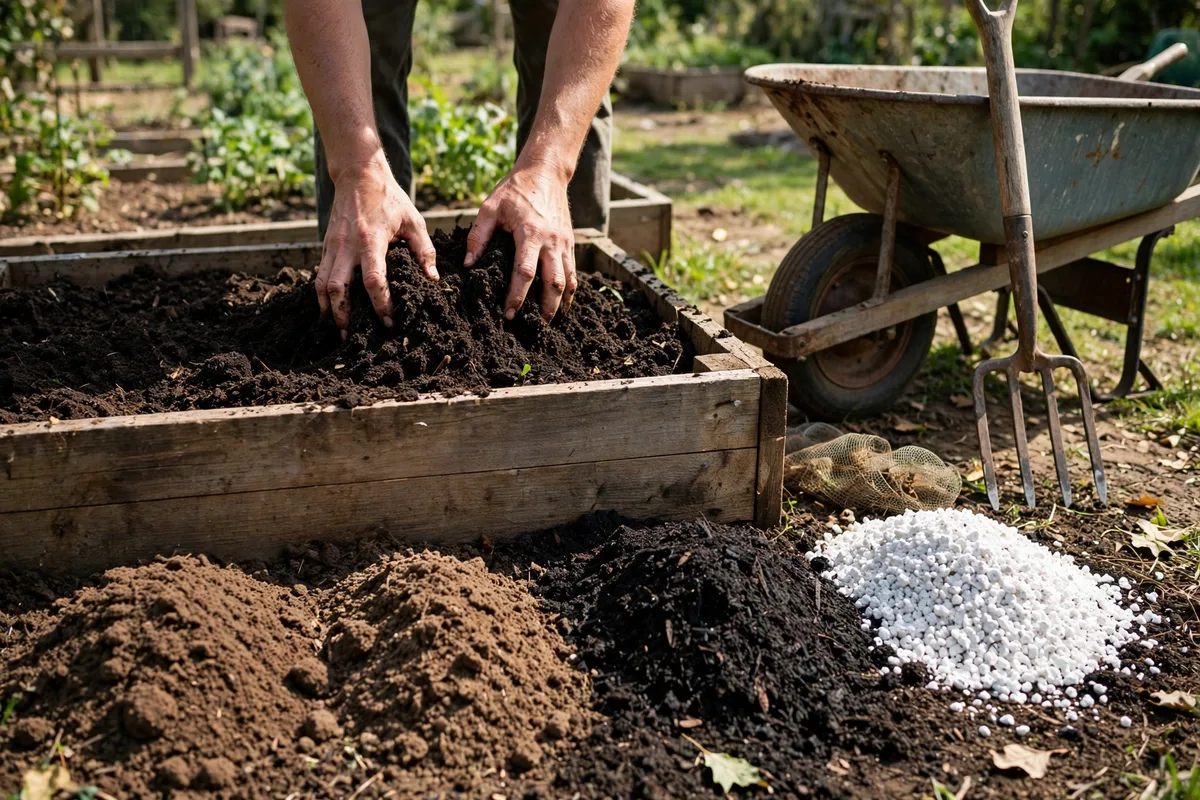
The best all-purpose soil mix for a raised garden bed is about 50–60% screened topsoil, 30–40% finished compost and 10–20% aeration material (perlite, pumice or pine bark fines), by volume — and the right recipe then bends with the bed: shallow beds need a lighter, more retentive mix, deep beds can carry a cheaper soil-heavy fill in their lower half, and root crops want more aeration while heavy-feeding tomatoes and squash want more compost. What never works is the two shortcuts gardeners reach for first: filling the bed with pure compost, which is too rich, holds too much water and shrinks away under the plants, or filling it with straight garden soil or cheap fill dirt, which compacts into the very problem the raised bed was built to escape. This guide gives the base recipe and its variations, explains what each component actually does, lists what not to use and why, and finishes with the refresh routine that keeps a bed's soil improving year after year. When you know your bed's size, size the exact volume — bags, cubic feet and yards — with the Raised Bed Soil Calculator before you buy anything.
The short answer, on one card
- Base recipe (most vegetables): 50–60% topsoil, 30–40% compost, 10–20% aeration, by volume.
- Mel's Mix (soilless, for beds on concrete or poor ground): equal thirds compost, peat moss or coir, and coarse vermiculite — light and fertile, but the most expensive way to fill a bed.
- Shallow beds (under 8 in / 20 cm): buy a quality bagged raised-bed or potting mix, or blend 40% topsoil, 40% compost, 20% aeration — shallow soil dries fast, so retention matters more than drainage.
- Heavy feeders (tomato, squash, corn, brassicas): push compost toward 40–50%.
- Root crops (carrots, parsnips, beets): push aeration toward 25–30% and sieve out stones — forked roots are a soil-texture report.
- Never: pure compost, unknown fill dirt, fresh manure, or dense clay topsoil on its own.
- Expect settling: loose mixes sink over the first season. Overfill slightly, then top up — settling is budgeted, not a defect.
What each component actually does
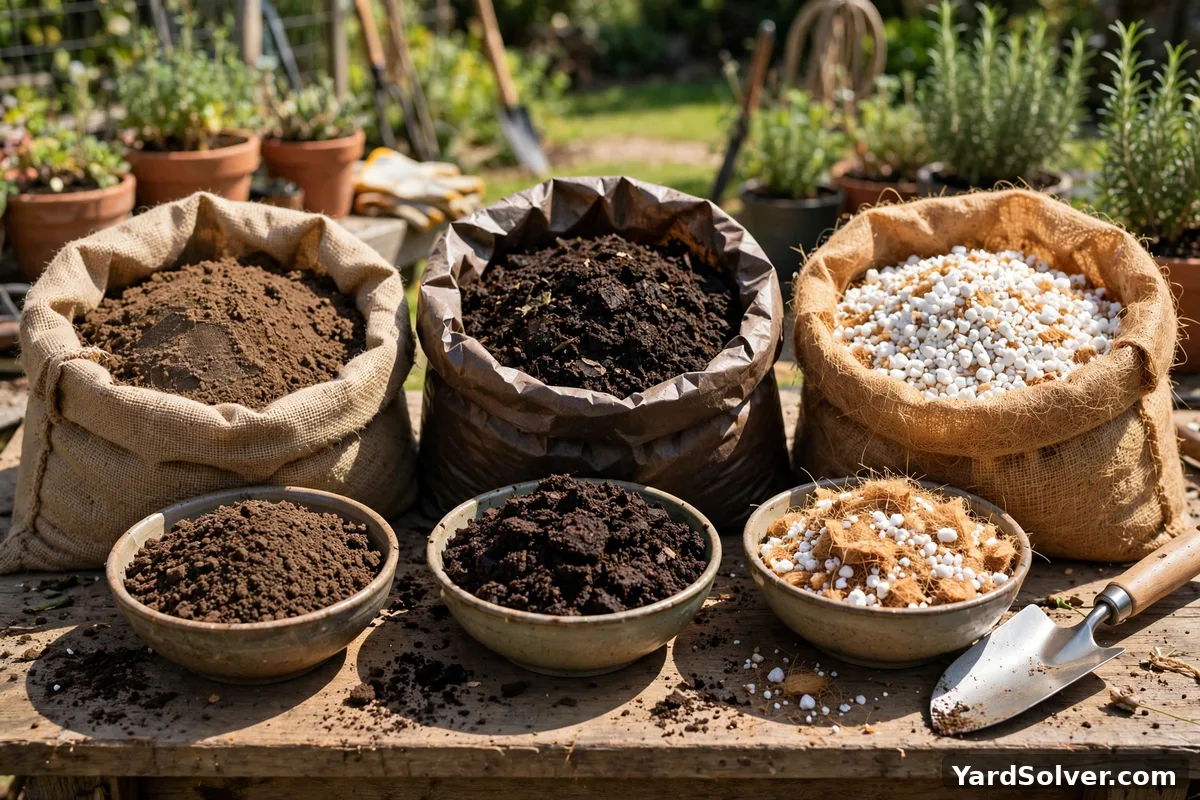
Topsoil is the structure. The mineral fraction gives the mix weight and stability, holds nutrients on its clay particles so they are not washed out with every watering, and keeps the bed from behaving like a giant pot. Buy screened topsoil — screened means stones and debris have been removed — and judge it in the hand: it should be loamy and crumbly, not sandy dust and not clay that ribbons between your fingers. Compost is the engine. It feeds the soil biology that feeds the plants, supplies the broad spread of nutrients no bagged fertilizer matches, holds water like a sponge and binds loose particles into the crumb structure roots love. Use finished compost — dark, crumbly, earthy-smelling, with nothing recognisable left in it — and blend sources where you can (garden compost, composted manure, municipal compost), because each brings a different nutrient profile. Aeration is the insurance. Perlite, pumice, coarse vermiculite or pine bark fines hold pore space open as the organic fraction decomposes and settles, so roots keep finding air in year three, not just month one. Bark fines decompose slowly and are the long-lived choice in ground-contact beds; vermiculite also holds water and suits the soilless mixes; perlite is cheap, permanent and the default for bagged blends. The percentages matter less than the presence of all three jobs: structure, food and air. A mix missing any one of them fails in its own characteristic way — slumping, starving or suffocating.
The recipes, by bed depth
| Bed / crop | Topsoil | Compost | Aeration / other | Why |
|---|---|---|---|---|
| Standard vegetable bed, 10–12 in deep | 50–60% | 30–40% | 10–20% perlite or bark fines | The balanced default; suits almost everything |
| Shallow bed, 6–8 in (herbs, greens) | 40% | 40% | 20% vermiculite or coir blend | Shallow soil dries fast — retention beats drainage |
| Deep bed, 18–24 in | Lower half: 70% topsoil, 30% compost. Top 10 in: standard recipe | — | Standard in the top layer | Roots feed in the top layer; the bottom is ballast — fill it cheaper |
| Heavy feeders (tomato, squash, corn) | 40–50% | 40–50% | 10% aeration | These crops eat; compost is the slow-release feed |
| Root crops (carrot, parsnip, beet) | 50% | 25% | 25% coarse sand, perlite or fine bark | Loose, stone-free depth lets roots run straight |
| Mediterranean herbs (rosemary, thyme) | 40% | 20% | 40% grit, sand or bark | These want lean and sharp-drained — the opposite of the vegetable recipe |
| Bed on concrete / patio (soilless) | — | 33% | 33% peat or coir + 33% vermiculite | Mel's Mix: no mineral soil to import; must be fed more often |
Two situations change the recipe's logic entirely. Where the bed sits matters as much as its depth: a bed on open ground with decent soil underneath barely needs imported mix at all — fork 4–6 inches of compost into the existing topsoil and the bed is built. A bed on concrete, a patio or heavily compacted subsoil is a true container and needs the full imported mix, plus a way for water to escape. And very deep beds invite the hugelkultur economy — logs and rough organic matter in the bottom third — which works, provided the top 10–12 inches is a proper recipe mix, because that is the layer seedlings and most roots actually live in. Our guide to how much soil a raised bed needs works the volumes for the standard bed sizes; multiply your bed's volume by each recipe's percentages and you have the shopping list, component by component. For the bulk fraction alone, the Topsoil Calculator converts the same volume into yards and bags.
What NOT to put in a raised bed
Pure compost. The most expensive mistake on this page: too rich for seedlings, waterlogged in wet spells, and shrinking by a third or more as it keeps decomposing, so the bed level drops away under the plants by midsummer. Compost amends soil; it is not soil. Unknown fill dirt. Cheap "fill" is subsoil — no organic matter, no biology, sometimes rubble or contaminated ground — and a bed filled with it is a raised rectangle of the problem you were avoiding. Fresh manure. It burns roots with ammonia, carries weed seed and pathogens, and smells like the mistake it is; manure belongs in the compost pile for a season first. Straight garden soil dug from elsewhere in the yard. It imports weed seed and soil-borne disease and compacts badly in a bed's loose structure; if your own soil is genuinely good loam, it can be the topsoil fraction — screened and blended, never the whole fill. Bagged "garden soil" of unknown content deserves the same suspicion as fill dirt: read what is actually in the bag, and be wary of mixes bulked with undecomposed bark, which rob nitrogen from the soil while they finish rotting. Finally, never line the bed's base with gravel "for drainage" — a coarse layer under fine soil creates a perched water table that holds water in the soil above it, the opposite of drainage.
Mixing, filling and the first season
Blend the components before they go in, not in layers: spread them on a tarp beside the bed in recipe proportions, turn the pile twice with a fork, and fill from the mixed pile. Layers settle into bands; a blend settles into soil. Fill to the brim and mound slightly — the first season's settling will take 10–15% of the volume, more if the compost fraction was fluffy. Water the filled bed deeply once before planting: it reveals the true level, settles air pockets, and shows you the drainage you actually built. Plant into it the same week; a bed left empty and uncovered loses its surface to weeds and its moisture to the sky. Through the first season, mulch the surface (straw, shredded leaves or wood chips on paths between crops) — mulch is what protects the structure you paid for, holding moisture in and stopping rain from capping the surface into a crust.
Refreshing old soil: the annual routine
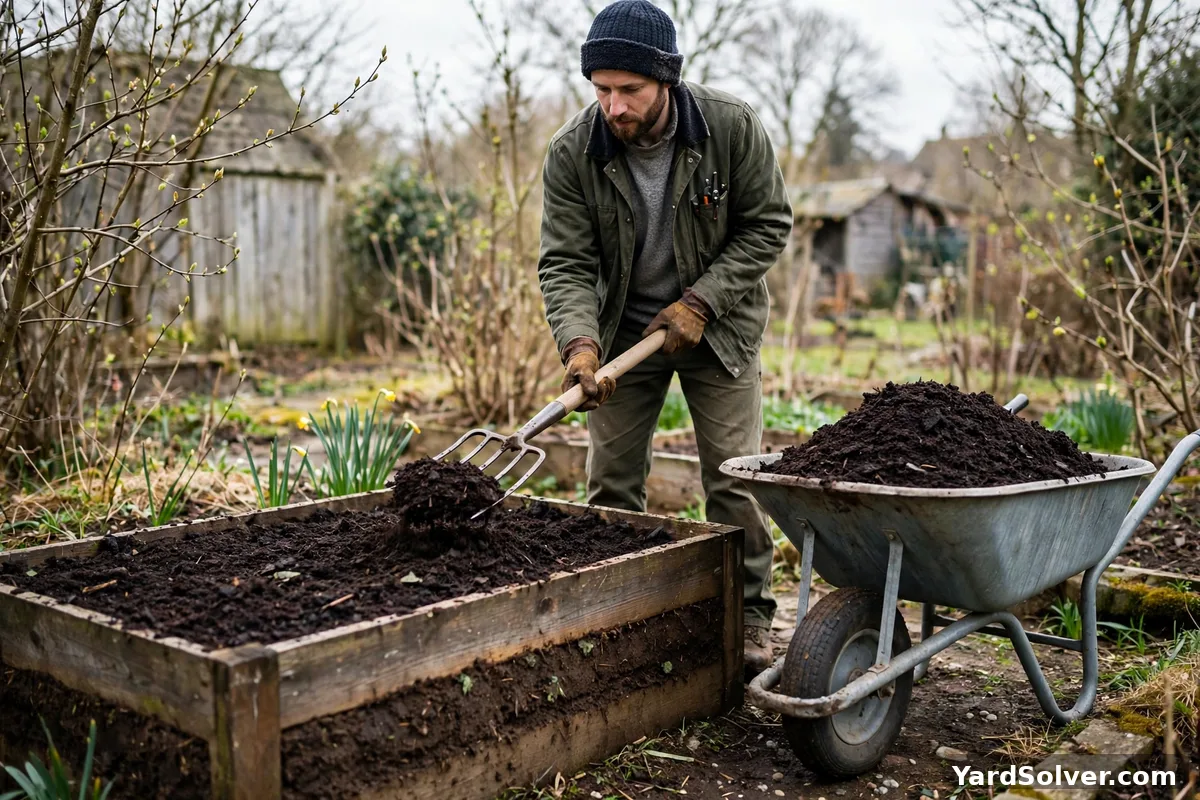
Raised bed soil is not replaced; it is maintained. Each spring, before planting: fork out any large roots and debris, then spread 1–2 inches of fresh compost over the whole bed and work it into the top few inches — that single habit replaces the organic matter the last crop consumed and restores most of the level settling took. Every second or third year, add a fresh aeration top-up (a bag of perlite or bark fines per bed) because the original aeration fraction is the part that disappears as bark decomposes. If the level has dropped several inches over the years, top up with a 50/50 blend of topsoil and compost rather than compost alone, so the mineral fraction keeps pace. Test the soil every two to three years — pH drifts in beds fed heavily with composted manure, and lime or sulfur corrections are cheap when they are small and early. The full routine, including diagnosing a bed that has gone compacted or sour, is in our guide to refreshing raised bed soil. The economics are the point: a bed maintained this way never needs its expensive first fill again.
Bags or bulk — and the pH check that finishes the job
The recipe also decides how you should buy. For a single shallow bed, bagged components — or one pre-blended bagged raised-bed mix — win on convenience: the volumes are small, and three half-used bulk piles are their own kind of waste. From about one cubic yard of total mix upward (roughly two 4×8 beds at a foot deep), bulk topsoil and bulk compost delivered to the driveway beat bags decisively on cost per cubic foot, with the aeration fraction still bought bagged, because perlite and bark fines are light, clean and used in smaller proportion. Whichever route you take, compare like with like: divide the price by the cubic feet in the pile or the bag, never by the bag count, because bag sizes differ by brand and by country. Then, once the bed is filled and watered in, run one last check before the first planting: a simple pH test. Most vegetables want a mix landing between pH 6.0 and 7.0. Compost-heavy fills occasionally arrive slightly alkaline and peat-heavy soilless fills slightly acid; both are corrected cheaply at this stage — a light sulfur dressing for the alkaline bed, lime for the acid one, each sized from the test result — and expensively once roots are in and the season is running. The mix, the volume and the pH are the whole job: get those three right and the bed will out-grow beds twice its size built on guesswork.
Keep going
Size your bed exactly with the Raised Bed Soil Calculator — volume, bags and bulk for any bed dimensions — and check the bulk fraction with the Topsoil Calculator. The worked volumes for standard beds are in How Much Soil for a Raised Bed?
Building the bed itself first? Start with How to Build a Raised Bed, and size the compost share of the mix with How Much Compost Do I Need?
Sources
Ratios and recipes cross-checked against Best Soil Mix for Raised Garden Beds: Ratios, What to Buy and What to Avoid, which summarises published university extension guidance including the University of Maryland Extension's raised-bed filling guidance and Iowa State University Extension's soil-mix recommendations (topsoil-to-compost blends of 2:1 to 1:1 on open ground, compost-to-soilless blends on hard surfaces, settling allowances), with crop-specific adjustments compared against PlantRef — Best Soil Mix for Raised Beds. Where sources give ranges, this guide prints the range rather than a single magic ratio, because topsoil quality — the variable no recipe controls — moves the answer.
Questions people ask
What is the best soil mix ratio for a raised bed?
For most vegetables, 50–60% screened topsoil, 30–40% finished compost and 10–20% aeration material (perlite, pumice or pine bark fines) by volume. On concrete or very poor ground, the soilless alternative is equal thirds of compost, peat moss or coir, and coarse vermiculite. Push compost up for heavy feeders and aeration up for root crops.
Can I fill a raised bed with compost only?
No. Pure compost is too rich, holds too much water, and shrinks noticeably as it continues to decompose, so the bed level drops under your plants by midsummer. Compost should be roughly a third of the mix — the engine, not the whole vehicle.
How much soil do I need for a 4×8 raised bed?
At 12 inches deep, a 4×8 bed holds 32 cubic feet — about 1.19 cubic yards, or sixteen 2-cubic-foot bags. At the standard recipe that splits into roughly 16–19 cubic feet of topsoil, 10–13 of compost and 3–6 of aeration. Run your own dimensions through the Raised Bed Soil Calculator for exact bag counts.
Is bagged raised-bed soil worth it?
For one shallow bed, yes — it is a pre-blended recipe and saves buying three components in small quantities. For several deep beds, bulk topsoil and compost blended on a tarp is far cheaper per cubic foot, and you control the ratio. Compare cost per cubic foot, never cost per bag.
Why did my raised bed soil level drop?
Settling and decomposition: loose mixes compact under watering, and the compost fraction literally becomes plant and air over the season. A first-season drop of 10–15% is normal. The fix is the annual refresh — 1–2 inches of compost forked into the top each spring — not a full refill.
What should you not put in a raised bed?
Pure compost, unknown fill dirt, fresh manure, undecomposed bark-heavy mixes, and a gravel layer at the base. Each fails in a known way: shrinkage, compaction, root burn and nitrogen robbery, or a perched water table that keeps the soil wetter, not drier.
Comments & ratings
No comments yet.
Be the first to share your experience.