
Guides · Seasonal Checklists · Published November 22, 2026 · By Faizan Ahmad
February Garden Checklist: 12 Jobs That Get Spring Started Early
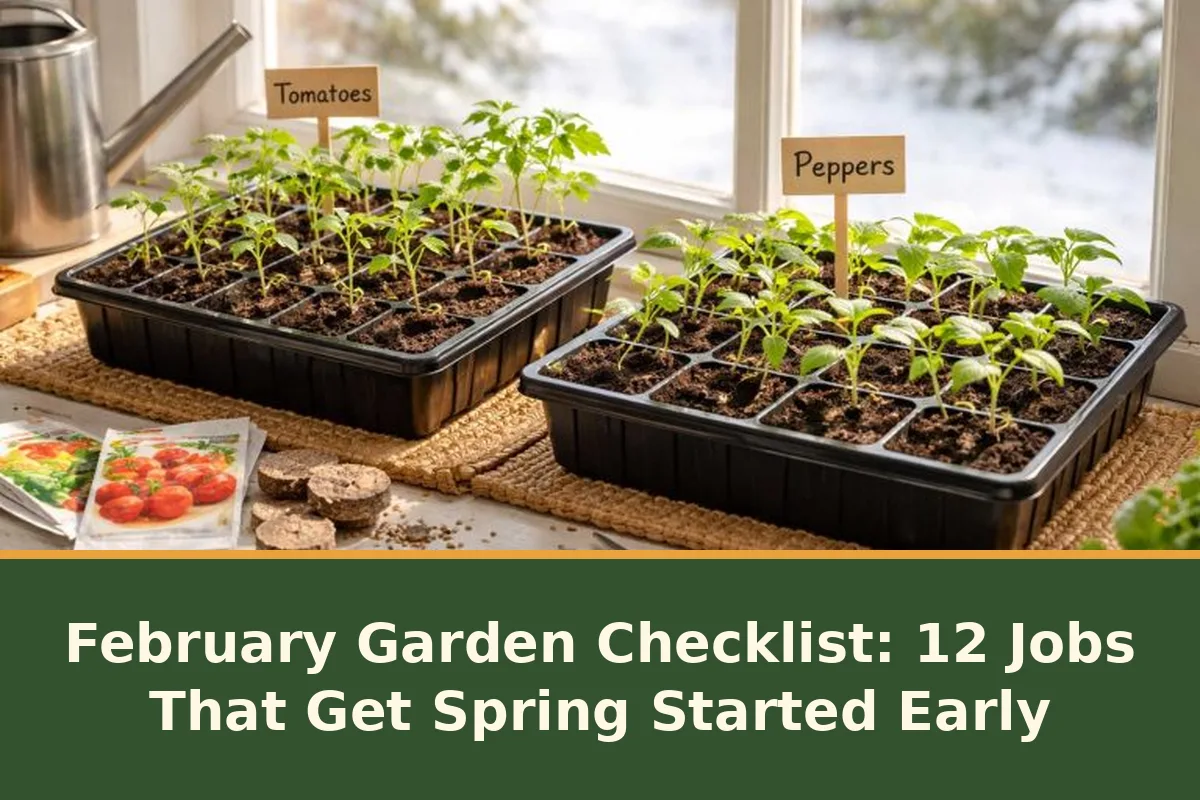
February is the month spring is actually decided: the February garden jobs that matter are starting onions, leeks, celery and peppers indoors, chitting seed potatoes, finishing dormant pruning before buds swell, sowing broad beans and peas under cover where your climate allows, forcing rhubarb, checking stored bulbs and tubers, protecting early blossom, prepping soil only when it is workable, and closing your seed order. This February garden checklist organises all twelve jobs by zone, so cold-climate and mild-climate gardeners each get the version that applies to them.
The short answer, on one card
- Start indoors now: onions, leeks, celery and peppers — the slow crops that need 8–14 weeks before they can go outside.
- Chit potatoes: set seed potatoes in a light, frost-free spot so short, sturdy sprouts form before planting.
- Prune while it is still winter: finish apples and pears, cut autumn raspberries to the ground, and prune roses, wisteria and late-flowering shrubs — but never spring-flowering shrubs, whose buds are already made.
- Sow under cover where your climate allows: broad beans and peas under fleece or in a cold frame in mild areas; in cold zones, wait and sow indoors instead.
- Prep, do not dig: spread compost on workable beds, but stay off wet or frozen soil — working it wet destroys its structure for the whole season.
Jobs 1–3: start the slow crops indoors
Job 1 — Sow onions, leeks and celery. Onions and leeks sown from seed need the longest runway of any common vegetable: 10–14 weeks indoors before they are big enough to plant out. A February sowing is not early enthusiasm — it is the only sowing that gives bulbs time to bulk up before midsummer day length triggers bulbing. Sow thinly in trays or modules, keep them at 15–20°C (59–68°F) to germinate, then grow them on somewhere bright and cool so they stay stocky rather than drawn. Celery and celeriac belong in the same sowing session: both need 10–12 weeks and constant moisture from day one.
Job 2 — Sow peppers and chillies by mid-month. Peppers are the slowest common crop to germinate and the slowest to reach fruiting size, which is why February — not March — is their month in short and moderate seasons. Sow into modules, give them steady warmth of 21–27°C (70–80°F), and expect 7–21 days to germinate depending on variety, with hot chillies at the slow end. The full sowing order for the whole spring is in Earliest Seeds to Start Indoors — February is where that list begins.
Job 3 — Hold the line on tomatoes. The February mistake that fills greenhouses with leggy plants is sowing tomatoes too early. In zones 3–7, tomatoes sown now will outgrow their pots weeks before the soil is warm enough to receive them; late February is the earliest sensible date, and only in zones 8–10 or under strong lights. Check your own dates on the Planting Calendar rather than copying a neighbour's — two gardens one zone apart can be three weeks apart in practice.
Jobs 4–5: potatoes and rhubarb, the February pair
Job 4 — Chit your seed potatoes. Chitting — letting seed potatoes sprout in the light before planting — advances the crop by roughly two weeks and is the standard February job wherever potatoes are grown. Stand the tubers in egg boxes or trays with the end carrying the most eyes facing up, in a cool, bright, frost-free place. You want short, dark-green, knobbly sprouts about 2 cm (¾ in) long; long white sprouts mean the spot is too warm and too dark. Our dedicated walkthrough is Chitting Potatoes.
Job 5 — Force rhubarb, and check the crowns you are not forcing. Cover one rhubarb crown with a forcing pot, a tall bucket or a traditional forcer with the light excluded, and you will pick tender pink stems weeks ahead of the outdoor crop. Only force a strong, established crown, and never force the same crown two years running — forcing exhausts it. Uncovered crowns need nothing except a mulch of compost around (not over) the crown once the soil can be worked.
Jobs 6–8: the last of the winter pruning
Job 6 — Finish pruning apples, pears and soft fruit. February is the tail end of the dormant-pruning window that opened in January: once buds swell, the window closes. Finish apples and pears on a dry, frost-free day, cut autumn-fruiting raspberries down to ground level (they fruit on new canes), and tie in the new canes of summer-fruiting raspberries. Stone fruit — plums, cherries, peaches — is still off limits: winter pruning invites silver-leaf and bacterial canker, so those wait for summer.
Job 7 — Prune roses, wisteria and late-flowering shrubs. Hybrid tea and floribunda roses take their main prune in late winter: remove dead, weak and crossing stems and cut back to outward-facing buds to keep the centre open. Wisteria gets its second prune now — shorten the whippy side shoots pruned in summer to 2–3 buds, which is the cut that concentrates the plant's energy into flower buds. Shrubs that flower on new wood later in the year — buddleia, hardy fuchsia, late clematis (Group 3) — can all be cut back hard this month.
Job 8 — Leave spring-flowering shrubs completely alone. Forsythia, lilac, camellia, flowering currant and Hydrangea macrophylla all flower on buds formed last year. Every stem you cut in February is a stem that does not flower this spring. Their pruning moment is immediately after flowering, not before it. If you remember one pruning rule this month, make it this one: prune after flowering for spring bloomers, before growth starts for summer bloomers.
Jobs 9–10: sow under cover, protect what is waking up
Job 9 — Sow broad beans and peas under cover, where your zone allows. Broad beans are genuinely frost-hardy and a February sowing under fleece or in a cold frame is standard practice in zones 7–10. Peas follow the same pattern in mild districts: sow into modules or guttering under cover and plant out once roots fill the container, which dodges both cold soil and hungry mice. In zones 3–6 February soil is usually frozen or saturated — there, the honest version of this job is sowing under cover indoors and waiting. Sowing into cold, wet soil does not give a head start; it gives rotted seed.
Job 10 — Protect early blossom and check stored roots. Apricot, peach and early plum blossom can open in a mild February spell, and one hard night after that costs the whole crop. Keep fleece ready to drape over blossom on forecast frost nights and take it off again in the morning so pollinators can work. Indoors, go through stored dahlia tubers, potatoes, onions and apples: remove anything soft or mouldy before rot spreads, and check dahlia tubers have not dried to husks — a light misting revives borderline ones.
Jobs 11–12: soil, tools and the seed order
Job 11 — Prep soil only when it is workable. The squeeze test decides: take a handful of soil and squeeze. If it forms a sticky ball that shines, it is too wet to work — walking on it and digging it now compacts it for the whole season. If it crumbles, you can spread 3–5 cm (1–2 in) of compost or well-rotted manure as a top dressing and let worms take it down, the no-dig way. February is also the month to take soil samples for a pH test, because lime applied now has time to act before spring planting.
Job 12 — Service tools and close the seed order. Sharpen spades, hoes and secateurs, oil wooden handles, and clean and disinfect seed trays and pots — February's seedlings die of damping-off fungus carried on dirty trays more often than any other single cause. Then finish ordering seed: the varieties that sold out in January are gone, but February is when the remaining gaps in your plan have to close, because March sowings cannot wait for a delivery. If you are still deciding the plan itself, work backwards from our December Garden Checklist — protection first, planting second — and forwards into spring.
The February jobs table, by zone
| Job | Zones 3–5 (cold) | Zones 6–7 (moderate) | Zones 8–10 (mild) |
|---|---|---|---|
| Onions, leeks, celery indoors | Sow mid–late Feb | Sow early Feb | Sow early Feb or in a cold frame |
| Peppers & chillies indoors | Sow late Feb, heat required | Sow mid-Feb | Sow early–mid Feb |
| Tomatoes indoors | Wait until March | Late Feb at the earliest, lights only | Sow late Feb |
| Chit potatoes | Start late Feb | Start early–mid Feb | Start early Feb |
| Broad beans & peas | Sow in modules under cover | Sow under fleece or cloches | Direct-sow outdoors |
| Dormant pruning (apples, pears, roses) | Finish by late Feb | Finish this month | Finish early Feb |
| Soil prep | Only if soil is thawed and crumbly | Top-dress compost on workable days | Full bed prep can begin |
| Force rhubarb | Cover late Feb | Cover early Feb | Cover early Feb |
Zone timings are guides, not dates: a February in a sheltered zone 6 garden can behave like zone 7, and an exposed zone 7 garden like zone 6. The soil squeeze test and the bud-swell check on your own trees outrank any table.
What NOT to do in February
Three February jobs do real harm. Do not dig or walk on wet soil — compaction made this month persists all season and roots cannot undo it. Do not prune spring-flowering shrubs, for the bud reason above. And do not sow half-hardy crops outdoors or into an unheated greenhouse in cold zones, however mild a single weekend feels: February's warm spells are borrowed, and the frost that reclaims them is the one that kills the seedlings. Patience in February is a technique, not a delay.
Keep going
This checklist sits in the middle of the monthly series: December Garden Checklist covered protection and planning, the January Garden Checklist opened the pruning window and the first indoor sowings, and February finishes the winter work while starting the crops spring depends on. Browse the whole library on the Guides hub, and pin your own sowing dates with the Planting Calendar.
Questions people ask
What should I do in the garden in February?
The jobs that matter are: start onions, leeks, celery and peppers indoors; chit seed potatoes; finish dormant pruning of apples, pears, roses and autumn raspberries; sow broad beans and peas under cover where your climate allows; force rhubarb; check stored bulbs and tubers; protect early blossom on frost nights; top-dress workable beds with compost; and service tools and finish your seed order.
What seeds should I start indoors in February?
The slow crops: onions and leeks (10–14 weeks before planting out), celery and celeriac (10–12 weeks), peppers and chillies (8–10 weeks, with steady warmth to germinate), plus broad beans and peas under cover in mild areas. Tomatoes wait until late February in warm zones and March in cold ones — sown too early they simply become leggy.
What should I prune in February?
Finish apples and pears, cut autumn-fruiting raspberries to the ground, prune roses and wisteria (side shoots to 2–3 buds), and cut back shrubs that flower on new wood such as buddleia and late clematis. Never prune spring-flowering shrubs like forsythia, lilac or camellia now — their flower buds were made last year — and never prune stone fruit in winter.
Can I sow broad beans and peas in February?
Yes, with protection matched to your climate. In zones 8–10 sow directly outdoors. In zones 6–7 sow under fleece, cloches or in a cold frame. In zones 3–5 sow in modules under cover indoors and plant out later — seed sown into frozen or waterlogged soil rots instead of germinating.
Is February too early to prepare soil?
Not if the soil is workable: squeeze a handful — if it crumbles, spread compost as a top dressing; if it forms a sticky, shiny ball, it is too wet and working it will compact it for the whole season. February is also a good month to take soil samples for a pH test so any lime has time to act before spring planting.
When should I start chitting potatoes?
About 4–6 weeks before you plan to plant them out, which lands in February for most gardeners. Stand seed potatoes in egg boxes with the eye-heavy end up, in a cool, bright, frost-free place, and aim for short, dark-green sprouts around 2 cm (¾ in) long.
February is where spring is actually decided
Almost nothing in a February garden looks like progress: trays of soil on a windowsill, potatoes sprouting in an egg box, bare shrubs cut back to a framework of sticks. Yet the harvest maths of the whole year is being set now. The onion sown this month is the onion that bulbs in July; the pepper started this month is the pepper that ripens before the first autumn frost; the apple pruned this month carries the blossom that becomes fruit. Gardeners who eat well in September are, very often, simply the ones who did February properly.
The second half of the lesson is restraint. February punishes impatience harder than any other month — soil dug wet, shrubs pruned at the wrong moment, seedlings sown into a warm weekend and killed by the frost that follows. Do the twelve jobs above, in the version your zone calls for, and then let the month be quiet. March will not be.
Sources
February job timing and pruning guidance cross-checked against RHS — What to do in the garden in February (chit potatoes, prune wisteria and late-flowering shrubs, sow under cover), The Old Farmer's Almanac — February Gardening Calendar (indoor sowing of onions, leeks and peppers by zone) and university extension guidance on dormant pruning and seed-starting intervals. Zone timings are YardSolver's synthesis for North American and UK readers; your local extension service's frost dates outrank any general table.
Related page
Read next: Earliest Seeds to Start Indoors: The Slow Crops That Cannot Wait.
Comments & ratings
No comments yet.
Be the first to share your experience.