
Guides · Plant problems and fixes · Published November 18, 2026 · By Faizan Ahmad
Mixing Garden Sprays & Feeds: Get the Dose Right Every Tank
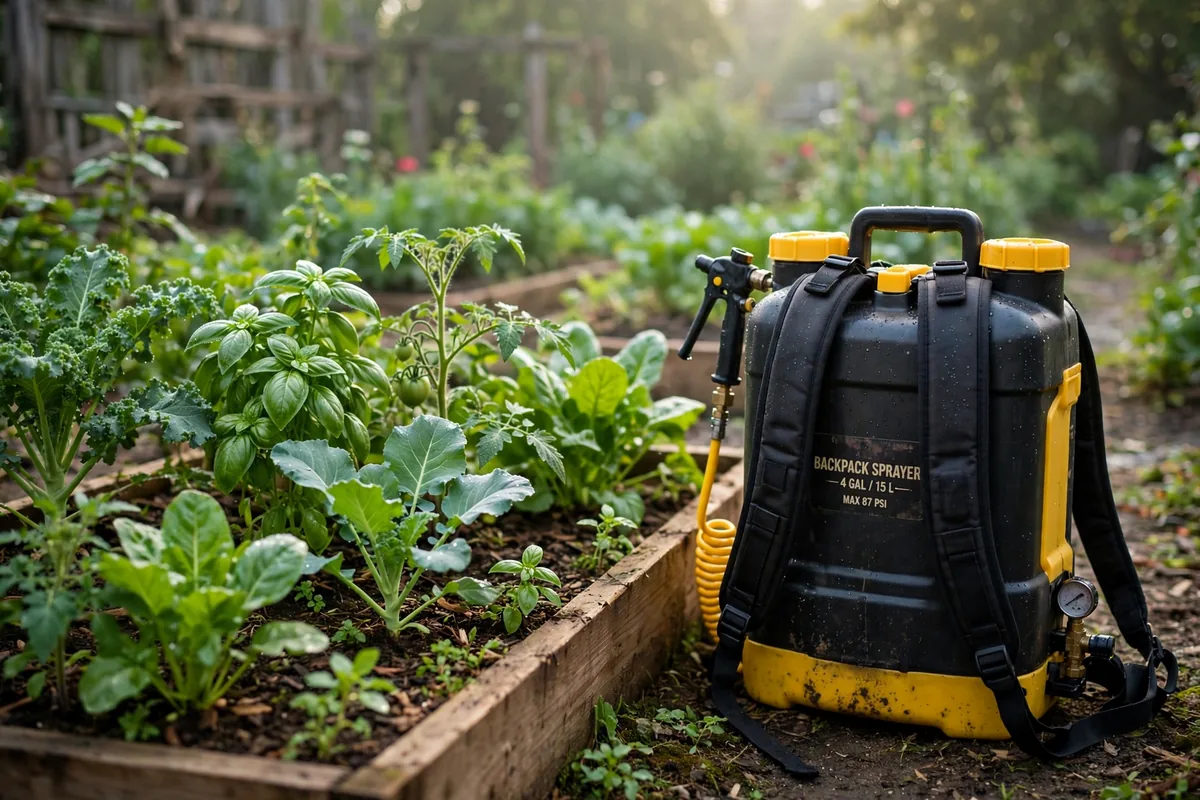
First, so there is no confusion: this guide is about mixing sprays and liquid feeds in water — neem oil, insecticidal soap, copper fungicide, liquid seaweed and liquid fertilizer — not about mixing soil. If you arrived here wanting a soil recipe for pots or beds, you want a different page, and it is linked below. For everyone holding a sprayer and a bottle whose label says something like “5 ml per litre” or “2 tablespoons per gallon” or simply “1:100”, this is your page. Those three instructions can mean almost the same strength, and misreading any one of them is how plants get burned or pests get a drink of flavoured water. The fix is one multiplication, and it is exactly what our Garden Mix Calculator — exact spray and feed amounts from your label dose runs for you. This guide shows how the calculator works, decodes the three dialects labels speak, works a complete neem example tank by tank, and sets out the safety rules that matter more than any number.
Arrived with soil on your mind instead? Read How Much Soil Do I Need for a Raised Bed? — it sizes the fill and the blend for a new bed. Come back here when the plants in that bed need spraying or feeding.
The short answer, on one card
- The formula: product per tank = label dose per litre × tank size in litres. Totals multiply by the number of tanks
- The label dose rules: the calculator ships with typical presets, but you correct the preset to match your label exactly — your label always wins
- Three dialects, one instruction: 5 ml per litre, about 1.3 tablespoons per gallon, and a 1:200 ratio are all roughly the same strength
- Kitchen measures: 1 teaspoon ≈ 5 ml, 1 tablespoon ≈ 15 ml — small amounts are shown in spoons because nobody owns a 5 ml measuring jug
- Mix order: half-fill with water, add the product, top up to the mark, shake gently
- Never keep leftover mixed spray: mix only today’s amount and rinse the sprayer afterwards
Step 1 — Read your label before you touch the calculator
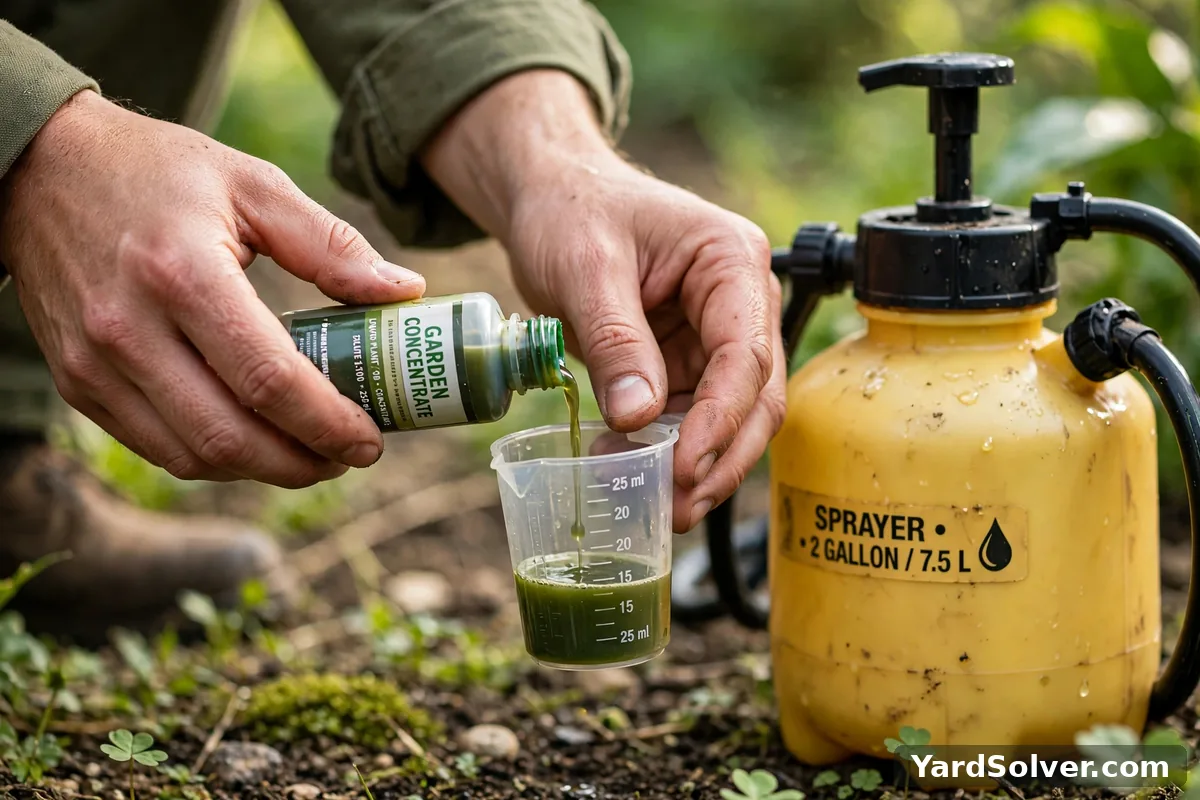
Every mixing mistake starts before the water, at the label. Find the dose line on your own bottle — not a forum recipe, not the dose for a different brand of the same-sounding product, and not last year’s memory. Formulations differ: two neem products can carry different strengths, and a “ready to use” spray is already diluted and must never be diluted again as if it were a concentrate. Note three things from the label: the dose number, the unit it is measured in (millilitres, grams, teaspoons or tablespoons), and the amount of water it is per (a litre, a gallon, or a stated tank size). If the label gives a range, start at the weaker end — you can repeat a weak spray on the label’s schedule, but you cannot un-burn a leaf. Note also what the label says about protective equipment, keeping children and pets away until the spray has dried, and how soon you may harvest after spraying. Those lines are part of the dose, not fine print.
The calculator’s product list — neem oil, insecticidal soap, copper fungicide, liquid feed, liquid seaweed, baking soda spray, Epsom salt solution — is prefilled with typical label rates only to save you typing. They are starting points. The moment your label disagrees with a preset, the preset loses: type your label’s number over it. That single habit is worth more than any conversion table on this page.
Step 2 — The three dialects: ml per litre, spoons per gallon, and ratios
Labels disagree about language, not about maths. A metric label gives millilitres per litre: add that many millilitres for every litre in the tank. An imperial label gives tablespoons per gallon: one tablespoon is about 15 ml and one US gallon is 3.785 litres, so one tablespoon per gallon works out to 15 ÷ 3.785 ≈ 4 ml per litre. A ratio label gives something like 1:100: one part product in 100 parts of finished spray, so a litre — 1,000 ml — needs 1,000 ÷ 100 = 10 ml per litre. Once everything is translated into ml per litre, every label is saying the same kind of sentence, and the calculator can do the rest. The table below does the common translations honestly, rounded only where a spoon makes finer precision meaningless.
| Label says | In ml per litre | Product in a 5 litre tank | Product in a 1 gallon (3.785 L) tank |
|---|---|---|---|
| 3 ml per litre | 3 ml/L | 15 ml (1 tbsp) | about 11 ml |
| 5 ml per litre | 5 ml/L | 25 ml (about 5 tsp) | about 19 ml |
| 10 ml per litre | 10 ml/L | 50 ml | about 38 ml |
| 1 tablespoon per gallon (≈15 ml per 3.785 L) | about 4 ml/L | about 20 ml | 15 ml (1 tbsp) |
| 2 tablespoons per gallon (≈30 ml per 3.785 L) | about 8 ml/L | about 40 ml | 30 ml (2 tbsp) |
| Ratio 1:200 | 5 ml/L | 25 ml (about 5 tsp) | about 19 ml |
| Ratio 1:100 | 10 ml/L | 50 ml | about 38 ml |
| Ratio 1:50 | 20 ml/L | 100 ml | about 76 ml |
Read the ratio rows carefully, because ratios are where honest confusion lives. A 1:100 ratio is usually read as 1 part product in 100 parts of finished spray — 10 ml per litre. Some labels instead mean 1 part product plus 100 parts water, which is 1,000 ÷ 101 ≈ 9.9 ml per litre. The difference is a tenth of a millilitre in a litre — far smaller than the wobble in any kitchen spoon — so 10 ml per litre is the honest working answer either way. What a ratio never means is 100 ml per litre; that misreading makes a mix ten times too strong, and it is the single most damaging translation error in home spraying. When a percentage is given instead, the same translation applies: 0.5% is 5 ml per litre, 1% is 10 ml per litre, and 2% is 20 ml per litre.
Step 3 — Run the calculator: what each input does
Open the Garden Mix Calculator and work top to bottom. Pick the closest product to set a sensible starting preset, then correct the dose number to match your label exactly, and set whether that dose is per litre or per gallon — the calculator converts gallons behind the scenes using 3.785 litres to the gallon. Enter your sprayer or tank size in litres or gallons, and how many tanks you expect to mix. Press Calculate and you get four honest numbers: product per tank, product in total, water per tank, and water in total — with small amounts also shown in teaspoons and tablespoons (1 teaspoon ≈ 5 ml, 1 tablespoon ≈ 15 ml), because that is what a kitchen actually offers for measuring 25 ml. Print the result and take it to the plant; a printed mix list beats a memory carried across a garden.
For dry products measured in grams — the calculator’s baking soda and Epsom salt presets work this way — the same maths applies in grams per litre, and for most powders a level tablespoon is roughly 15 g. Weighing beats spooning for powders if you have a kitchen scale, because a heaped spoon and a level spoon are different doses wearing the same name.
Step 4 — The maths, and one whole job worked start to finish
There is no hidden model. Product per tank = label dose per litre × tank size in litres. If the dose arrived per gallon, the calculator first divides it by 3.785 to get the per-litre dose. Totals = per-tank amount × number of tanks, and the water is simply the tank size times the number of tanks. Here is the calculator page’s own example, worked in full. Neem oil at a label dose of 5 ml per litre, in a 5 litre sprayer: product per tank = 5 × 5 = 25 ml — about 5 teaspoons — and water = 5 litres. A big bed needs two tanks, so the totals are 25 × 2 = 50 ml of neem and 5 × 2 = 10 litres of water. Change the dose to your label’s number and every answer follows it; change the tank to the sprayer you actually own and the same thing happens. Sanity-check any result with the table in Step 2: at 5 ml per litre, a 5 litre tank must land on 25 ml, and if a calculator — this one included — ever tells you otherwise, the input, not the plant, needs correcting.
Feeding follows exactly the same maths, only the bottle changes. A liquid feed at 10 ml per litre in that same 5 litre sprayer is 50 ml per tank — and if you want the feeding programme behind the bottle, with dry fertilizers, rates per area and timing, read How Much Fertilizer Do I Need?, this guide’s companion on feeding by the numbers. Mixing the feed correctly and feeding at the right time are two halves of the same job.
Step 5 — Mix in order, then spray like you mean it

Mix in the calculator’s order, every time: half-fill the tank with water, add the measured product, top up to the full mark, and shake gently. Half-filling first means the product disperses through moving water instead of sitting as a concentrated slug at the bottom, and topping up afterwards means the tank ends at the size the maths assumed. Oils need the shake most — neem and water separate as they stand, so shake gently again every few minutes while you spray, or the first plants get mostly water and the last plants get mostly oil. Spray on a calm, dry morning or evening: never in hot midday sun, which scorches wet leaves; never in wind, which delivers your dose to the neighbour’s garden; and never onto open flowers while bees are working. Cover the tops and undersides of the leaves, as in the photo — aphids, whitefly and mites live underneath, and a spray that only wets the tops has missed its target no matter how perfect the mix was.
Now the calibration honesty this page owes you. The calculator guarantees what is in the tank; it cannot guarantee what leaves the nozzle. Two gardeners with identical tanks can put down very different amounts per plant because one walks faster, pumps harder, or holds the lance closer. Calibrate once a season with plain water: fill to a marked level, spray for exactly one minute the way you normally work into a measuring jug, and note the litres — that is your real output per minute. A partly blocked nozzle or a tired pump seal shows up immediately in that test, and cleaning the nozzle and filter fixes most of what it finds. If a problem is not improving after a week of correctly mixed, correctly timed spraying, re-check the diagnosis before mixing stronger — more is not better, and a wrong diagnosis at double strength is still a wrong diagnosis.
Safety rules — read these before the numbers
- The label is the law. Your product’s label dose, protective equipment, harvest interval and warnings override this guide, the calculator’s presets, and any recipe — always.
- Never tank-mix two products unless both labels allow it. If both labels do allow it, mix a small test batch first and spray a few leaves before committing a whole tank. When in doubt, apply products separately on different days.
- Never keep leftover mixed spray. Mix only the amount you will use today, use it the same day, and rinse the sprayer afterwards — mixed sprays lose strength and can turn unsafe in storage.
- Keep mixed product away from children and pets, exactly as the label directs — while you mix, while you spray, and until treated plants have dried. Store concentrates locked away, in their original labelled bottles, never in drink bottles.
- Test first on precious plants: spray a few leaves with a new product or a new plant, wait a day, and only then spray the whole plant.
What the calculator can’t do
Honesty about the edges, so the numbers earn your trust. The calculator cannot read your label for you — if the dose you type in is wrong, the answer will be precisely, confidently wrong, which is why Step 1 exists. It cannot know your product’s true strength, so a preset is never a substitute for your bottle. It cannot calibrate your sprayer, judge your walking pace, or tell you whether the pest you are treating is the pest you actually have. Its spoon conversions are honest approximations — a tablespoon is about 15 ml, not exactly 15.00 ml — and for doses under about 10 ml, a cheap measuring syringe from any pharmacy is more accurate than any spoon and worth owning. What the calculator does guarantee is the arithmetic, checked above in the open: dose per litre times tank size, totals times tanks, in whatever dialect your label arrived in.
Keep going
Run your own bottle through the Garden Mix Calculator, then feed by the numbers with How Much Fertilizer Do I Need?. If you came here looking for soil rather than spray, How Much Soil Do I Need for a Raised Bed? sizes the bed fill you were after.
Planning when to spray, feed and plant across the whole season? The Garden Planner lays out spraying, feeding and planting in one calendar, so treatments land on the days the labels allow.
Questions people ask
Can I mix two products in one tank?
Only if both labels say tank-mixing is allowed, and even then mix a small test batch first and spray a few leaves to check for damage. When in doubt, apply the products separately on different days — a second trip is cheaper than a burned crop.
Can I keep leftover spray for next week?
No. Mixed sprays lose strength, can separate or turn unsafe, and should never be stored mixed. Mix only what you will use today, use it the same day, and rinse the sprayer afterwards.
My label gives tablespoons per gallon — what do I enter?
One tablespoon is about 15 ml and one US gallon is 3.785 litres, so 1 tablespoon per gallon is about 4 ml per litre (15 divided by 3.785). In the calculator you can enter 15 as the dose and choose per gallon, or enter about 4 and choose per litre — both give the same tank.
What does a 1:100 ratio mean in ml per litre?
It means 1 part product in 100 parts of finished spray, so one litre (1,000 ml) needs 1,000 divided by 100 = 10 ml of product. Enter 10 as the dose per litre. If a label instead means 1 part product plus 100 parts water, the answer is about 9.9 ml per litre — for garden purposes, 10 ml per litre.
Why did my spray burn leaves even at the label dose?
Dose is only one cause. Spraying in hot midday sun, spraying a drought-stressed or very tender plant, not shaking an oil mix so it goes on unevenly, or spraying a plant the label does not list can all scorch leaves. Spray on a calm, dry morning or evening, test on a few leaves first with a new product or plant, and keep spray off open flowers.
How do I check my sprayer is putting out what I think?
Calibrate with plain water. Fill the tank to a marked level, spray the way you normally walk and pump for exactly one minute into a measuring jug, and note the litres used — that is your real output per minute. If it is far from what you expected, clean the nozzle and filter and test again. The calculator gets the mix in the tank right; calibration is what gets that mix onto the plants evenly.
A garden mix is a recipe by volume — the calculator turns bed size into ingredient amounts
Soil mixes fail on proportions guessed by eye: too much compost burns and slumps, too much native soil reintroduces the drainage problem the bed was built to escape, and too little of the coarse fraction leaves a mix that holds water like a sponge cake. A proper raised-bed or garden mix is blended by volume — topsoil, compost and aeration material in stated parts — so the calculator's real job is converting your bed's length, width and depth into the cubic amount of each ingredient to buy or barrow.
Measure depth honestly, allow for settling of about a tenth, and mix on a tarp beside the bed rather than layering ingredients in place, where they stay in strata roots must cross. If you are topping up an old bed rather than filling a new one, calculate only the settled deficit — the top-up amounts guide linked from the tools does that smaller job — and never pay for a full fill twice.
Sources
Key facts on this page cross-checked against Soil — Wikipedia — background on soil and its composition and Raised-bed gardening — Wikipedia — background on raised-bed gardening and its soil mixes.
Related page
Read next: Best Vegetables for Containers: Pots, Soil & Watering.
Comments & ratings
No comments yet.
Be the first to share your experience.