
Guides · Water & irrigation · Published November 22, 2026 · By Faizan Ahmad
How Long Should I Run My Sprinklers? Your Precipitation Rate Decides
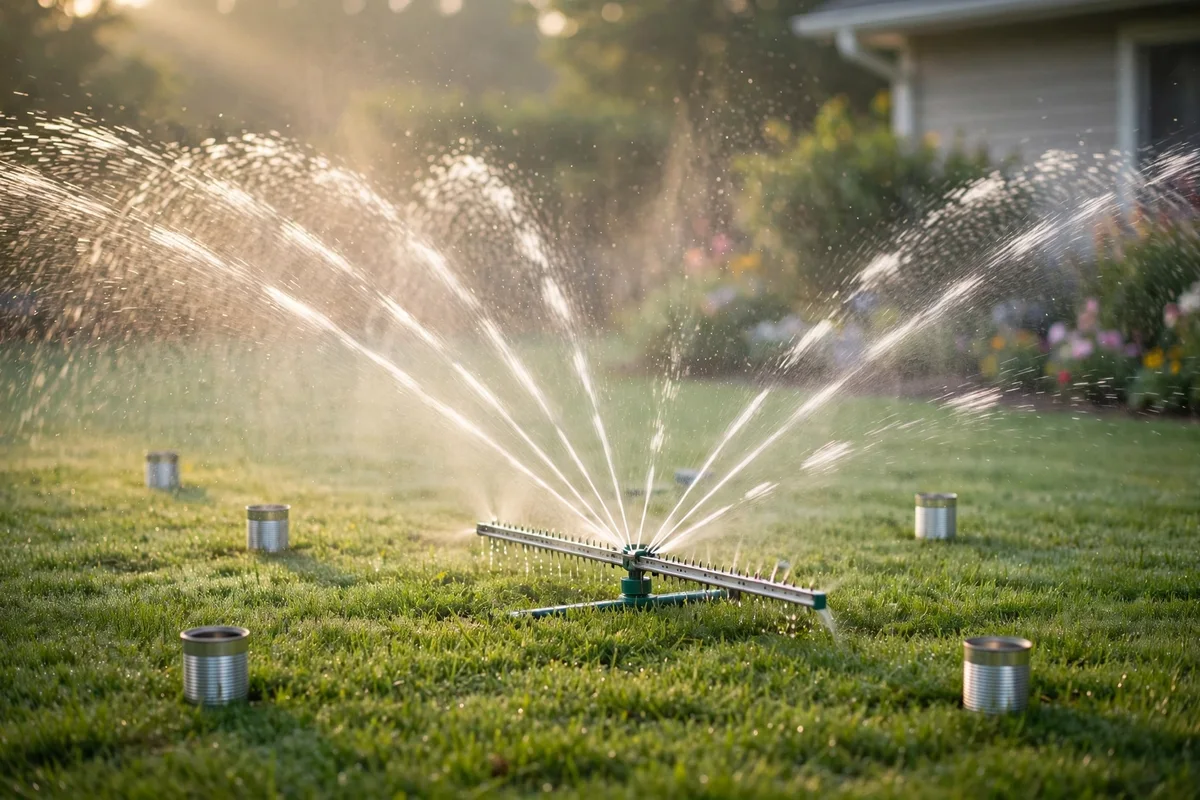
Run them until they have applied the depth your lawn needs — typically ½ to 1 inch per session — and the minutes that takes are different on every zone you own. The deciding number is your precipitation rate, and our Sprinkler Calculator computes it from head flow and zone size with the industry formula. This guide covers the method, the tuna-can test that verifies it, and the cycle-and-soak technique for soils that cannot drink as fast as sprays pour.
The short answer, on one card
- The formula: precipitation rate (in/hr) = 96.3 × total flow (gal/min) ÷ zone area (sq ft)
- Run time = depth ÷ rate: 1 inch at 0.96 in/hr takes about 62 minutes
- Sprays pour fast (1.5+ in/hr), rotors pour slowly (~0.5 in/hr) — never mix them on one zone
- The tuna-can test verifies everything: 15 minutes of runtime, depth in the cans × 4 = true in/hr
- Clay and slopes need cycle-and-soak: several short runs an hour apart, same total, no runoff
On this page
Step 1 — Rate first, minutes second
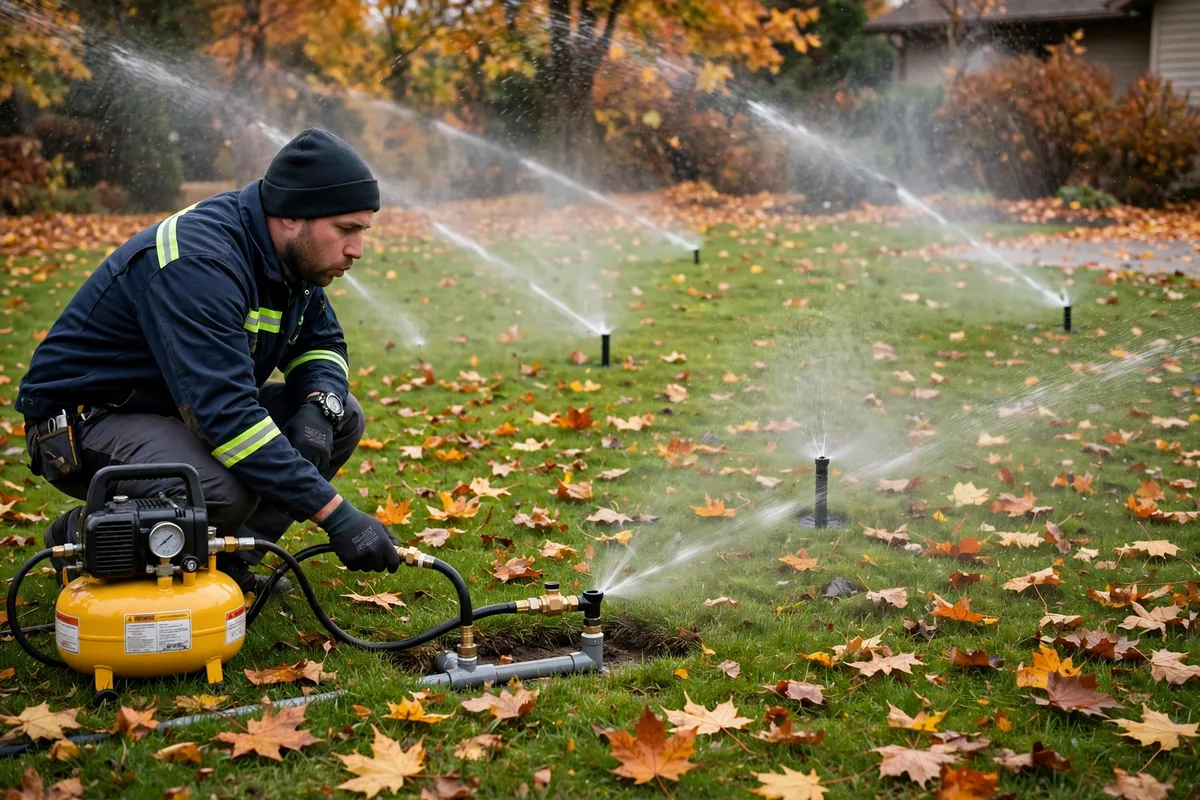
A sprinkler zone is a rain machine with a fixed rainfall rate, and asking "how many minutes" before knowing the rate is asking the wrong question in the wrong unit. A spray zone may pour 1.6 inches per hour; a rotor zone on the same controller may pour 0.45. Twenty minutes is a soaking from one and a sip from the other, and both controllers will happily display "20" with equal confidence.
The rate comes from one formula the irrigation industry has used for decades: 96.3 × total gallons-per-minute ÷ area in square feet. The constant is no mystery — an inch of water over a square foot is 0.623 gallons, and 60 minutes ÷ 0.623 gives 96.3. Count your heads, take their rated flow (or bucket-test one), measure the zone, and the calculator hands you the rate and the run time for any depth.
Step 2 — Typical zones, typical run times
Worked examples at common flows, for the lawn standard of one inch. Your zone will differ — that is the point of the exercise — but the spread between rows shows why no universal minute count can be honest.
| Zone type | Flow & area | Precipitation rate | Minutes for 1 inch |
|---|---|---|---|
| 4 spray heads | 4 × 2.5 gal/min over 600 sq ft | 1.60 in/hr | ≈ 37 minutes |
| 4 rotor heads | 4 × 3 gal/min over 1,200 sq ft | 0.96 in/hr | ≈ 62 minutes |
| 6 rotor heads, large lawn | 6 × 3.5 gal/min over 3,000 sq ft | 0.67 in/hr | ≈ 89 minutes |
| 4 rotary nozzles (high-efficiency) | 4 × 0.8 gal/min over 800 sq ft | 0.39 in/hr | ≈ 156 minutes |
Run your own zone through the Sprinkler Calculator — rate and run time from your numbers. Laying out a zone that does not exist yet? The Sprinkler Coverage Calculator spaces its heads first, head-to-head.
Step 3 — The tuna-can test: trust, but verify

Formulas assume rated pressure and honest nozzle charts; your street supply and your ten-year-old heads have their own opinions. The can test arbitrates: set out several flat, straight-sided cans — tuna or cat-food tins are the standard gauge — across the zone, run it for exactly 15 minutes, and measure the water in each. Average depth × 4 is your true inches-per-hour, and the spread between cans is your uniformity report.
If the cans agree with the formula, water with confidence. If they read low, your pressure or flow is below rating and run times stretch by the same ratio. If they disagree wildly with each other — one can double its neighbour — the problem is coverage, not time: heads spaced too far apart, a tilted or sunken head, a nozzle mismatched at replacement. No run time fixes geometry; the coverage calculator and a flag-marked walk of the zone do.
Step 4 — Cycle-and-soak: when the soil can’t keep up
Soil drinks at its own rate — sand quickly, loam moderately, clay at perhaps 0.2 inches per hour. Pour faster than the intake rate and the excess does not wait politely; it runs off, taking the watering with it and leaving the lower lawn wet and the upper lawn thirsty. Spray zones on clay are the classic mismatch: 1.6 in/hr of rain onto a 0.2 in/hr soil.
Cycle-and-soak resolves it by splitting the run: three sessions of a third of the total, spaced an hour apart, let each dose sink before the next arrives. Same total depth, no runoff, and the controller setting takes two minutes. Slopes earn the same treatment on almost any soil. It is the single highest-value adjustment in lawn irrigation — free, immediate, and invisible in every way except the lawn’s.
Questions people ask
How much water does a lawn need each week?
About an inch in mild weather including rainfall, rising toward 1.5 inches in sustained heat. A rain gauge settles what the sky contributed; the can test settles what the sprinklers did. Lawns watered deeply and infrequently root deeper and need the schedule less desperately than daily-sipped lawns.
Is it better to water in the morning or evening?
Early morning wins on every count: wind is calmest (less drift), evaporation lowest, and foliage dries quickly in the rising sun, denying fungal diseases their long wet night. Evening is an acceptable second; midday in heat and wind is the wasteful shift.
Why do parts of my lawn stay dry even with long runs?
Because coverage, not duration, is failing — heads spaced beyond head-to-head leave rings that no amount of extra minutes fully reaches, since the wettest spots simply get wetter. Diagnose with the can test’s spread, then fix spacing, arcs and sunken heads.
My controller has a 'seasonal adjust' percentage — how should I use it?
Set your run times for the hottest month, then scale down with seasonal adjust in spring and fall (50–70% is typical) instead of reprogramming minutes. It is the rate method wearing a dial: the depth target changes with the weather, the zone’s rate does not.
Do smart controllers make this maths unnecessary?
They automate the calendar and skip rainy days, which is genuinely valuable — but they still multiply a rate somebody entered, and a wrong rate automates the wrong watering beautifully. Measure once with cans, enter the truth, and let the controller handle the weather.
Sources
Key facts on this page cross-checked against Watering Established Lawns — Colorado State University Extension — extension guidance on lawn watering depths, rates and scheduling Drip Irrigation for Home Gardens — Colorado State University Extension — the companion extension guidance for the drip side of the yard.
Comments & ratings
No comments yet.
Be the first to share your experience.