
Guides · Planning & layout · Published November 22, 2026 · By Faizan Ahmad
How Many Plants Do I Need for a Flower Bed? Counts at Mature Spacing
You need the number of plants that fills the bed at their mature spread — bed area divided by spacing squared — which is always fewer than the young plants in their pots tempt you to buy, and always more than guesswork suggests for groundcover. Our Flower Bed Calculator counts plants on square and staggered grids, plus mulch and edging. This guide covers the spacing honesty, the grid bonus, and filling year-one gaps without buying year-three crowding.
The short answer, on one card
- The count: plants = bed area ÷ spacing² — a 48 sq ft bed at 18 in spacing takes 22 plants
- Staggered grids fit ~15% more at the same spacing — groundcover’s friend
- Space for the mature plant: the pot it came in is a liar by design
- Fill year one with annuals between the perennials — colour now, room later
- Complete the list: 3 in of mulch and the full perimeter of edging, counted at the same sitting
On this page
Step 1 — The mature-spread rule
Every plant label carries two sizes: the pot it is sold in and the spread it will reach. Beds are planted to the second number and shopped by the first, which is how a border becomes a wrestling match by its third summer — perennials dug, divided and evicted at exactly the size they always said they would be. Spacing by mature spread feels extravagant in May: six hostas rattle in a bed built for their future. By the second July the bed looks inevitable, which is what designed planting actually is — the future, planted early.
The arithmetic is the calculator’s: area divided by spacing squared. What the arithmetic cannot supply is the spacing itself — read it off the label or the variety’s references, not off the nursery bench, where everything is young, tight and on its best behaviour.
Step 2 — Counts for common beds and spacings
Square-grid counts (staggered adds about 15%). Note how violently spacing drives the count: halving the spacing quadruples the plants — the most expensive sentence in bed planning is "they’ll fill in".
| Bed | At 12 in spacing | At 18 in spacing | At 24 in spacing |
|---|---|---|---|
| 4 × 4 ft (16 sq ft) | 16 plants | 8 plants | 4 plants |
| 12 × 4 ft border (48 sq ft) | 48 plants | 22 plants | 12 plants |
| 20 × 5 ft border (100 sq ft) | 100 plants | 45 plants | 25 plants |
| Round bed, 6 ft across (28 sq ft) | 29 plants | 13 plants | 8 plants |
Your own bed goes into the Flower Bed Calculator — plants, mulch and edging together. Vegetable beds count differently — by the Plant Spacing Calculator and Row Spacing Calculator.
Step 3 — The staggered bonus and where it belongs
Offsetting each row by half a spacing — the triangular or staggered grid — packs plants hexagonally: each keeps its full spacing from its neighbours while the bed fits about 15% more of them. For groundcover sweeps, bedding annuals and any planting meant to knit into a weed-proof carpet, that bonus is real money and real coverage.
For specimen perennials the bonus mostly evaporates: their spacing is set by individual architecture, not by carpet logic, and the honest count is the square grid’s. Use each grid where its assumption lives — staggered for carpets, square for specimens — and be suspicious of any count that flatters the shopping list.
Step 4 — Year one’s gaps, honestly filled
A correctly spaced new bed looks sparse, and the gardener’s two failure modes are overplanting it (year-three crowding) and apologising for it. The third way is the annual interplant: quick annuals — sown or planted between the perennials — fill the first season’s gaps with colour, suppress weeds by occupation, and leave exactly when the perennials expand to claim the space. Cosmos, zinnias and calendula are the classic tenants: cheap, fast, and gone without an eviction fight.
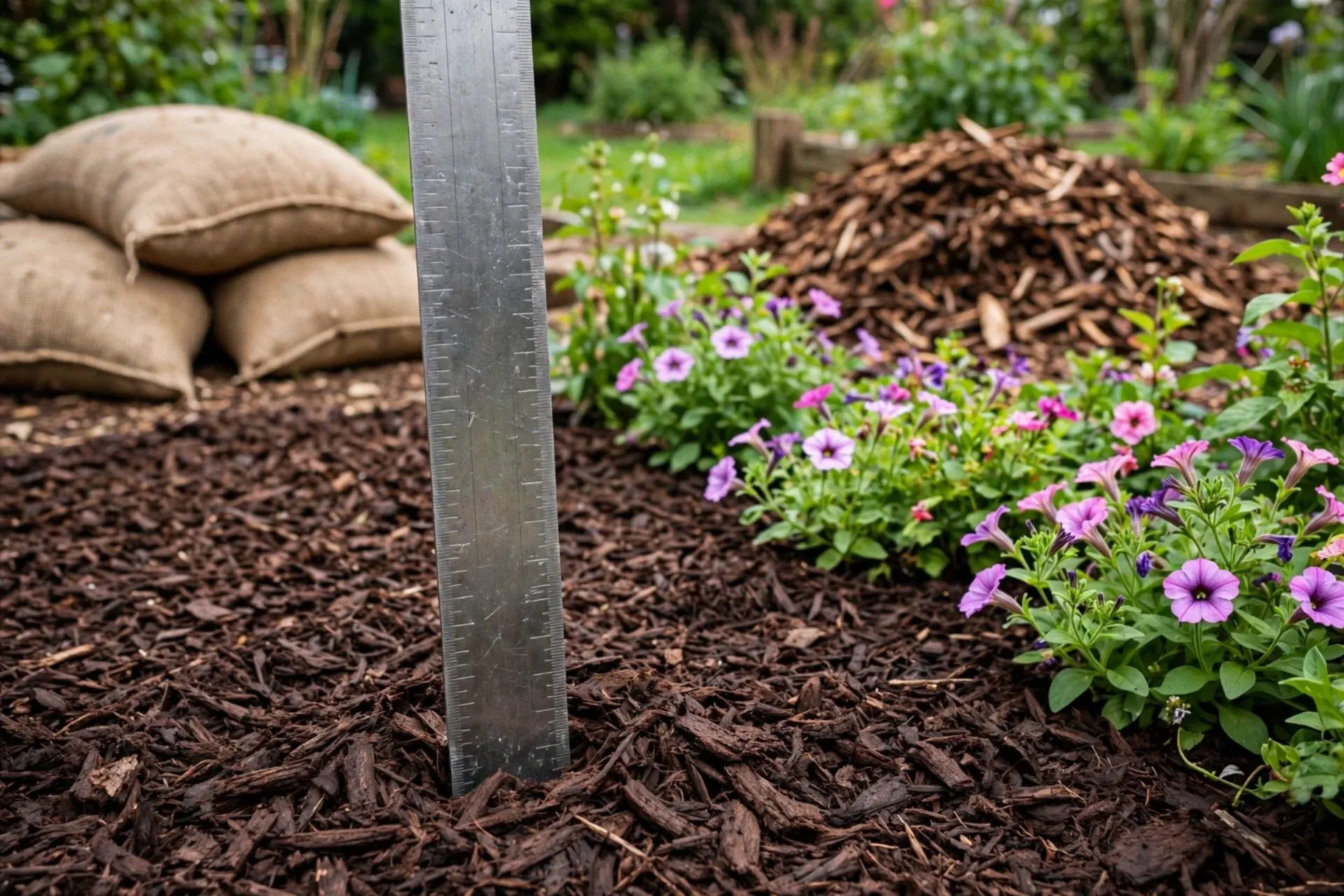
Mulch carries the same season: three inches over the gaps keeps them weed-free while the perennials are small, and the bed reads as finished from the day it is planted. Sparse is a stage, not a verdict — photograph the bed in June of year one and year three side by side and the spacing maths makes its own argument.
Questions people ask
Why do garden centres plant displays so much tighter than the labels say?
Because a display is a photograph, not a planting — it is built to look complete this weekend and quietly replanted as things fail. Your bed has to live at its spacing for years. Shop the display for ideas; plant by the label’s spread.
How many plants for a quick groundcover carpet?
At the staggered grid and the plant’s true spread — then accept that 'quick' is set by the plant’s growth, not the count. Doubling density buys a few weeks of coverage at twice the price and a division job later; the patient count plus mulch wins on every horizon past one season.
Should perennials go in groups or singles?
In odd-numbered groups — threes and fives of one variety read as a designed drift where singletons read as a collection of apologies. The total count is unchanged; the arrangement is the design. Specimen plants (a peony, a grass) are the deliberate exception.
What if my bed is an odd shape?
Decompose it: rectangles and circles on paper, each run through the calculator, totals added. For a wavy border, the longest length × average width slightly over-counts — the surplus lands in groundcover and mulch, the forgiving directions.
How much edging do I really need?
The full perimeter, measured — including the side against the fence, where the eye forgives but the mower does not. The calculator returns the perimeter with the plant count; buy edging in one trip with a small overage for cuts, because dye lots and profiles change between seasons.
Sources
Key facts on this page cross-checked against Square foot gardening — Wikipedia — background on intensive spacing grids and bed layouts Planting a Vegetable Garden — University of Minnesota Extension — extension spacing guidance — the same geometry governs ornamental beds.
Related page
Read next: How to Plan a Cut Flower Garden: Beds That Bloom All Season
Comments & ratings
No comments yet.
Be the first to share your experience.