
Guides · Garden planning · Published November 20, 2026 · By Faizan Ahmad
How to Plan a Cut Flower Garden: Beds, Spacing and a Season of Bouquets
To plan a cut flower garden, draw it on paper in winter: choose your sunniest bed, lay it out in rows about 1.2 m (4 ft) wide that you can reach across, plant annuals tightly at about 23 cm (9 in) spacing so stems grow long and straight, include all four bouquet ingredients — a spike, a round focal flower, a filler and foliage — and schedule succession sowings every two to three weeks from spring to midsummer so something is always coming into bloom as something else finishes. The cutting garden is the one part of the 2027 garden that rewards planning out of all proportion to its size, because its failures are never growing failures — they are calendar failures. Every gardener who has tried it knows the pattern: a glorious fortnight in July when everything flowers at once, buckets on every surface, and then a long green silence for the rest of the season. That is not bad luck; it is a plan that planted one of everything on one day. Ohio State University Extension's cut flower teaching makes the production point plainly: a cutting garden is managed like a crop, with beds sized for reach, a soil test before planting, tight spacing for vertical growth, and succession planting to spread the harvest across the whole window. This guide turns that into a home-scale plan: the bed, the spacing, the four-ingredient planting list, the succession calendar, the support and harvest routines, and a worked example of one bed's year. Winter is when it happens — the same paper season as when to order seeds for spring and the variety hunting in best new seed varieties for 2027 — because by the time the soil is workable, the plan should already be a shopping list.
The short answer, on one card
Site: full sun, six hours or more, close to water; a dedicated bed beats flowers scattered through display borders. Shape: beds about 1.2 m (4 ft) wide with 45 cm (18 in) paths, rows running north–south where you can. Soil: test it, then compost and a balanced feed — production beds are fed like vegetable beds. Spacing: about 23 cm (9 in) for most annual cut flowers, 30 cm (12 in) for bulky branching plants. The planting rule: every bouquet needs a spike, a round flower, a filler and foliage — plant all four categories, every season segment. Succession: sow zinnias, cosmos and sunflowers in batches every 2–3 weeks until midsummer; sunflowers flower once per plant, so their rows are pure calendar. Support: horizontal netting at 30–45 cm (12–18 in) over tall rows, installed before plants are 30 cm (1 ft) tall.
Plan it like a crop, not a border
The single decision that separates a cutting garden from a flower border is intent, and it changes every measurement. A border is planted for the view from the path; a cutting garden is planted for the bucket, which means rows you can work, spacing set by stem quality rather than by how a plant looks in a catalogue, and varieties chosen for vase life and cutting stage rather than for garden display. Ohio State's master gardener teaching starts where a vegetable grower would: stake the plot, keep production and efficiency in mind, make beds about 48 inches wide so the centre is reachable from either side, and take a soil test before planting anything. Tight planting is the counterintuitive heart of it. The same teaching puts the most common cut flower spacing at 9 by 9 inches — far closer than ornamental labels suggest — because crowded plants grow upward instead of outward: long, straight, unbranched stems that fit a vase, with a canopy that shades out weeds as a bonus. The quotable fact of this guide follows directly: in a cutting garden, crowding is not a mistake to apologise for — it is the tool that makes stems long, straight and worth cutting. The layout corollaries are practical: orient beds north–south so rows share the light evenly, put the tallest crops — sunflowers, tall dahlias — at the north end where their shade falls away from the rest, keep a path wide enough for a bucket and your knees, and site the whole thing near the tap, because a cutting bed in production drinks like a vegetable bed and is watered like one, deeply and at the base.
The four ingredients every bouquet needs
| Ingredient | Job in the vase | Reliable home choices | Season |
|---|---|---|---|
| Spike | Height and line; the bouquet's architecture | Snapdragons, larkspur, gladiolus, foxglove | Spring to midsummer; glads in succession to fall |
| Round / focal | The flower the eye lands on | Zinnias, dahlias, sunflowers, peonies, roses | Late spring (peony) through fall (dahlia) |
| Filler | Air, texture and volume between focals | Cosmos, nigella, orlaya, scabiosa, calendula | Spring (nigella, calendula) and summer (cosmos) |
| Foliage | The green frame that makes colours read | Basil, dill, mint, dusty miller, eucalyptus, hosta leaves | All season; herbs double as kitchen crops |
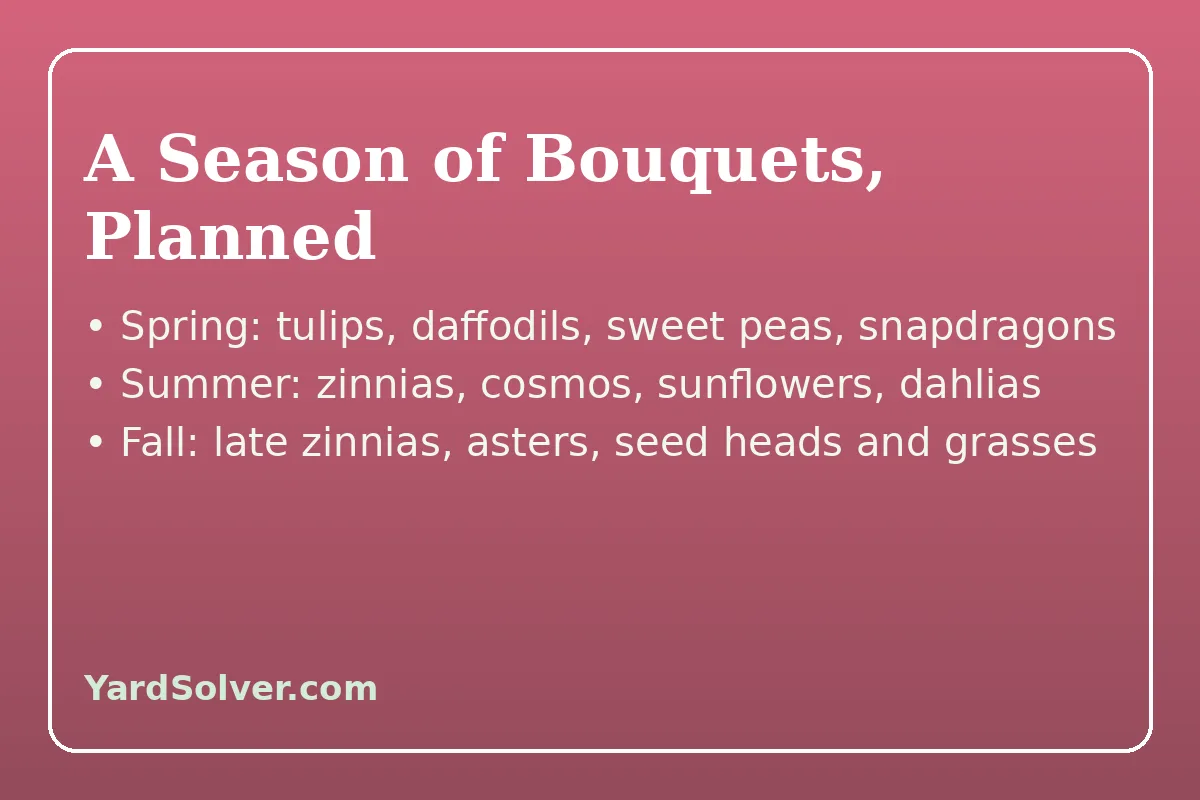
Most beginner plans plant three rows of focal flowers and nothing else, then wonder why the bouquets look like a pile of heads. Florists build in four parts, and the home plan should steal the structure whole. The Old Farmer's Almanac's cutting garden plan is built exactly this way — a blended planting of perennials, annuals, bulbs and foliage plants arranged for a steady supply rather than a single show, with a centre bed that itself runs a succession: tulips for spring, then orlaya, zinnias and cosmos taking the same ground for summer. Note the two structural tricks in that plan. Perennials and bulbs carry the season's edges — tulips, daffodils and peonies in spring, dahlias and asters in fall — while fast annuals carry the long summer middle. And every segment of the calendar holds all four ingredients at once, so a bouquet can be cut in May, July and September with the same recipe and different flowers. When you draft your own list, draft it as a grid — four ingredient rows against three season columns — and refuse to order a seed until every cell holds at least one name. The empty cells are your plan's honest gaps, found in January when they cost nothing, instead of in August when they cost the bouquet.
Succession: the calendar that prevents the July glut
Succession planting is the discipline of sowing the same crop in small batches weeks apart, and Ohio State's teaching divides cut flowers by how strictly they need it. Cut-and-come-again flowers — zinnias, cosmos, scabiosa — bloom over a long window from one sowing if you keep cutting them, and a second sowing a month later mainly insures against a failed first batch. One-flush flowers are the strict case: a sunflower plant produces its flowers in a single pass and is done, so a sunflower row is a date, not a planting — sow a short row every two weeks from the last frost to midsummer and the harvest becomes a conveyor instead of a cliff. The season's bookends run on different clocks again. Hardy annuals — calendula, nigella, larkspur, sweet peas — are sown in early spring or even the previous fall for the first cuts of the year, and the slow aristocrats, snapdragons and lisianthus, are started indoors in late winter because they need months to reach flowering size; the station in how to build a seed starting station exists largely for them. Pinching is succession's partner technique: when young plants of branching annuals reach about 20–30 cm (8–12 in), cut the growing tip just above a leaf pair, and the plant responds with several stems instead of one — more, slightly later flowers from the same square of bed. Deadheading and cutting itself are the third partner: a zinnia cut hard, just above a leaf set, branches and re-blooms, while a zinnia left to set seed reads the season as finished. In a cutting garden, the harvest is the pruning, and the gardener who cuts generously is rewarded with more to cut.
Support, water and the harvest routine
Three working systems keep the plan standing — literally, in the first case. Tall, branching crops grown at tight spacing will flop in the first summer storm unless support goes in early: Ohio State's methods are corralling with posts and string for bulky plants, horizontal netting for branching crops, staking for individuals, and trellising for climbers like sweet peas. For home beds, netting is the workhorse — stretch it horizontally over the row at about 30–45 cm (12–18 in) high, secured to corner posts, before the plants reach 30 cm (1 ft), and let them grow up through it; stems emerge straight, and a storm moves the whole row as a unit instead of flattening it. Watering is vegetable-bed discipline: deep drinks once or twice a week, drip or soaker lines preferred so foliage stays dry, mulch once plants are established to hold moisture and end the weeding. Feeding follows the soil test — a balanced feed every few weeks through the production season, since a bed being harvested weekly is exporting fertility in every bucket. The harvest itself has a craft worth learning in the plan stage. Cut in the cool of early morning or evening, with clean sharp snips, taking stems long and cutting just above a leaf set to encourage the next branch; carry a bucket of cool water to the bed and put stems straight into it, because a stem that wilts on the path rarely recovers fully. Indoors, strip every leaf that would sit below the water line, recut the stems, and let the bucket rest a few hours in a cool dark spot before arranging; change vase water every day or two and keep arrangements out of direct sun. One honest caution belongs in every plan: several beloved cut flowers, lilies above all, are seriously toxic to cats, and daffodils, tulips and ranunculus also appear on pet-toxicity lists — a household with cats plans its lily row for outdoor vases or skips it, and keeps cut stems out of feline reach.
One bed's year: a worked example to copy
Here is a single 1.2 by 4.8 m (4 by 16 ft) bed run as a complete plan, in a cold-climate garden. Down its centre, a permanent spine of perennials and bulbs: tulips and daffodils planted the previous fall at the south end, a peony and two shrub roses mid-bed, three dahlias at the north end lifted each fall with the tubers stored by the method in storing dahlia tubers over winter. Either side of the spine, the annual rows rotate by calendar. In early spring, hardy rows go in: calendula, nigella and larkspur direct-sown, sweet peas at a trellis on the north end, snapdragons — started indoors in February — transplanted under the netting. First cuts come in May: tulips, daffodils, then nigella and calendula as the bulbs fade. After the last frost, the summer rows follow in their succession rhythm: zinnias and cosmos sown in three batches three weeks apart, a short sunflower row every fortnight, gladiolus corms planted every two weeks for a ladder of spikes, basil and dill threaded through as the foliage ingredient. July and August cut daily if you let them. In midsummer, one tired row is cleared and sown with a final fast batch for September, while the dahlias — pinched, netted, deadheaded — build toward their fall peak. October's last bouquets are dahlias, asters, seed heads and grasses, and the bed's final job of the year is the one that started it: tulip bulbs going in where the zinnias stood, and the whole year's notes — which varieties cut best, which succession gap showed — written into the journal for next winter's improved plan. Nothing in that year is exotic. It is a spine, four ingredients, and a calendar, drawn once on paper in the snow months and then simply followed.
The plan on paper: drawing the bed before ordering a seed
The worked example began as a drawing, and the drawing method is worth its own paragraph because it is where most plans quietly fail — they live as a list of seed names rather than as a map of ground. Take one sheet per bed. Rule it to scale, a centimetre to ten centimetres of bed, and mark the compass point, the path, and the water source. Draw the permanent spine first — bulbs, perennials, roses, the dahlia positions — because those are fixed addresses everything else must fit around. Then divide the remaining ground into row-blocks and assign each block a season segment and an ingredient, in pencil: "spring, filler — nigella," "summer, focal — zinnia succession 1/2/3," with the sowing dates written under each assignment, counted back and forward from your last frost date with the calendar in the 2027 planting calendar open beside you. Count the plants the spacing allows — a 4.8 m row at 23 cm holds about twenty plants — and let that number, not the catalogue photograph, set the seed order; a single packet of most annuals covers a row, and the classic beginner surplus of eleven half-used packets is a drawing failure, not a shopping failure. Photograph the finished sheet and keep it with the seed box. In the season, the drawing rides in a plastic sleeve at the bed's end, and every deviation — the row that failed, the variety that sulked — is pencilled onto it in the moment. Next winter's plan then starts from evidence instead of from the same hopeful list, which is the entire difference between a garden that improves and a garden that merely repeats.
Keep going
Set the plan's dates with When to Order Seeds for Spring, start its slow flowers under How to Build a Seed Starting Station, and store its dahlias by Storing Dahlia Tubers Over Winter.
Sources
The production framework — stake the plot for efficiency, beds about 48 inches wide so the centre is reachable, a soil test before planting, the most common annual cut flower spacing of 9 by 9 inches with 12 by 12 for bulkier branching plants, succession planting divided between cut-and-come-again types sown a month apart and one-flush types sown every two weeks, and the four support methods (corralling, netting installed before plants are a foot tall at about 18 inches, staking, trellising) — follows Ohio State University Extension's master gardener teaching, Cut Flower Gardens. The blended layout of perennials, annuals, bulbs and foliage for a steady cutting supply, with a centre succession bed running tulips into orlaya, zinnias and cosmos, and the plant list's spacings (zinnias 9-12 inches, cosmos 12 inches, nigella 6 inches, scabiosa 9-12 inches) follow The Old Farmer's Almanac, Cut Flower Garden Plan: Perennials and Annuals. Harvest craft — cut in the cool of morning or evening into a bucket of water, pinch young plants at 8 to 12 inches, condition stems before arranging — follows the beginner plan at How to Start a Cut Flower Garden.
Questions people ask
How big should a cut flower garden be?
One bed about 1.2 m (4 ft) wide and 3 to 5 m (10 to 16 ft) long is a genuine production unit — enough for weekly bouquets all season if it is planted tightly and succession-sown. The width matters more than the length: you must reach the centre from the paths without stepping into the bed.
How close together do you plant cut flowers?
Much closer than ornamental spacing: about 23 cm (9 in) each way for most annuals, 30 cm (12 in) for bulky branching plants. Tight spacing forces long, straight, upright stems — exactly what a vase needs — and the leaf canopy shades out weeds.
What are the easiest cut flowers for a beginner?
Zinnias and cosmos for summer focal and filler, calendula and nigella as hardy spring flowers, branching sunflowers for drama, and snapdragons started early indoors for spikes. All are cut-and-come-again or succession-friendly, forgiving of timing, and productive in a single bed.
What does succession planting mean for flowers?
Sowing the same flower in small batches two to three weeks apart instead of all at once, so harvests arrive as a conveyor rather than a single glut. It is essential for one-flush flowers like sunflowers, which bloom once per plant, and useful insurance for cut-and-come-again types like zinnias and cosmos.
When should I plan and order for a cut flower garden?
In winter. Draw the bed plan and the four-ingredient planting grid in December or January, order seeds at the same time as your vegetable order, and start the slow flowers — snapdragons, lisianthus — indoors in late winter. Spring is for executing the plan, not writing it.
Why do my bouquets look like a pile of flower heads?
The planting was all focal flowers. A bouquet needs four ingredients: a spike for height, a round focal flower, an airy filler such as cosmos or nigella, and foliage to frame them. Plant all four categories in every season segment and the same flowers arrange themselves.
Comments & ratings
No comments yet.
Be the first to share your experience.