
Guides · Fall and winter · Published November 18, 2026 · By Faizan Ahmad
How Much Water Does a Real Christmas Tree Need? (The 1-Quart-Per-Inch Rule)

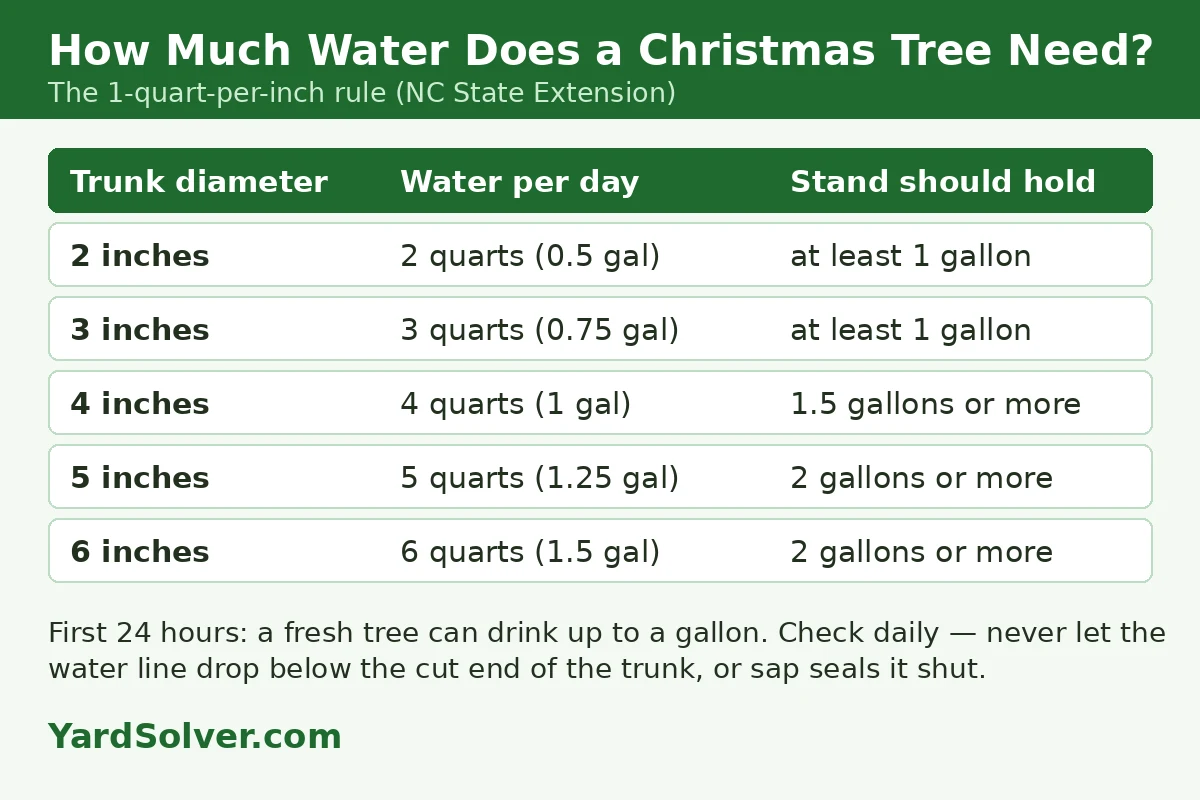
A real Christmas tree needs up to 1 quart of water per day for every inch of its trunk diameter — so a typical tree with a 4-inch trunk drinks about a gallon a day at its thirstiest, and it can take a full gallon in the first 24 hours alone. That is the whole answer, and it is the rule extension services across North America teach: measure the trunk, and the trunk tells you the water. Everything else in this guide — the table, the stand sizes, the fresh-cut rule, and the additives that university research says to skip — is that one rule worked out in practice, so your tree is still fresh, fragrant and holding its needles when the day itself arrives.
The short answer, on one card
1 quart per inch of trunk diameter, per day. A 3-inch trunk: 3 quarts a day. A 4-inch trunk: 4 quarts (1 gallon). A 6-inch trunk: 6 quarts (1.5 gallons). Give it up to a gallon in the first 24 hours whatever its size, use a stand that holds at least a gallon — more for thick trunks — saw a fresh half-inch off the base before it goes in, fill with plain tap water, and check the level every day so the cut end never sits dry. No sugar, no aspirin, no preservatives: plain water is the whole recipe.
The rule, in one table
Trunk diameter is measured across the cut end of the trunk — the method is in the next section. Read your row for the daily water to expect and the smallest stand that keeps up. The daily figures are "up to" numbers: a tree drinks hardest in its first days indoors and on warm days near heat, and settles down as the season goes on. The stand column is the capacity rule extension services give — at least a gallon, or 1 quart per inch of trunk, whichever is more.
| Trunk diameter | Water per day, up to | In litres | Stand should hold |
|---|---|---|---|
| 2 in (5 cm) | 2 quarts (0.5 gal) | 1.9 L | At least 1 gallon |
| 3 in (7.5 cm) | 3 quarts (0.75 gal) | 2.8 L | At least 1 gallon |
| 4 in (10 cm) | 4 quarts (1 gal) | 3.8 L | 1.5 gallons or more |
| 5 in (13 cm) | 5 quarts (1.25 gal) | 4.7 L | 2 gallons or more |
| 6 in (15 cm) | 6 quarts (1.5 gal) | 5.7 L | 2 gallons or more |
Step 1 — Measure the trunk (a worked example)
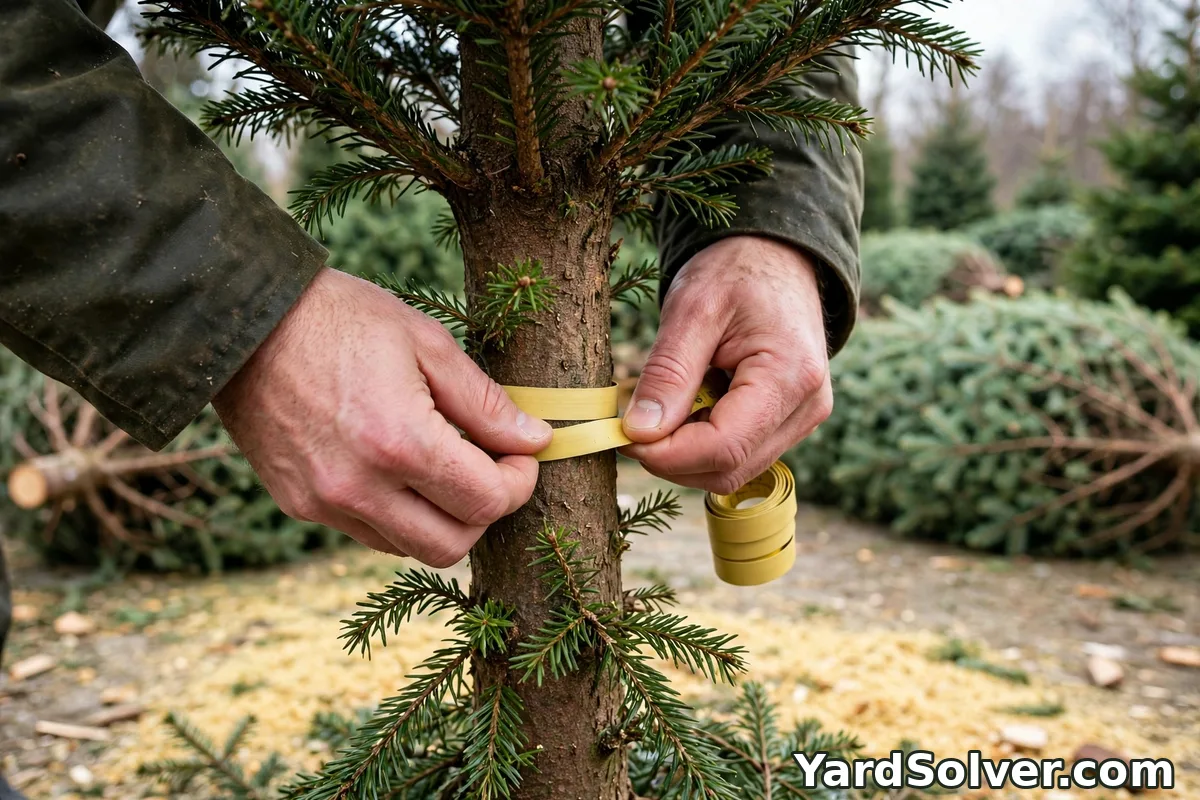
The rule runs on diameter — straight across the trunk — and the easiest way to get it is to measure around the trunk and divide. Wrap a tape or a piece of string around the trunk at its base, then divide that circumference by 3.14. Worked example: the tape around a typical lot tree reads 12.6 inches. 12.6 ÷ 3.14 = 4.0 — a 4-inch trunk, so the tree wants up to 4 quarts (a gallon) a day and a stand in the 1.5-gallon class. In metric the same tree measures about 32 cm around, which is a 10 cm trunk drinking about 3.8 litres a day. Thirty seconds with a tape at the lot also tells you whether your stand at home fits the tree — the mismatch discovered in the living room, with the tree already shedding needles on the carpet, is the one to avoid.
Step 2 — The fresh cut: half an inch, straight across
A cut tree seals its own plumbing. Within hours of cutting, sap hardens over the cut face and the trunk stops drinking — which is why the fresh cut matters more than anything you can pour. Just before the tree goes into its stand, saw about half an inch straight across the base. Straight across, not at an angle: an angled cut does not drink better and makes the tree harder to set plumb. NC State Extension's guidance is to make this fresh cut on any tree that has been stored dry for more than 3 days, and it is cheap insurance on every tree, since few buyers know exactly when theirs was cut. Two related myths to leave at the lot: drilling a hole up the centre of the trunk does not improve uptake, and whittling a thick trunk down to fit a small stand removes exactly the wood that carries the water — buy the bigger stand instead. Once the tree is in and filled, the cut end must stay under water from that moment on; if the level drops below the base and the face dries, the seal forms again and the tree quietly stops drinking behind its decorations.
If the tree has to wait before it comes indoors
Not every tree goes straight from the lot to the living room, and the waiting days are where freshness is quietly lost. If yours must wait, treat it as a cut flower, not furniture: stand it in a bucket of water in the coolest sheltered spot you have — a garage, a porch, the shaded side of the house — out of wind and sun, both of which pull moisture through the needles. A tree stored this way, drinking, loses almost nothing; a tree stored dry on a driveway starts its indoor life with the clock already run down, and needs that fresh half-inch cut all the more when it finally comes in. When the day comes, carry it in, cut, stand, fill — in that order, in one trip, before a single decoration goes on.
Step 3 — The first 24 hours, and the daily routine after
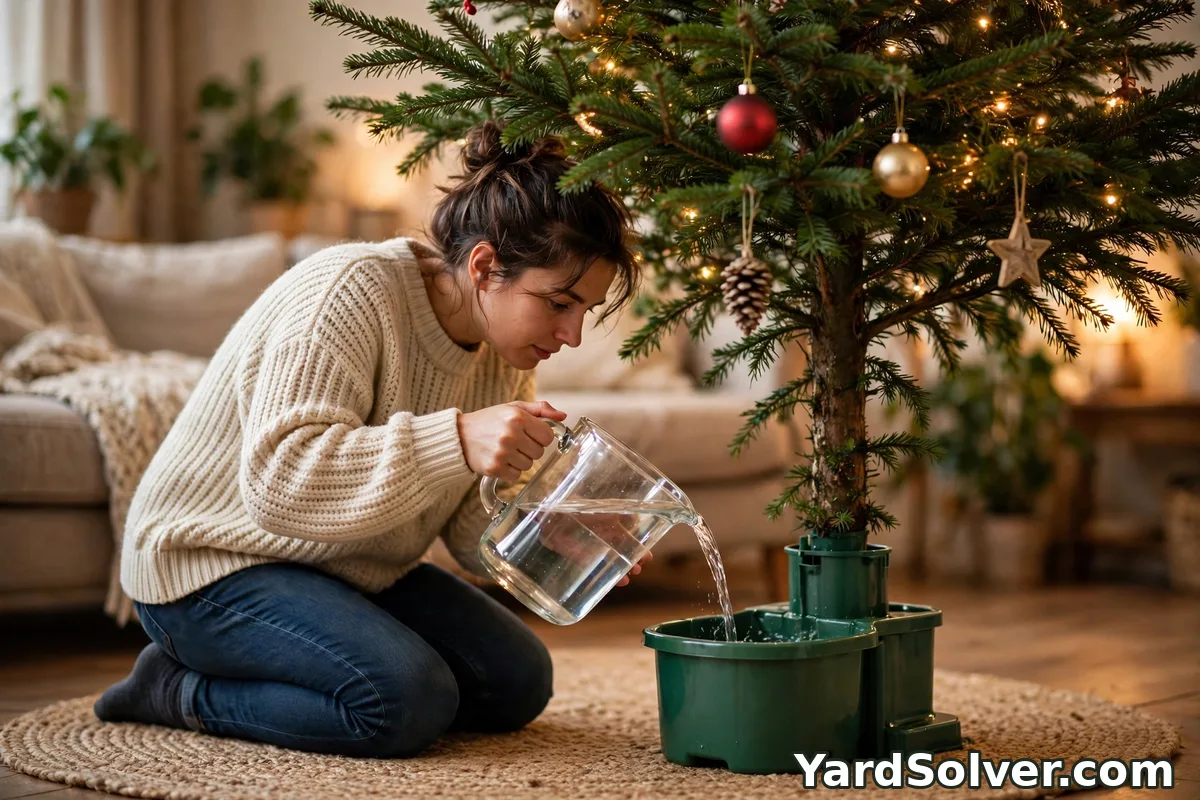
The first day is the thirstiest of the tree's life indoors: a fresh tree can take up a gallon of water in its first 24 hours, and a very dry tree may take a day or two to start drinking properly at all — do not judge it on the first evening. Fill the stand as soon as the tree is set, check it again before bed, and again the next morning. After that, the routine is a daily habit, not a schedule of measurements: look at the level every day, top up before the water reaches the base of the trunk, and expect to add roughly your table amount in the first week and less after. Plain tap water is the correct water — cold, warm or room temperature makes no difference to uptake, so use whatever the nearest tap gives you. A funnel with a tube, or a watering can with a long spout, reaches the stand without an annual battle through the lower branches.
Additives: what university research actually found
Every December the same recipes circulate — sugar in the water, an aspirin tablet, a splash of bleach or soda, a bottle of shop-bought "tree preservative" — and every December they fail the same test. NC State Extension states it plainly: university research has repeatedly shown that water additives are not needed, and in many cases they make foliage drying and needle loss worse. Ohio State and Illinois Extension give the same advice in the same words: plain water is all a tree needs. The logic is simple once you see it — a cut tree is not feeding, it is drinking, and anything dissolved in the stand is at best ignored and at worst coats the cut face the water has to pass through. Spend the preservative money on a stand big enough to hold a day and a half of water instead; capacity, not chemistry, is what keeps a tree fresh.
Stand size and placement: the two quiet decisions
The stand rule bears repeating because the too-small stand is the most common cause of a dried-out tree: at least 1 gallon of capacity, or 1 quart per inch of trunk diameter, whichever is more. A big reservoir is also forgiveness — it lets the tree survive a forgotten day. Placement is the other half of freshness. More than half of a fresh tree's weight is water, and heat is what spends it: set the tree away from fireplaces, heating vents and radiators, cover or close any vent near it, and prefer LED lights, which run cool. There is a safety dividend, too — in test after test cited by NC State, fresh, well-watered trees resist ignition from a spark or momentary flame, while a dry tree is the fire risk of the season. Water is the fire policy as well as the freshness policy. Kept watered and away from heat, a fresh tree typically holds its needles and scent for three to four weeks — the whole season it was bought for.
No tape measure? Water by tree height
Trunk diameter is the honest measure, but height is the one everybody knows, so here is the translation. Trunk thickness varies with species and growing conditions — a slim spruce and a stocky fir of the same height can differ by an inch — but the typical ranges below cover most lot trees, and they err on the generous side, which is the safe side for water.
| Tree height | Typical trunk | Water per day, up to |
|---|---|---|
| 4–5 ft (tabletop-plus) | 2–3 in | 2–3 quarts |
| 6–7 ft (the standard tree) | 3–4 in | 3–4 quarts |
| 7–8 ft | 4–5 in | 4–5 quarts (1–1.25 gal) |
| 9 ft and over | 5–6 in | 5–6 quarts (1.25–1.5 gal) |
Use the height table to choose the stand and to sanity-check the jug you are carrying: if you are refilling a 7-foot tree with a teacup, something is wrong — either the stand is tiny or the tree has stopped drinking, and the next section separates those two.
Signs your tree is thirsty — and the rescue
A drinking tree is a quiet tree: the level falls steadily, needles stay supple, and a branch end bends before it snaps. The warning signs arrive in a reliable order. First, the water level stops falling — the earliest and most useful signal, because it appears days before the tree looks any different. Second, needles begin to drop from the inner branches when the tree is brushed, beyond the light shedding every real tree does in its first days indoors. Third, branch tips turn brittle and the scent fades. The rescue depends on how far it has gone. If the level simply stopped falling, check the base: if it sat dry, sap has sealed it, and the fix is the fresh cut again — half an inch, straight across, then straight back into a full stand. It is awkward with decorations on, which is exactly why the daily level check is the whole game. If the tree is still drinking but dropping needles, move it away from the heat source it is probably standing beside, and shorten the hours its lights burn. A tree that has gone fully dry and brittle is no longer a watering problem — it is a fire risk, and the honest advice is to take it down early rather than nurse it.
Keep going
Bought a living, potted tree instead? It plays by different rules — an inch or two of water in its tub, a short stay indoors, then planting out — and NC State's guide to selection and care of living Christmas trees covers the replanting this guide's planner door assumes: if a living tree joins your garden in January, plan its spot and its first-year watering in the Garden Planner.
The outdoor version of this same maths is How Much Water Does a New Tree Need? — gallons per week by trunk size for trees planted in the ground, from the same measure-the-trunk principle.
And the evergreens already in your garden face December from the other side: How to Prevent Winter Burn on Evergreens explains why a deep watering before the ground freezes is the best protection you can give them.
Keeping a tree alive instead of cut? Our Living Christmas Tree Care guide covers the potted tree: the 7-day indoor rule, acclimatisation, and planting it out in January.
Sources
The watering rule, fresh-cut guidance, stand capacity and additives findings are from NC State Extension — Selection and Care of Christmas Trees, whose Christmas tree programme works with one of the largest tree-growing regions in North America. The 1-quart-per-inch rule and plain-water advice are stated in the same terms by Ohio State Extension, Illinois Extension and Penn State Extension, and the living-tree guidance is NC State's companion publication, linked above.
Questions people ask
How much water does a Christmas tree need per day?
Up to 1 quart of water per day for every inch of trunk diameter. A typical 6–7 foot tree with a 4-inch trunk drinks about 4 quarts — a full gallon — a day at its thirstiest, and less as the season settles. In the first 24 hours it can take up to a gallon on its own, whatever its size.
How often should I water my Christmas tree?
Check the stand every day and top it up before the water line reaches the base of the trunk. Most trees need a top-up daily in the first week, and every day or two after that. The rule that matters is not the schedule but the level: the cut end of the trunk must never sit dry.
Should I add sugar, aspirin or bleach to Christmas tree water?
No. Plain tap water is best. NC State Extension reports that university research has repeatedly shown that water additives are not needed and in many cases make foliage drying and needle loss worse — that includes sugar, aspirin, bleach, soda and shop-bought tree preservatives.
What size stand does a Christmas tree need?
One that holds at least 1 gallon of water, or 1 quart for every inch of trunk diameter, whichever is more. A tree with a 5-inch trunk needs a stand in the 2-gallon class. A stand that is too small is the most common reason a tree dries out early.
Do I need to cut the bottom of the tree off?
Yes — saw about half an inch straight across the base just before the tree goes into the stand, especially if it has been stored dry for more than 3 days. The fresh cut reopens the water pathways that sap seals shut. Cut straight across, not at an angle, and never whittle the trunk down to fit a small stand.
Why has my tree stopped drinking?
Almost always because the water level fell below the base of the trunk and sap sealed the cut, or because the tree stood dry for too long before its first drink. If the tree is not decorated yet, take it out, make another fresh half-inch cut and reset it in water. Prevention is easier: check the level every single day.
Comments & ratings
No comments yet.
Be the first to share your experience.