
Guides · Growing Wisdom · Watering · Published November 22, 2026 · By Faizan Ahmad
How Much Water Each Vegetable Needs Weekly
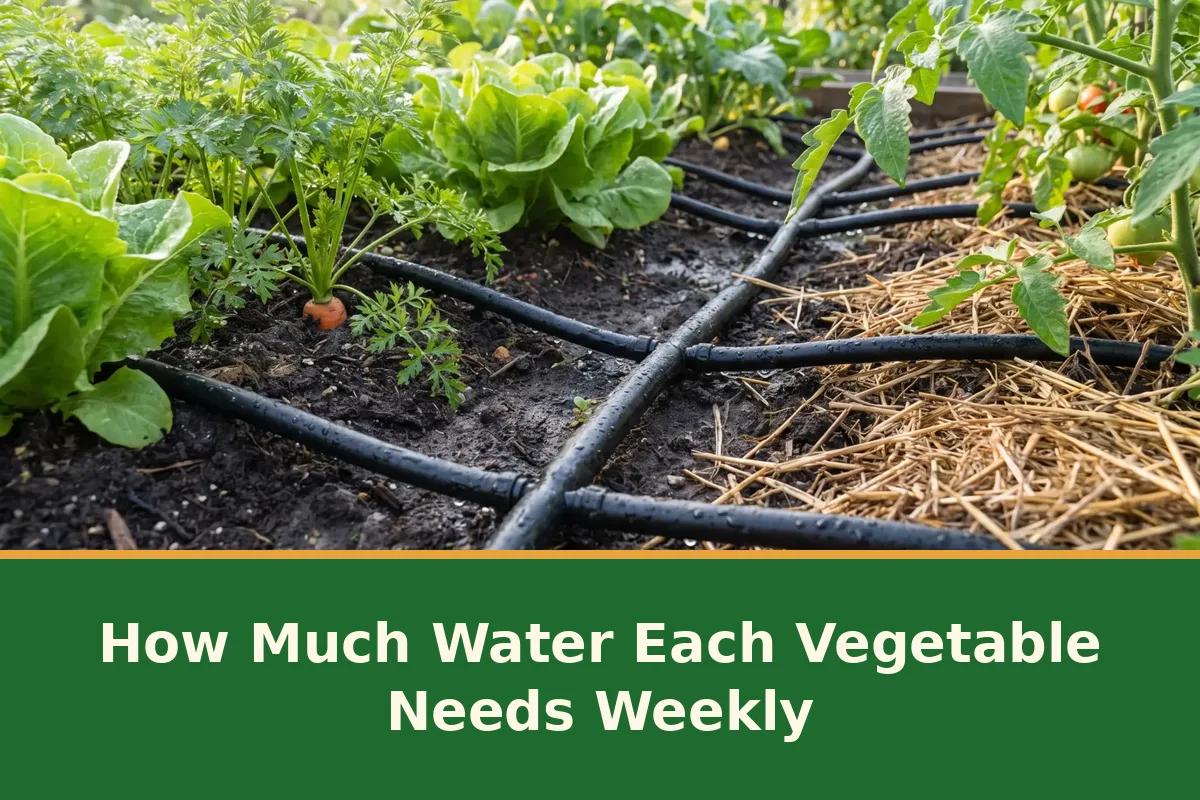
Most vegetables need about 1 inch (2.5 cm) of water per week, rain included — roughly 0.6 gallons per square foot. The heavy drinkers — cucumbers, zucchini and sweet corn — need 1.5 to 2 inches in warm weather, leafy greens take their inch in smaller, more frequent drinks, and tomatoes care less about the total than about its steadiness. This guide gives the per-crop chart, the stages where water matters most, and the delivery method that makes the numbers work.
Weekly watering at a glance
- The baseline: most vegetables need about 1 inch (2.5 cm) of water a week — rain plus irrigation — equal to roughly 0.6 gallons per square foot.
- The heavy drinkers: cucumbers, zucchini and sweet corn want 1.5–2 inches, especially while fruiting and silking.
- The critical rule: consistency beats volume. Tomatoes crack and develop blossom end rot on a feast-and-famine cycle, not on a slightly modest ration.
- The delivery rule: deep and less often — two good soakings a week grow deeper roots than a daily sprinkle.
- The exception: containers play by different rules entirely — daily watering in summer heat is normal and correct.
Step 1 — Start from the one-inch rule, then adjust
Nearly every extension service starts vegetable watering at the same place: about 1 inch of water per week, counting rainfall, for an established garden in average weather. One inch over one square foot is 0.6 gallons — so a 4×8 raised bed at the standard ration drinks about 19 gallons (72 L) a week. Treat that inch as the floor, not the prescription. Three things move it: heat and wind (a hot, dry week pushes most crops to 1.5 inches), soil (sand drains fast and wants the ration split into three waterings; clay holds it and takes two), and stage (a germinating seed bed needs the surface constantly damp, while the same crop at harvest may need half as much). Measure what actually falls and what you actually apply with a straight-sided can or rain gauge set in the bed — guessing is how gardens end up both over- and under-watered in the same week. For the whole-garden totals — hoses, beds and bills — see Garden Water Use in Gallons per Week.
Step 2 — Water by crop: the weekly table
Crops differ by root depth, leaf area and what they're building. Fruit is mostly water — a cucumber is about 96% water, a tomato about 95% — so fruiting crops at fruiting time are the garden's big drinkers, while leaf and root crops run leaner. Use this table as the weekly target per crop, rain included, in warm summer weather:
| Vegetable | Water per week | The moment it matters most |
|---|---|---|
| Cucumbers | 1.5–2 in (3.8–5 cm) | Flowering and fruiting — stress makes bitter, tapered fruit |
| Zucchini & summer squash | 1.5–2 in | Once fruit sets; big leaves wilt at noon but recover — water the soil, not the panic |
| Sweet corn | 1.5–2 in | Tasselling and silking — the two weeks that decide the cobs |
| Tomatoes | 1–1.5 in | Steady from flowering on; swings cause cracking and blossom end rot |
| Peppers | 1–1.5 in | Flowering and fruit set; like tomatoes, hate swings |
| Potatoes | 1–1.5 in | Tuber initiation (flowering); ease off as vines yellow at the end |
| Cabbage & brassicas | 1–1.5 in | While heads form; dry heads stay small and loose |
| Lettuce & leafy greens | 1–1.5 in | Shallow roots — smaller drinks, more often |
| Beans | ~1 in | Flowering and pod fill; modest before that |
| Peas | ~1 in | Flowering and pod fill; cool-season crops in drying spring soil |
| Carrots & beets | ~1 in | Constant light moisture to germinate; steady after, or roots fork and crack |
| Onions & garlic | ~1 in | While bulbs size; stop onions when the tops fall over |
| Melons & watermelon | 1–2 in, then less | Plenty while vines grow and fruit sizes; ease off in the final ripening week for flavour |
Read the table as targets for the thirstiest week, not a daily drip-feed: in a cool, cloudy week, or after an inch of rain, the correct amount of added water is often none.
Step 3 — Deliver it deep, at the roots, in the morning
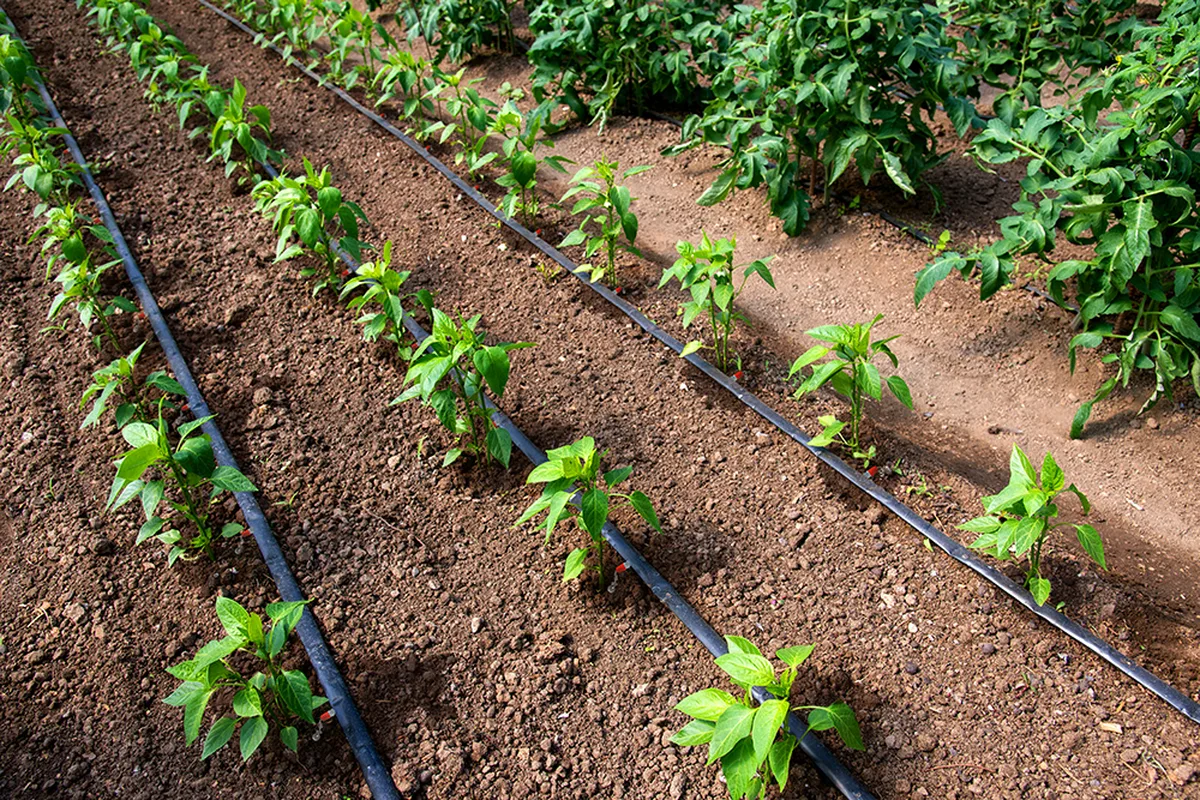
How the water arrives matters almost as much as how much. Deep and infrequent — the week's ration in two soakings — wets the top 6–8 inches where roots feed, and trains roots downward; a daily sprinkle wets the top inch and trains a garden that panics in every dry spell. At soil level — drip lines or a soaker hose beat sprinklers twice over: no evaporation loss to wind, and dry foliage, which is the cheapest disease control in the garden (most leaf diseases need wet leaves to spread). If you run drip, Drip Irrigation Run Time by Plant converts this table into minutes per emitter, and How to Set Up Drip Irrigation covers the install. In the morning, so anything splashed dries fast. And mulch: 2–3 inches of straw or shredded leaf over the bed cuts evaporation so effectively that many gardeners find it worth a quarter of the ration — depths are in How Deep Should Mulch Be?
Step 4 — Read the plants, not the calendar
The table sets the ration; the garden grades it. Learn the three signals. The finger test: push a finger 2 inches into the bed — dry at that depth means water today; cool and damp means wait. It beats every schedule ever printed. Noon wilt: squash, cucumbers and tomatoes often droop in peak heat with wet soil — a parasol reflex, not thirst. Check again at 6 pm; a plant still drooping at dusk is genuinely dry. The over-watering signature: yellowing lower leaves, stalled growth and soil that smells sour mean too much love — more vegetables die of kindness in wet summers than of drought, and chronically wet soil suffocates roots exactly as surely as dry soil starves them. Wilting plus wet soil is the paradox to remember: it usually means root trouble from too much water, and the rescue guide is Overwatered Plant Rescue.
Step 5 — Containers and new plantings break the rules (on purpose)
Two exceptions rewrite the table. Containers: a potted tomato in July sun can need water every day, sometimes twice — the pot holds a few gallons of soil, not a bed's reservoir, and the one-inch rule becomes "check daily, water when the top inch is dry, soak until it runs from the drainage holes." Self-watering pots and bigger pots are the labour-saving answers; the crop list for pots is in Best Vegetables to Grow in Containers. New plantings: seeds and seedlings live in the top inch, so they need light water daily — sometimes twice daily for carrot and lettuce seed in warm weather — until roots reach down, tapering to the adult ration over two to three weeks. Transplanted seedlings get a deep drink at planting and another check the next morning. The weekly table is for established plants; babies and pots run on observation, not arithmetic.
Keep going
Set it up: How to set up drip irrigation · Drip irrigation run time by plant · Garden water use in gallons per week
Read next: How deep should mulch be? · Overwatered plant rescue · How to water plants while on vacation
Questions people ask
How much water do vegetables need per week?
About 1 inch (2.5 cm) per week including rainfall for most vegetables — roughly 0.6 gallons per square foot. Heavy drinkers such as cucumbers, zucchini and sweet corn need 1.5–2 inches in hot weather, and nearly everything needs more during its flowering and fruiting stage.
Is it better to water vegetables every day or once a week?
Neither extreme: the standard advice is the week's ration in two deep soakings, which wets the top 6–8 inches and grows deep roots. Daily sprinkling keeps roots shallow. The exceptions are seed beds and containers, which genuinely do need daily attention.
How many gallons is 1 inch of water on a garden bed?
About 0.6 gallons per square foot — so roughly 19 gallons (72 L) for a 4×8 ft raised bed, per inch applied. A rain gauge or straight-sided can in the bed tells you what rain and sprinklers actually delivered.
Why do my tomatoes crack even though I water them?
Usually the pattern, not the amount: a dry spell followed by a heavy watering (or downpour) swells the fruit faster than the skin can stretch. Steady, even moisture — helped by mulch — is the prevention, which is why tomatoes sit in the "consistency matters most" row of the chart.
The garden drinks on a rhythm, not a schedule
New gardeners water by the calendar and experienced ones water by the soil — and the difference shows up in August, when the calendar gardens are cracked, bitter and mildewed while the soil gardens are boring and productive. The weekly numbers in this guide are the starting rhythm: an inch a week, more for the fruiting heavyweights, split into deep drinks. After that, the finger test overrules everything, because your soil, your mulch and your weather are not the averages in any table — including this one.
Keep one habit and the rest follows: walk the garden in the morning with a coffee, finger-test two beds, look at the underside leaves, and water only what asks. Ten minutes of observation a day replaces nearly every watering gadget ever sold — and the plants, given a steady ration and dry leaves, will do the rest themselves.
Sources
The one-inch-per-week baseline and crop adjustments follow standard university extension vegetable-watering guidance; fruit water-content figures (cucumber ≈96%, tomato ≈95%) are USDA food-composition values. Whole-garden volume conversions use the standard 0.623 gallons per square foot per inch of water.
Related page
Read next: Drip Irrigation Run Time by Plant: Minutes per Emitter, by Crop.
Comments & ratings
No comments yet.
Be the first to share your experience.