
Guides · Indoor gardening · Published November 20, 2026 · By Faizan Ahmad
How to Care for Cyclamen Indoors: Cool Air, Bottom Watering, Months of Bloom
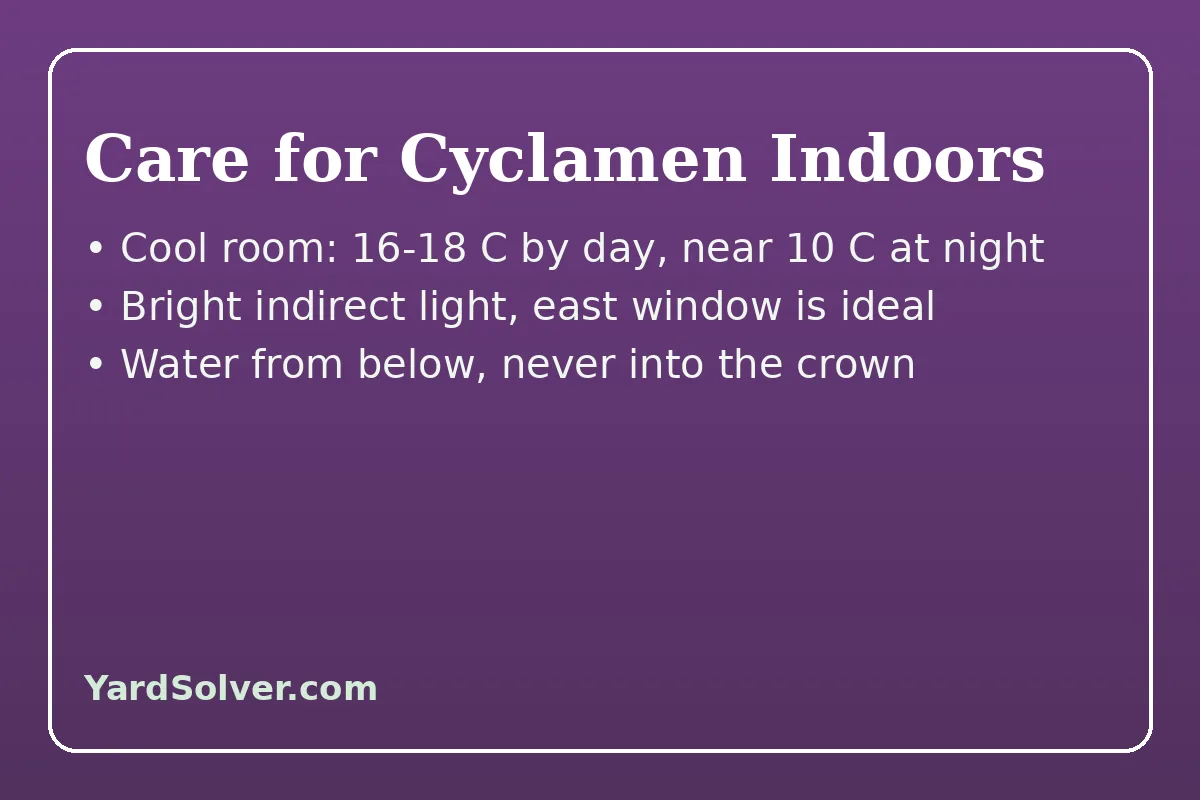
To care for a cyclamen indoors, keep it cool — about 16–18 °C (60–65 °F) by day and near 10 °C (50 °F) at night — in bright indirect light, water it from below whenever the soil surface feels dry, letting it drink for about 15 minutes and then drain completely, keep water out of the crown where the leaves meet the tuber, and hold the humidity up with a pebble tray or humidifier. The florist's cyclamen, Cyclamen persicum, is the winter houseplant most often killed by kindness in a warm room. It is a Mediterranean plant that flowers through cool, damp winters at home and rests through hot, dry summers, and a heated living room in December tells it that summer has arrived: flowers collapse in days, buds stop opening, and the plant slides into an early, confused dormancy its owner reads as death. Kept cool, the same plant is one of the longest-blooming houseplants sold — the University of Wisconsin–Madison Extension notes that individual flowers and the whole blooming season stretch when temperatures stay low, with a well-kept plant flowering for up to three months. This guide gives the full system: the cool-room rule and where to find one in a heated house, the bottom-watering technique that protects the tuber, humidity and feeding, the grooming that keeps buds coming, and the honest account of summer dormancy — the stage at which most cyclamen are thrown away alive. It joins the winter windowsill collection alongside poinsettia care and the Christmas cactus, the three plants that carry a northern home from December to spring.
The short answer, on one card
Temperature first: 16–18 °C (60–65 °F) days, nights near 10 °C (50 °F); above about 21 °C (70 °F) the plant fades fast — move it away from heat vents, radiators and fireplaces. Light: bright and indirect all day; an east window is the classic spot, and in a northern winter a south window can serve better. Water: from below when the surface is dry — stand the pot in a shallow bowl for about 15 minutes, then drain; never let it sit in water, and never pour into the crown. Humidity: above 50 percent if you can manage it, via a pebble tray or humidifier. Feeding: a dilute low-nitrogen feed for flowering plants every two weeks while it grows and blooms. After bloom: yellowing leaves in late spring are dormancy, not death — rest the tuber cool and nearly dry for 2–3 months and restart it in late summer.
Cool is not a preference. It is the plant's climate
Every other rule in this guide is negotiable at the margins; this one is not. Cyclamen persicum evolved on rocky Mediterranean slopes where winter — its growing and flowering season — is cool and wet, and its physiology still runs on that calendar. Wisconsin Extension gives the ideal as daytime temperatures of 60 to 65 °F with nights around 50 °F, noting that modern hybrids tolerate a somewhat wider range but still perform longest when kept cool; the New York Botanical Garden's houseplant guide lands in the same place, 55 to 65 °F by day with a dip to 50–55 °F at night, and adds the diagnosis every owner should memorise: short-lived cyclamen are usually the result of warm growing conditions. Heat attacks the display from both ends — each open flower lasts days instead of weeks, and the buds still folded in the crown stop developing — while the plant simultaneously reads the warmth as the approach of its summer rest and begins withdrawing into the tuber. Hence the quotable fact of this guide: a cyclamen on a warm mantelpiece is not being pampered, it is being told the season is over — cool air is not this plant's preference, it is its calendar. Finding cool in a centrally heated house is a placement puzzle with standard solutions: the brightest windowsill in the least-heated room, a cool bedroom, an enclosed porch or sunroom that stays frost-free, or the sill of a window that leaks a little winter around its frame — the draughty spot every other houseplant hates is, for a cyclamen, the best seat in the house. The night dip matters as much as the daytime figure, which is why a room that cools when the heating rests overnight suits it better than a uniformly warm one.
Water from below: the technique that protects the tuber
| Job | How | Why |
|---|---|---|
| When | When the soil surface looks and feels dry | Cyclamen resent both soggy and bone-dry soil; both yellow the leaves |
| Method | Stand the pot in a shallow bowl of room-temperature water for about 15 minutes | The mix drinks upward; the crown and tuber top stay dry |
| After | Lift out and drain completely; empty the saucer | A pot left standing in water waterlogs the tuber it was meant to protect |
| If watering from above | Pour at the rim of the pot, close to the edge | Keeps water from pooling in the crown, where rot starts |
| Tuber position | Top of the tuber at or just above the soil surface | A half-exposed tuber sheds water instead of holding it against the crown |
The anatomy explains the ritual. Leaves and flower stems rise in a rosette from a flattened, corm-like tuber that sits half-exposed at the soil surface, and that crown — the dense centre where everything joins — rots readily if water lodges in it. The New York Botanical Garden calls learning to water from below the important trick of cyclamen care for exactly this reason, and Wisconsin's guidance agrees: water thoroughly when the surface is dry, avoid watering the crown or centre, and bottom-watering by standing the pot in water for about 15 minutes is the method many growers prefer. Use room-temperature water; cold tap water shocks a plant already managing a cool-room life. Then be as strict about drainage as about watering: the saucer is emptied, the decorative outer pot is checked, and the plant never stands in its own runoff. Yellowing leaves are the plant's one-word complaint, and it means either too wet or too dry — the finger test in the top centimetre of mix tells you which, and the correction is to fix the rhythm, not to drench or starve it further. In the dry air of a heated house the rhythm quickens, which is where humidity help — the pebble tray of the humidity guide, or a humidifier shared with the rest of the winter collection — lengthens both the watering interval and the life of every flower.
Light, feeding, and the grooming that keeps buds coming
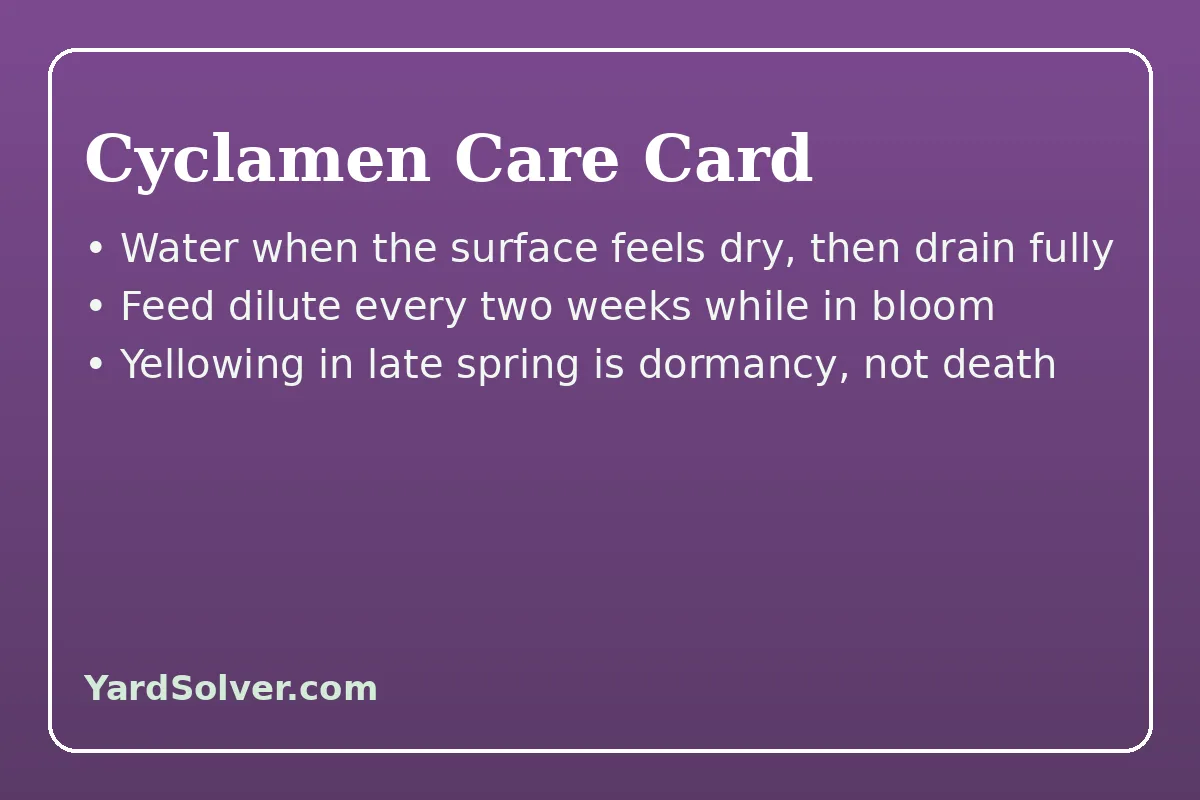
Light is the cyclamen's second need, and the prescription is bright but not hot: bright indirect light all day, an east window as the standard answer, with Wisconsin's northern-climate refinement that a southern exposure may actually serve better in the darkest weeks of winter, when the sun is weak and low. What the plant cannot use is strong direct sun through glass in a warm room, which scorches leaves and heats the crown — brightness and coolness must arrive together, which is why the cool bright windowsill satisfies both at once. Feeding follows the flowering: a water-soluble feed for blooming houseplants, low in nitrogen, given dilute every two weeks while the plant is growing and flowering. Wisconsin warns against generosity here — too much fertiliser promotes soft, lush growth that is more susceptible to disease — so half-strength and on schedule beats full-strength and enthusiastic. Grooming is the third leg, and it is mechanical rather than chemical. Spent flowers and yellowing leaves should not be cut, which leaves a stub to rot at the crown; instead, twist the stem and pull sharply so it comes away cleanly from the base, exactly as Wisconsin Extension directs. A cyclamen carries its next flowers already folded in the crown, and every cleanly removed spent stem makes room and light for them. Do this weekly on the same round as the water check and the display renews itself: a plant bought full of buds in December, kept cool and groomed, is still opening fresh flowers in March — the full three-month season the extension promises, and the reason a healthy plant at purchase matters. Buy for buds, not for open flowers: a plant carrying many tight buds and few open blooms, with dark green, firm, silver-marbled leaves and no soft spots at the crown, has its whole season ahead of it.
Dormancy: the plant is not dead, it is resting
In late spring the display winds down: flowering stops, leaves yellow one by one, and the plant that was glorious in February looks, by May, like a loss. It is doing precisely what its wild ancestors do when the Mediterranean summer arrives — withdrawing into the tuber to wait out heat and drought — and the kindest and most knowledgeable response is to let it. Reduce watering gradually as the foliage declines, stop feeding, and when the leaves have withered, rest the tuber cool and nearly dry: kept in its pot in a cool, shaded place, or lifted and stored in dry vermiculite at about 10 °C (50 °F) for 6 to 12 weeks, per Wisconsin's method. Dormancy lasts two to three months. In mid-to-late summer, repot the tuber into fresh, well-drained mix with its upper half above the surface, begin watering, and return it to bright light and cool air as new growth shows; Iowa State's after-bloom guidance runs the same calendar, restarting plants in warmer late-summer conditions and growing them on into the fall flowering. Set expectations honestly, as the botanical garden guides do: bringing a florist's cyclamen back to the full glory of its first season is challenging, because a home rarely matches the nursery conditions that built the tuber, and many gardeners reasonably treat the plant as a one-season treasure. But the attempt costs a cool corner and a summer of near-neglect, the tuber that does return is genuinely yours in a way a bought plant is not, and even a second season at two-thirds splendour is a bargain. The plant's pests respect the same calendar: cyclamen mites, which distort new growth and damage buds and thrive in warm dry air, are the one serious enemy — badly infested plants are best discarded, as extension guidance advises, rather than nursed among the rest of the collection described in Winter Houseplant Pests.
Troubleshooting: reading what the plant is saying
Flowers collapsing within days of purchase: warmth, almost always — the plant came from a cool greenhouse into a hot room; move it to the coolest bright spot and it will usually steady, opening its remaining buds properly. Flower stems flopping over the pot edge: thirst, if the mix is dry — bottom-water and they often lift within hours — or crown rot, if the mix is wet and the stems are soft at the base, which is not recoverable. Leaves yellowing steadily during the season: the water rhythm is wrong in one direction or the other; check the mix before assuming, and check that the pot is not standing in a full saucer. Buds forming but never opening: air too warm and dry, or light too low; cooler nights and better light are the correction. Grey fuzzy mould on stems and crown (botrytis): stagnant, humid air plus water in the crown — remove affected parts cleanly, space the plant for air movement, and water strictly from below. New leaves small, curled and distorted: suspect cyclamen mite and isolate the plant at once. Read as a set, the table repeats the guide's whole argument: this is an easy plant kept in the one condition — cool — that modern heated homes are designed to prevent, and a difficult plant nowhere else. Give it the cold windowsill the winter houseplant round reserves for it, between the plants that want the warm room, and it will outflower everything else you own this winter.
Buying well: choosing the plant that lasts the season
Because so much of a cyclamen's season is decided before it reaches your windowsill, ten minutes of choosing at the shop is worth a month of nursing at home. Choose buds over blooms: the plant to buy is the one crowded with tight, marble-sized buds still folded low in the crown and carrying only a few open flowers, because those buds are the season still to come, while a plant in full spectacular flower on the shelf has already spent its best weeks in the greenhouse. The foliage should be dark green, firm and crisply marbled, rising on sturdy stems from a crown that feels solid — press gently at the centre, and reject any plant whose crown is soft, brown or slimy, which is rot already in progress and the one fault no care at home reverses. Check the undersides and the crown for the grey fuzz of botrytis and for distorted, stunted new leaves, the mite signature, and pass those plants by however fine their flowers look. Size matters less than condition, but a larger tuber carries larger reserves, and reserves are what a second season is built from. Then protect the purchase on the way home: a cyclamen carried through a freezing parking lot in an open bag can be chilled in minutes, and a plant warmed in a hot car and then set in a cool room has had the two shocks the troubleshooting table warns about in a single afternoon. Sleeve it, carry it in the cabin, and let it meet its cool windowsill within the hour. The plant bought this way, on a cold bright day in December, is the plant still flowering beside the Norfolk Island pine when the decorations come down — and still going, weeks later, when the pine has settled into being simply a handsome green tree.
Keep going
Complete the winter windowsill with Poinsettia Care After Christmas, solve a silent bloomer with Why Is My Christmas Cactus Not Blooming?, and raise the room's humidity for all of them with How to Increase Humidity for Houseplants.
Sources
The care framework — bright indirect light with an east window as the usual spot and a southern exposure sometimes better in a northern winter, ideal daytime temperatures of 60 to 65 F and nights around 50 F, the extension of individual flowers and of the whole blooming season when plants are kept cool, thorough watering when the surface is dry with the crown kept dry, bottom watering by standing the pot in water for about 15 minutes, high humidity on a tray of wet gravel, low-nitrogen feeding every two weeks while actively growing with a warning that excess feed makes lush disease-prone growth, removing spent blossoms by twisting and pulling sharply from the base, and the dormancy method of storing the withered tuber in dry vermiculite at about 50 F for 6 to 12 weeks before repotting with the upper half above the mix — follows University of Wisconsin–Madison Extension, Cyclamen – Wisconsin Horticulture. The corroborating ranges — 55 to 65 F by day dipping to 50 to 55 F at night, short-lived cyclamen as the result of warm growing conditions, bottom watering to protect the half-exposed tuber, humidity above 50 percent, and high-phosphorus feeding every two weeks — follow the New York Botanical Garden, Cyclamen (Cyclamen persicum): Houseplant Care. The dormancy calendar — gradually reducing water as foliage dies back, a rest of about 6 to 8 weeks at 45 to 50 F in a shaded place, then warmer conditions and resumed watering in mid-to-late summer — follows Iowa State University Extension, All About Cyclamen.
Questions people ask
Why is my cyclamen wilting even though I water it?
Check the temperature before the water. In a warm room — above about 21 C (70 F) — cyclamen collapse and stop opening buds no matter how well they are watered, because warmth tells the plant its season is over. Move it to the coolest bright spot you have. If the mix is dry, bottom-water it; if the mix is wet and stems are soft at the base, the crown has rotted, which does not recover.
Should you water cyclamen from the top or the bottom?
From the bottom. The tuber sits half-exposed at the surface and water pooling in the crown where leaves and stems join causes rot. Stand the pot in a shallow bowl of room-temperature water for about 15 minutes when the soil surface feels dry, then lift it out and let it drain completely. If you must water from above, pour at the rim of the pot, never into the centre.
What temperature do cyclamen like indoors?
Cool: about 16-18 C (60-65 F) by day with nights near 10 C (50 F). Kept cool, individual flowers last far longer and the blooming season can stretch to three months. Warm rooms, heat vents, radiators and fireplaces are the commonest cause of a short-lived plant — extension guides name warm growing conditions as the reason cyclamen fail early.
Do cyclamen come back after they die down in spring?
They are not dead — they are dormant, resting through what would be a hot dry Mediterranean summer. Let the foliage wither, keep the tuber cool and nearly dry for 2 to 3 months (or store it in dry vermiculite at about 10 C / 50 F for 6 to 12 weeks), then repot in fresh mix with the top half of the tuber above the surface, water, and grow it on cool and bright. A second season is achievable, though often a little less full than the first.
How long do cyclamen flowers last indoors?
Kept cool, a plant in good condition flowers for weeks to months — up to about three months across the season, with buds opening in succession from the crown. Warmth shortens everything: in a hot room individual flowers may last only a few days and unopened buds may never develop. Removing spent flowers by twisting and pulling them cleanly from the base encourages the next buds.
Why are my cyclamen leaves turning yellow?
During the flowering season, steady yellowing usually means the watering rhythm is wrong — cyclamen dislike both wet and dry soil, and both yellow the leaves. Check whether the mix is soggy (often a pot standing in water) or bone dry, and correct the rhythm. Yellowing in late spring, as flowering ends, is different: that is the plant entering its normal summer dormancy.
Comments & ratings
No comments yet.
Be the first to share your experience.