
Guides · Indoor gardening · Published November 20, 2026 · By Faizan Ahmad
How to Care for a Norfolk Island Pine Indoors: The Living Christmas Tree That Stays
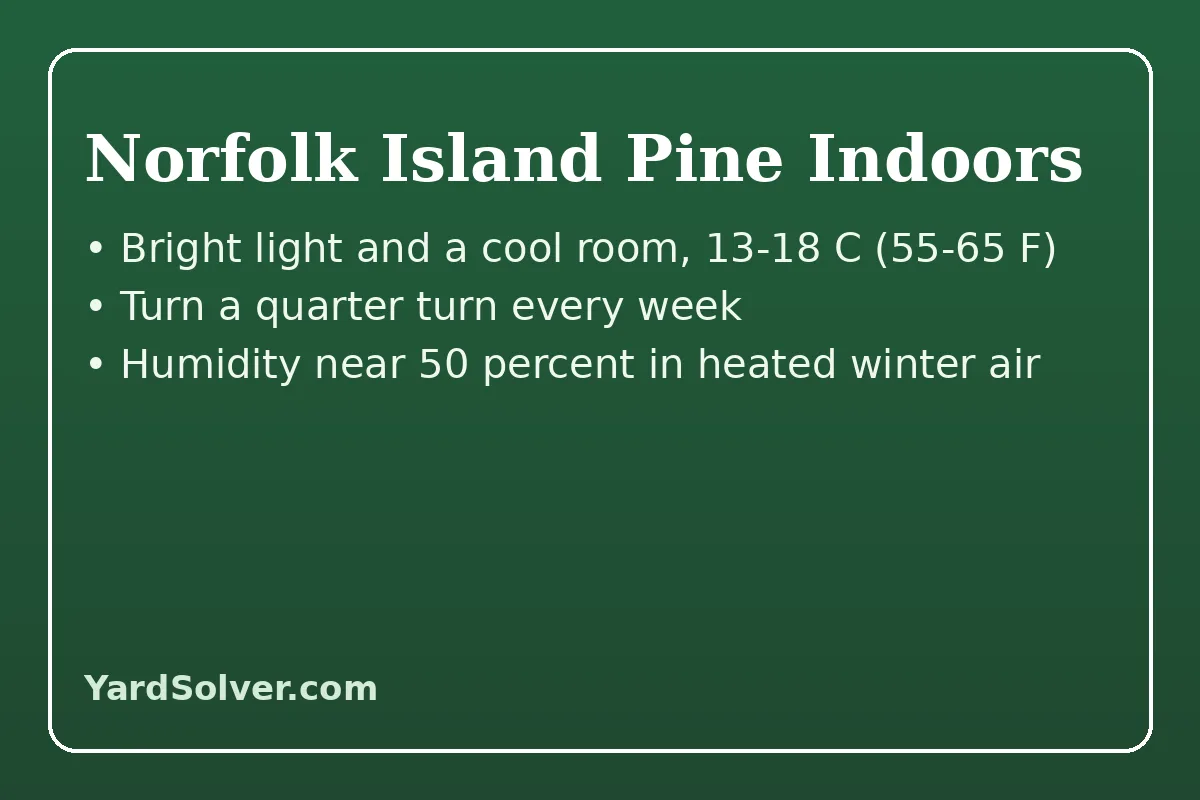
To care for a Norfolk Island pine indoors, give it your brightest position near an east, west or south window, turn the pot a quarter turn every week, water thoroughly whenever the soil surface feels dry and discard the drainage, keep it in a cool room at roughly 13–21 °C (55–70 °F) away from heat vents and drafts, and raise the humidity around it — with a humidifier or a pebble tray — through the heated winter months. The correction that unlocks everything else comes first: despite the name and the perfect Christmas-tree silhouette, Araucaria heterophylla is not a pine. It is a tropical conifer from Norfolk Island in the South Pacific, sold every November and December as a living Christmas tree, and it wants the opposite of what a hardy pine wants — no frost, ever; in Canada and most of the US it is a permanent houseplant, not a tree waiting to be planted out. That single fact separates it from the spruce and fir in Living Christmas Tree Care, which endure the holidays indoors briefly and then go into the ground. The Norfolk pine stays. Treated well it keeps its tiered, symmetrical shape for years, growing slowly toward the 2.7 m (9 ft) indoor height NC State Extension records. This guide gives the full care system — light, water, humidity, feeding, decorating limits and troubleshooting — so the tree bought this December is still the tree in the corner, larger and better, next December.
The short answer, on one card
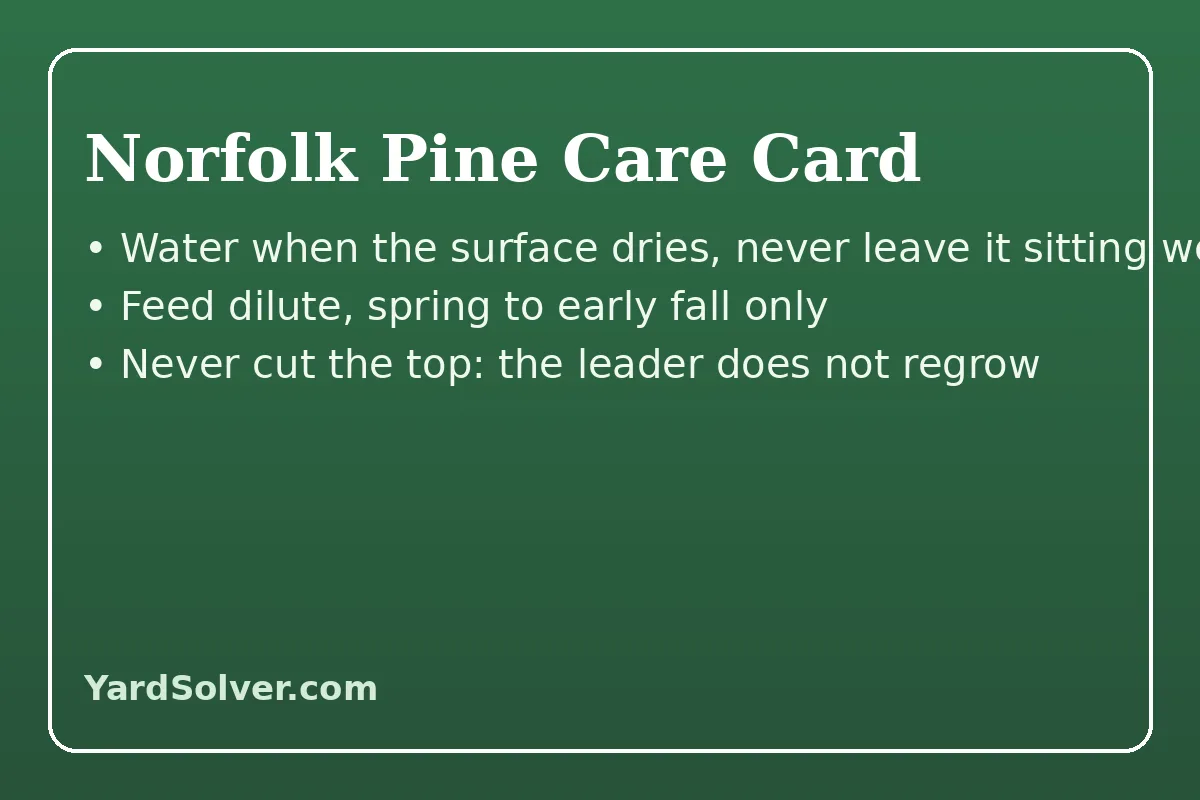
Light: high — the brightest spot in the house, with full sun welcome; dim light is tolerated for a year or two and then paid for in dropped lower branches. Water: evenly moist, never soggy, never bone dry; water when the surface dries, empty the saucer, ease off in winter. Temperature: a bright, cool room — NC State's 55–65 °F and Iowa State's 55–70 °F agree on cool, not warm. Humidity: the winter battleground; heated homes fall far below the roughly 50 percent it prefers. Feeding: dilute liquid fertilizer every two to four weeks from spring to early fall, none in winter. Pruning: essentially none — never cut the top, and remove only dead branches, at the trunk.
Not a pine: the identity that decides the care
NC State Extension's Plant Toolbox describes the species precisely: endemic to Norfolk Island in the Pacific, east of Sydney, between New Zealand and New Caledonia; a graceful pyramidal tree with branches in whorled, horizontal tiers — typically five to a whorl — around a single straight trunk; 60–100 ft (18–30 m) in cultivation outdoors in mild climates and up to 200 ft (60 m) in its native habitat, against about 9 ft (2.7 m) indoors. Every care rule in this guide descends from that biography. A maritime, frost-free island climate means the tree has no dormancy programme and no cold hardiness to call on — a night on a freezing porch that a spruce shrugs off will kill or maim it. Porous, sandy, slightly acidic, free-draining soil at home means a light, open potting mix in the pot, not heavy garden soil. And a single straight leader with whorled tiers means the shape is grown, never pruned into being. The quotable fact to carry away: a Norfolk Island pine is a tropical tree wearing a Christmas tree's shape — care for the tropical tree and the shape takes care of itself. Gardeners who grasp that stop asking why it cannot go in the garden in spring, and start asking the productive questions — light, humidity, water — that the next sections answer. For the hardy alternative that does get planted out, with its strict seven-days-indoors limit, see Living Christmas Tree Care; the two trees share a season and nothing else.
Light and the weekly turn
| Need | The setting | What goes wrong without it |
|---|---|---|
| Light | Brightest spot; east, west or south window; full sun normally best | Stretched, drooping tiers; then leaf drop and loss of lower branches |
| Rotation | Quarter turn every week | A one-sided lean toward the window that never straightens |
| Temperature | 13–21 °C (55–70 °F), cool room preferred | Hot, dry air at vents browns tips and drops branches |
| Humidity | Around 50 percent; humidifier or pebble tray in winter | Brown branch tips, then whole lower branches lost |
| Soil | Fertile, porous, slightly acidic, free-draining mix | Wet, heavy mix rots roots; the decline looks like thirst |
| Feeding | Dilute liquid feed every 2–4 weeks, spring to early fall | Feeding in winter feeds nothing; the tree is resting, not growing |
Iowa State University Extension's care answer puts the tree in a brightly lit location near an east, west or south window and prescribes the rotation in the same breath: rotate the plant weekly to prevent it growing toward the light and becoming lopsided. NC State is more permissive about sun than most houseplant advice — full sun is normally best for compact, symmetrical growth, with light afternoon shade only where foliage might bleach — and more honest about dim rooms: indoor plants tolerate very low light for two to three years, but then display leaf drop and loss of lower branches. Read that tolerance correctly: it is a slow loan, not a lifestyle. The tree in the dark corner is spending its lower branches to survive, and branches on this species do not grow back — a bare lower trunk is permanent. In northern homes the practical answer to December's short days is the brightest window you have, the weekly turn done on a fixed day so it actually happens, and, for a prized specimen, a few hours of LED grow light through the darkest weeks, applying the principles in Houseplant Winter Care. Move the tree as it grows: tabletop trees graduate to the floor beside the window rather than retreating to a dimmer corner that fits them.
Water, humidity and feeding through a heated winter
Iowa State's watering rule is the one to memorise: thoroughly water when the soil surface becomes dry to the touch, and discard the excess that drains out of the bottom of the pot. Both halves matter. Even moisture is the goal — NC State's version is to water regularly from spring to autumn while avoiding soil that is too wet, and to water sparingly in winter — because this tree punishes both extremes in the same currency: soggy mix rots the roots, and a root ball allowed to bake dry browns the branch tips, and either way the damage shows first at the extremities. Humidity is where winter is actually lost. Iowa State names winter's low relative humidity in heated homes as the season's chief difficulty and prescribes a humidifier or a pebble tray — a wide saucer of pebbles and water under the pot, the pot standing on the pebbles above the waterline — while NC State adds the simple habit of misting in heated rooms. The full toolkit is in How to Increase Humidity for Houseplants; for this tree, grouping it with other houseplants and keeping it out of the direct blast of vents and radiators does as much as any gadget. Feeding is modest and seasonal: Iowa State's dilute solution every two to four weeks from spring to early fall (NC State's weekly-to-biweekly dilute applications across spring through fall are the generous end of the same range) — and nothing in winter, when the tree is resting and unused fertilizer only salts the mix. Repot rarely, in spring, one size up, into that porous slightly acidic mix; a slow tree that adds one tier a year is in no hurry, and a stable root ball beats a disturbed one.
Decorating it without damaging it
The tree's December job comes with weight and heat limits its soft branches enforce. Those whorled branches are slender and springy, built for needles, not for glass baubles: decorate with the lightest ornaments you own — small, hollow, paper, wood, felt — concentrated toward the trunk where branches are strongest, and skip the heavy heirlooms for the cut tree or the mantel. Lights should be LED, which run cool; old incandescent mini-lights pressed against foliage in a dry, heated room are a scorch and fire risk no decoration justifies, and any light string should come off rather than be left baking the tree for weeks after the holiday. Tinsel and flocking sprays are out — flocking especially, since the tree has to live in its own skin after January. Water before decorating and keep the watering up through the display weeks; a decorated tree in a warm room dries faster than the same tree in its usual cool corner, and December drought is the commonest reason a Norfolk pine enters January with browning tips. When the season ends, undecorate promptly, give the tree its cool bright spot back, and resist the January urge to 'rest' it somewhere dark — the post-holiday slump owners report is usually just the light and humidity bill for December arriving, and the cure is the normal routine, resumed.
Troubleshooting: reading what the tree is telling you
Iowa State gathers the diagnosis into one sentence: low relative humidity, insufficient light, or excessively dry soil may induce browning of branch tips and lead to the loss of the lower branches. Work those three causes in that order — they account for nearly every unhappy Norfolk pine in a northern home. Brown tips alone, on an otherwise full tree, is the humidity-and-water complaint: check the saucer habit, the vent positions, the pebble tray. Lower branches browning and dropping while the top stays green is the light complaint, usually after a year or more in a too-dim spot: move the tree brighter, accept that the lost branches are gone, and let new tiers rebuild the silhouette from above. A few oldest, lowest branches yellowing on an old, well-grown tree can be simple age — NC State lists the tree as generally pest-free but susceptible to scale, sooty mould and leaf spot, so inspect the undersides and stems during the weekly turn, and treat the pest patterns with Winter Houseplant Pests. Two prohibitions close the guide. Never cut the top: the single leader is the tree's only upward engine, and a topped Norfolk pine does not bush out like a shrub — it stops, permanently disfigured. And never move it outdoors for a Canadian winter or plant it out in spring hope: outdoors year-round belongs to zones 10–11. Indoors, bright and cool and humid, this is one of the longest-lived houseplants there is — a Christmas purchase that becomes furniture, then a fixture, then the tree grandchildren decorate, at their own careful weight limit.
Buying well in December: choosing the tree that will last
Most Norfolk pines are bought in a hurry in December, and five minutes of selection decides whether the tree thrives or spends a year recovering. Choose symmetry first: tiers evenly spaced around a straight trunk, branches in full whorls on every side — a tree already one-sided at the shop was grown crowded, and while good light improves new growth, the existing silhouette is the one you will live with longest. Needles should be a fresh, even green to the branch tips, with no browning at the extremities and no pale, stretched top growth, which is the signature of a tree that has already been light-starved on a dim shop floor. Check the pot as carefully as the plant: many holiday trees are sold several seedlings to a pot, which looks lush at tabletop size and becomes a crowding problem as they grow — a single trunk is the better long-term buy, and a multi-stem pot should be priced and planned as the thicket it will become. Lift the pot: a suspiciously light pot is a dry root ball, and the tree should be watered the day it comes home, before it is decorated, placed or admired. Inspect the undersides of branches and the stem joints for the white, cottony specks of scale or mealybug — NC State lists scale among the tree's few pests, and a pest brought home in December colonises the whole houseplant collection by February, which is why a new tree earns a fortnight's quarantine in its bright spot, admired and decorated, before it joins the permanent grouping. Buy the tree its proper pot and mix at the same time, plan the spring repot while the intention is fresh, and the December impulse becomes what it should be: the first day of a decades-long tenancy.
Keep going
Set this tree apart from its hardy cousins with Living Christmas Tree Care, support it through the season with Houseplant Winter Care and How to Increase Humidity for Houseplants, and check the dim-room alternatives in Best Low-Light Indoor Plants.
Sources
The species' origin on Norfolk Island, its whorled tiers of typically five branches around a single straight trunk, outdoor heights of 60 to 100 feet against about 9 feet indoors, the bright cool room at 55 to 65 °F, the fertile, porous, slightly acidic well-drained mix, full sun being normally best for compact symmetrical growth, regular watering spring to autumn avoiding wet soil with sparing watering and misting in winter, dilute feeding from spring through fall, susceptibility to scale, sooty mould and leaf spot, and the warning that very low light is tolerated for two to three years before leaf drop and loss of lower branches follow North Carolina State Extension, Norfolk Pine — Araucaria heterophylla (NC State Extension Gardener Plant Toolbox). The bright location near an east, west or south window, the weekly rotation against lopsided growth, watering thoroughly when the surface dries and discarding the drainage, dilute feeding every two to four weeks from spring to early fall, the suitable temperature of 55 to 70 °F, the humidifier or pebble tray for winter's low humidity, and the diagnosis linking low humidity, insufficient light and dry soil to browning tips and lower-branch loss follow Iowa State University Extension, How Do I Care for a Norfolk Island Pine?.
Questions people ask
Is a Norfolk Island pine a real pine, and can it be planted outside?
No on both counts in cold climates. It is Araucaria heterophylla, a tropical conifer from Norfolk Island in the South Pacific, hardy outdoors only in zones 10 to 11. In Canada and most of the US it is a permanent houseplant; frost that a true pine ignores will kill it.
How much light does a Norfolk Island pine need indoors?
As much as you can give it: a bright spot near an east, west or south window, with full sun normally best for compact, symmetrical growth. It tolerates low light for two to three years, NC State Extension notes, but then begins dropping leaves and lower branches — and lost branches do not regrow.
How often should you water a Norfolk Island pine?
Water thoroughly whenever the soil surface feels dry to the touch, then discard whatever drains into the saucer. Keep the mix evenly moist but never soggy, ease off to sparing watering in winter, and never let the root ball bake completely dry — dry soil is one of the three causes of browning branch tips.
Why are my Norfolk pine's branch tips turning brown?
Iowa State Extension lists the three usual causes: low relative humidity, insufficient light, or excessively dry soil. In a heated winter home, humidity is the first suspect — add a humidifier or pebble tray, move the tree away from vents, and check your watering rhythm before anything else.
Can you prune a Norfolk Island pine to keep it small?
Essentially no. Never cut the top: the tree grows from a single central leader, and cutting it ends upward growth and spoils the shape permanently. Remove only dead branches, cutting at the trunk. Slow growth — roughly a new tier a year — keeps it manageable for many years without pruning.
How do you decorate a Norfolk Island pine as a Christmas tree?
Lightly. Its soft, slender branches carry only light ornaments — paper, felt, wood, small hollow pieces — placed toward the trunk, with cool-running LED lights only. Skip heavy baubles, tinsel and flocking spray, keep watering through the display weeks, and undecorate promptly in January.
Comments & ratings
No comments yet.
Be the first to share your experience.