
Guides · Indoor gardening · Published November 20, 2026 · By Faizan Ahmad
How to Grow Sprouts Indoors: The 5-Day Jar Method, Done Safely
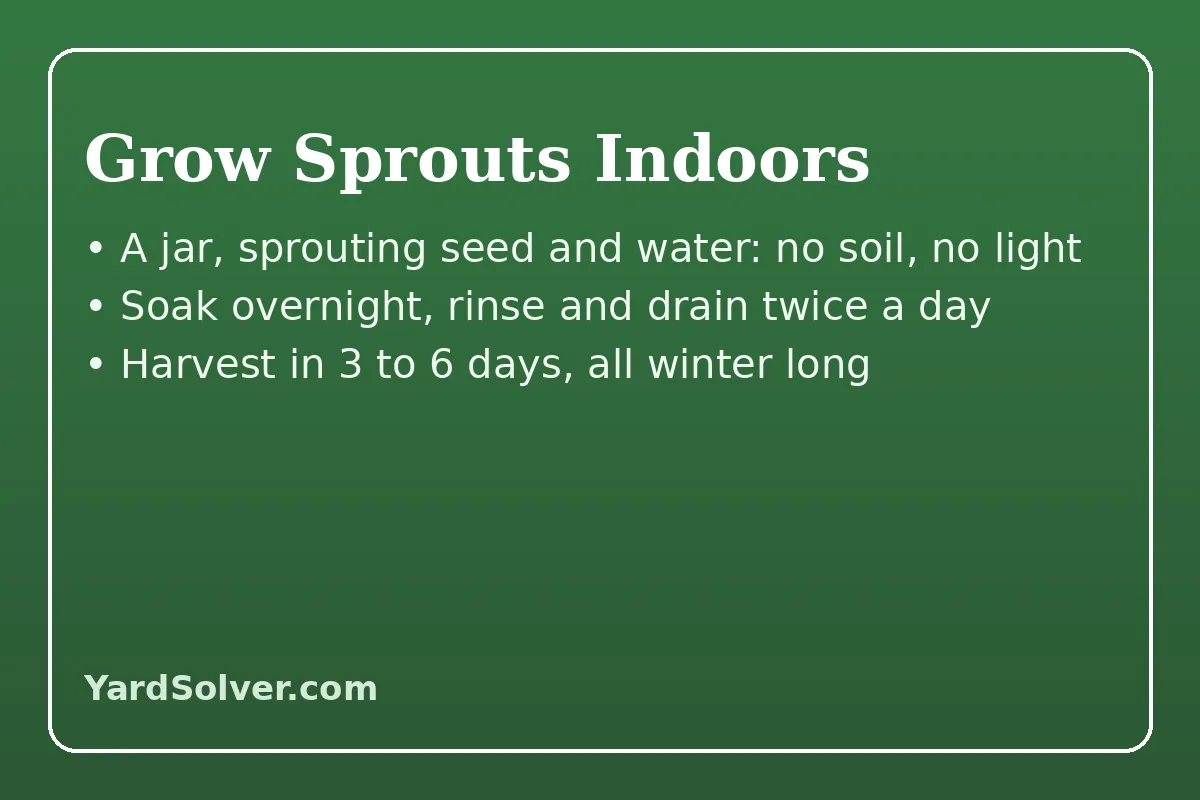
To grow sprouts indoors, put two tablespoons of seed sold specifically for sprouting into a wide-mouth quart jar, cover it with a mesh sprouting lid, soak the seed in clean water for 6 to 12 hours, then drain it and rinse and drain again at least twice a day — every 12 hours at minimum — keeping the jar propped at an angle, mouth down, out of direct sunlight at room temperature; in three to six days the sprouts are ready to give a few hours of light, dry, refrigerate and eat. Sprouting is the winter garden reduced to its essence: no soil, no lights, no window, no season, a harvest inside a week from equipment already in the kitchen. It is also — and any honest guide must say this in the first paragraph, not the last — the one indoor crop with a real, documented food-safety record, because the warm, humid conditions that germinate seed are the same conditions that grow bacteria. Virginia Cooperative Extension's sprout safety publication states it without softening: the humid, warm growing conditions during sprouting are ideal for Salmonella, E. coli and Listeria as well as for sprouts. The correct response is neither fear nor dismissal; it is the routine. This guide gives both halves together — the jar method day by day, the seed table with soak and harvest times, and the full safety system (seed sourcing, sanitising, rinse discipline, storage limits, and who should eat sprouts cooked or not at all) that extension services attach to it. It is the quick companion to how to grow microgreens indoors: microgreens take a week longer and carry no comparable raw-eating warning, while sprouts are faster and ask for more care — many winter kitchens run both, a jar beside the microgreen tray.
The short answer, on one card
Equipment: a wide-mouth quart jar, a mesh sprouting lid or muslin and a ring, a bowl to prop the jar at an angle. Seed: only seed sold for sprouting, from a reputable source — never garden seed. Soak: 2 tablespoons of seed, covered in clean water, 6–8 hours for small seeds, 8–12 for beans and lentils. The rhythm: rinse and drain at least every 12 hours, more often in a warm room; jar angled mouth-down between rinses, out of direct sun. Harvest: day 3–6 depending on the seed; a few hours of indirect light at the end to green them. Storage: dry thoroughly, refrigerate at 4 °C (40 °F) or below in a clean container, eat within 4–6 days, and discard anything slimy, dark or musty-smelling without tasting it.
Why the seed bag is a safety decision, not a shopping detail
Every extension source on sprouting begins at the same place, before the jar is even wet: the seed. Virginia Cooperative Extension's first at-home rule is to use only seeds that have been pre-tested for pathogenic bacteria, bought from a reputable commercial source. The reason is structural. In the majority of investigated sprout outbreaks, the primary source of contamination was the seed itself — bacteria present on or in the seed before it ever reached a kitchen, which then multiply happily through the warm, wet sprouting days. Garden seed fails the test twice over: it is produced and handled for soil planting, not for raw eating, with no pathogen testing for food use, and some of it is treated with fungicide coatings that have no place in a salad. Sprouting seed, sold for exactly this purpose, is the tested product. The quotable fact of this guide is therefore a shopping rule: with sprouts, you do not rinse your way to safety after the fact — safety is bought with the seed, kept with the rinsing, and finished in the fridge. Buy sprouting seed from a source that states its testing, store it dry and clean like the food it is, keep it away from pets and raw-food preparation areas as Virginia Tech advises, and treat every later step in this guide as protecting a good start rather than rescuing a doubtful one.
The jar method, day by day
| Seed | Soak | Days to harvest | Character |
|---|---|---|---|
| Lentils | 8–12 hours | 2–4 | The fastest, most forgiving beginner sprout; earthy, holds a bite |
| Mung beans | 8–12 hours | 3–5 | The thick crunchy stir-fry sprout; keep darker for thick white shoots |
| Radish | 6–8 hours | 3–5 | Peppery and assertive; a spoonful livens a whole jar of milder sprouts |
| Broccoli | 6–8 hours | 4–5 | Mild, fresh, the most studied sprout; rinse consistency matters most |
| Alfalfa | 6–8 hours | 4–6 | The classic sandwich sprout; tiny seeds clump, so shake the jar after rinsing |
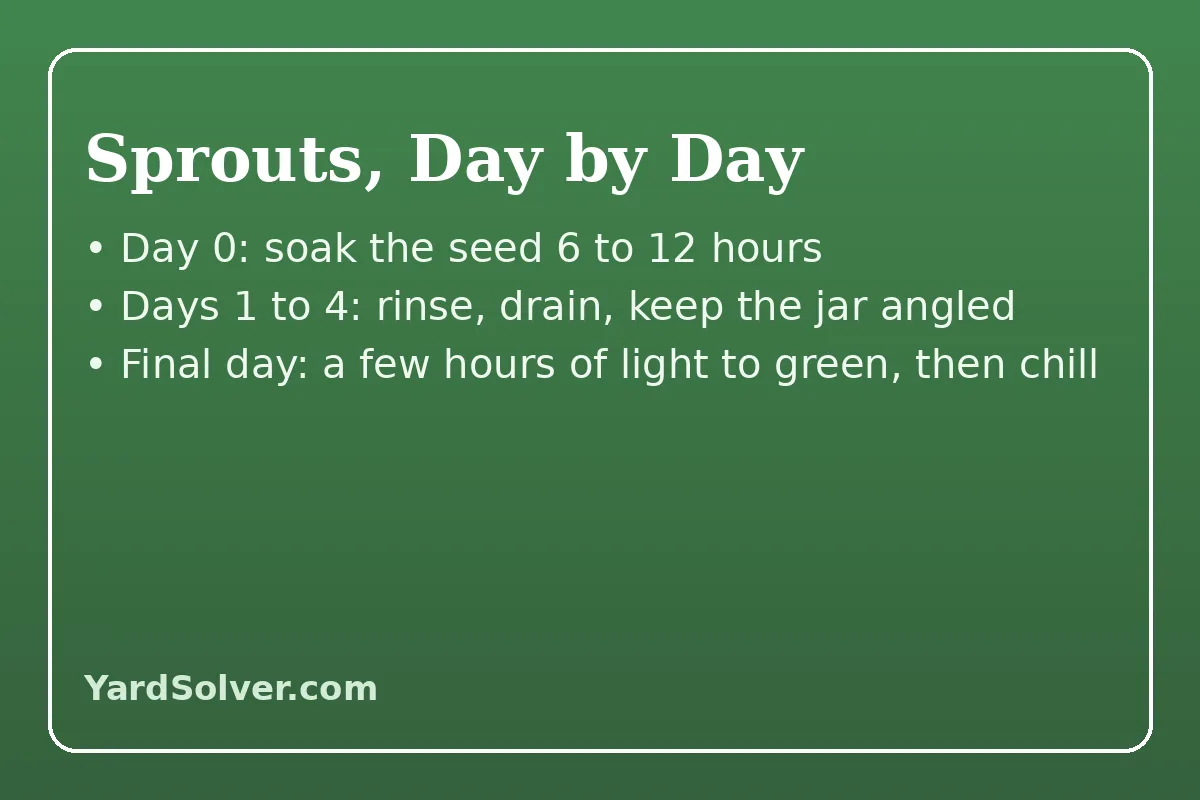
Day 0 — sanitise and soak. Before the first batch and between batches, wash and sanitise the jar, lid and mesh; a dishwasher's hot cycle or a five-minute soak in a food-safe sanitising solution both serve, followed by a clean rinse and air-dry. Add two tablespoons of seed — a little goes a long way, since a jar of alfalfa expands several-fold — cover with clean, potable water, and soak for the hours in the table. Days 1 to harvest — the rinse rhythm. Drain the soak water, rinse with fresh water, drain again thoroughly, and prop the jar at an angle, mouth down, in its bowl so the last water escapes and air circulates. Repeat at least every 12 hours; Virginia Tech's guidance for sprouts eaten raw raises that to every 6 hours in warm conditions. Keep the jar at ordinary room temperature, roughly 18–24 °C (65–75 °F), out of direct sunlight — sprouts grow on the seed's stored energy and need no light until the end. Avoid standing water in the jar at all times; a sprout sitting in its own rinse water is the failure mode behind most slimy, sour batches. The final day — green, dry, chill. When the sprouts have filled the jar and reached about 2.5–5 cm (1–2 in), with the first small leaves showing, give them a few hours of indirect light to green, rinse a last time, and dry them properly — a salad spinner or a clean towel — because surface water is what shortens fridge life. Refrigerate at 4 °C (40 °F) or below in a clean container and eat within four to six days, rinsing under cool running water just before serving.
The safety system, stated whole
Because this is the section most sprouting guides skim, it gets its own heading and no apologies. Hands and surfaces: wash hands before and after handling seed and sprouts, and keep jars, lids and counters clean — cross-contamination in the kitchen is the second route in, after the seed itself. Water: only clean, potable water for soaking and rinsing, every rinse, no exceptions for "it looks fine." Rhythm: the 12-hour maximum between rinses is a safety interval, not a serving suggestion; in a warm kitchen, tighten it toward 6 hours for sprouts that will be eaten raw. Judgement: sprouts that are slimy, darkened or musty-smelling are discarded whole, untasted — the University of Connecticut's food safety guidance and the FDA advice it summarises are blunt that rinsing cannot remove bacteria that are present, which is why prevention carries the whole load. People: children, older adults, pregnant women and anyone with a weakened immune system should avoid raw sprouts of any kind — that is the FDA position, repeated by Virginia Tech and UConn alike — and for those households the honest recommendation is sprouts cooked thoroughly, which kills the bacteria, or the microgreen tray instead. Storage discipline: dry before refrigerating, 4 °C (40 °F) or below, clean container, four to six days maximum, and a batch that has sat warm on the counter for hours is compost, not lunch. None of this is difficult, and none of it is optional garnish. It is simply the recipe, printed in full — the same standard of honesty this site applies to garden remedies and every other guide where enthusiasm usually edits out the caution.
Troubleshooting: what the jar is telling you
Slimy sprouts with a sour smell: the drainage failed — the jar sat level, water pooled, rinses were skipped, or the room ran warm. Discard the batch, sanitise everything, and fix the angle and the rhythm; do not try to rinse a slimy batch back to health. Seeds that never sprout: usually old or heat-damaged seed, or a soak in water that was hot rather than tepid; test a spoonful of the seed lot on a damp paper towel, and if it fails there too, replace the lot — the germination-test habit from seed keeping applies to the sprouting shelf as much as to the seed box. Mouldy patches: true mould is fuzzy and grey or black and means discard; the fine white root hairs that appear on healthy radish and broccoli sprouts are not mould — they are thirsty roots, they lie flat along the shoot, and they vanish at the next rinse. Learning that one distinction saves more good batches than any other in this guide. Bitter, tough sprouts: they grew too long; harvest a day earlier next batch, since sprouts are at their sweetest just as the first leaves open. A jar that will not drain: the seed choice is wrong for a jar — chia and flax form gels that seal the mesh; sprout those on a tray or skip them. Run the jar beside the soil-grown crops of growing herbs indoors in winter and the winter kitchen produces something fresh at three different speeds: sprouts in days, microgreens in a fortnight, herbs in a month.
A winter rhythm: one jar, always in motion
The sprouting habit that survives is a rhythm, not a project, and it takes about a minute twice a day. Keep two jars. On Monday evening, jar one gets its soak; on Tuesday it joins the rinse rhythm, morning and evening, thirty seconds each time it is your turn at the sink anyway. On Friday those sprouts are dried, boxed and in the fridge, and jar two — soaked on Thursday — is mid-growth to replace them, so the household never faces the empty-jar gap that kills the habit. Alternate the seed by the week: lentils when speed matters, mung beans when a stir-fry is planned, a broccoli-and-radish mix when sandwiches are the destination. Note the lots and the timings on the jar with a grease pencil or in the notebook — which seed, soaked when, harvested when, how it tasted — because sprouting, like the seed station and the cut flower bed, improves exactly as fast as you write it down. By February the counter holds a small, reliable farm that no blizzard can interrupt: seed bought once, water from the tap, and a fresh green harvest every four or five days until the garden itself wakes up and takes over the job.
Sprouts, microgreens and shoots: choosing your winter speed
Three crops share the indoor winter shelf and are constantly confused, so the plan is worth stating once. Sprouts are germinated seeds eaten whole — root, shoot and seed together — grown in water alone, in the dark, in three to six days; they are the fastest and, as the safety section above sets out, the one crop of the three with a raw-eating caution attached. Microgreens are seedlings grown in a shallow layer of mix or mat under light for seven to fourteen days and cut above the root at the first true leaves; they are slower, need the light shelf, and carry no comparable raw-eating warning, which is why the paired guide to growing microgreens indoors recommends them as the default for households with young children or anyone immunocompromised. Shoots — pea shoots are the standard — are the microgreen method pushed further: sturdier seedlings cut at ten to twenty centimetres after two to three weeks, with a texture closer to a vegetable than a garnish. A winter kitchen with one jar and one tray can run all three speeds at once: sprouts for this week's sandwiches, microgreens for next week's salads, pea shoots for the stir-fry after that. The honest allocation is by eater, not by enthusiasm — sprouts raw for the healthy adults who follow the routine, cooked sprouts or the tray crops for everyone the extension guidance names. Written that way into the household's habits, the distinction stops being a warning you re-read and becomes simply how the winter shelf works.
Keep going
Grow the slower shelf beside it with How to Grow Microgreens Indoors, keep fresh herbs coming with Grow Herbs Indoors in Winter, and check every garden claim the way we do in Garden Remedies, Fact-Checked.
Sources
The safety framework — sprouting's warm, humid conditions are ideal for Salmonella, E. coli and Listeria; in most outbreaks the seed itself was the contamination source; use only pre-tested seed from a reputable source; wash hands before and after handling; clean all containers and surfaces; use only clean potable water; keep sprouts moist but never in standing water; rinse at least every 12 hours and every 6 hours in warm conditions for raw consumption; dry before refrigerating at 40 F or below; eat within 4 to 6 days; and vulnerable people should avoid raw sprouts — follows Virginia Cooperative Extension, Sprout Safety (FST-344). The outbreak record, the FDA position that rinsing cannot remove bacteria and that at-risk groups should not eat raw sprouts, and the advice that home growers carry the same risk as commercial growers follow the University of Connecticut's food safety programme, Seed and Bean Sprouts. The seed-treatment research reference (3 percent hydrogen peroxide at 140 F) follows the University of California's fact sheet as cited by Virginia Tech, Growing Seed Sprouts at Home.
Questions people ask
How long do sprouts take to grow in a jar?
Two to six days depending on the seed: lentils in 2 to 4 days, mung beans and radish in 3 to 5, broccoli in 4 to 5, and alfalfa in 4 to 6. The routine is an overnight soak, then rinsing and draining at least twice a day with the jar propped at an angle to drain.
Can I sprout ordinary garden seed or dried beans from the pantry?
No for garden seed: it is not tested for food pathogens and may carry fungicide treatments. Sprouting seed is sold pre-tested for exactly this use, and extension guidance makes it the first safety rule. Plain dried lentils and mung beans sold as food are the traditional exception many growers use, but tested sprouting seed is the recommended route.
How often do sprouts need rinsing?
At least every 12 hours, without exception — and Virginia Cooperative Extension recommends every 6 hours in warm conditions for sprouts that will be eaten raw. Rinsing removes the moisture film bacteria favour, cools the jar and keeps the sprouts crisp; skipped rinses are the usual cause of slimy batches.
Are home-grown sprouts safe to eat raw?
They carry the same documented risk as commercial sprouts, because contamination usually starts on the seed. Healthy adults reduce the risk substantially with tested seed, sanitised equipment, strict rinse discipline and prompt refrigeration — but rinsing cannot remove bacteria that are present, and children, older adults, pregnant women and immunocompromised people should avoid raw sprouts entirely. Cooking sprouts thoroughly kills the bacteria.
Why did my sprouts go slimy?
Water stood in the jar: it was propped level instead of angled, the mesh clogged, rinses were skipped, or the room was warm. Discard a slimy or sour batch whole — do not try to rinse it back — then sanitise the jar and fix the drainage angle and rinse rhythm for the next batch.
What is the white fuzz on my sprouts — is it mould?
Usually not. Fine white root hairs on radish, broccoli and other sprouts lie flat along the shoot, appear between rinses and disappear when rinsed; they are a sign the sprouts are thirsty, not spoiled. True mould is grey or black, visibly fuzzy in patches and often smells musty — that batch is discarded.
Comments & ratings
No comments yet.
Be the first to share your experience.