
Guides · Winter jobs · Published November 20, 2026 · By Faizan Ahmad
How to Prevent Salt Damage to Lawns and Plants: Use Less, Shield More, Flush in Spring
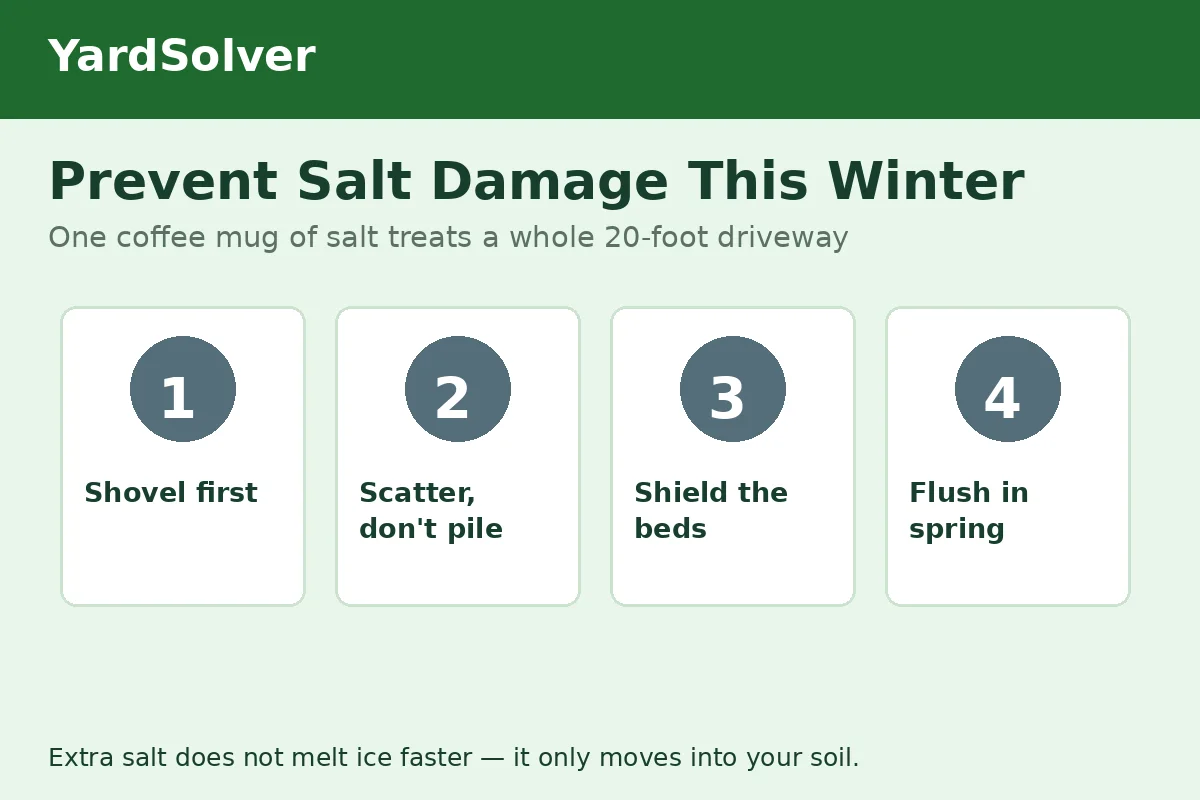
You prevent salt damage to lawns and plants with three habits: use far less deicer than feels right — about 12 ounces, one coffee mug, treats a whole 20-foot driveway — shield the plants beside pavement with burlap screens, and flush the soil beside walks and drives with water as soon as the ground thaws in spring. Deicing salt injures gardens two different ways at once: salty meltwater soaks into soil, where sodium wrecks soil structure and roots cannot take up water even from wet ground, while salty spray thrown up by tires and boots dehydrates the buds, needles and twigs it lands on. The damage is done silently all winter and only shows in spring, as dead lawn edges, scorched evergreen sides and shrubs that leaf out thin on the road side. This guide separates the two injuries, compares the deicers honestly by working temperature and plant risk, and gives the November set-up and the spring rescue in order. It pairs with our cold-season lawn care in Snow Mold — the other spring surprise that starts under winter cover.
The short answer, on one card
Dose: shovel first, then scatter deicer on ice only — roughly a handful per square metre, about 12 oz (340 g) for a 20-ft driveway or 10 sidewalk squares. Piles and white crusts are pure waste. Product: rock salt is the harshest common choice; calcium chloride, magnesium chloride and potassium chloride are gentler on plants; calcium magnesium acetate (CMA) is salt-free and gentlest, at a higher price. Shield: burlap or snow-fence screens on the road side of evergreens and shrubs; never pile shovelled salty snow onto beds. Spring: soak soil beside pavement deeply and repeatedly to leach salt below the roots.
Two injuries, two defences
Soil salt — the root injury
Every application ends up somewhere, and meltwater carries most of it into the soil strip beside the pavement. There the dissolved salt separates into sodium and chloride. Sodium displaces calcium and magnesium on soil particles, degrading structure so the soil compacts and drains poorly, and the salty soil solution pulls water away from roots — a plant can wilt in wet soil because the salt out-competes it for the water. Chloride taken up by roots accumulates in leaves and scorches them from the margins inward. Extension guidance is blunt that high soil salt also blocks uptake of potassium, calcium and magnesium, so the plant is starved and thirsty at the same time. Soil salt concentrates exactly where gardeners notice spring damage first: the 30–60 cm (1–2 ft) strip of lawn along every driveway and walk is the highest-salt soil in most home gardens.
Salt spray — the above-ground injury
Slush thrown by tires and wind-blown dry salt land directly on foliage and buds, drawing moisture out of the tissue. Evergreens show it first and worst — one-sided browning on the road-facing side of spruce, pine, boxwood, yew and rhododendron is the signature — because their needles are present and exposed all winter. Deciduous shrubs show spray injury as buds that fail and twig dieback on the pavement side in spring. Spray defence is physical, not chemical: a screen between the road and the plant, covered in the set-up below.
The dose rule: why less salt melts just as much ice
Deicer works by lowering the freezing point of the thin water film it dissolves into — once that film exists, adding more crystals on top adds almost no melting, only runoff. That is the quotable core of every municipal and extension recommendation: extra salt does not melt ice faster; it only moves into your soil. Minnesota's pollution-control guidance, widely repeated by extension services, puts the working dose at about 12 ounces — a coffee mug — scattered for a 20-foot driveway or roughly 10 sidewalk squares (about 1,000 sq ft of pavement at a light scatter). Practical technique matters as much as the number: shovel and sweep first so deicer lands on ice, not on snow that will be shovelled off carrying the salt with it; scatter with space between grains rather than dumping piles; treat steps and slopes, not whole flat driveways; and sweep up leftover granules after the storm for reuse instead of hosing them into the lawn edge.
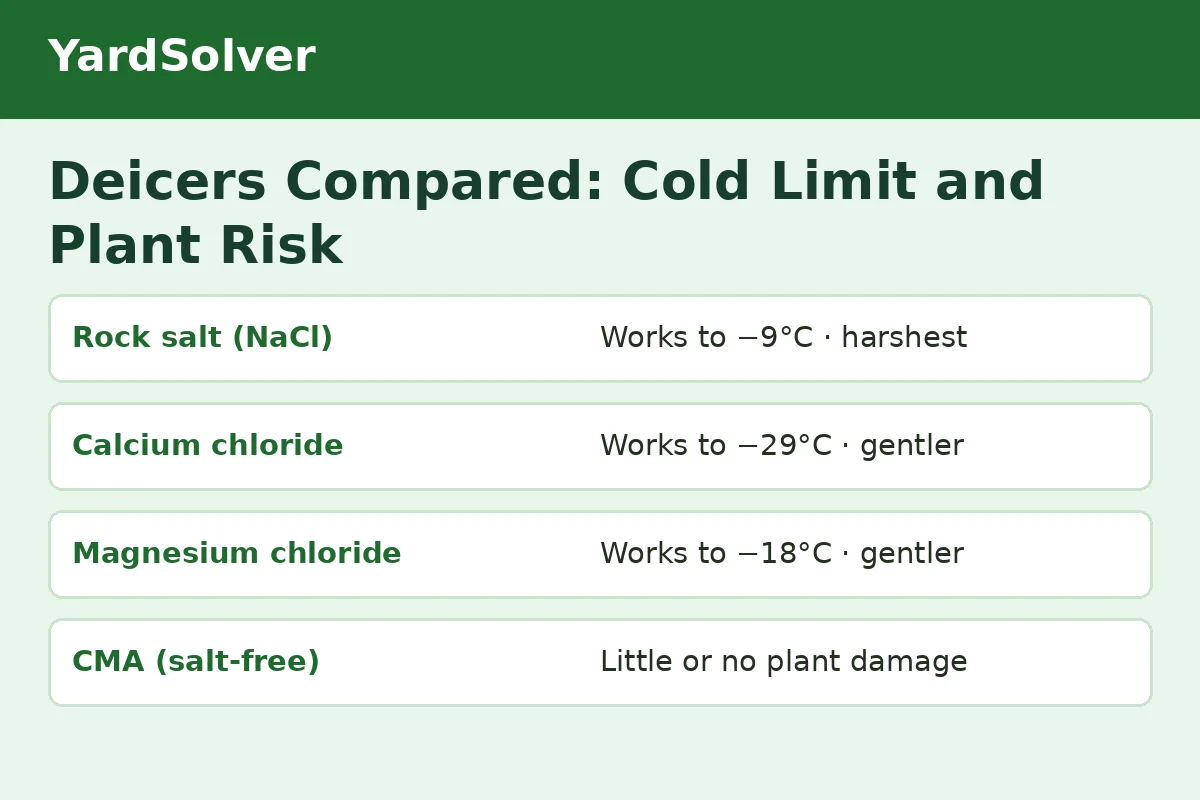
Deicers compared: working temperature and plant risk
| Deicer | Works down to (approx.) | Plant and soil risk | Notes |
|---|---|---|---|
| Sodium chloride (rock salt) | −9°C (15°F) | Highest — sodium also damages soil structure | Cheapest and most common; the one to ration hardest |
| Calcium chloride | −29°C (−20°F) | Lower than rock salt | Fast-acting in deep cold; corrosive to metal and concrete — use sparingly |
| Magnesium chloride | −18°C (−13°F) | Lower than rock salt | Common in gentler blends; still a chloride — overuse still injures |
| Potassium chloride | Similar range to rock salt | Lower than rock salt | Sodium-free, but still a chloride salt |
| Calcium magnesium acetate (CMA) | About −9 to −15°C (15 to 5°F) | Lowest — salt-free, little or no plant damage | Most expensive; best reserved for steps and beds' edges |
| Coarse sand | Does not melt — traction only | None to plants | The zero-damage option for flat, shaded walks; sweep up in spring |
Two honest cautions belong with this table. First, "pet-friendly" and "plant-safe" on a bag are marketing terms, not standards — every chloride deicer injures plants when over-applied, and dose discipline beats brand choice. Second, temperature limits are practical working limits, not laboratory minima: below its range a deicer simply sits on the ice until a warmer hour, which is an argument for sand and patience in a deep cold snap, not for doubling the salt.
The November set-up (30 minutes that saves the spring)
1. Screen the exposed evergreens. Staple burlap to stakes on the road or driveway side of vulnerable shrubs and small evergreens, leaving the top open for light and air — the same burlap logic that prevents winter burn on evergreens, doing double duty against spray. 2. Decide where snow will go. Salty snow shovelled onto a bed delivers the whole winter's salt in one pile; choose a lawn area away from shrubs and garden beds as the snow dump, and keep it there all winter. 3. Plant and plan with distance. New trees and shrubs belong at least 1 m (3 ft) back from walks and drives, and the strip right at the pavement edge is the honest place for the toughest, most salt-tolerant plants you grow — fine fescues, for example, tolerate roadside salt noticeably better than Kentucky bluegrass, which is why lawn edges seeded with fescue blends survive springs that kill bluegrass edges. 4. Stage the small dose. Keep the deicer bucket with a mug or scoop in it, so the measured dose is the easy dose at 6 a.m. in the dark.
Spring rescue: flushing, testing and reseeding
As soon as the ground thaws and hoses can run, soak the soil beside drives, walks and road frontage deeply — repeated heavy watering leaches soluble salt down below the root zone; extension guidance estimates roughly 15 cm (6 in) of water applied over time moves about half the soluble salt out of the surface soil. Rinse salt spray off evergreen foliage with plain water in the same week. Then wait before judging: give lawn edges until normal green-up is well established elsewhere before reseeding, because some "dead" edge is merely late. Where an edge truly has died two springs running, treat it as a design problem, not a seed problem — widen the pavement border, switch that strip to a fescue blend, or edge it with stone. A soil test that includes salinity is worthwhile for a bed that fails repeatedly beside a road; our method is in How to Test Your Garden Soil, and spring lawn recovery overall is in How to Overseed Your Lawn.
Keep going
Winter harms gardens quietly in several ways — see also How to Prevent Winter Burn on Evergreens, Snow Mold and How to Protect Young Trees in Winter, and keep the month's jobs in order with the December Garden Checklist.
Sources
Deicer working temperatures, relative plant risk by compound (sodium chloride harshest; calcium, magnesium and potassium chlorides less damaging; CMA little or no damage), the soil and foliage injury mechanisms and symptom descriptions follow Iowa State University Extension, Using Deicing Salts in the Home Landscape. The two-pathway injury explanation (sodium blocking nutrient uptake, salt drawing water from roots and leaves) and the burlap-barrier and alternative-deicer recommendations follow the University of Illinois Extension, Preventing Salt Damage to Landscape Plants. The 12-ounce-per-driveway dose reflects Minnesota Pollution Control Agency guidance as reported in extension summaries.
Questions people ask
What is the least damaging ice melt for plants?
Calcium magnesium acetate (CMA) causes little or no damage to landscape plants and is the gentlest option, but it costs considerably more. Among the chlorides, calcium chloride, magnesium chloride and potassium chloride are all less damaging than ordinary rock salt (sodium chloride), which extension guidance ranks as the harshest on plants and soil. No chloride deicer is harmless when over-applied — dose matters more than brand.
How much ice melt should I actually use?
Far less than most people pour: about 12 ounces — one coffee mug — scattered evenly treats a 20-foot driveway or about 10 sidewalk squares. Shovel first so the deicer lands on ice, scatter it with gaps between grains, and sweep up leftovers after the storm. Extra salt does not melt ice faster; it just ends up in your soil.
Why is my lawn dead along the driveway every spring?
That strip receives the whole winter's salty meltwater, and sodium in the soil stops roots absorbing water and nutrients — the grass effectively dies of thirst in wet soil. Flush the strip deeply with water as soon as the ground thaws, and if it dies two springs running, reseed it with a salt-tolerant fine fescue blend rather than Kentucky bluegrass.
Can salt damage be repaired in spring?
Much of it, yes. Salts are water-soluble: repeated deep watering as soon as the ground thaws leaches them below the root zone — roughly 15 cm (6 in) of water moves about half the soluble salt. Rinse spray off evergreen foliage, prune out dead twigs, and delay reseeding until you can tell late green-up from true death.
Is sand better than salt for my garden?
For the plants, unambiguously — sand adds traction with zero chemical injury, which makes it the right choice for flat, shaded walks. It does not melt ice, and it must be swept up in spring so it does not build up in lawn edges, but beside sensitive beds it is often the smartest tool in the bucket.
Does 'pet-safe' ice melt mean it is safe for plants?
No. 'Pet-safe' and 'plant-safe' on packaging are unregulated marketing terms. Most such products are still chloride salts that injure plants when over-applied — read the ingredient list for the actual compound and apply the same small, measured dose whatever the bag promises.
Comments & ratings
No comments yet.
Be the first to share your experience.