
Guides · Winter jobs · Published November 20, 2026 · By Faizan Ahmad
How to Winterize a Garden Pond: Fish, Pumps and Ice Done Safely
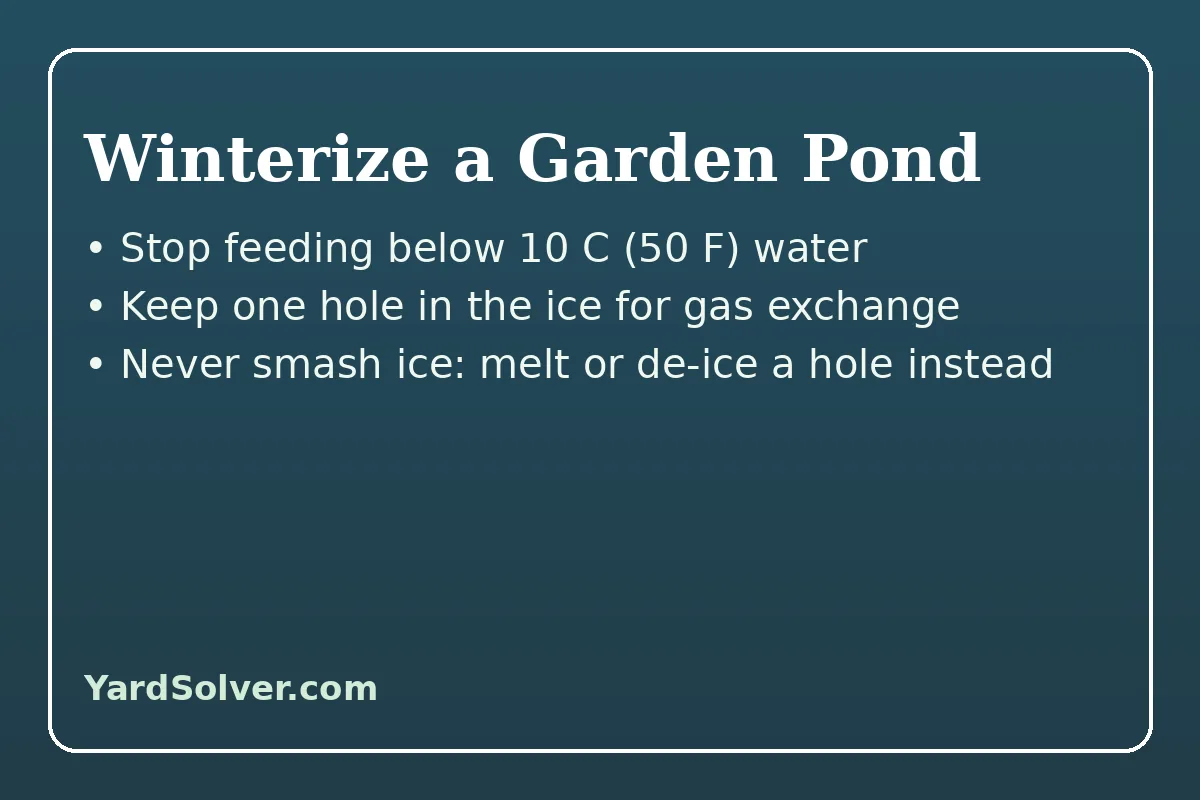
To winterize a garden pond, clean it first — net and skim out every leaf and trim dying plant growth before freeze-up — stop feeding fish once the water stays below 10 °C (50 °F), move hardy water lilies into the deep zone and take tropical plants out, shut down, clean and store pumps and external filters somewhere frost-free, and then keep one small hole open in the ice all winter with an aerator whose diffuser sits on a shallow shelf, a floating de-icer, or both. Hardy fish such as koi and goldfish do not need a warm pond; they need a stable one. As water cools they sink to the deepest zone, where the water sits at about 4 °C (39 °F) — water's densest, warmest winter state — and wait out the season in torpor, barely eating, barely moving. What kills pond fish in winter is rarely the cold itself. It is the sealed lid: ice covering the whole surface while fallen leaves rot underneath, consuming oxygen and releasing gases that cannot escape. Every step in this guide serves one of two masters — reduce what rots, and keep the pond breathing. It is written for fish ponds and wildlife ponds across Canada and the northern US, and it pairs with How to Keep a Birdbath From Freezing in Winter, the same open-water principle at saucer scale.
The short answer, on one card
Depth decides: fish overwinter outdoors only where part of the pond stays liquid below the ice — at least 60 cm (2 ft), and 90–120 cm (3–4 ft) in cold-winter regions; a shallow pond needs an indoor tank plan instead. Clean: leaves out, by net or by hand, before they sink and rot. Feeding: switch to wheat-germ food as water cools through the teens Celsius, stop entirely below 10 °C (50 °F), and do not restart for a warm spell. Equipment: pumps and external filters off, cleaned, drained and stored frost-free; a stored pump sits in a bucket of water so its seals do not dry and crack. The hole: aerator diffuser raised to a shallow shelf, or a thermostat de-icer — checked weekly. Never: smash ice with a hammer or axe.
How a pond survives winter: the physics working for you
Water behaves helpfully at exactly the temperatures that matter. It reaches its greatest density at about 4 °C (39 °F), so as a pond cools, that densest water sinks and pools at the bottom, while colder, lighter water rises and freezes at the top. The ice sheet then insulates the water below it, and the deep zone holds near 4 °C through months of bitter air above. Fish evolved for this: koi and goldfish slow into torpor, settle into that deep, stable layer, and need almost nothing — no food, little oxygen, no disturbance. Two human errors break the system. The first is sealing it: a complete ice lid over a pond full of rotting leaves turns the water into a closed jar in which decomposition consumes oxygen and releases ammonia, carbon dioxide and hydrogen sulphide with nowhere to go. The second is stirring it: powerful circulation or an aerator diffuser left on the pond floor drags the warm bottom water up to the freezing surface and supercools the very refuge the fish are using. Hence the quotable rule of this guide: winter kills pond fish through the lid and the rot, not through the cold — keep one hole open and the bottom clean, and the physics does the rest. That is also why the guide's equipment advice splits in two: most machinery is stored away, while the one device that maintains the hole — run gently, placed shallow — stays on.
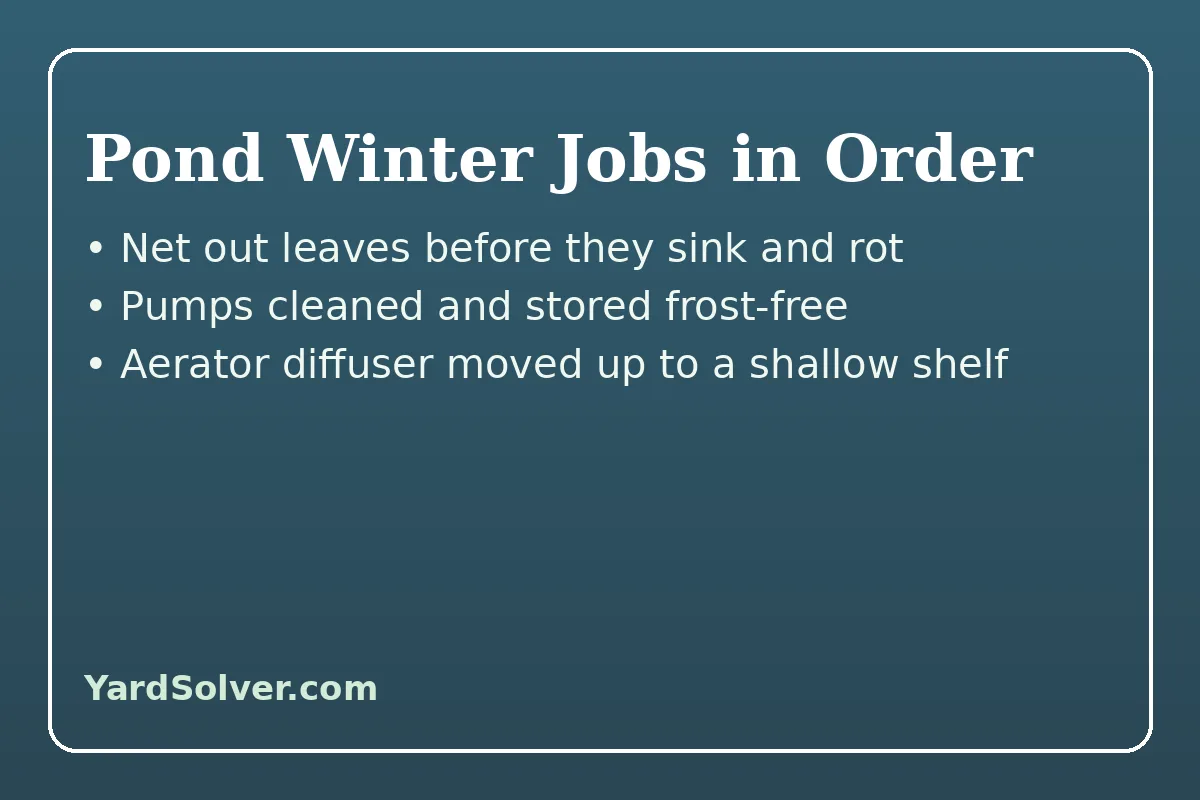
The winterizing sequence, step by step
| Step | Job | Timing and detail |
|---|---|---|
| 1. Net the fall | Stretch a leaf net over the pond, or skim daily | Before and during leaf fall; every leaf removed is gas that never forms |
| 2. Clean the bottom | Lift out sunken debris and sludge by net or vacuum | On a mild fall day, weeks before freeze-up, gently — fish are still active |
| 3. Trim plants | Cut marginals back; remove tropical floaters | Water hyacinth and lettuce die at frost and become the rot problem |
| 4. Set lilies deep | Cut dead foliage to a few cm; move pots to the deep zone | Hardy lilies overwinter below the ice line in the pond |
| 5. Taper feeding | Wheat-germ food in cool water; stop below 10 °C (50 °F) | Do not resume during a brief warm spell |
| 6. Shut down equipment | Pumps, filters, UV off, cleaned, drained, stored frost-free | Store a removed pump submerged in a bucket of water, seals protected |
| 7. Set the winter air | Aerator diffuser on a shallow shelf, and/or a floating de-icer | In place before the first lasting ice forms; check weekly all winter |
The order is not arbitrary. Cleaning comes first because everything else assumes a pond entering winter with a low rot load — Royal City Nursery's winterizing guide, written from a Canadian nursery practice, builds the whole season on that fall cleanup and on adjusting fish care as temperatures drop, and Aquascape's support guidance for overwintering koi and pond fish lists the same preparation: remove leaves and debris, prepare the water before freeze-up, and only then manage the ice. Plant handling follows the hardiness line exactly: tropical floaters and tender plants come out to compost or indoor keeping because their frost-killed tissue is tomorrow's sludge; hardy lilies stay, cut back to short stubs, with their pots lowered into the deep zone where the crown cannot freeze; submerged oxygenators such as hornwort are left in place, still quietly working. If your pond is too shallow for the depth rule in the card above, this is also the moment of honesty: fish move to a stock tank in a garage or basement for the season, and the pond is winterized as a water feature only — drained lines, stored pump, no lives depending on a hole in ice that reaches the bottom.
Feeding: the taper and the hard stop
Fish digestion is temperature machinery. Through the cooling weeks of fall, pond keepers switch from growth food to a wheat-germ-based cold-water food, which fish digest more easily as their metabolism slows, and feed less, less often. The stop line is consistent across Canadian and manufacturer guidance alike: once water temperature falls consistently below 10 °C (50 °F), stop feeding altogether. Below that line the fish are entering torpor; they will not eat with intent, food they do take cannot be properly digested, and everything uneaten becomes part of the rot load the ice is about to seal in. The subtler rule follows from the same biology and catches conscientious keepers out: do not restart feeding during a February thaw. A few warm days raise surface temperatures and bring fish up hopefully, but their digestive systems need sustained warmth over several days to reactivate, and a fed fish hit by the returning freeze is worse off than a fasting one. Resume in spring only when water holds above 10 °C steadily, starting with the same wheat-germ food, lightly. Note the temperatures on the journal page from How to Start a Garden Journal — your pond's own dates for the feeding stop and the first lasting ice are the two numbers that time next year's whole routine.
Keeping the hole open: aerator, de-icer, and the ice rules
One open hole, roughly the size of a dinner plate or larger, is the entire winter requirement — the rest of the ice sheet is insulation and should be left alone. Two devices maintain it, and they combine well. An aerator — a small air pump on shore pushing air through weighted tubing to a diffuser — keeps water moving at the surface so ice cannot close, while directly supporting gas exchange; its winter placement is the detail that matters most: raise the diffuser onto a shallow shelf, roughly the top third of the pond's depth, never leave it on the bottom, because bottom aeration in winter mixes away the warm deep layer the fish are resting in. A floating de-icer does the job with heat instead, a thermostat-controlled ring that holds its own patch open; it uses more electricity than an aerator and is the stronger tool in severe cold, which is why many cold-climate keepers run the aerator as the worker and the de-icer as the back-up that switches on in a deep freeze. Aquascape's winter guidance pairs the two in exactly that way and adds the rule that must travel with every ice discussion: never break ice by force — the shock wave from hammering travels through the water and can injure or kill torpid fish resting below. If a hole must be reopened by hand, set a pot of hot water on the ice and let it melt through. Waterfalls deserve a decision, not a default: a running waterfall keeps its own area open, but long, shallow streams ice-dam in hard cold and can divert water out of the pond entirely, quietly draining it — most small ponds are safer with the waterfall shut down, its pump stored, and the hole kept by air or heat instead. Check the hole on a weekly round, the same circuit as the birdbath in How to Keep a Birdbath From Freezing in Winter and the December jobs in the December checklist: hole open, de-icer seated, airline running, water level sane. Five minutes a week is the whole maintenance contract until spring.
Wildlife ponds, spring wake-up, and the honest limits
A wildlife pond without fish follows the same guide with the stakes lowered: no feeding questions, no torpor to protect, but the clean-out and the hole still serve frogs overwintering in the bottom mud and the birds and mammals that drink at the ice edge — keep a shallow, rough ramp or a floating plank at the margin so anything that falls in can climb out on ice-slick edges. Spring reverses the sequence gently: as ice retreats and water holds above 10 °C, restart equipment cleaned and checked, resume feeding lightly with cold-water food, lift the lilies back to their shelf in stages, and expect a week or two of green water while the pond's biology restarts — resist the urge to drain and refill, which resets the very stability the fish just wintered on. The honest limits deserve the last word. This method assumes a pond deep enough to hold a liquid deep zone; it cannot save fish in a 30 cm (12 in) ornamental tub in a zone 3 January, and no de-icer made will change that — depth is the pond's true winter equipment, bought at digging time. It also assumes the fall clean happened; a pond sealed in November over a mattress of oak leaves can lose fish by February with the hole faithfully open, because the hole vents gas at the rate the rot produces it only up to a point. Depth, cleanliness, one open hole, and peace: give a pond those four and winter, which looks like its most dangerous season, becomes the one in which it asks least of you — the fish you fed in October rise in April, hungry and intact, out of water you barely touched.
The winter check round: five minutes, once a week
Winterizing is an afternoon; winter keeping is a habit, and it should be written down as one. The weekly round has five checks. The hole: open, wide enough, with the de-icer floating level or the aerator's bubbles rising in their usual place — a hole that has shrunk to a coin's width after a cold night is the system asking for its back-up device. The water level: ice formation and wind lower it slowly, and a pump or airline intake left high and dry by a falling level fails silently, so top up with a bucket of cold water poured gently at the margin, never a hose left running and forgotten. The fish: on mild days they may rise slowly near the hole; they should look unhurried and whole, and any fish gasping at the surface in mid-winter is an oxygen alarm that means the hole gets enlarged by melting and the aerator checked the same day. The edges: ice expanding against a rigid pond edge or a stone coping can lever and crack it, so keep a soft buffer — a floating ball, a plank, a section of foam — at one margin of small formal ponds to give the sheet somewhere to push. And the visitors: tracks in the snow tell you who is drinking at the hole — birds daily, mammals at night — and whether a heron has discovered that a winter pond concentrates fish in one slow, shallow-resting place, in which case the net that kept leaves out in fall goes back on as a heron guard until spring. Record the round in a line or two, with the week's lowest temperature: by the second winter you will know exactly how cold your pond can go before the de-icer must join the aerator, which is knowledge no general guide, this one included, can give you for your own water.
Keep going
Run the rest of the winter water round with How to Keep a Birdbath From Freezing in Winter, protect the other stored water with How to Winterize a Rain Barrel, and drain the pressurised lines with How to Winterize a Sprinkler System.
Sources
The winterizing framework — assess the pond, adjust fish care as temperatures drop, switch toward cold-water food in fall and stop feeding once water falls consistently below 10 °C (50 °F), keep a small area ice-free with an aerator or floating de-icer so gas exchange continues, care for hardy and submerged plants in place, and shut down, clean and store pumps and filters in a frost-free location — follows Royal City Nursery, A Complete Guide to Winterizing Your Pond. The minimum depth of 2 ft, gas exchange as the most critical factor, the de-icer and aeration pairing, positioning aeration higher in the water column rather than at the bottom, the rule never to break ice by force, shutting down and draining external filters in freezing conditions, and cleaning and preparing the pond before winter follow Aquascape, What Do I Do With My Koi and Pond Fish Over the Winter? The Canadian framing — koi in torpor below 10 °C needing depth of at least 90 cm and ideally 120 cm or more, decomposing organic matter under ice as the biggest threat, fall cleanup and netting during leaf fall, and weekly checks that the aerator or de-icer is holding the hole open — follows Fontana Water Features, How to Winterize a Koi Pond Without Losing Your Fish.
Questions people ask
How deep does a pond need to be for fish to survive winter outside?
At least 60 cm (2 ft) of depth in the deep zone as a minimum, and 90 to 120 cm (3 to 4 ft) in regions with hard, long winters, so a layer of water near 4 °C stays liquid below the ice for fish to rest in. A pond shallower than that can freeze through; its fish need an indoor tank for the season.
When should you stop feeding pond fish in winter?
Stop entirely once the water temperature falls consistently below 10 °C (50 °F). In the cooling weeks before that, switch to a wheat-germ cold-water food and feed less. Do not restart during a brief warm spell — digestion needs sustained warmth over several days to reactivate.
How do you keep a hole in pond ice for fish?
Run an aerator with its diffuser raised onto a shallow shelf, a floating thermostat de-icer, or both together in severe cold. One open patch is enough for gas exchange; the rest of the ice insulates and should stay. Check weekly that the hole is open and the equipment is running.
Why should a pond aerator diffuser be moved shallow in winter?
Because the pond's warmest water — about 4 °C — pools at the bottom, and that is where torpid fish rest. A diffuser left on the bottom mixes that warm layer up to the freezing surface and supercools the refuge. On a shallow shelf it keeps the surface hole open without disturbing the deep water.
Can you break pond ice with a hammer to let fish breathe?
No. The shock wave from striking ice travels through the water and can injure or kill fish resting in torpor below. If a hole has closed and no de-icer is available, set a pot of hot water on the ice and let it melt a hole through gently.
Should a pond pump run all winter?
Usually not in a freezing climate. Pumps and external filters are normally shut down, cleaned, drained and stored frost-free — a removed pump stored in a bucket of water so its seals do not dry out. The exception is a pond designed to run its waterfall all winter, watched for ice dams that can divert water out of the pond.
Comments & ratings
No comments yet.
Be the first to share your experience.