
Guides · 2027 planning · Published November 20, 2026 · By Faizan Ahmad
How to Start a Garden Journal: The Winter Habit That Plans Your 2027 Garden
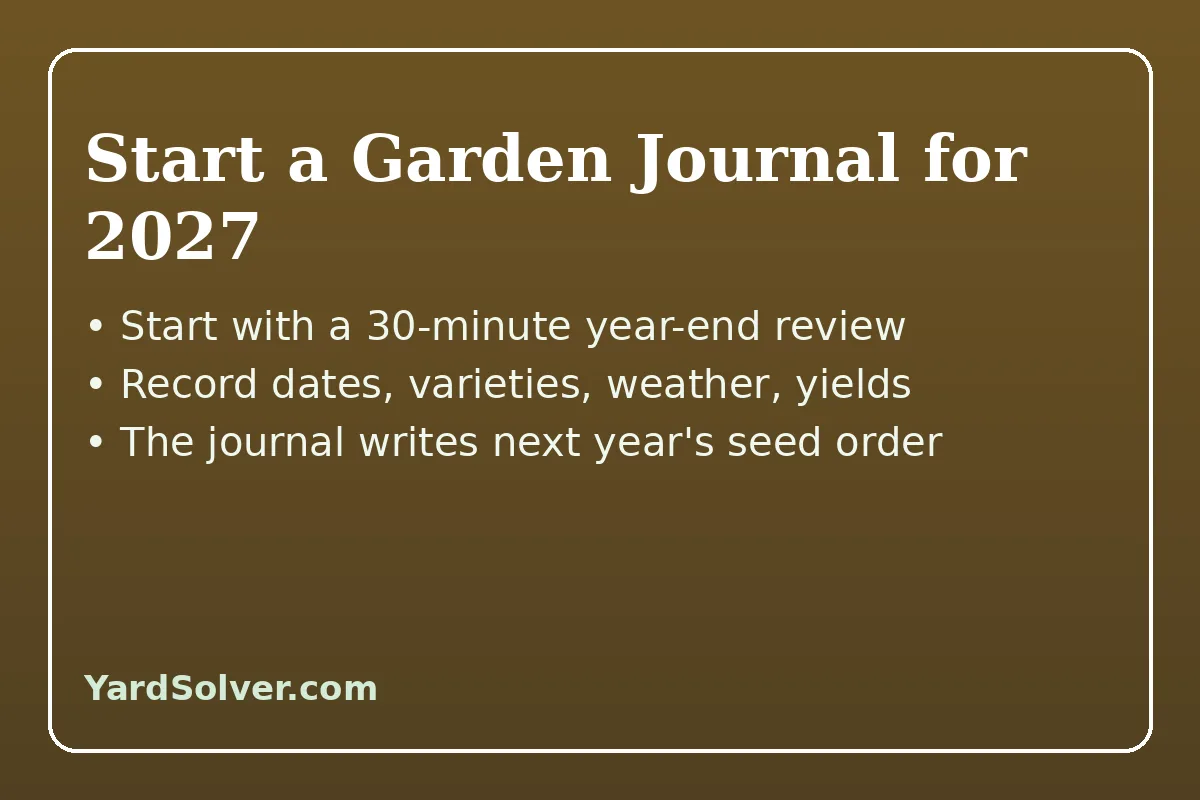
To start a garden journal, sit down this winter with a notebook, binder or notes app and spend thirty minutes writing the season just ended while you can still remember it — what grew where, which varieties earned their space, when the frosts came, what the pests did and what everything cost — then set up five standing pages (a garden map, a sowing and harvest log, weather landmarks, a problems page and a spending page) and keep them with five minutes a week. That is the whole system, and it is the highest-return habit in gardening, because every other winter task runs on information the journal holds: the seed order, the rotation plan, the soil programme and the calendar all get sharper the moment they are built from records instead of recollection. Gardeners who keep journals, Purdue Extension observes, begin to see what works and what does not, spot trends in pest problems, and compare bloom times year over year — patterns no single season ever shows you. This guide gives the year-end review that starts the journal, the five pages in detail, the weekly rhythm that keeps it alive without becoming a chore, and how the finished pages feed directly into the 2027 planning work on this site.
The short answer, on one card
Format: any — a three-ring binder with pockets is the extension favourite because it swallows seed packets, plant tags and soil reports, but a notebook, a wall calendar or a phone note all beat the perfect journal never opened. Start: with the past, not the future — a thirty-minute review of the season just ended. Core records: planting dates and locations, varieties, weather landmarks, harvest dates and yields, problems and what fixed them, and spending. Rhythm: five minutes a week in season, planning sessions in winter. Payoff: next December's seed order and rotation plan take an hour, because the journal already made the decisions.
Step one: the thirty-minute year-end review
Do not begin with blank pages and good intentions; begin with the season that just ended, while its evidence is still standing in the garden. Walk the beds once with the notebook in hand and then sit down with a hot drink and write, in any order, under four headings. What worked: the varieties that produced, the bed that thrived, the experiment that surprised you — name them exactly, variety names included, because "the tomatoes were great" buys nothing in January while a named variety can be reordered in one click. What failed: the crop that bolted, the shrub the deer found, the corner that stayed wet — with your best guess at why. What surprised you: the late frost, the early peas, the pest that arrived in June instead of July; surprises are the data points that recalibrate a calendar. What it cost: a rough total is enough — the University of Vermont's extension journaling advice makes the practical point that even bulk purchases belong in the record, because next year you will want to know how much mulch you ordered and whether it was the right amount. University of Vermont Extension also urges capturing exactly this moment: details fresh in mind today will not be there in spring, and ideas noticed while putting the garden to bed — the bed to expand, the shrub to move, the project to research — should be written down the week they occur. Photos count as entries: a dated photograph of each bed in November is worth a page of prose in March.
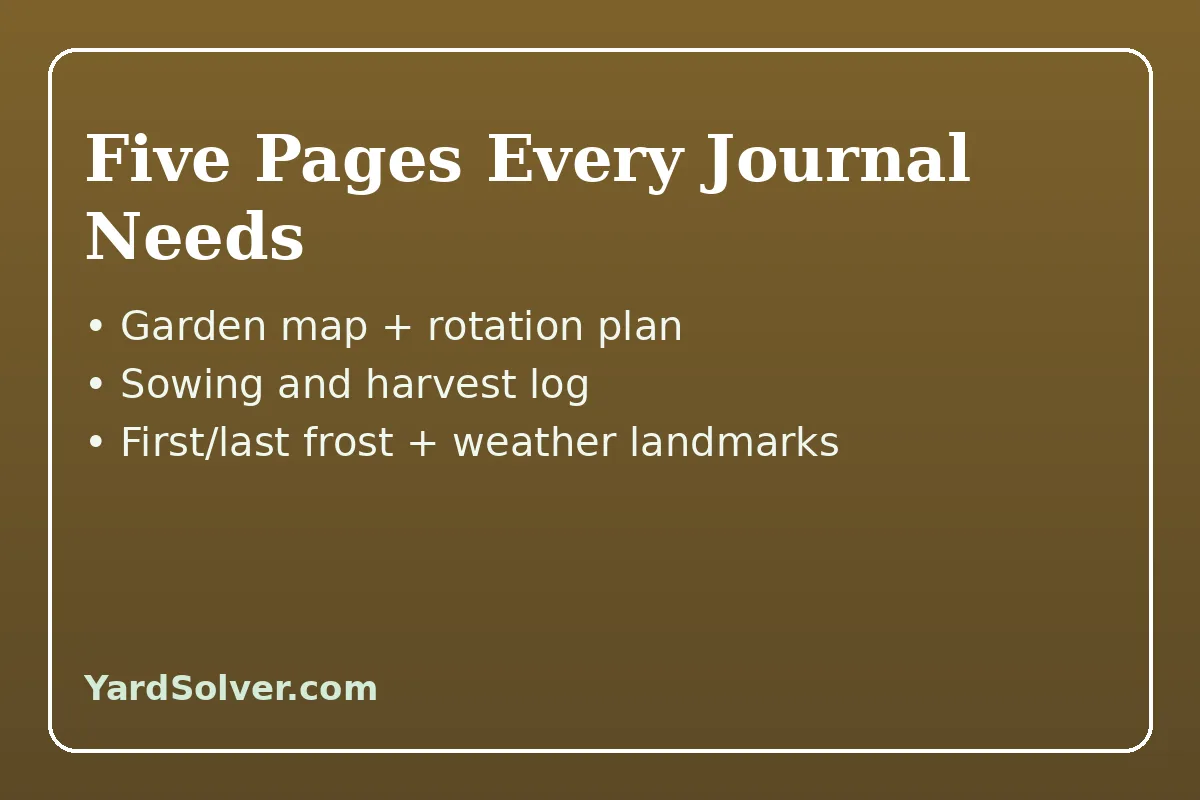
The five pages every journal needs
| Page | What goes on it | What it decides later |
|---|---|---|
| 1. Garden map | Each bed's dimensions and what grew where, this season | Next year's rotation — you cannot rotate away from a layout you have forgotten |
| 2. Sowing and harvest log | Variety, source, sowing and transplant dates, harvest dates and rough yields | Which varieties to reorder, drop or try — the seed order's evidence base |
| 3. Weather landmarks | Actual first and last frost, soil warming, heat waves, drought stretches, first pest and first bloom dates | Your real local calendar, replacing the zone average with your garden's own dates |
| 4. Problems and fixes | Pests, diseases, animal damage and deficiencies, with dates and what worked | Next year's prevention timing — problems arrive on a schedule once you can see it |
| 5. Spending and inventory | Purchases with cost and source, seed inventory with years, soil test results | The budget, the stash audit, and whether last year's spending matched the harvest |
Iowa State University Extension's journaling guide lists what experienced keepers record, and the list is usefully unglamorous: weather conditions, blooming times, planting dates and locations, seed-starting dates, harvest dates and amounts, plant and seed inventories, favourite cultivars, the plants that thrive and the ones that fail, anomalies, plant sources, the crop rotation plan, garden maps and dimensions, equipment maintenance, problem weeds, animal damage, insect and disease problems, fertilizer and pesticide applications, and the to-do list for next season. You do not need all of it in year one — the five pages above carry the load — but the list shows where a journal grows as its keeper does. Iowa State's planning guidance adds the keeper's habit that makes the log useful at ordering time: record the source of seeds and plants, where and how they were planted, and tuck the seed packets, plant tags and labels themselves into the journal, which is why the binder format, with pockets, keeps winning. The quotable rule: a journal entry is a decision made once instead of five times — the gardener who wrote it down never re-litigates last year's questions.
The weekly habit: five minutes, honestly kept
Journals die of ambition, not neglect — the keeper who resolves to write an essay after every session writes three and stops. The sustainable rhythm is a dated line or two, at a fixed moment: the end of the week's main garden session, tools down, drink in hand. One line per bed that changed: what was sown, planted, harvested, fed or found. Purdue Extension's journaling advice frames the keeper's reward correctly — as self-chroniclers of their own gardens, journal keepers begin to see what works, identify trends in pest problems and observe bloom times from year to year — and none of that requires literature, only dates and facts accumulated patiently. In winter the habit changes shape rather than stopping: the journal becomes the planning desk, where the December checklist jobs, the seed inventory and the first sketches for spring get worked through in the warm, at leisure, instead of in a cold March weekend. Keep the journal where the gardening happens — by the back door, in the shed, in the pocket of the garden coat in phone form — because a journal that lives in a desk drawer records a garden nobody visited.
How the journal runs the 2027 programme
Here is the payoff, task by task. The seed order: open the sowing log and the stash page together and the order in When to Order Seeds for Spring builds itself — proven varieties reordered, failures dropped without a pang of catalogue doubt, quantities set by recorded yields instead of optimism. The rotation: last season's map is the only honest starting point for the plan in Crop Rotation Basics, because soil remembers what grew where even when the gardener does not. The calendar: your recorded frost dates and sowing results correct the zone averages in the 2027 Canada planting calendar and the seed-starting dates into your garden's own schedule within two or three seasons. The soil programme: test results and amendment records filed together show whether the programme in How to Test Your Garden Soil is moving the numbers or merely moving compost. And the winter jobs: the problems page is where this month's snow damage, animal browsing and heaved crowns get logged against the shrubs that suffered them, so next November's protection round starts from evidence. None of these tasks disappears — the journal simply converts each from an annual act of reconstruction into an act of reading.
Paper, binder or phone: choosing the format you will keep
Choose by friction, not by beauty. The three-ring binder is the extension services' recurring recommendation — the University of Vermont guide suggests it directly — because it customises endlessly: a monthly calendar at the front, sections per bed or per topic, graph paper for maps, plastic pockets for packets, tags, receipts and soil reports. The bound notebook suits the keeper who writes in sequence and values a shelf of finished years; its weakness is exactly its order, since a map drawn in March cannot move beside December's plan. The wall calendar is the minimalist's journal and a genuinely good one for dates alone — frosts, sowings, first blooms — kept where the household actually looks. The phone or tablet wins on search, photographs and being already in your pocket in the garden, and loses on pockets, paper artefacts and the pleasure of the object. Hybrid keepers do well: calendar for dates, binder for artefacts, phone for photographs, reviewed into one winter sitting a year. What does not work, in any medium, is the system that requires transcribing, colour-coding or catching up — the journal that survives is the one whose standard entry is thirty seconds long. Start yours with the year-end review this week, while the garden it describes is still standing outside the window; by the time the January checklist arrives, you will be planning 2027 from records, which is to say, like a gardener in their tenth year — whatever year you are actually in.
What a year of entries actually looks like
New keepers often stall on a fair question: what does a real entry say? Shorter than you fear. January: "Ordered seed — list filed in front pocket. Last year's tomatoes: 'Gardener's Delight' cropped to mid-October, reorder; the big beefsteak ripened six fruit total, drop." March: "Sowed peppers Mar 3, up Mar 11. Soil in the cold frame at 8 °C." May: "Last frost May 9, ten days earlier than last year. Lilac first bloom May 14." July: "First cucumber beetles Jul 2 — three weeks after last year's date; covers went on the squash the same day. Zucchini yield absurd; plant one, not two, next year." September: "Garlic ordered. The north bed stayed wet all season — drainage is the winter project, again, and this time it is written down." November: "Frost Nov 4. Year-end review done; map redrawn; seed inventory counted — 14 packets still viable, test the 2024 beans." Five lines a month would have carried most of that. Notice what the entries share: a date, a fact, and frequently a decision already made for a future month. That third element is the one that compounds. A journal full of observations is a diary; a journal whose observations end in decisions is a management system, and the difference shows up the following December, when the seed catalogue lands and the keeper with decisions already recorded spends an evening ordering while everyone else spends a month remembering.
Keeping it for decades: the archive habit
The final habit separates a notebook from an archive: one hour, once a year, in the same winter sitting as the year-end review, spent making the year findable. Number or date the finished sections, copy the landmark dates — first and last frost, first pest arrivals, the year's best and worst varieties — onto a single summary page at the front of the binder or the top of the digital folder, and file the year's photographs beside it. That summary page is what you will actually consult in year five, when nobody can face reading five winters of weekly lines; the lines are the evidence, the summary is the index, and together they let a decade of gardening answer questions in minutes. Gardeners who keep this up become, measurably, the people neighbours ask — not because their memories are better, but because their records are. Start this winter, keep the entries short, summarise once a year, and the journal quietly becomes the most valuable tool you own that never needs sharpening.
Keep going
Put the journal straight to work: order from its evidence with When to Order Seeds for Spring, rotate from its map with Crop Rotation Basics, audit the stash it inventories with the Seed Stash Audit, and run the winter from the December Garden Checklist.
Sources
The journal-keeping benefits (seeing what works, identifying pest trends, comparing bloom times year over year) and the record categories — vegetable layout and rotation planning, landscape bed sketches, seasonal landmarks including frost dates and pest arrivals, regular activities with yields, and the budget record — follow Purdue University Extension, Consider a Garden Journal. The full what-to-record list (weather, bloom times, planting and harvest dates and amounts, inventories, favourite cultivars, anomalies, sources, rotation plan, maps, problems and applications) follows Iowa State University Extension, Garden Journaling. The capture-it-now advice, the bulk-purchase example, and the three-ring binder recommendation with calendar, pockets and soil-test filing follow the University of Vermont Extension, Garden Journal: Your New Favorite Garden Tool.
Questions people ask
What should you write in a garden journal?
The facts next season depends on: what was planted where and when (with variety names and sources), sowing and transplant dates, first and last frost and other weather landmarks, harvest dates and rough yields, pest and disease problems with dates and what worked, soil test results, and what everything cost.
When is the best time to start a garden journal?
Right now, in late fall or winter, with a review of the season just ended — what worked, what failed, what surprised you and what it cost — while the evidence is still standing in the garden and the details are fresh. University of Vermont Extension makes exactly this point: details fresh today will not be there in spring.
How often should you write in a garden journal?
About five minutes a week in season — a dated line or two per bed that changed — and in planning sessions through winter. Journals die of ambition: the keeper who writes short, factual entries at a fixed weekly moment keeps the habit for years; the essayist stops by June.
Is a paper journal or an app better for garden records?
Whichever you will actually open in the garden. A three-ring binder swallows seed packets, plant tags and soil reports and is the extension services' recurring recommendation; a phone wins on photographs and search. Many keepers run a hybrid: calendar or app for dates, binder for artefacts, one winter review to bring them together.
How does a garden journal help plan next year's garden?
It supplies the evidence every winter task needs: the seed order is built from recorded variety performance and yields, crop rotation starts from last season's actual map, sowing dates are corrected by your own recorded frost dates instead of zone averages, and prevention for pests is timed from last year's arrival dates.
What is the first entry a new garden journal should have?
A map of the garden as it was this season — every bed, its dimensions and what grew in it — drawn before you forget the layout. Rotation planning, the single most valuable use of the journal, is impossible without it, and it takes ten minutes with a tape measure and a pencil.
Comments & ratings
No comments yet.
Be the first to share your experience.