
Guides · Pruning · Published November 20, 2026 · By Faizan Ahmad
Plants to Never Cut Back in Winter: The List That Saves Spring Flowers
Never cut back spring-flowering shrubs, old-wood hydrangeas, tender perennials, seed-head perennials or ornamental grasses in winter: forsythia, lilac, azalea and their kin are carrying next spring's flower buds on the growth in front of you; penstemons, salvias and lavender are wearing their old stems as frost armour; and echinacea, rudbeckia and the grasses are standing bird food. A winter tidy-up of these plants costs a season of flowers, sometimes the plant itself, and the wildlife value of the whole border. This guide gives the full never-cut list grouped by the reason, the timing each group gets cut instead, and the short list of things you should still cut in winter — because the rule is not "never prune"; it is "know what the growth is for before you remove it."
The short answer, on one card
Never in winter: forsythia, lilac, flowering quince, azaleas and rhododendrons, spring spirea, weigela, mock orange (they flower on last year's wood) · bigleaf and oakleaf hydrangeas (flower buds sit in the old heads) · penstemon, salvia, lavender, Russian sage (old growth is frost armour) · echinacea, rudbeckia, sedum, ornamental grasses (seed heads feed birds, stems shelter insects). Cut instead: spring bloomers right after flowering; armour plants in mid-spring; seed heads when new growth pushes in spring.
Group 1 — The spring bloomers: winter cuts remove the flowers
Forsythia, lilac, flowering quince, azaleas and rhododendrons, spring-flowering spirea, weigela, mock orange and deutzia all flower on old wood — the buds for next spring's display were formed last summer and are sitting, visible, on the stems right now. Cut the shrub in January and you have not tidied it; you have deflowered it, and the shrub will answer with a spring of pure leaf. This is the single most common pruning disappointment in gardens, and it is always self-inflicted. The correct moment is the opposite end of the cycle: prune these shrubs immediately after they flower, taking out the oldest third of stems at the base every year or two, so the plant constantly renews the wood that carries buds. If a spring bloomer is wildly overgrown, renovation still waits for after flowering — a hard January cut-back sacrifices one spring of flowers for no benefit at all.
Group 2 — Old-wood hydrangeas: the heads are insulation
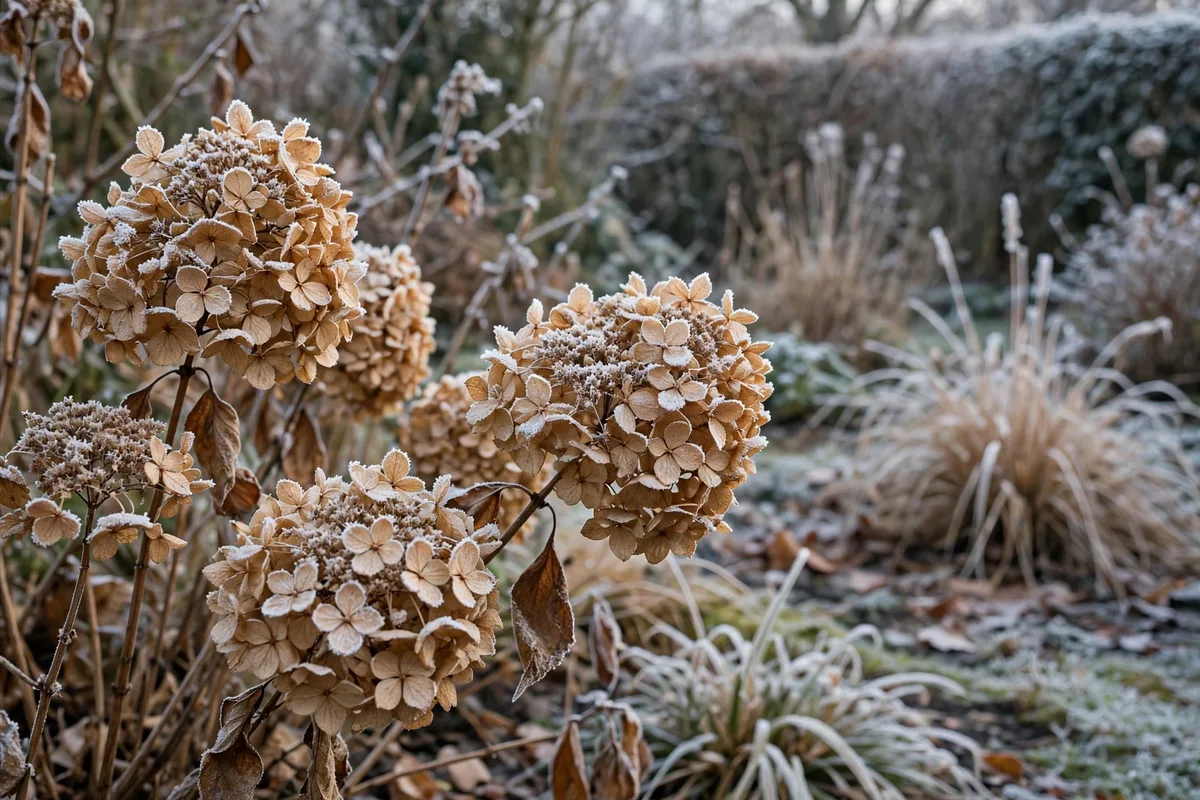
Bigleaf and oakleaf hydrangeas flower from buds formed the previous year, and the spent flower heads left on the plant are not untidiness — they are a thatch that shelters the buds beneath from the worst frosts. Our hydrangea pruning guide gives the full method, but the winter rule fits in one line: deadhead old-wood hydrangeas in spring, when the worst frosts have passed and you can see which buds are alive. Panicle and smooth hydrangeas are the exceptions — they flower on new wood and can be cut in late winter — which is exactly why identifying your type matters more than any calendar. When in doubt, wait: a hydrangea cut too late loses a few flowers; a hydrangea cut too early can lose the year.
Group 3 — The armour plants: old growth is the winter coat
A second group keeps its growth for protection, not flowers. Penstemons cut down in autumn or winter routinely die in the cold that follows — the old stems hold frost off the crown, and the cut is made in mid-spring when new shoots show at the base. Salvias and Russian sage follow the same rule: hollow, cut stems channel freezing rain straight into the crown. Lavender is never cut into old wood at all — it does not reliably regrow from bare old stems — and even its light trim waits for spring in cold districts; our Lavender page gives the shaping method that keeps it compact without killing it. Hardy fuchsias, caryopteris and buddleia join the list in cold zones: tidy them if you must, but the real cut is a spring job. The principle generalises — in a cold garden, any plant of borderline hardiness keeps its top growth until spring, because the growth is not the problem winter poses; it is the answer to it.
Group 4 — The seed heads: the border is a bird table
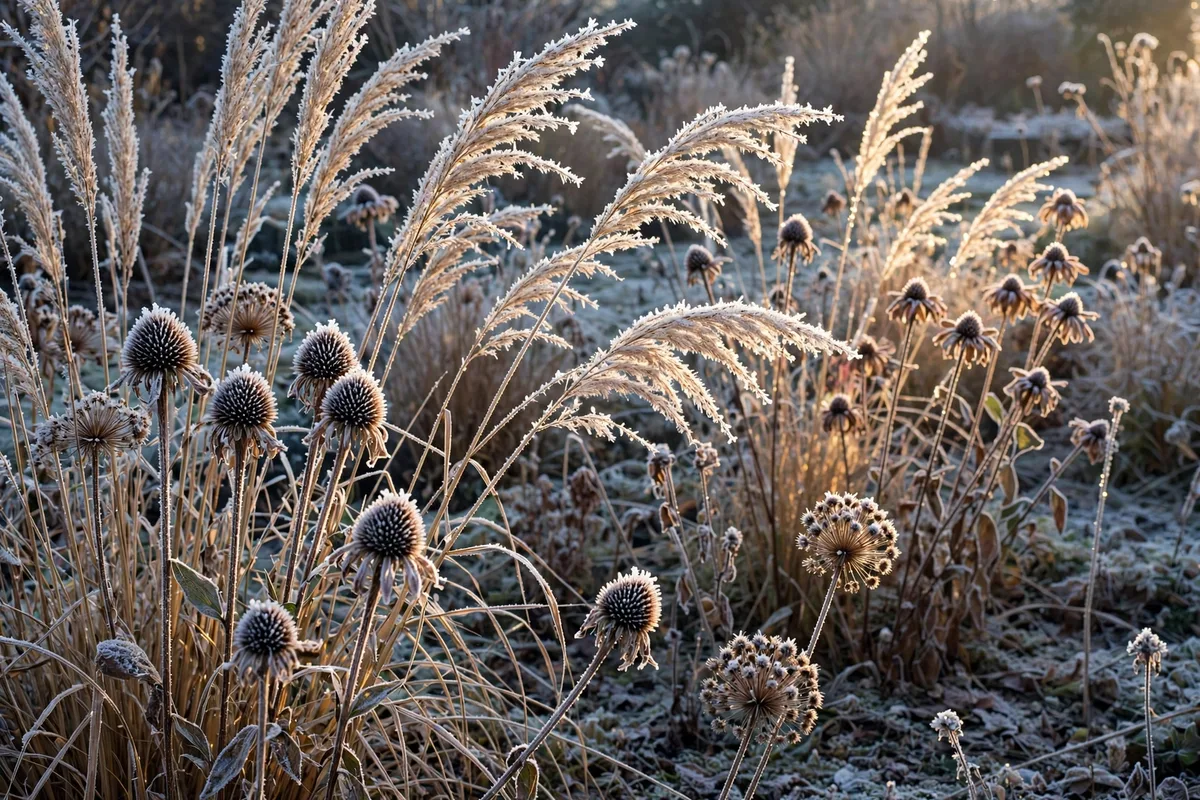
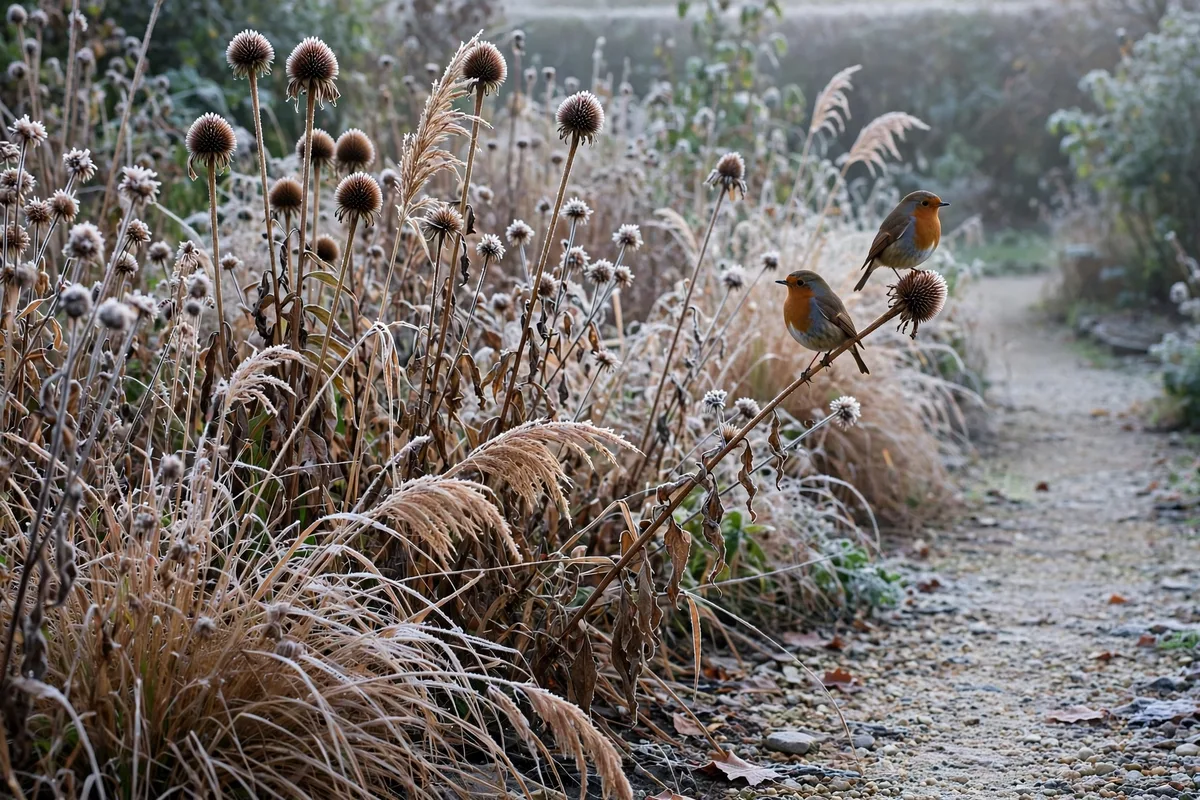
The fourth group should stand for the wildlife. Echinacea, rudbeckia, sedum and the ornamental grasses hold their seed heads into winter precisely when birds need them most — goldfinches work an echinacea head like a feeder — and their hollow stems are where solitary bees and other beneficial insects overwinter. University of Minnesota Extension's winter guidance makes the same case: leave seed heads standing for birds, leave stems for pollinator nesting, and let fallen leaves shelter the insects and amphibians that the spring garden will need. Our winter birds guidance lists what each plant feeds. The cut for this group comes in spring, and it comes with a condition: wait until temperatures are consistently mild and new growth is pushing, because the insects in those stems leave on their own schedule, not yours. Cut the stems into lengths and stack them in a corner rather than shredding them, and the shelter survives the tidy-up.
What you SHOULD cut in winter
The never-cut list is not an excuse to put the pruners away — winter has its own proper cutting list, and it matters. Dead, damaged and diseased wood comes out of anything, any time you find it, with tools disinfected between plants when disease is the reason. Apple and pear trees get their main structural prune in the dormant season — the full method is our winter fruit-tree pruning guide. Grapevines must be cut before the sap rises in late winter or they bleed. Summer-flowering shrubs that bloom on new wood — panicle hydrangea, buddleia in mild zones, roses in late winter as buds swell — take their cut at winter's end. And winter is the season for hardwood cuttings: the prunings of currants, gooseberries and many shrubs are free plants, cut as a by-product of the jobs you should be doing. The winter rule, whole: cut for structure, disease and propagation — never for tidiness.
When each group gets cut instead: the timing table
| Group | Examples | Cut instead |
|---|---|---|
| Spring bloomers (old wood) | Forsythia, lilac, azalea, weigela, spirea | Immediately after flowering |
| Old-wood hydrangeas | Bigleaf, oakleaf | Spring, after worst frosts, to live buds |
| Armour perennials | Penstemon, salvia, Russian sage, fuchsia | Mid-spring, when base shoots show |
| Lavender | All lavenders | Spring trim; never into old wood |
| Seed heads & grasses | Echinacea, rudbeckia, sedum, miscanthus | Spring, when new growth pushes |
| New-wood shrubs | Panicle hydrangea, buddleia, roses | Late winter — the exception that proves it |
Put the spring cut-back dates in the Garden Planner when you plan the beds — the plants you spare in January are the ones the planner should remind you about in April, alongside the whole winter-to-spring sequence in Putting Your Garden to Bed run in reverse.
The borderline cases, honestly
Three plants sit on the border of the rule, and the honest answer for each is "it depends on your winter." Roses are cut in late winter in most climates — but that means the end of winter, as the buds swell, not the depths of it; a rose cut hard in a January cold snap loses wood to dieback and can lose the crown in a severe one, so cold-zone gardeners wait, and mild-zone gardeners may go a few weeks earlier. Buddleia flowers on new wood and takes a hard late-winter cut in mild districts, but in cold zones its stems are its own protection and the cut waits for spring — the same plant, two correct answers, separated by a hardiness zone. Ornamental grasses divide by type: the warm-season grasses (miscanthus, pennisetum) stand all winter and are cut in spring, full stop; the cool-season evergreen grasses (festuca, carex) are never cut to the ground at all, in any season — they are combed, not pruned, and a winter haircut can kill the crown outright. The pattern underneath all three is the guide's whole argument: the question is never "is it winter?" but "what is this growth doing for this plant, in this garden, this year?" Answer that, and the timing answers itself.
Keep going
Record which shrubs are old-wood bloomers in the Garden Planner — the note you write this winter is the spring flowers you keep next year.
Go deeper with When to Prune Hydrangeas for the type-by-type method, How to Prune Fruit Trees in Winter for the cuts winter is actually for,.
Sources
The leave-it-standing guidance follows University of Minnesota Extension — Winter garden cleanup: it's complicated (leave seed heads for birds, stems for pollinator nesting, leaves for overwintering insects; tidy in spring once temperatures are consistently warm) and the winter-jobs framing in Countryfile — Jobs for the Garden This Winter (January pruning applies to apples; other plants' cuts are season-specific).
Questions people ask
What plants should not be cut back in winter?
Spring-flowering shrubs (forsythia, lilac, azalea, weigela, spring spirea, mock orange) because they flower on last year's wood; bigleaf and oakleaf hydrangeas, whose old heads shelter the flower buds; penstemons, salvias, Russian sage and lavender, whose old growth is frost armour; and echinacea, rudbeckia, sedum and ornamental grasses, whose seed heads feed birds and whose stems shelter insects.
Why shouldn't I cut back forsythia and lilac in winter?
Because next spring's flowers are already formed as buds on the stems you would remove. Winter pruning of old-wood bloomers removes the entire flower display. Prune them immediately after flowering instead, removing the oldest third of stems at the base.
Can I deadhead hydrangeas in winter?
Not the old-wood types (bigleaf and oakleaf). Their spent heads insulate the flower buds beneath through the coldest weeks. Deadhead in spring, after the worst frosts, cutting back to the first pair of strong live buds. Panicle and smooth hydrangeas flower on new wood and are the exceptions.
When should I cut back penstemons and salvias?
In mid-spring, when new shoots are visible at the base. Cut down in winter, the hollow stems channel freezing rain into the crown and the plant often dies — the old growth is its frost protection, not untidiness.
What should I prune in winter, then?
Dead, damaged and diseased wood on anything; apple and pear trees (their main structural prune); grapevines before the sap rises; and new-wood shrubs like panicle hydrangea and roses at winter's end. Winter cutting is for structure, health and hardwood cuttings — never for tidiness.
Do birds really need the seed heads left standing?
Yes — echinacea, rudbeckia and grass seed heads are a standing food source through the hungriest months, and goldfinches in particular work them like feeders. The hollow stems also shelter overwintering solitary bees. Extension guidance is to leave them until spring temperatures are consistently warm.
Comments & ratings
No comments yet.
Be the first to share your experience.