
Guides · Water & irrigation · Published November 22, 2026 · By Faizan Ahmad
How Far Apart to Space Sprinkler Heads? The Head-to-Head Rule
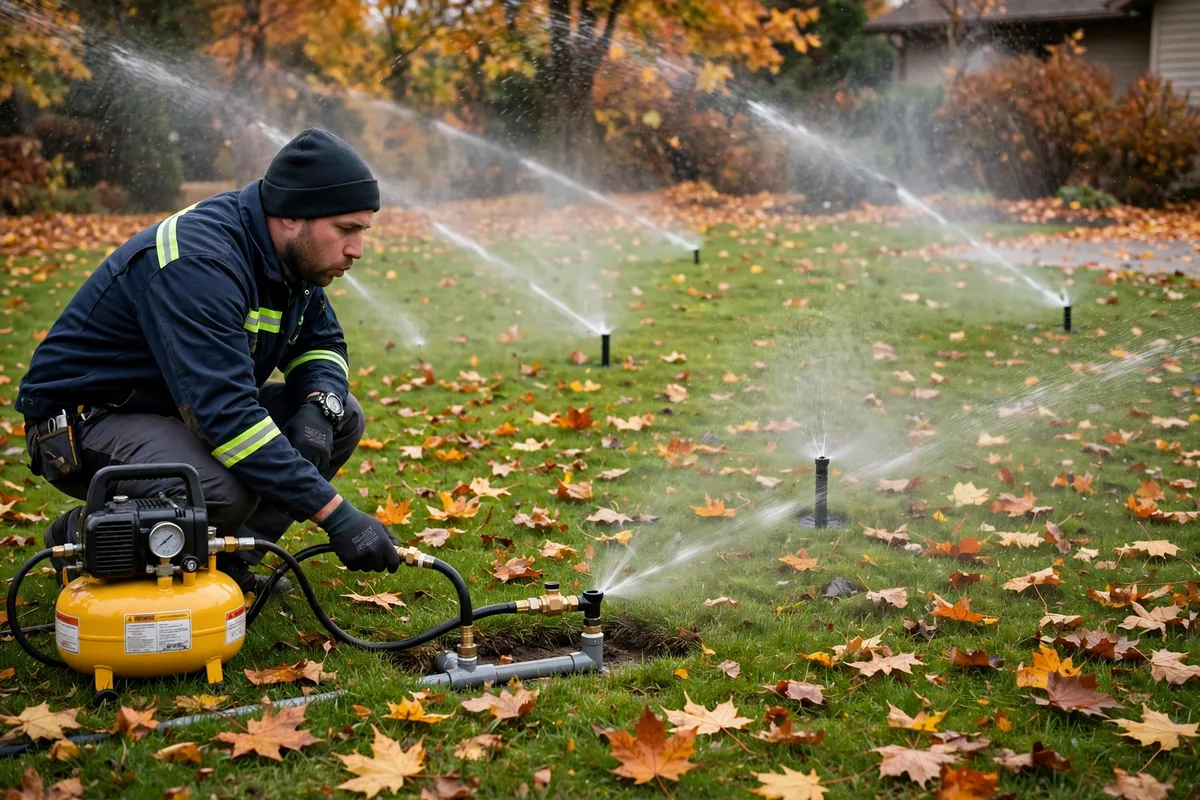
Space sprinkler heads one throw radius apart — close enough that each head’s spray lands on the next head — because a sprinkler’s own circle is driest at its edge, and only overlap fills the rings in. Our Sprinkler Coverage Calculator counts heads and spacings for square and triangular layouts. This guide explains the rule, the patterns, and the boundary mistakes that leave corners thirsty.
The short answer, on one card
- Spacing = radius, never diameter: a 15 ft head belongs 15 ft from its neighbour
- Diameter spacing is the classic error: it guarantees dry rings by midsummer
- Triangular beats square on evenness: rows at radius × 0.866, offset by half a spacing
- Use your real radius: the throw at your pressure, measured in your yard — not the box maximum
- Corners and edges first: boundary heads are the ones whose absence shows
On this page
Step 1 — Why a sprinkler’s edge is its driest ground
A sprinkler does not water its circle evenly. The application is heaviest in the inner ring and thins steadily outward — the edge of the throw is where the pattern is weakest, and the ground right at the head often gets less than the middle distance too. Design with one head per circle and the map of your lawn becomes a set of overlapping discs of adequacy separated by rings of drought, which announce themselves in July in perfect, damning geometry.
Head-to-head spacing is the industry’s answer: place each head exactly where its neighbour’s throw lands — one radius away — so the weak edge of every pattern is covered by the strong middle of two others. The overlaps sum to something close to uniform. It uses more heads than intuition suggests, and it is non-negotiable physics rather than salesmanship: the dry-ring lawns in every neighbourhood are the ones spaced by diameter to save four heads.
Step 2 — Square vs triangular, counted
For a 60 × 40 ft lawn with heads that truly throw 15 ft. Both patterns obey head-to-head; they differ in row spacing and evenness. The calculator runs both for your dimensions and radius.
| Pattern | Head spacing | Row spacing | Heads for 60 × 40 ft | Character |
|---|---|---|---|---|
| Square | 15 ft | 15 ft | 20 (5 × 4) | Simplest to lay out, stake and repair |
| Triangular | 15 ft | 13 ft (15 × 0.866) | 25 on the grid (5 × 5), offset rows | Most even coverage — the professional default |
| By diameter (the error) | 30 ft | 30 ft | About 6 | Dry rings guaranteed; the saving is repaid in reseeding |
Counts include corner and edge heads — omitting them is its own classic error. Your figures go into the Sprinkler Coverage Calculator — counts and spacings for your area. Once heads are counted, the Sprinkler Calculator converts the zone into a precipitation rate and honest run times.
Step 3 — Your real radius is the one in your yard
The radius on the box is measured at the rated pressure with the rated flow in still air. Your yard offers the pressure left after a long pipe run, a filter, and an elevation change, plus whatever breeze the morning brings. A head rated 15 ft may honestly throw 11 in situ — and a layout drawn for 15 will dry-ring just as faithfully as one spaced by diameter.
Measure before you trench: run one head on a calm morning and tape from the head to where its water actually lands, at several points around the arc. Design to the shortest honest reading. If the shortfall is large, the fix is upstream — pipe size, pressure, or nozzle choice — and it is far cheaper diagnosed with a tape measure than after the trench is backfilled.
Step 4 — Edges, corners and curves
Uniformity is won or lost at the boundary. Every corner needs its own head throwing into it — corners served "from the middle of the lawn" are the first dry ground of summer — and edges need part-circle heads whose arcs stop at the boundary rather than watering the driveway. The grid discipline stays the same; only the boundary heads change their arcs to match the shape they serve.
Curved and irregular areas break into near-rectangles, each laid out on the same spacing, with the overlaps between blocks accepted as the price of evenness. What never changes is the rule itself: whatever the shape, wherever two heads neighbour, their distance is a radius. Keep that one law and the lawn forgives almost every other improvisation.
Questions people ask
Why do installers insist on so many heads?
Because uniformity is overlap, and overlap is heads. Each head must be reached by its neighbours’ throws, which fixes spacing at the radius and the count by geometry. Fewer heads at wider spacing does not water the same lawn more cheaply; it waters a smaller effective lawn with dry rings in between.
Can I mix head types in one zone if the spacing is right?
No — spacing governs coverage, but run time governs depth, and sprays apply water roughly three to five times faster than rotors. On one zone, one type floods while the other thirsts regardless of spacing. Zone by head type; space by radius.
What about the strip along the house and the driveway?
Boundaries take part-circle and strip-pattern heads placed on the edge itself, throwing inward. A full-circle head pulled back from the edge leaves the classic dry strip along every wall and walk — the most visible dry ground a lawn can have, and purely a boundary-head omission.
My existing system has dry rings — must I re-trench everything?
Not always. Sometimes the heads are right and the nozzles were swapped for shorter-throw ones at a repair, or pressure fell as zones were extended. Audit first: measure real throws, compare with spacing, and check the can-test spread. Adding one head to a zone with flow headroom is a small trench, not a rebuild.
Does triangular spacing really matter on a small lawn?
Less than on a large one — on a small rectangle the square grid’s thin diagonals are short and often rescued by boundary overlap. It costs nothing but layout care, though, and on any lawn over a few thousand square feet the evenness difference is visible by the second summer.
Sources
Key facts on this page cross-checked against Watering Established Lawns — Colorado State University Extension — extension guidance on lawn watering and system uniformity Drip Irrigation for Home Gardens — Colorado State University Extension — the extension companion for beds, where drip usually beats spray.
Related page
Read next: How Long Should I Run My Sprinklers? Your Precipitation Rate Decides
Comments & ratings
No comments yet.
Be the first to share your experience.