
Guides · Patios and paths · Published November 18, 2026 · By Faizan Ahmad
How Much Concrete Do I Need?
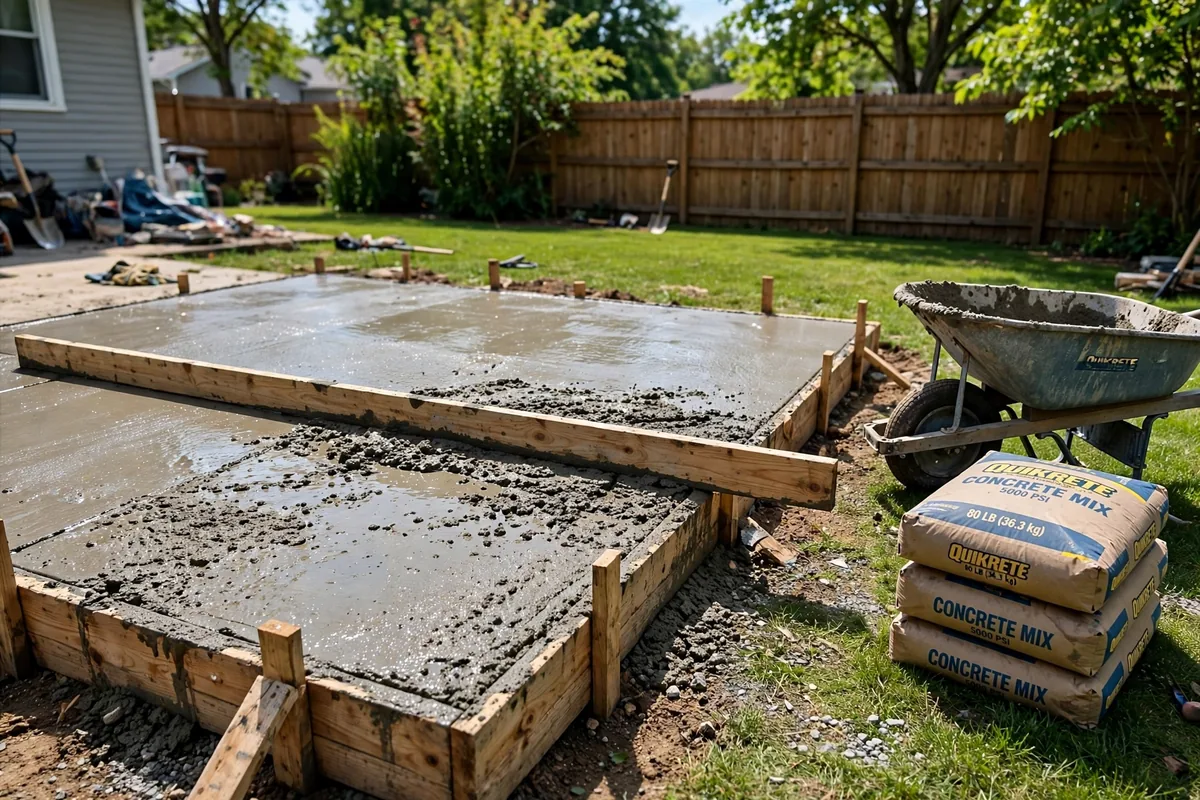
Concrete is the one yard material you cannot pause. Once mixing starts you have about 90 minutes to place and finish the pour, so running short is not an inconvenience — it is a weak seam across a half-finished slab and a rushed second batch that never quite matches. Running long is its own pain: dozens of heavy bags bought, hauled and returned. The fix is one volume calculation, and it is exactly what our Concrete Calculator — bags and cubic yards for any slab runs for you. This guide shows how the calculator works, the bag maths most guides never show, and the thickness trap that quietly inflates almost every home pour: a slab formed with 2x4 boards is not 4 inches thick at all. By the end you will be able to check any bag count — ours, a store's, a neighbour's — against your own numbers.
The short answer, on one card
- The formula: length × width × thickness = volume. The calculator adds 10% extra automatically for waste and uneven ground
- Bag yields: an 80 lb bag makes about 0.60 cu ft; a 60 lb bag makes about 0.45 cu ft — roughly 45 bags of 80 lb per cubic yard
- Thickness: 4 inches suits patios, walkways and shed bases; go 5–6 inches for driveways
- The 2x4 trap: a 2x4 measures 3.5 inches across, so a slab poured flush with 2x4 forms is 3.5 inches thick — entering 4 inches over-orders by about 14%
- Bags vs truck: past about 1 cubic yard, a ready-mix truck is usually cheaper and far less work than mixing bags
Step 1 — Measure the slab (length, width, and honest thickness)
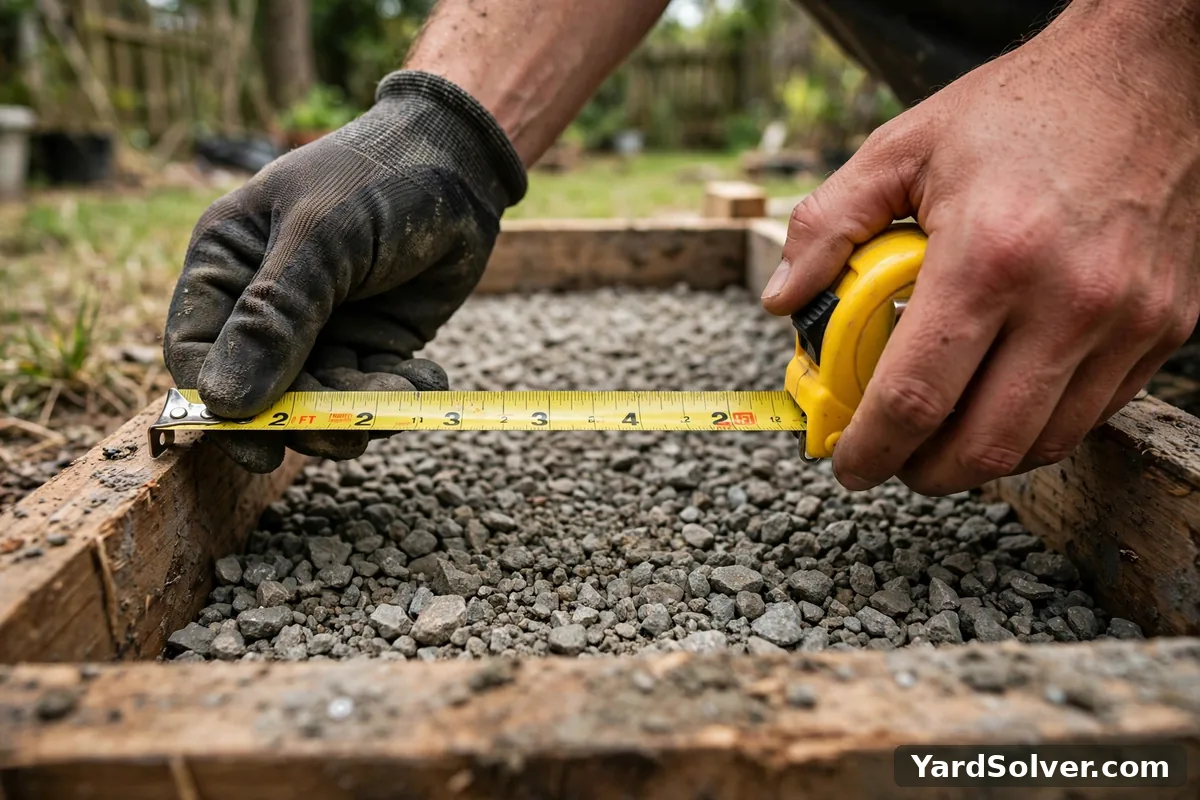
Measure inside the forms, not outside them: run a tape along the inside length and the inside width, in feet. If the slab is not a simple rectangle, split it into rectangles, measure each one, and add the volumes later — the same add-first habit that saves bags on every multi-part pour. If you are still at the string-and-stakes stage, How to Measure Your Yard's Square Footage walks through getting an honest area from an awkward plot. Then the measurement everyone gets wrong: thickness. Decide it from the job — 4 inches for patios, walkways and shed bases, 5 to 6 inches for a driveway that will carry cars — and then check what your forms will actually give you. A 2x4 on edge, the board almost everyone forms a patio with, measures 3.5 inches across, not 4. Pour flush with the top of those forms and your slab is 3.5 inches thick, full stop. That is a perfectly good patio thickness — but only if you enter 3.5 in the calculator. Enter 4 for a 3.5-inch form and you over-order by about 14%, which on a mid-size patio is eight or nine bags you mixed for nothing. Want a true 4 inches with 2x4 forms? Dig half an inch below the bottom of the forms before you set and level them, so the form top sits 4 inches above the base. Measure the base honestly too: a base that dips an inch in the middle is an inch of extra concrete across that whole dip, and that is exactly what the calculator's 10% allowance is there to absorb.
Step 2 — Run the calculator: what each input does
Open the Concrete Calculator and work down its inputs. Length and width are the inside-form measurements from Step 1, in feet. Thickness is the honest number from Step 1 — 4 inches for a patio, walkway or shed base, 5 to 6 inches for a driveway, and 3.5 inches if your 2x4 forms sit on top of the base rather than over a dug-down edge. That is the whole input list, and that is deliberate: concrete volume has only three dimensions. Behind the scenes the calculator multiplies the three together, adds 10% for waste, spillage and uneven ground, and then converts the result three ways at once: cubic feet (the raw volume), cubic yards (the unit a ready-mix truck sells in — divide cubic feet by 27), and bags, using the real yields — about 0.60 cubic feet from an 80 lb bag and 0.45 from a 60 lb bag — rounded up, because you cannot buy part of a bag and you cannot finish a pour with part of one either. Read all three answers before you decide anything: the bag count tells you the work, the yardage tells you whether a truck should be doing that work instead, and Step 6 turns that comparison into a decision.
Step 3 — The maths the calculator is doing
There is no hidden model here either — just volume, done carefully. Volume = length (ft) × width (ft) × thickness (ft), with the thickness converted from inches by dividing by 12, so a 4-inch slab uses 1/3 ft. Then the calculator adds 10% for waste and uneven ground. From the padded volume: ÷ 27 = cubic yards, ÷ 0.60 = 80 lb bags, ÷ 0.45 = 60 lb bags, each bag count rounded up. The yield numbers are worth memorising, because they let you audit any quote on the spot: an 80 lb bag really does make only about six-tenths of a cubic foot, which is why a cubic yard takes roughly 45 of them — a fact that surprises almost everyone the first time a "small" slab turns into a pallet. The table below is the same maths pre-run for the slab sizes people search for most, all at 4 inches with the 10% already included. Screenshot it before any store trip.
| Slab size | Concrete (with 10%) | 80 lb bags | Ready-mix order |
|---|---|---|---|
| 6 × 8 ft | 17.6 cu ft | 30 bags | 0.65 cu yd |
| 10 × 10 ft | 36.7 cu ft | 62 bags | 1.36 cu yd |
| 10 × 12 ft | 44.0 cu ft | 74 bags | 1.63 cu yd |
| 12 × 12 ft | 52.8 cu ft | 88 bags | 1.96 cu yd |
| 10 × 20 ft | 73.3 cu ft | 123 bags | 2.72 cu yd |
Check one row by hand so the table earns your trust: a 10 × 10 ft slab at 4 inches is 100 sq ft × 1/3 ft = 33.3 cubic feet; add 10% and you get 36.7; divide by 0.60 and you get 61.1, rounded up to 62 bags; divide 36.7 by 27 and you get 1.36 cubic yards. Every other row is the identical three steps. Notice, too, what the bag column is quietly telling you: even a modest 10 × 10 patio is 62 eighty-pound bags — over two tons of dry mix to lift, move, open and mix. That is not an argument against bags; it is the reason the bags-vs-truck line in Step 6 sits where it does.
Step 4 — Posts, steps and other shapes that are not flat slabs
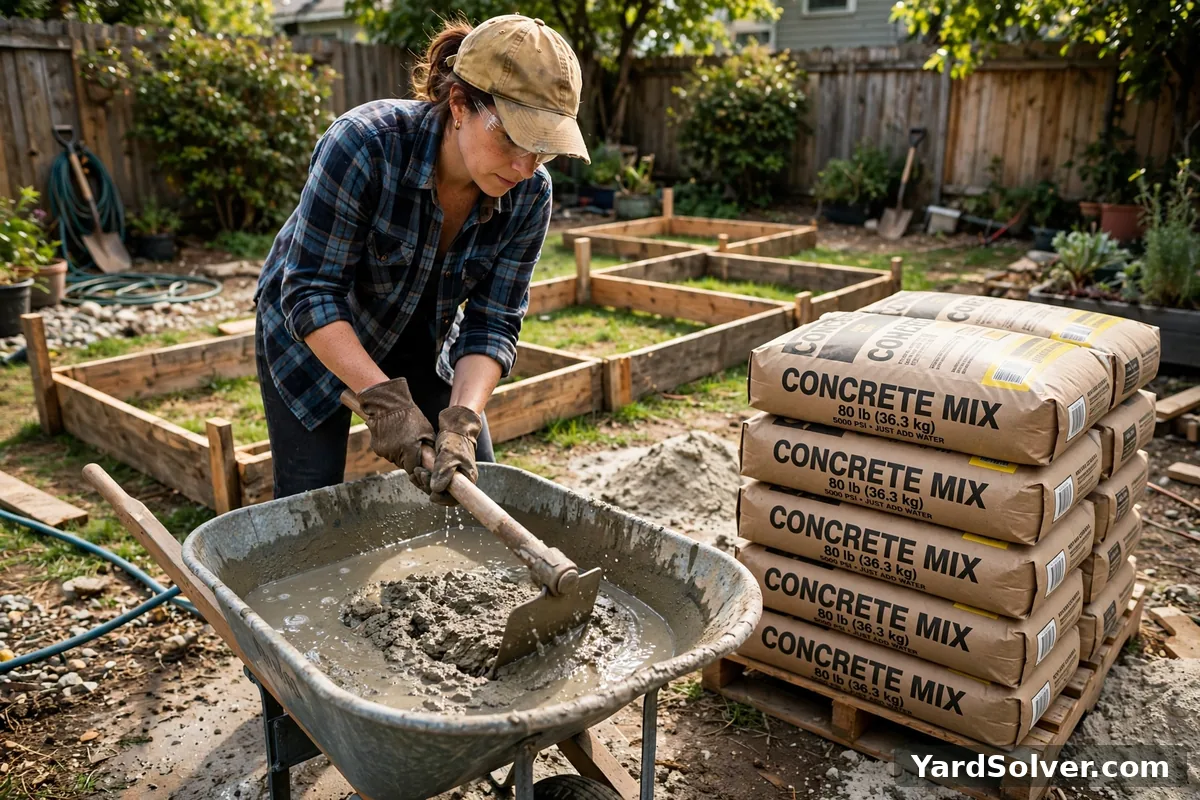
The calculator is built for slabs, but most yards also throw up smaller, stranger pours, and each one is still just volume. Fence and deck post holes: treat each hole as its own small slab stood on end — a hole 12 inches across and 30 inches deep holds roughly 2 cubic feet once the post itself displaces its share, so one 80 lb bag per hole is a fair planning figure for narrow holes, and two for wide ones; run the hole's depth as the "thickness" and its cross-section as the area if you want it exact. Steps: size each step as its own thin slab — tread depth × width × riser height — and add the steps together before converting to bags, so you round up once instead of once per step. A slab with a thicker edge: many shed bases and driveways pour a deeper rim for strength; calculate the flat middle at its thickness, then the rim as a long, narrow slab of its own, and add the two volumes. Slopes: use the average thickness — measure the shallow and deep edges and split the difference — and lean on the 10% allowance, which exists for exactly this kind of unevenness. And whatever the shape, remember the clock from the introduction: mixed concrete gives you roughly 90 minutes of working time, less on a hot, windy day. A shape you can mix in small batches is a shape bags handle well; a shape that must be poured in one continuous run is quietly arguing for the truck.
Step 5 — A 10×12 patio, worked start to finish
Here is the patio from the photo at the top, done exactly the way the calculator does it. The slab is 10 × 12 ft at 4 inches. Area first: 10 × 12 = 120 square feet. Thickness in feet: 4 inches = 1/3 ft. Volume: 120 × 1/3 = 40 cubic feet, which is 40 ÷ 27 = 1.48 cubic yards. Now the calculator's 10%: 40 × 1.10 = 44 cubic feet = 1.63 cubic yards — that padded figure is the one you buy against. In bags: 44 ÷ 0.60 = 73.3, rounded up to 74 bags of 80 lb; or 44 ÷ 0.45 = 97.8, rounded up to 98 bags of 60 lb. Hold those numbers for a second, because now the honesty test. Suppose those forms are 2x4s sitting on the base, so the true thickness is 3.5 inches, not 4. Redo it: 120 × (3.5 ÷ 12) = 35 cubic feet; add 10% and you get 38.5 cubic feet; 38.5 ÷ 0.60 = 64.2, rounded up to 65 bags of 80 lb. The thickness honesty alone is worth 9 bags — 720 lb you do not have to buy, haul, mix or return. Neither answer is "wrong": if you dug half an inch below the forms, 74 bags is the true 4-inch order; if you did not, 65 bags pours the slab you actually built. What is wrong is paying for one slab and pouring the other.
Step 6 — Bags or ready-mix? The one-yard rule
The calculator states its own rule plainly, and experience backs it: past about 1 cubic yard, a ready-mix truck is usually cheaper and far less work. The maths behind the rule is the yield table from Step 3 — one cubic yard is roughly 45 bags of 80 lb, and every bag must be lifted onto a tailgate, carried, slit, poured, mixed with the right water, and emptied, all inside that 90-minute working window once you start placing. At the 10 × 12 patio's 1.63 cubic yards, bags mean 74 lifts of 80 lb — close to three tons handled by hand, twice. A truck backs up, pours the same volume in minutes, and leaves you all of your energy for the part that decides how the slab looks: screeding, floating and finishing. Below the line, bags win just as clearly: a 6 × 8 ft pad at 0.65 cubic yards is 30 bags and a steady morning's mixing, with no delivery fee, no minimum-order or short-load surcharge, and no truck schedule to pour against. Two honest caveats either way. Ready-mix pricing varies a lot by region and by how far the plant is from you, so get the delivered quote for your exact yardage before deciding — the one-yard rule is a starting point, not a quote. And if you do mix bags for anything near a yard, rent or borrow a mixer: wheelbarrow-and-hoe mixing, like the photo in Step 4, is honest work for five bags and a punishing way to make fifty.
What the calculator can't do
Honesty about the edges, so the number earns your trust. The calculator assumes a flat slab of even thickness on a level base: a dipping or sloping base changes the true volume, and the 10% allowance absorbs normal unevenness, not a base that was never levelled. It cannot know your forms — the 3.5-inch 2x4 question in Step 1 is yours to answer, and it swings the answer more than any rounding does. It cannot judge the pour itself: reinforcement, control joints, drainage slope away from the house, and curing are real decisions this guide deliberately leaves to your slab plan, and none of them change the volume. Its bag counts assume the standard yields printed above; a specialty or high-strength mix can yield slightly differently, so check the bag's own coverage line if you switch products. And it cannot price your job — bag prices and delivered ready-mix quotes move by store, season and distance. What it does guarantee is the volume maths, checked in full in Steps 3 and 5: get the length, the width and the honest thickness right, and the bags and yards follow.
Building the patio in pavers instead of poured concrete? The base still has to be right first — Paver Patio Base: Depth, Gravel and Sand Explained covers the layers under the surface, and the Paver Calculator — pavers, sand and gravel by patio size sizes the materials themselves. Either way, put the pour or the laying day in the Garden Planner with a dry forecast — concrete and a rainstorm keep very poor company.
Keep going
Run your own slab through the Concrete Calculator — bags and cubic yards for any slab, then get the groundwork right with Paver Patio Base: Depth, Gravel and Sand Explained and double-check your measurements with How to Measure Your Yard's Square Footage.
Planning the whole project, not just the pour? The Garden Planner lays out digging, forming, pouring and planting in one calendar.
Questions people ask
How many bags of concrete do I need for a 10x12 slab?
At 4 inches thick, a 10x12 slab is 120 square feet x 1/3 ft = 40 cubic feet. With the calculator's 10% allowance that is 44 cubic feet — 74 bags of 80 lb (44 / 0.60) or 98 bags of 60 lb (44 / 0.45), which is 1.63 cubic yards. That is past the one-yard line, so a ready-mix truck is usually the better buy.
Why does the calculator add 10% automatically — can I turn it off?
The 10% is built in because ground is never perfectly level, forms bow a little, and some concrete is always lost to spillage and the wheelbarrow — and running short mid-pour is the worst outcome, because a cold joint weakens the slab. You cannot turn it off in the calculator; for a perfectly formed, level base, use the pre-10% raw volume figure and divide that by the bag yield instead.
60 lb or 80 lb bags — which should I buy?
It is the same concrete either way. An 80 lb bag yields about 0.60 cubic feet and usually costs less per cubic foot, so it is the cheaper route if you can lift it all day. A 60 lb bag yields about 0.45 cubic feet and is kinder to lift, carry and mix for hours — many people choose it for a long solo pour even though they need more bags.
My forms are 2x4s, so is my slab 4 inches?
No. A 2x4 measures 3.5 inches across, not 4, so a slab poured flush with the top of 2x4 forms is 3.5 inches thick. Enter 3.5 inches in the calculator for the honest bag count, or dig half an inch below the bottom of the forms before you set them if you need a true 4-inch slab.
How much concrete for an 8x10 shed base?
At 4 inches thick, an 8x10 shed base is 80 square feet x 1/3 ft = 26.7 cubic feet. With the 10% allowance that is 29.3 cubic feet — 49 bags of 80 lb, or 1.09 cubic yards. That sits right at the bags-vs-truck line, so compare the bag total against a short-load ready-mix price before you decide.
Concrete is ordered by volume — length times width times depth, plus a waste margin
Every concrete job, from a fence-post footing to a shed slab, reduces to the same arithmetic: the volume of the shape you are filling, worked out in cubic metres or yards, plus a margin for spillage, uneven ground and the extra depth you discover when the excavation is actually dug. Ground is never as level as the tape suggested, and a slab dug a centimetre deep over its whole area quietly eats a noticeable share of the order.
Decide bagged versus ready-mix by that volume: small footings and repairs suit bags mixed on site, while anything approaching a cubic metre rewards a delivered load — but a truck will not wait while you reconsider, so forms, help and tools must be ready before it arrives. Order about ten percent over the neat calculation, state depths honestly (a slab's strength lives in its thickness, not its surface), and never thin a mix with extra water to stretch it: the volume you save is paid back in strength.
Sources
Key facts on this page cross-checked against Concrete — Wikipedia — background on concrete, its composition and its use and Ready-mix concrete — Wikipedia — background on ready-mix concrete and delivery.
Related page
Read next: How Many Concrete Blocks Do I Need? The 1.125 Rule, Plus Mortar — How the Calculator Works.
Comments & ratings
No comments yet.
Be the first to share your experience.