
Guides · Indoor gardening · Published November 20, 2026 · By Faizan Ahmad
How to Build a Terrarium: Closed and Open Jars That Actually Last
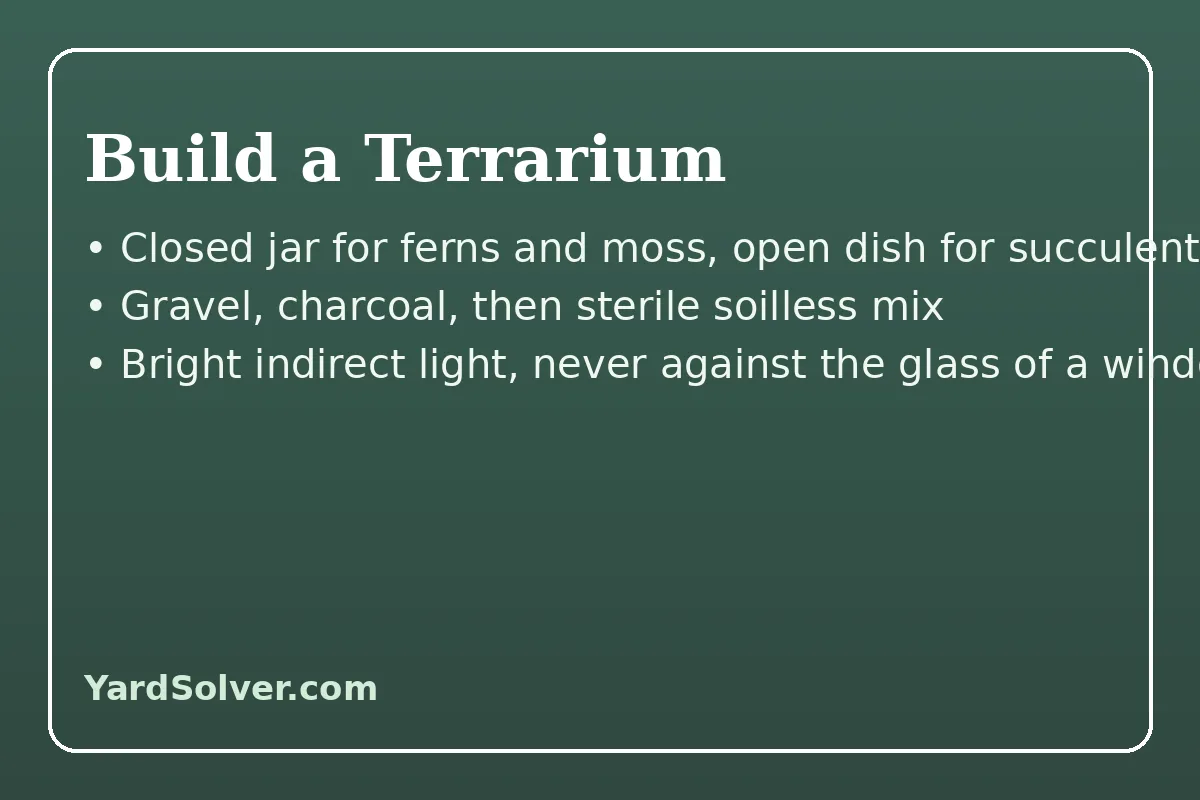
To build a terrarium, decide closed or open before you buy a single plant — a lidded jar for humidity-loving ferns, mosses and tropical miniatures, an open dish for succulents and cacti — then wash a clear glass container, layer washed gravel and a thin layer of horticultural charcoal under sterile soilless mix deep enough for the largest root ball, plant small, slow-growing plants with matching light and water needs, water sparingly, and set the finished jar in bright indirect light where sun through glass can never cook it. The terrarium is the winter garden in its most concentrated form: a whole landscape, weather included, inside a jar on a table. Mississippi State University Extension's design guide frames the appeal exactly — a closed terrarium, once its little ecosystem establishes, is surprisingly easy to maintain, recycling its own moisture in a private rain cycle. But the same sealed kindness kills the wrong plants in weeks, which is why every extension source begins at the same place: the lid decision. This guide follows that order: closed versus open and the plants each allows, the container, the layers and what each one honestly does, the planting, the light and watering discipline, and the maintenance rhythm that carries a jar through its expected one-to-two-year display life — a perfect December project, built from the same shelf of small tropical plants as the low-light indoor plants, and a living gift that beats another poinsettia.
The short answer, on one card
Closed terrarium: a jar with a lid or narrow mouth; humid inside; for small ferns, mosses, nerve plant, creeping fig, peperomia and other tropical miniatures. Open terrarium: a wide bowl without a lid; drier, airier; for succulents, cacti and air plants. Container: clear, untinted glass or plastic, washed in hot soapy water. Layers, bottom to top: washed gravel about 1–4 cm (½–1½ in), a thin layer of horticultural charcoal (closed jars especially), a mesh or fabric screen if you use one, then sterile soilless mix to about one-fifth of the container. Planting: the smallest plants available, all sharing the same light and moisture needs, set with room to spare. Site: bright indirect light, east exposure ideal; never hard against a sunny window. Water: lightly at planting, then by the condensation gauge — heavy misting inside means vent the lid for an hour.
Closed or open: the decision that decides everything
| Closed terrarium | Open terrarium | |
|---|---|---|
| Container | Lidded jar, narrow-mouthed bottle, cloche | Wide bowl, open dish, geometric frame with gaps |
| Air inside | Humid; water condenses and rains back | Room-dry; moisture escapes freely |
| Plants that belong | Small ferns, mosses, nerve plant (fittonia), creeping fig, peperomia, pilea, selaginella | Succulents, cacti, haworthia, echeveria, jade, air plants |
| Plants that fail | Succulents and cacti — they rot in the humidity | Mosses and humidity-loving ferns — they crisp |
| Watering | Rare and light once established | Small drinks when the mix dries, like a pot with no drain |
| Main risk | Too much water and too little air | Too much water, full stop — there is no drainage hole |
Mississippi State Extension divides terrariums by container into exactly these two systems, and Penn State Extension's closed-terrarium guidance is blunt about the boundary: succulents and cacti do not make good closed terrarium plants. The reason is atmospheric, not personal. A lidded jar runs a rain cycle — water evaporates from mix and leaves, condenses on the glass, and returns to the soil — holding the air near saturation day and night. Woodland and tropical understory plants evolved in that air and idle happily in it. Desert plants evolved to dry out completely between rare drinks, and in saturated air their tissues simply rot, usually within the first month, while the jar's owner waters less and less in confusion. The quotable fact of this guide belongs to this decision: a terrarium does not fail at the watering can — it fails at the plant shelf, in the minute a succulent is planted under a lid. Choose the system first, then shop strictly inside it, choosing — as the University of Vermont's rule, repeated across extension guides, puts it — plants that are naturally small or slow-growing and that share the same light and moisture requirements. One vigorous plant among miniatures is a takeover scheduled for spring.
The layers: what each one honestly does
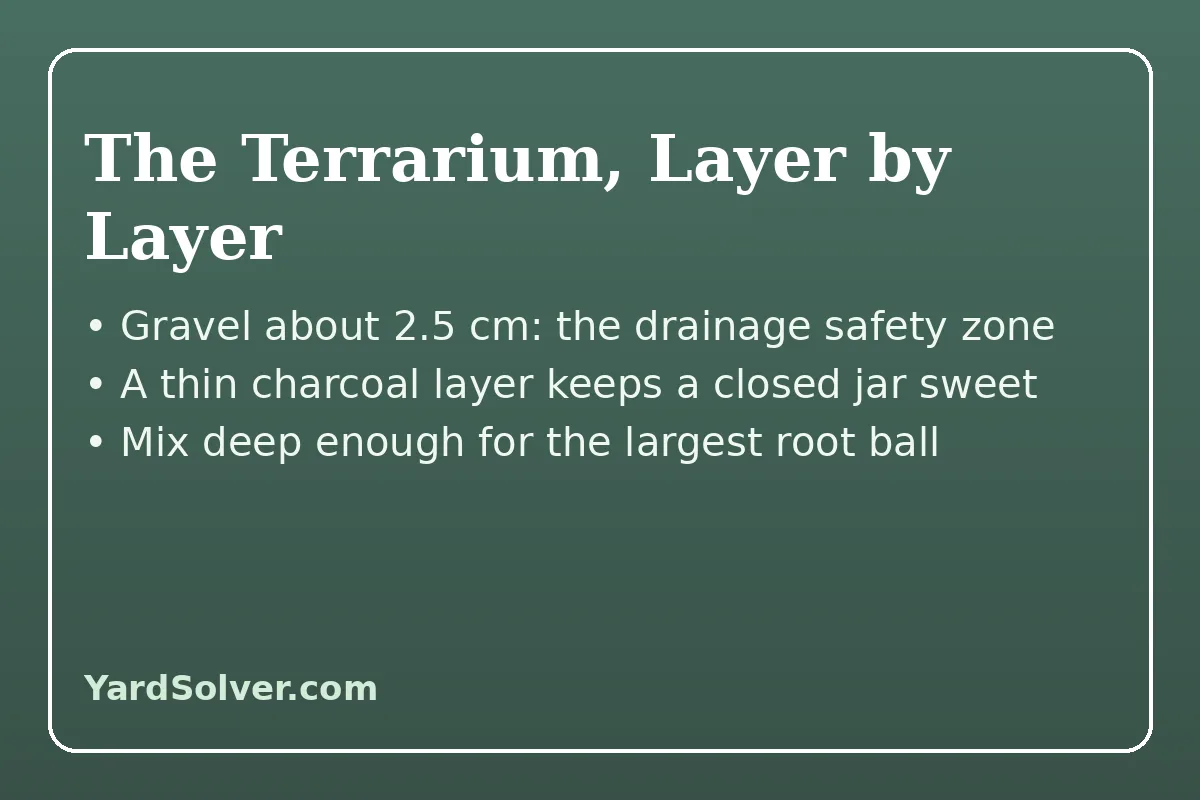
Every terrarium is built in the same strata, and UF/IFAS Extension's building guide gives the proportions that scale to any jar. The container comes first: any clear glass or plastic vessel — fish bowl, canning jar, apothecary jar, cookie jar — washed before use in hot soapy water or a diluted bleach solution and rinsed thoroughly, because, as Penn State warns, the warm enclosed humidity is a perfect breeding ground for any pest or pathogen carried in. Cloudy or tinted glass is disqualified on sight: Mississippi State notes it restricts the light the whole system runs on. Then the layers. Gravel: pea-size washed gravel lining the bottom and about one-fifth of the way up the walls in a large vessel — UF/IFAS gives 1–4 cm (½–1½ in) as the working range — forming the reservoir where excess water can sit below the roots instead of among them. Charcoal: a thin layer of horticultural charcoal over the gravel — about 6 mm (¼ in) in the UF/IFAS closed-jar method — whose job is sweetness: it adsorbs the compounds that make a sealed jar smell sour. A separator of synthetic fabric, screen or nylon mesh over the drainage layer keeps the mix from silting down into the gravel and destroying its function. Mix: sterile soilless potting mix — never garden soil, which is too heavy, compacts, and imports fungi — to about one-fifth of the container, or as Penn State phrases it, deep enough to equal the largest root ball; Penn State's method also mixes a handful or two of charcoal through the soil itself. One modern honesty note belongs here, and Penn State raises it: the gravel layer was long taught as drainage, but in a sealed jar nothing drains away — the layer is a safety reservoir that keeps roots out of standing water, which is a reason to water sparingly, not a licence to pour.
Planting day: small plants, clean hands, light water
The build itself is an hour's pleasant work, and the extension sequences agree on its order. Water the plants in their nursery pots a few hours or the day before, so their root balls are moist and cohesive. Set the layers as above, sculpting the mix into a gentle slope or valley with a spoon — higher at the back for a jar viewed from one side, the tallest plant at the centre of a jar viewed from all around, per the UF/IFAS layout rule. Work with clean hands or gloves, and with long tweezers, a chopstick and a narrow funnel as your tools in a small-mouthed jar; Penn State's hygiene warning applies to the builder as much as the container, because everything sealed in on planting day lives there for the jar's life. Tease each plant from its pot, shake the old mix from its roots, set it into a hole sized to its root ball, and firm the mix around it with the chopstick. Brush stray soil off the glass with a dry soft paintbrush — the UF/IFAS finishing touch — and add any stones, shells or miniatures last. Then water lightly, with a mister or a spooned trickle at each plant's base: UF/IFAS is emphatic that overwatering at this step saturates the mix and kills roots, and in a closed jar the error cannot evaporate away. The soil should end just damp, not wet. Set the lid on a closed jar and put the whole thing in its site, and resist — this is the hard part — doing anything else to it for a fortnight.
Light, the condensation gauge and the year's rhythm
A terrarium's site is chosen once and matters daily. Mississippi State's guidance: bright indirect light, an eastern exposure with morning sun ideal, a western one acceptable if afternoon heat is avoided — and keep the jar away from close against a window, because solar energy builds heat inside glass fast enough to burn plants. Direct sun through a lidded jar is a cooker; the same shelf logic as the Norfolk Island pine applies — bright room, no sunbeam. Once sited, a closed terrarium is read, not scheduled. Fine misting on the glass in the morning that clears by midday is the system breathing correctly. Mississippi State's rule for the other state: when heavy condensation forms on the walls or lid, open the lid for about an hour to let the excess evaporate — the jar is telling you it holds more water than its cycle needs, and venting, not patience, is the answer. A jar that never condenses at all is too dry and wants a spoonful of water at the base of each plant. The growth goal is slowness itself: extension guidance notes that terrarium culture aims to encourage slow growth, which is why feeding is essentially never done — a fed terrarium plant is a plant outgrowing its jar. Maintenance across the year is minutes a month: pinch or snip any shoot touching the glass, remove a yellowing leaf the day it appears (sealed humidity turns one dead leaf into a mould colony), wipe the outside glass, and rotate the jar a quarter-turn weekly so growth stays even. Set expectations honestly, as Mississippi State does: a terrarium's display life is typically one to two years before plants outgrow it or the balance tires, at which point the jar is opened, the plants are potted on to a second life, and the glass is washed for a new landscape — which most builders, by then, are quietly eager to plant.
Three builds to copy: a woodland jar, a desert dish, a bottle garden
The closed woodland jar is the classic first build, and Mississippi State's own project materials are its recipe: a two-gallon glass jar, a small nerve plant for colour at ground level, a miniature Boston fern for soft height, a baby parlour palm (Neanthe bella) as the single taller accent, sheet moss pressed over the mix between them, and the standard layers beneath — gravel, charcoal, mix — with finely chopped bark as a mulch detail. Water it in lightly, lid it, and expect the first fortnight to need two or three ventings while the moisture balance settles; after that, the jar should mist lightly in the mornings and clear by noon. The open desert dish inverts every choice: a wide, shallow glass bowl, no lid, a grittier mix cut with extra coarse sand or fine gravel, and three to five small succulents — an echeveria rosette, a haworthia, a small jade — planted with bare space between them, because succulents in a dish are sculpture first and planting second. The gravel layer still goes in as a reservoir, the charcoal is optional in open air, and watering is a measured few spoonfuls at each plant's base when the mix has dried completely, which in winter may be monthly. Put it in the brightest spot you own; open succulent dishes fail from dim rooms far more often than from thirst. The bottle garden is the connoisseur's version of the woodland jar: a large bottle with a mouth too narrow for a hand, planted entirely with tweezers, a funnel and patience — a creeping fig, a selaginella carpet, one small fern — and then essentially sealed. It is the slowest build and the most self-sufficient, sometimes going a year between waterings, and it teaches the terrarium's central lesson better than any other format: the less a sealed system is opened, fed and fussed over, the longer it runs. Choose by temperament — the jar for the gardener, the dish for the designer, the bottle for the philosopher — and by the plants you already own, since a terrarium built from the spare shelf costs almost nothing and starts its life already acclimatised to your house.
Keep going
Stock the jar from Best Low-Light Indoor Plants, keep the room's other plants thriving with How to Increase Humidity for Houseplants, and grow the windowsill beside it with Grow Herbs Indoors in Winter.
Sources
The system framework — open versus closed systems defined by container, clear untinted glass required, bright indirect light with an eastern exposure ideal and a warning against placing a terrarium close to a window where solar heat builds, horticultural charcoal of about quarter-inch chips, washed gravel and sterile soilless mix only, venting the lid for about an hour when condensation forms, slow growth as the culture goal, and a typical display life of one to two years — follows Mississippi State University Extension, How to Design a Closed-System Terrarium. The hygiene and planting method — wash the container with soap and hot water and wait days after any glass cleaner before planting, mix a handful or two of charcoal into a low-fertility soilless mix, soil depth equal to the largest root ball, succulents and cacti excluded from closed terrariums, and small slow-growing plants with matched needs — follows Penn State Extension, Creating a Closed Terrarium. The layer dimensions — gravel from half an inch to an inch and a half lining about one-fifth of the container, a quarter to half inch of charcoal above it, a synthetic fabric separator, and sterilised potting soil to about one-fifth of the container, with sparing watering — follow UF/IFAS Extension, Plants and Youth: Designing and Building a Terrarium (ENH121/MG356).
Questions people ask
What is the difference between a closed and an open terrarium?
The lid. A closed terrarium recycles its own moisture and stays humid inside, suiting ferns, mosses and tropical miniatures. An open terrarium loses moisture to the room and stays dry, suiting succulents, cacti and air plants. The plants are not interchangeable: succulents rot under a lid, and mosses crisp in an open bowl.
What layers go in a terrarium, in order?
Bottom to top: washed gravel (about 1-4 cm, a reservoir for excess water), a thin layer of horticultural charcoal to keep a closed jar sweet, an optional mesh or fabric separator, then sterile soilless potting mix deep enough for the largest root ball — roughly one-fifth of the container. Never use garden soil.
How often do you water a closed terrarium?
Rarely, once it is established — the jar recycles its water. Read the glass instead of a schedule: light morning condensation that clears is correct; heavy, constant condensation means vent the lid for about an hour; no condensation at all plus dry mix means add a spoonful of water at each plant's base.
Why is my terrarium mouldy or sour-smelling?
Too much water, too little air, or a dead leaf left inside. Vent the lid, remove any decaying material with tweezers, and let the jar dry slightly before closing it again. The charcoal layer prevents sourness in a well-run jar; it cannot rescue a waterlogged one.
Can I put succulents in a closed terrarium?
No — extension guidance is explicit that succulents and cacti do not belong in closed terrariums and quickly rot in the constant humidity. Give them an open bowl instead, water them sparingly, and remember the open dish has no drainage hole either.
How long does a terrarium last?
Typically one to two years of display life, as Mississippi State Extension notes, before plants outgrow the jar or the balance tires. Then open it up, pot the plants on, wash the glass and rebuild — most growers treat the rebuild as part of the pleasure.
Comments & ratings
No comments yet.
Be the first to share your experience.