
Guides · Indoor gardening · Published November 20, 2026 · By Faizan Ahmad
How to Care for Orchids After Blooming: The Rebloom Routine That Works
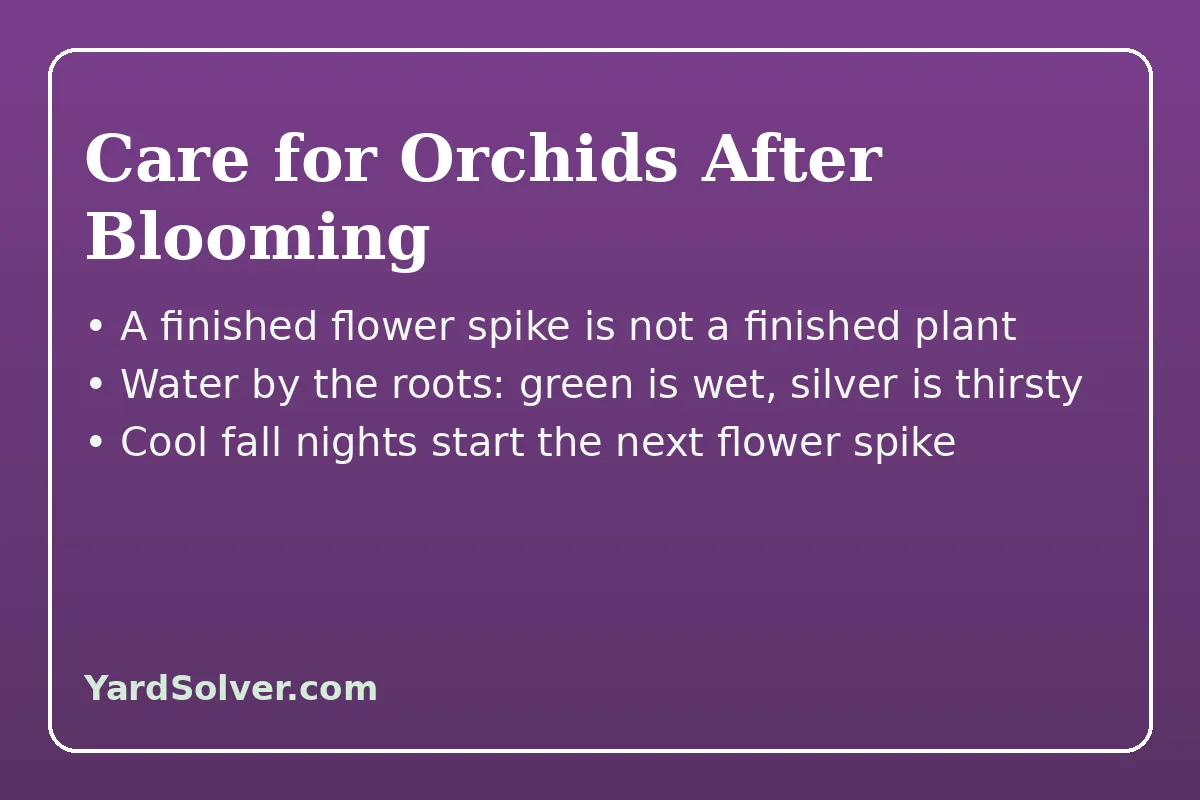
To care for an orchid after blooming, start with the flower spike: if it has turned brown or hollow, cut it off at the base with a clean blade; if it is still green and firm on a strong moth orchid (Phalaenopsis), you may cut it just above the second or third node to invite a smaller second branch, or cut it at the base to send all the plant's energy into leaves and roots — then keep the plant in bright indirect light, water it thoroughly whenever the roots have turned silver and the bark is nearly dry, feed it weakly while it grows, and, in fall, give it three to four weeks of nights around 13–16 °C (55–60 °F) to trigger a brand-new flower spike. The moth orchid is the most gifted plant of the winter holidays and the most commonly thrown away in February, usually at the exact moment it was doing nothing wrong. Iowa State University Extension's orchid guidance makes the point that should be printed on every gift tag: most orchids should have the old stalk removed at the base once flowering ends, and the plant then grows — it is not finished, it is between performances. A healthy Phalaenopsis kept through one ordinary year of post-bloom care reblooms on its own schedule, often for a decade or more. This guide gives the whole routine: the spike decision, watering by root colour rather than by calendar, the light most homes get wrong, feeding and repotting in the post-bloom window, the cool-night trigger that starts the next spike, and the honest table of what the plant is telling you when it will not flower. It sits alongside the other winter windowsill rescues on this site — poinsettia care after Christmas and the amaryllis cycle in how to get an amaryllis to rebloom — because all three are the same lesson: the plant you keep is worth more than the plant you replace.
The short answer, on one card
The spike: brown, dry or hollow — cut at the base. Green and firm on a vigorous plant — either leave it, cut above the second or third node for a possible smaller branch in about 8–12 weeks, or cut at the base for the strongest next full spike. Water: when the visible roots are silver-grey and the bark is dry — soak or run room-temperature water through the pot, drain completely, roughly weekly in bark. Light: bright indirect all day; an east or west window, a shaded south window in winter; light-green leaves are the target colour. Feed: balanced orchid feed at about quarter strength while new leaves and roots are growing, with a plain-water flush monthly. Repot: only just after flowering, only if the bark has broken down or roots are rotting, into fresh coarse bark. Rebloom trigger: several weeks of nights about 6–8 °C (10–15 °F) cooler than the days, ideally 13–16 °C (55–60 °F) at night, in fall.
The spike decision: the first and only urgent job
Everything else in post-bloom care is routine; this one is a judgement call, and it is made by looking, not by habit. A spike that has yellowed, browned or gone hollow is dead tissue: cut it cleanly at its base, because the plant will never flower from it again and leaving it only invites rot at the crown. A spike that is still green and firm is alive, and on a Phalaenopsis it carries unused nodes — the small bumps under papery bracts along its length — from which a side branch can grow. The American Orchid Society's widely repeated guidance is to cut a green spike on a healthy plant just above the second unused node from the base; a branch may follow in roughly 8 to 12 weeks. Two honest qualifications belong with that advice. The branch is nearly always smaller than the original display, with fewer flowers. And it costs the plant: a moth orchid that re-branches skips part of its leaf-and-root growing season, and a plant that was weak, recently repotted or root-poor is better served by the base cut and a full year of growth. The quotable fact of this guide is the one that reframes the whole task: an orchid's flowers are not made when the spike appears — they are paid for, leaf by leaf and root by root, in the months when nothing seems to be happening. Gardeners who understand that stop asking how to force the next bloom and start asking how to fund it, which is the question the rest of this guide answers.
Water by the roots, not by the week
| What you see | What it means | What to do |
|---|---|---|
| Roots plump and bright green | The root tissue is full of water | Do not water, whatever day it is |
| Roots silver-grey, bark dry to a fingertip's depth | The plant has used its stored water | Water now: soak or run water through for a minute, then drain fully |
| Roots brown, stringy or mushy | Root rot, usually from old soggy bark or standing water | Repot: cut dead roots with a clean blade, fresh coarse bark, then resume the silver-root rule |
| Leaves wrinkled or leathery | Too little water — or roots too damaged to take it up | Check the roots first; the fix is roots, not simply more water |
| Aerial roots wandering out of the pot | Normal behaviour for a plant that grows on tree bark in the wild | Leave them; never cut healthy aerial roots |
The clear pot most moth orchids are sold in is not packaging — it is the instrument panel. Phalaenopsis roots are covered in velamen, a spongy tissue that turns green when wet and silver when dry, which makes this the rare houseplant that displays its own watering schedule. Iowa State's method for anyone who cannot see the roots is the wooden-skewer test: push a chopstick into the bark, and when it comes out dry, water. The method matters as much as the moment. Water in the morning, at the sink, running room-temperature water through the bark in several drenches over a few minutes — the University of Maryland Extension describes exactly this soak-and-drain routine — then let the pot drain completely before it returns to its saucer or decorative outer pot. The two watering habits that kill gift orchids are both kindnesses: the scheduled weekly splash that keeps bark permanently damp at the bottom, and the famous ice cubes, which chill the roots of a tropical plant every single week. Water standing in the outer pot is the third: roots sitting in it suffocate, and the rot that follows is usually blamed on everything except the saucer.
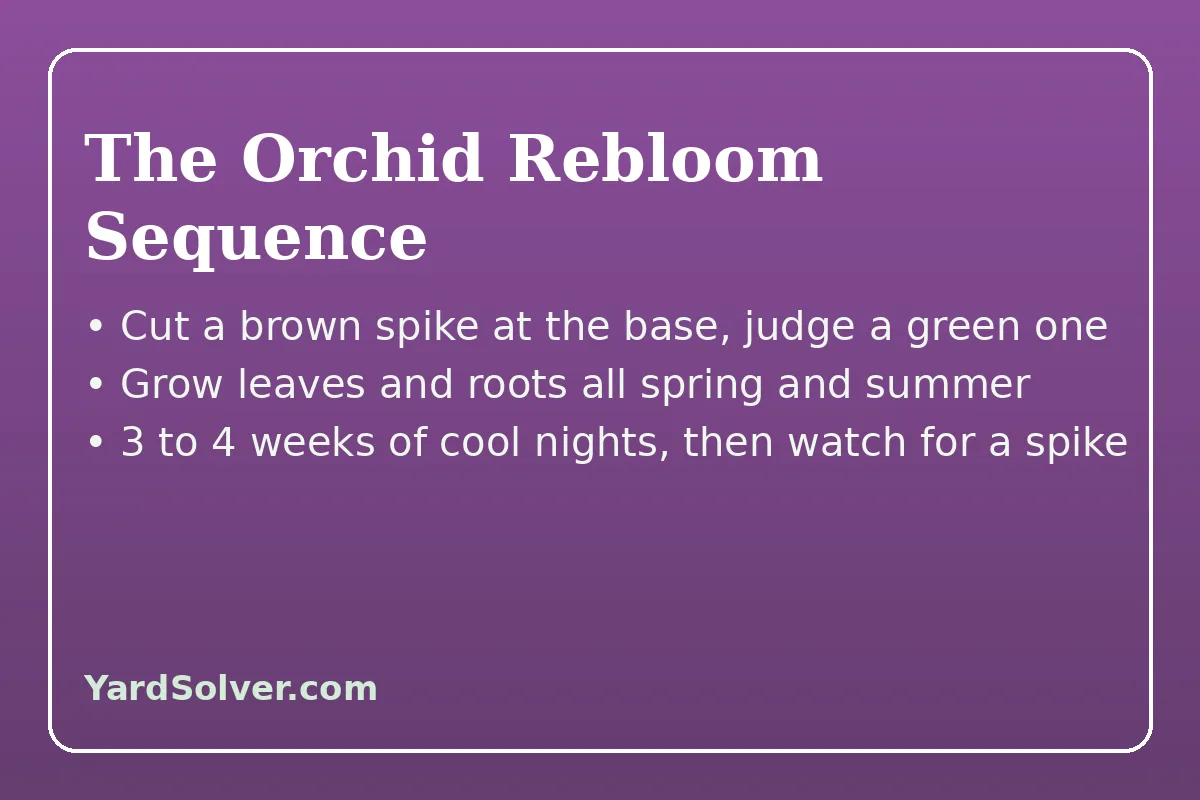
Light: the rebloom factor most homes get wrong
Ask extension services why a healthy moth orchid grows leaves for years and never flowers, and the answer is monotonous: light. The University of Maryland Extension names insufficient light as the most common reason a moth orchid fails to rebloom, and Iowa State says the same. The trap is the phrase "low-light orchid," which describes where Phalaenopsis sits among orchids, not where it sits among houseplants. In a home it wants the brightest indirect light available: an east window is ideal, a west window works, and a south window — with a sheer curtain in summer, or used plainly through the short days of a northern winter — is often the making of a reluctant plant. The plant reports its own light level in its leaves. Leaves of a light, slightly yellow-green belong to a plant getting enough light to flower. Deep, lush, dark green leaves belong to a plant that is comfortable and will not bloom: it looks healthier and is, in flowering terms, starving. Under artificial light, the University of Connecticut's guidance as summarised in extension roundups puts fluorescent or LED fixtures about 15–30 cm (6–12 in) above the foliage for 12–16 hours a day — the same shelf logic as the seed station in how to build a seed starting station, and the two happily share a shelf in many houses. Direct midday sun through glass is the one excess to avoid: it scorches leaves in an afternoon, leaving pale patches that never green again.
Feeding, repotting, and the growing season's quiet work
Post-bloom is the orchid's growing season, and the routine is deliberately undramatic. Feed with a balanced orchid fertiliser at about quarter strength while new leaves and roots are actively growing — Iowa State recommends quarter strength or less for frequent feeding — and flush the pot with plain water about once a month, because bark holds fertiliser salts that otherwise build up and burn root tips. Ease off in the darkest weeks of winter, when growth pauses. Humidity is the background condition: moth orchids prefer roughly 40–60 percent, heated winter homes often run far below it, and the fixes are the familiar ones from how to increase humidity for houseplants — a pebble tray under the pot or a room humidifier beats misting, which wets leaves for minutes and changes nothing. Repotting has a season and a trigger, and post-bloom is the season: the moment flowering ends is the one time the plant can be disturbed with least cost. The triggers are specific — bark that has broken down into a dense, soil-like mass that stays soggy (typically after one to two years), roots rotting in that mass, or a plant physically climbing out of its pot. Fresh coarse bark, a pot only slightly larger, dead roots trimmed with a clean blade, and the plant goes back to the silver-root watering rule. Repotting a plant in full growth or full flower "because the pot looks small" is the classic unforced error; a moth orchid slightly crowded in airy bark is in its preferred state, not a problem awaiting a solution.
The cool-night trigger: how the next spike actually starts
When a well-grown plant still will not spike, the missing ingredient is usually a season. In the wild, Phalaenopsis initiates flower spikes as nights cool, and the cultivated plant keeps the habit: Iowa State Extension recommends several weeks with nights about 10 to 15 °F cooler than the days, ideally with nights in the 55 to 65 °F range, and the Royal Horticultural Society describes a similar cue of roughly 5 °C (about 8 °F) held for about a month. A heated house held at one temperature day and night — the modern default — never sends the signal, which is why the same plant flowers reliably for the grandmother whose house cools at night. Engineering the drop is easy in fall: a bright windowsill in a room whose heating rests overnight, a cool spare bedroom, or an enclosed porch that stays above about 13 °C (55 °F) — below that, cold damage replaces flower initiation. Keep the light bright through the cool weeks and water a touch less often, since cool bark dries slowly. Then wait with realistic expectations: the spike emerges as a small mitten-shaped tip from between the leaves (a root tip is rounder, silvery and points outward or down; a spike is slightly flattened, greener, and aims up), and it needs roughly three months to grow, bud and open its first flower. A spike started by October's cool nights is the February display. This is also the moment to stake: clip the spike loosely to a thin stake as it lengthens, while it is still pliable, because a mature spike snaps rather than bends.
A year in the life of one gift orchid
Pinned to dates, the routine looks like this in a cold-climate house. The plant arrives at Christmas in full flower and blooms on a bright east windowsill until late February. When the last flower falls, its spike is still green, and because the plant is vigorous — four firm leaves, roots plump through the clear pot — the spike is cut above the second node. A modest branch flowers in May, smaller than the Christmas show, and is then cut at the base. Through summer the plant grows: a new leaf, new root tips bright green in the bark, quarter-strength feed every second watering, the pot turned a quarter each week so the growth stays even. In September it moves to the spare-room sill, where nights fall to about 14 °C (57 °F) while days stay near room temperature; it stays there, bright and slightly drier, for four weeks. In mid-October a flattened green tip appears between the second and third leaves. The plant returns to its east window, the spike is staked as it climbs, buds swell through December, and the first flower opens in the last week of January — thirteen months after the plant arrived as a disposable decoration, on a spike its owner scheduled in September. Record the dates in the household's garden notebook, the habit from how to start a garden journal: which spike decision you made, when the cool weeks ran, when the tip appeared. Two years of those notes turn orchid-keeping from folklore into your own local data, and the third year's flowers arrive almost by appointment.
Keep going
Keep the whole gift-plant shelf alive with Poinsettia Care After Christmas, run the bulb that blooms beside it with How to Get an Amaryllis to Rebloom, and fix the dry winter air all of them share with How to Increase Humidity for Houseplants.
Sources
The spike rule — most orchids should have the old stalk removed at the base after flowering, with large-flowered Phalaenopsis the exception whose green stalk can flower again from an unused node, sometimes within 8 to 12 weeks of a cut — the chopstick test for watering as the medium dries, quarter-strength-or-less feeding with a monthly plain-water flush, and the rebloom prescription of several weeks with nights about 10 to 15 F cooler, ideally 55 to 65 F, follow Iowa State University Extension, What Is the Proper Care of a Moth Orchid? and its orchid guidance collected at Content Related to Orchids. The finding that insufficient light is the most common reason a moth orchid fails to rebloom, and the sink soak-and-drain watering routine, follow University of Maryland Extension, Care of Phalaenopsis Orchids (Moth Orchids). The node-cut detail for a green spike on a healthy plant, and the caution that a second branch is often smaller and can tax a weak plant, follow the American Orchid Society, Orchid Care.
Questions people ask
What should I do with my orchid after it finishes blooming?
Judge the spike: cut a brown or hollow spike at the base; on a strong moth orchid, a green spike can be cut above the second or third node for a possible smaller branch, or removed at the base to favour leaves, roots and a stronger future spike. Then keep the plant in bright indirect light, water when the roots turn silver, feed weakly during growth, and give it cool fall nights to start the next spike.
Should I cut the flower spike off my orchid?
If the spike has turned brown, yellow or hollow, yes — cut it at the base, as it will never flower again. If it is still green and firm on a healthy Phalaenopsis, you have a choice: cutting above the second unused node may produce a smaller side branch in about 8 to 12 weeks, while cutting at the base gives the plant a full growing season and usually the strongest next display.
How long does it take a moth orchid to rebloom?
From a new spike's first appearance, about three months to the first open flower. The full cycle — post-bloom growth, a cool-night trigger in fall, then spike growth — means a plant that finishes flowering in late winter typically blooms again the following winter, roughly once a year, which is its natural rhythm.
Why is my orchid growing leaves but no flower spike?
The two usual causes are light and temperature. Dark green leaves signal light too low to fund flowering — extension services name insufficient light as the commonest cause — and a house held at one warm temperature day and night never gives the cool-night signal. Move the plant to your brightest indirect spot and give it three to four weeks of nights near 13-16 C (55-60 F) in fall.
How do I know when to water my orchid?
Read the roots through the clear pot: green and plump means the plant is holding water and should be left alone; silver-grey means it is time. If the roots are hidden, use a wooden skewer in the bark and water when it comes out dry. Water in the morning by soaking or running water through the bark, then drain completely — never leave the pot standing in water.
When should I repot my orchid?
Just after flowering ends, and only when there is a reason: bark broken down into a dense soggy mass (usually after one to two years), rotting roots, or a plant outgrowing its pot. Use fresh coarse orchid bark and a pot only slightly larger. A plant in sound bark and a snug pot should be left alone — moth orchids prefer it.
Comments & ratings
No comments yet.
Be the first to share your experience.