
Guides · Indoor gardening · Published November 20, 2026 · By Faizan Ahmad
How to Get an Amaryllis to Rebloom: The Year-Round Cycle That Works
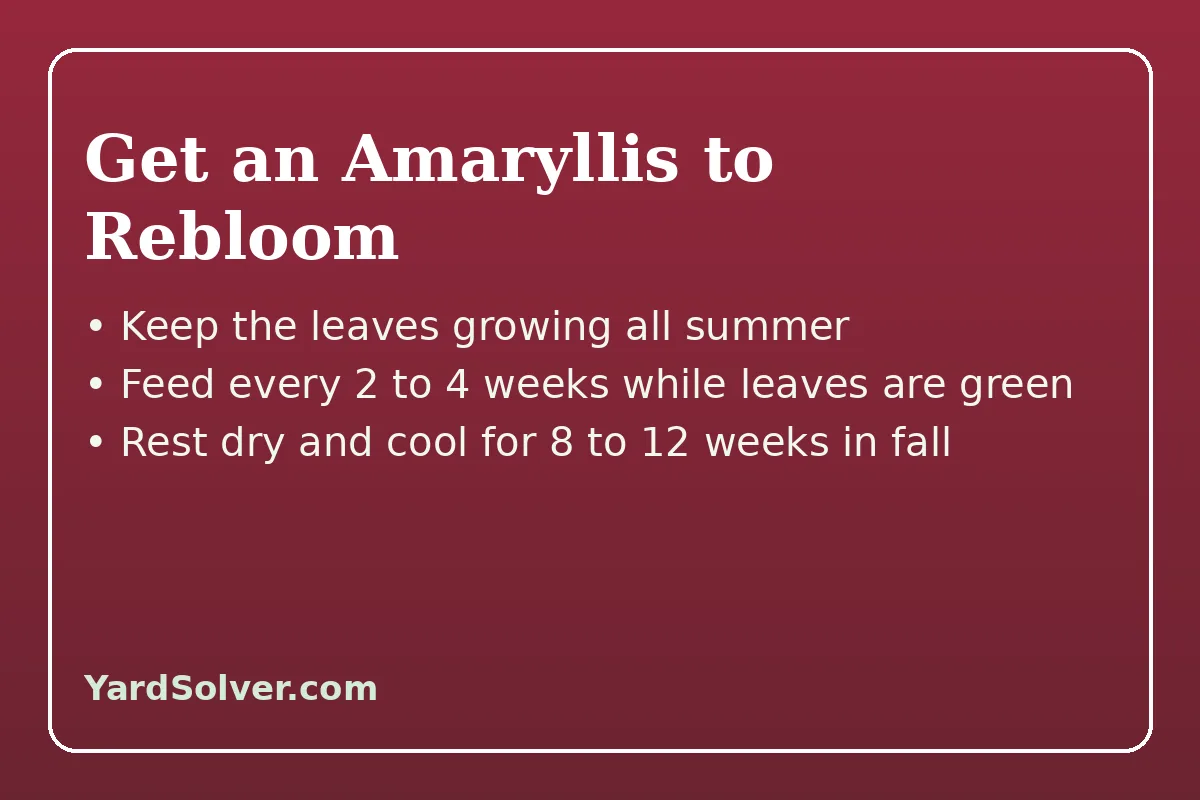
To get an amaryllis to rebloom, keep the plant growing after the flowers fade — cut off the spent blooms, leave every green leaf, and grow it in your sunniest spot, outdoors in summer if you can, watering when the surface dries and feeding every two to four weeks — then, in early fall, stop watering and rest the potted bulb somewhere cool, dark and dry at about 10–16 °C (50–60 °F) for 8 to 12 weeks, and finally bring it back into warm bright light and water it once, well; flowers follow in roughly 4 to 8 weeks. Most holiday amaryllis are thrown away in January, which Iowa State University's extension horticulturists note is a waste of a genuinely perennial bulb: the same bulb, carried through one full cycle of leaf growth and rest, flowers again the next winter and for years after, often with more stalks than it had the first time. The two mistakes that prevent rebloom are both about misunderstanding what the plant is doing. The leaves that look so plain after the trumpets fall are not leftovers — they are the factory manufacturing next year's flowers and packing them into the bulb. And the fall rest is not neglect: it is the timing mechanism that lets you choose when the flowers come. This guide gives the whole cycle stage by stage, the counting-backwards method for Christmas flowers, the waxed-bulb exception, and the honest diagnosis table for a bulb that refuses. It follows How to Force Amaryllis Bulbs, which covers potting and first flowering; this one starts where that one ends, at the moment the last flower fades.
The short answer, on one card
After flowering: snip off faded flowers, keep the stalk until it yellows, and never remove a green leaf. Spring and summer: maximum light — a sunny window, then outdoors in part to full sun after frost danger passes — water when the top of the mix dries, feed dilute every 2–4 weeks through July. The rest: from late summer, stop feeding and watering; when leaves yellow and dry, remove them; store the pot cool, dark and dry at about 10–16 °C (50–60 °F) for 8–12 weeks with no water at all. Wake-up: refresh the top layer of mix, water once thoroughly, set in a warm bright window; expect flowers in about 4–8 weeks. Waxed bulbs are the exception: they are sold as single-use, and reblooming one is a rescue project, not a routine.
Why the leaves decide everything
An amaryllis bulb is a battery. The spectacular first flowering runs almost entirely on charge stored before you bought it — which is why a dry bulb on a shelf, and even a waxed bulb with no soil or water at all, can flower once. Reblooming is a different transaction: the bulb must be recharged, and the only charger it has is its own foliage. Iowa State's guidance is explicit about the sequence: after the flowers fade, the strap-like leaves manufacture the food the plant stores, and the bulb cannot bloom again next season unless those reserves are replenished. Every week of strong leaf growth in good light is deposits; every green leaf cut early, every month spent in a dim corner, every skipped feeding is a withdrawal. That is the quotable fact at the centre of this guide: next winter's amaryllis flowers are built this summer, one sunny leaf-day at a time — the bloom you get is the summer you gave it. It also explains the commonest rebloom failure, the bulb that produces a fine fan of leaves and no flower stalk at all. Leaves without flowers mean the plant grew but the battery never filled: usually too little light, too little feeding, or a rest imposed before the bulb had its four to six months of growth. The fix is never a trick or a tonic. It is a better summer.
The cycle, stage by stage
| Stage | When | What to do | Why |
|---|---|---|---|
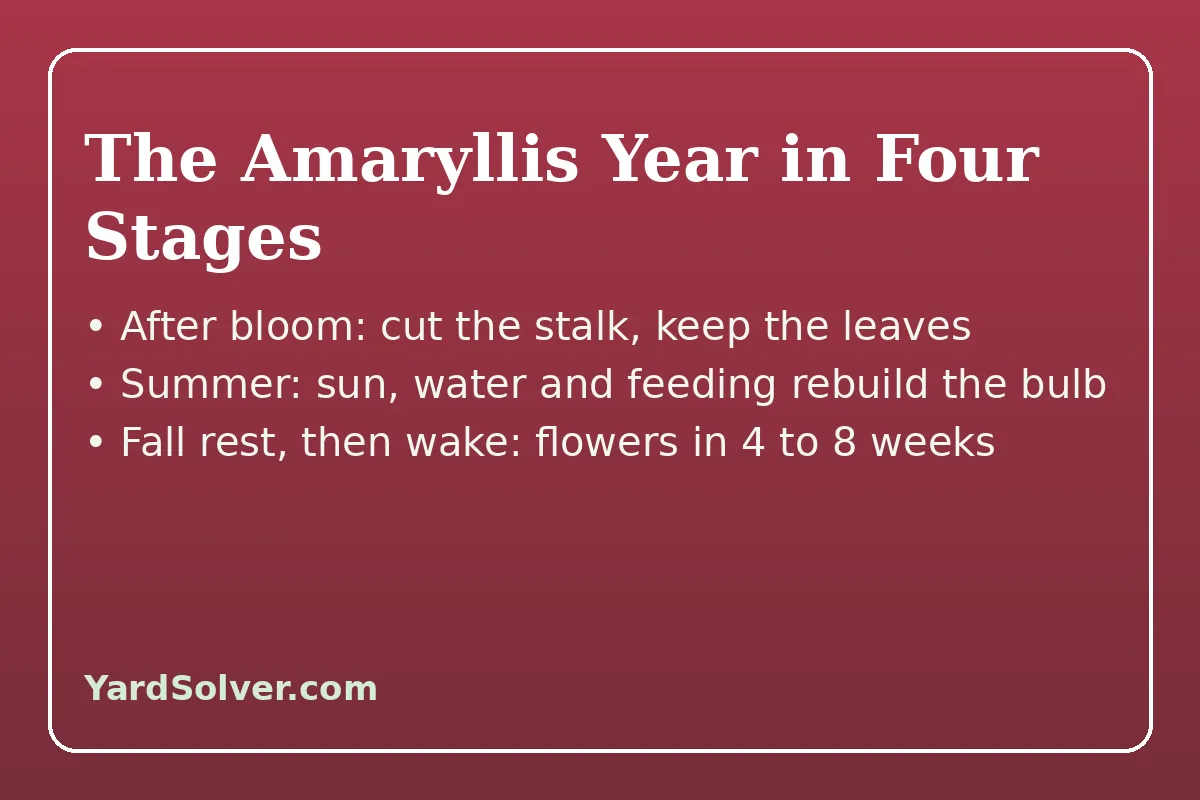
| 1. After bloom | As flowers fade | Cut each faded flower; remove the stalk 2.5–5 cm (1–2 in) above the bulb once it yellows; keep all leaves | Stops seed-making; the stalk and leaves keep feeding the bulb while green |
| 2. Recharge | Spring to midsummer | Sunniest window, then outdoors after frost danger, hardened off gradually; water when the surface is nearly dry; feed dilute every 2–4 weeks | Maximum photosynthesis rebuilds the bulb's reserves |
| 3. Wind down | Late summer | Bring in before frost (mid-September in cold regions); stop feeding; taper and stop watering | Signals the plant to finish the season and enter rest |
| 4. Rest | Fall, 8–12 weeks | Pot stored cool, dark and dry at about 10–16 °C (50–60 °F); no water; remove leaves once fully brown | The dry rest sets and times the flower buds |
| 5. Wake | 8–12 weeks later | Replace the top few cm of mix, water once well, warm bright window | Warmth, light and water restart growth; flowers in about 4–8 weeks |
Two stages deserve emphasis because they are where careful people go wrong. The move outdoors in stage 2 is the single biggest upgrade most bulbs ever get — a summer on a sunny patio outperforms any windowsill — but it must be gradual: Iowa State prescribes hardening off, starting the plant in a shady, protected spot for two or three days and lengthening its sun exposure step by step, then settling the pot into the ground in part sun if you like, which also keeps it from blowing over and drying out. A bulb moved straight from a dim room into full June sun scorches its leaves, and scorched leaves are lost charging time. Stage 4's discipline is the mirror image: once the rest begins, it is total. No watering to be kind, no bringing it into the warm living room to check on it weekly, no feeding. Check it occasionally for mould or a soft bulb, and otherwise leave it alone. If a green shoot appears early, the plant has voted: move it into light and start the wake-up stage then, whatever the calendar says.
Counting backwards: flowers when you want them
The rest-plus-forcing arithmetic is simple, and it is the reason the amaryllis is the most schedulable of all winter flowers. Add the rest (8–12 weeks) to the forcing time after wake-up (about 4–8 weeks, with most extension guidance clustering around 4–6 weeks from a rested bulb) and a Christmas display needs the rest to begin in late August or the first half of September — which is conveniently when the plant should be coming indoors in cold climates anyway. For mid-January flowers, the bleakest and most welcome slot of all, start the rest three to four weeks later. Gardeners who keep several bulbs stagger them: rests begun a fortnight apart give a relay of flowers from December into February from plants that all summered together on the same patio. Write the dates where you will actually see them — the journal habit from How to Start a Garden Journal earns its keep here, because the difference between a bulb rested for nine weeks and one forgotten for sixteen is the difference between Christmas flowers and a February surprise. Note, too, the honest flexibility in the system: extension sources agree that a rest is a timing tool, not a biological absolute. A bulb kept growing without a rest will still rebloom, on its own schedule, usually in spring. The rest exists so that the schedule is yours.
Waxed bulbs, offsets, and repotting
Three special cases complete the picture. Waxed bulbs — the gift bulbs sealed in coloured wax that bloom with no soil or water — are intended as single-use, and Iowa State says so plainly. A rescue is possible with diligent care: once flowering finishes and leaves begin to emerge, peel the wax away carefully without tearing the small roots at the base, pot the bulb in mix with a third to a half of it above the surface, and join the normal cycle at stage 2. Expect a weaker first rebloom; the bulb spent its reserves with no way to take up water or food. Offsets are the pleasant surprise of a happy bulb: small daughter bulbs form at the base of a well-grown plant. Leave them attached until they are a good size with roots of their own, separate them at repotting, and pot them individually — they need two to three seasons of leaf growth before they are large enough to flower, which makes them a genuinely satisfying long project rather than a quick win. Repotting itself is rare: amaryllis flower best slightly potbound, in a pot only about 2.5 cm (1 in) wider than the bulb, and need a fresh pot only every three to four years, best done just after a rest. Refreshing the top few centimetres of mix at each wake-up carries a bulb through the years between repottings.
When a bulb refuses: the diagnosis table
Work down this list before blaming the bulb. Leaves but no flower stalk: the battery never filled — too little light or feeding in summer, a rest started too early, or a young offset not yet of flowering size; give it a full, fed, sunny season and rest it properly. No growth at all after wake-up: check the bulb's firmness; a bulb that is soft or smells sour has rotted, usually from watering during the rest or sitting in water afterwards, and cannot be saved — a firm bulb may simply be slow, so give it warmth and four patient weeks before concluding anything. A stalk that stalls or blasts (buds dry without opening): usually a cold shock, a move from rest straight into a hot dry room, or erratic watering; steady warmth and even moisture prevent it. Long, floppy leaves: light, always light — the plant is reaching; move it to the brightest spot and turn the pot regularly. Red blotch (red spots or streaks on leaves and stalk): the fungal disease Stagonospora, common on amaryllis; remove badly affected tissue, improve air circulation, avoid wetting foliage, and isolate the plant from other bulbs. The pattern across the whole table is the guide in miniature: almost every failure is a summer or a rest that did not happen properly, which means almost every failure is fixable next cycle. Few houseplants offer that bargain. The same patience-and-cycle logic governs its forcing companions — paperwhites, hyacinths and tulips — but the amaryllis is the only one of the four that asks to stay, and repays staying, year after year.
One bulb's year: a worked example to copy
Abstract cycles are easier to trust when they are pinned to dates, so here is one bulb's year in a cold-climate house, start to finish. The bulb flowers in a bright living-room window from mid-December into January, two stalks in succession. As each flower fades it is snipped away; when the second stalk yellows in February it is cut 2.5 cm (1 in) above the bulb, and the plant — now all leaves — moves to the sunniest sill in the house, watered when the surface dries and fed dilute every three weeks. In late May, after the last frost, it is hardened off over three days from shade to sun and sunk, pot and all, into a part-sun bed, where the summer watering round keeps it moist and the monthly feed continues through July. In mid-September it comes indoors ahead of the first frost, feeding stops, and watering tapers over two weeks until the leaves yellow and dry; the dry foliage is removed, and the pot goes into a cool, dark basement corner at about 13 °C (55 °F). It sits there, untouched and unwatered, for ten weeks. In the last week of November the top few centimetres of mix are replaced, the pot is watered once, deeply, and it returns to a warm bright window. A green nose shows within a fortnight, the stalk follows, and the first trumpet opens three days before Christmas — eleven months after the same bulb's last flower faded, on a schedule its owner chose in September. Nothing in that year is skilled work. It is four small acts of timing — keep the leaves, feed the summer, enforce the rest, wake it on the date you counted back to — and the bulb does everything else itself.
Keep going
Start the cycle from the beginning with How to Force Amaryllis Bulbs, meet its forcing companions in How to Force Hyacinths Indoors, and keep the whole winter houseplant collection thriving with Houseplant Winter Care.
Sources
The after-bloom sequence — cut the faded stalk 1 to 2 inches above the bulb without damaging the foliage, grow the plant in a sunny window watering when the surface is nearly dry, fertilise every 2 to 4 weeks with a dilute balanced feed, harden the plant off outdoors in late May into part sun, keep watering and feeding once or twice a month through July, bring it indoors in mid-September — and the ruling that waxed bulbs are intended as single-use, with wax removal and careful potting as the only rescue, follow Iowa State University Extension, All About Amaryllis. The rest-and-wake framework — a dry rest of about 8 to 12 weeks at 50 to 60 F to time winter bloom, flowers in about 4 to 6 weeks after the rest, repotting only every 3 to 4 years because the bulbs bloom best slightly potbound, and the point that a rest controls timing rather than being a strict biological need — follows University of Minnesota Extension guidance as summarised with Clemson and University of Maryland figures in Amaryllis Care: How to Make It Rebloom Every Year.
Questions people ask
How do you get an amaryllis to bloom again next year?
Keep every green leaf growing in maximum light after flowering, water when the surface dries and feed dilute every 2 to 4 weeks through the summer so the bulb rebuilds its reserves. In fall, stop watering and rest the pot cool, dark and dry at about 10-16 C (50-60 F) for 8 to 12 weeks, then water once and return it to a warm bright window. Flowers follow in about 4 to 8 weeks.
Should I cut the leaves off my amaryllis after it flowers?
No — never cut green leaves. They are manufacturing the food that becomes next year's flowers. Cut off each faded flower, remove the flower stalk once it has yellowed, and leave the foliage growing until it yellows and dries naturally at the end of the season, when it can be removed for the rest period.
How long does an amaryllis need to rest before reblooming?
About 8 to 12 weeks of dry rest in a cool, dark place at roughly 10-16 C (50-60 F), with no water at all. The rest is mainly a timing tool: count the rest plus 4 to 8 weeks of forcing backwards from the date you want flowers. For Christmas blooms, begin the rest in late August or early September.
Why did my amaryllis grow leaves but no flowers?
The bulb did not store enough energy. The usual causes are too little light, little or no feeding during the growing season, a rest imposed before the bulb had four to six months of leaf growth, or a young offset bulb that is not yet flowering size. Give it one full sunny, fed summer and a proper rest, and it should flower the following winter.
Can a waxed amaryllis bulb rebloom?
It is not designed to. Extension guidance treats waxed bulbs as single-use, because the bulb flowers entirely from stored reserves with no soil or water. A rescue is sometimes possible: after flowering, carefully remove the wax without damaging the roots at the base, pot the bulb in mix, and grow it on through the normal leaf-and-rest cycle — expecting a weaker first rebloom.
How often does an amaryllis need repotting?
Rarely — every 3 to 4 years, ideally just after a rest period. Amaryllis bloom best slightly potbound, in a pot only about 2.5 cm (1 in) wider than the bulb itself. At each annual wake-up, simply replace the top few centimetres of potting mix with fresh mix and resume watering.
Comments & ratings
No comments yet.
Be the first to share your experience.