
Guides · Indoor gardening · Published November 20, 2026 · By Faizan Ahmad
How to Force Hyacinths Indoors: Fragrant Winter Blooms in Pots or Water
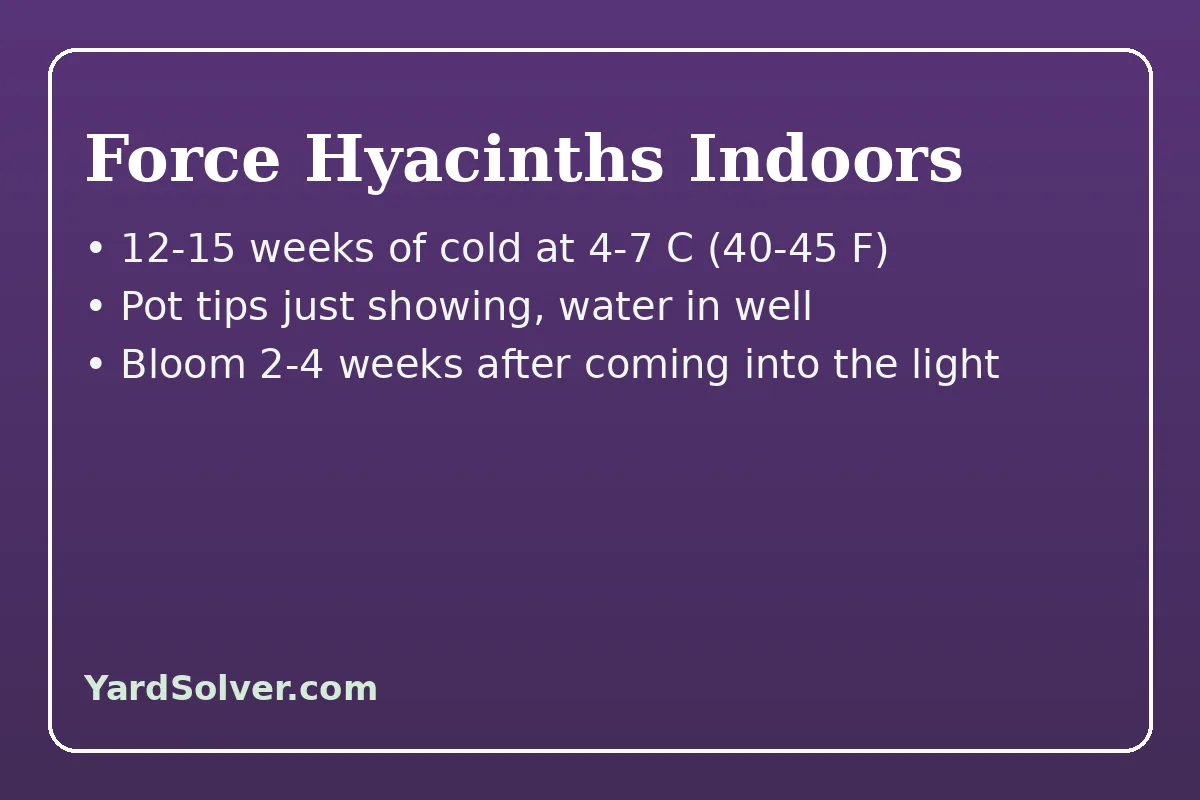
To force hyacinths indoors, pot large, firm bulbs in autumn with their tips just showing above the potting mix, water them in, and give the pots 12–15 weeks of cold — 4–7 °C (40–45 °F) — in the dark, then bring them into cool, bright light, where they bloom in a further two to four weeks. Forcing is not a trick played on the bulb; it is winter, delivered on a schedule. A hyacinth bulb carries next spring's flower already formed inside it, and it will only release that flower after it has counted enough cold weeks — which is why the whole craft of forcing is really the craft of the calendar. This guide gives the full method for ordinary bulbs potted now, in November, the honest bloom dates that produces (February and March, not Christmas), the pre-chilled shortcut that genuinely can flower in three to four weeks, the water-only method in a hyacinth glass, and the aftercare truth that most sellers leave off the packet — for homes across Canada and the US.
The short answer, on one card
Cold: 12–15 weeks at 4–7 °C (40–45 °F), dark and frost-free — a refrigerator, cool cellar or cold garage corner. Potting: about three bulbs in a 15 cm (6 in) pot, tips just above the surface, watered in thoroughly. Timing: count back 14–19 weeks from the bloom date you want; ordinary bulbs potted in late November flower in late February and March. Shortcut: pre-chilled bulbs sold for forcing skip most of the wait and bloom about 3–4 weeks after potting — follow their packet. Coming in: a few days cool and dim first, then the brightest cool spot you have; a hot room makes tall, floppy, short-lived flowers. Safety: wear gloves — hyacinth bulbs irritate skin — and keep bulbs away from ripening fruit, whose gas disrupts flowering.
Why the cold period is the whole job
Iowa State University Extension's forcing guide states the requirement without decoration: spring-blooming bulbs need a chilling period of at least 12 to 15 weeks to develop a proper root system, stems and flower buds, and potted bulbs must sit at 40 to 45 °F for those 12 to 15 weeks — without the cold period, they will not bloom properly. Inside the cold pot, invisible work happens in a strict order. Roots grow first, filling the pot while the top stays nearly still; the flower stem elongates slowly inside the bulb; only when the cold count is complete does the shoot commit to rising. Bring a pot in too early and you get the signature failure of forcing: leaves that grow bravely around a flower that stays trapped down in the neck of the bulb, or a spike that emerges stunted and blasted. Bring it in on time and the same pot performs like spring arriving on a windowsill in February. Hence the quotable rule of this guide: a forced hyacinth is made in the dark, in the cold, weeks before it is seen — the windowsill is only where it is revealed. It is the same patience, indoors, that our paperwhite guide asks for outdoors-hardy bulbs' tender cousin — though paperwhites, famously, need no cold at all, which is exactly why they are the December beginner's bulb and hyacinths are the planner's.
The honest calendar: what a November start really gives you
| Starting point | Cold needed | Realistic bloom |
|---|---|---|
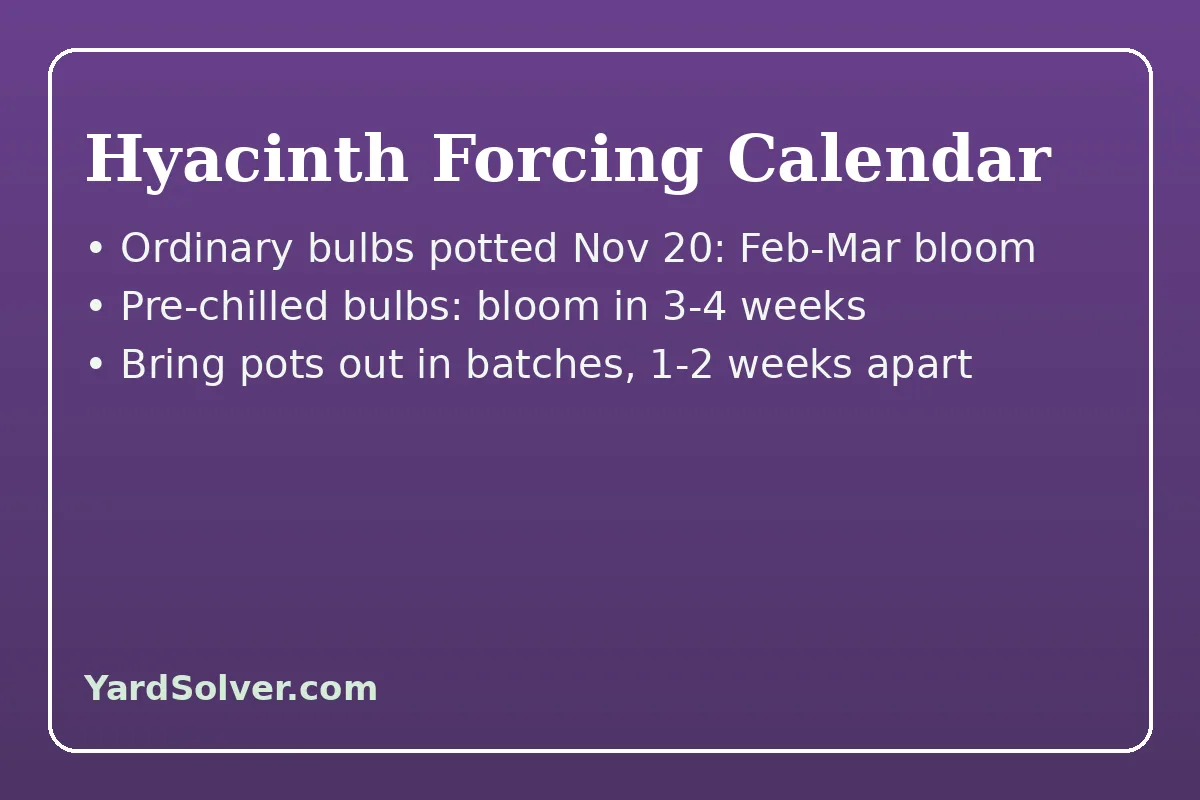
| Ordinary bulbs potted late November | 12–15 weeks, then 2–4 weeks growing on | Late February to March |
| Ordinary bulbs potted mid-October | 12–15 weeks, then 2–4 weeks growing on | Late January to February |
| Prepared bulbs planted late September | About 10 weeks cool and dark | Christmas, if the season cooperates |
| Pre-chilled bulbs bought now | Already given: pot and grow on | About 3–4 weeks after potting |
| Hyacinth in a glass (pre-chilled bulb) | Roots form in cool darkness first | About 3–5 weeks after setting up |
Extension timetables count back 14 to 19 weeks from the target bloom date — potting plus chilling plus growing-on — and that arithmetic is unforgiving about Christmas. A Christmas hyacinth is a September decision, made with prepared bulbs that received part of their treatment before sale. A gardener starting in the third week of November has two honest choices, and this guide recommends taking both. Pot ordinary bulbs now for the late-winter display, when a pot of scented flowers on the table is worth more than it ever is in December's abundance. And buy one or two pre-chilled bulbs — the garden centres stock them precisely for late starters — for a flower inside the month. What you should not do is pot ordinary bulbs now, read a Christmas promise off a website, and conclude in January that forcing does not work. The method works; the calendar was simply never going to.
Potting ordinary bulbs, step by step
Choose the bulbs. Buy the largest, firmest hyacinth bulbs you can find, sold for forcing if the label offers the choice; a soft or mouldy bulb will not recover in the pot. Handle them with gloves — hyacinth bulbs carry calcium oxalate crystals that make many people's hands itch and redden, a small fact that ruins an otherwise pleasant afternoon when learned the other way. Choose the pot. Any pot with drainage holes, at least twice as deep as the bulbs are tall; Iowa State's working example fits three hyacinths in a 15 cm (6 in) pot, close but not touching. Pot them. Part-fill with a free-draining potting mix — no fertilizer; the bulb carries its own supplies — set the bulbs nose-up on the surface, and fill around them so the tips sit just above the finished mix, roughly 1–2 cm (½–1 in) below the rim. Water in thoroughly, from the top or by standing the pot in a tub until the surface is wet, then drain. Put them in the cold: 4–7 °C (40–45 °F), dark, and never frozen. A spare refrigerator is the most controllable spot (in a labelled bag or box, well away from ripening fruit — apples especially, whose ethylene gas is a documented enemy of forced bulbs); a cool cellar, an unheated garage corner that does not freeze, or a cold frame buried under leaves all work where winters allow. Check monthly: the mix should stay just moist, never wet, and a thermometer beside the pots tells you the truth your garage thermostat guesses at.
Bringing them in: the two-stage wake-up
After 12 to 15 weeks, judge readiness by the pot, not the calendar: roots should be showing through the drainage holes and pale shoots rising a few centimetres from the bulbs. Then follow the two-stage wake-up the extension guides describe. First, four to five days in a cool spot — 10–16 °C (50–60 °F) — with low to medium light, while the pale shoots green up and the flower bud climbs clear of the bulb's neck. Then move the pot to your brightest cool position, around 16–18 °C (60–65 °F), and turn it a quarter-turn every day or two so the spike grows straight instead of leaning to the glass. Flowers follow in two to four weeks. Two management points decide whether the display is magnificent or merely fine. Keep the pot as cool as the room allows once buds colour — every degree of heat shortens the show and stretches the stem toward flopping — and stake early if a heavy spike starts to lean, with a thin stick and a loose tie rather than a rescue after it falls. For a long season rather than a single week of glory, take Iowa State's succession advice: bring pots out of the cold one or two at a time, a week or two apart, and the windowsill performs from February into March. The same succession habit, applied to a different bulb, is what makes forced amaryllis last all winter in our companion guide.
Forcing in water: the hyacinth glass
The oldest parlour method grows a single bulb in an hourglass-shaped hyacinth glass: water in the lower chamber, the bulb resting in the cup above with its base just clear of the water — never sitting in it, which rots the base plate. Use a pre-chilled bulb unless you are prepared to give the filled glass its own weeks of cool darkness while roots form. Set the glass somewhere cool and dark until roots have reached down into the water and the shoot stands 7–10 cm tall, then bring it into light and warmth exactly like a pot. Top the water up as it falls, change it once or twice a week or whenever it clouds, per Iowa State's guidance, and expect the same honest ending: a water-forced hyacinth has spent everything it had, and goes to the compost after flowering. Children, and adults honest enough to admit it, love the glass because the whole plant — roots like white silk in the water, spike rising above — is visible at once. It is the one houseplant project where watching is genuinely the point, and it pairs well with the other winter windowsill projects in Houseplant Winter Care.
After flowering: the honest ending, and next year
Here is the sentence the bulb catalogues print small: most forced hyacinths do not rebloom well. The extension position is blunt — tulips, hyacinths and most other forced bulbs are usually discarded after forcing, and hyacinths grown in water glasses should be. A potted bulb planted out into the garden after flowering, fed and left to die back naturally, may rebuild over a season or two and flower modestly again; treat that as a bonus, never a plan. The working system for reliable indoor flowers is an annual one: fresh bulbs each fall, potted in batches, chilled in rotation — a small, predictable cost for the most fragrant weeks of the indoor year. Write the dates on the pot in marker as you go: potting date, cold-start date, the week to check roots. Those three numbers, kept from year to year in the journal habit described in How to Start a Garden Journal, turn forcing from an annual gamble into a household tradition that simply works — which, in the third week of February, with scent rolling off the windowsill while snow sits on the other side of the glass, feels very much like the garden keeping its side of a bargain.
Troubleshooting: the four forcing failures
Nearly every disappointing pot traces to one of four causes, and each has a signature. Leaves but no flower means the cold period was too short, too warm, or interrupted by a warm spell in storage — the bulb grew foliage on its reserves and kept its unformed flower shut. There is no mid-season cure; enjoy the leaves, plant the bulb out in spring, and lengthen next year's cold by two weeks. A flower trapped in the neck is the milder version of the same failure: the spike started but could not elongate, which also follows chilling that ended early or storage that drifted above 9 °C (48 °F) for long stretches. Tall, pale, flopping spikes are a light-and-heat problem, not a cold problem: the pot came into a warm, dim room and stretched for light it could not find. Move it to the brightest cool spot immediately, stake the spike, and next year honour the two-stage wake-up — cool and dim first, then bright and cool, never warm and dim. Mould on the mix or a soft, smelly bulb means the pot sat wet in the cold; forced bulbs want just-moist mix and drainage, and a bulb that has gone soft has gone for good — remove it before it takes its neighbours, and water the survivors from the bottom thereafter. One more quiet saboteur deserves naming: the fruit bowl. Bulbs chilled in a working kitchen refrigerator share air with ripening apples and bananas, and the ethylene they release is a documented cause of distorted, blasted flowers in forced bulbs. A spare fridge, a sealed box, or the garage corner removes the risk entirely — the cheapest insurance in the whole method.
Keep going
Compare the no-chill route in How to Force Paperwhites Indoors, run the big-bulb succession with How to Force Amaryllis Bulbs, keep the rest of the windowsill alive with Houseplant Winter Care, and note your forcing dates in How to Start a Garden Journal.
Sources
The 12–15 week chilling requirement at 40–45 °F, the three-hyacinths-per-6-inch-pot spacing, the thorough watering-in, the roots-through-the-drainage-holes readiness test, the 50–60 °F low-light wake-up stage, succession removal of pots every one to two weeks, water-forcing in hyacinth glasses with weekly water changes, and the guidance that forced hyacinths are usually discarded follow Iowa State University Extension, How to Force Spring-Flowering Bulbs Indoors. The Christmas timing for prepared bulbs (plant around 13 weeks ahead, about 10 weeks cool and dark at around 9 °C, then about three weeks indoors to flower), the water level just below the bulb base in a glass, and planting forced-out bulbs into the garden afterwards follow How to Grow Hyacinths (Gardeners' World). The pre-chilled shortcut timings and the fast-forcing 'Anna Marie' note follow Grow Indoor Hyacinths for Christmas (Gardening Know How).
Questions people ask
How long does it take to force a hyacinth indoors?
From potting to bloom, 14–19 weeks in total: 12–15 weeks of cold at 4–7 °C (40–45 °F) while roots and the flower stem develop, then two to four weeks growing on in cool, bright light. Pre-chilled bulbs skip the cold you would otherwise provide and bloom about three to four weeks after potting.
Can I still force hyacinths in November and have flowers for Christmas?
Not from ordinary, unchilled bulbs — the cold requirement alone runs past Christmas. Pot ordinary bulbs now for a late-February and March display, and buy pre-chilled bulbs sold for forcing if you want flowers within the month; follow their packet directions.
What temperature do hyacinth bulbs need to chill at?
Between 4 and 7 °C (40–45 °F), in the dark, for 12–15 weeks, without freezing. A spare refrigerator, a cool cellar or a frost-free garage corner all work. Keep the pots away from ripening fruit, especially apples, whose ethylene gas interferes with flowering.
Why did my forced hyacinth flower down inside the leaves?
It came out of the cold too early, or the cold was not cold enough. The flower stem needs the full chilling period to elongate properly; a short or warm cold period leaves the spike trapped in the neck of the bulb while the leaves grow on without it.
Can you force a hyacinth in water without soil?
Yes, in an hourglass hyacinth glass: water in the lower chamber, the bulb resting above it with its base just clear of the water. Use a pre-chilled bulb or give the glass its own cool, dark weeks while roots form, change the water weekly, and compost the bulb after flowering.
Will a forced hyacinth bloom again next year?
Usually not well. Extension guidance is that forced hyacinths are generally discarded after flowering. A potted bulb planted out in the garden and allowed to die back naturally may rebuild and flower modestly in a year or two, but reliable indoor displays come from fresh bulbs each fall.
Comments & ratings
No comments yet.
Be the first to share your experience.