
Guides · Indoor gardening · Published November 20, 2026 · By Faizan Ahmad
How to Force Tulip Bulbs Indoors: Pots That Bloom in Late Winter
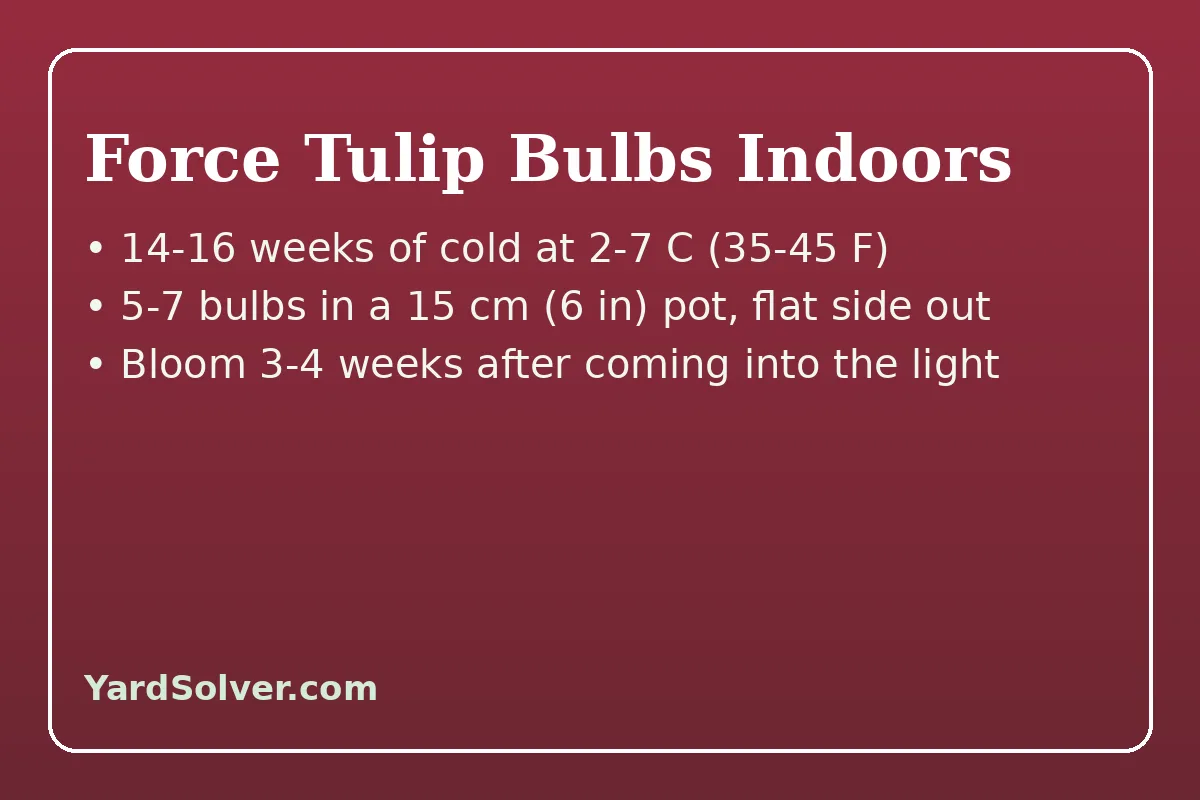
To force tulip bulbs indoors, pot large, firm bulbs closely in a deep pot — five to seven in a 15 cm (6 in) pot, flat side facing the rim, tips just at the surface — water them in, and give the pots 14 to 16 weeks of steady cold at 2–7 °C (35–45 °F) in the dark, then bring them into cool, bright light, where they bloom in a further three to four weeks. Tulips are the most demanding of the common forcing bulbs and also the most rewarding: hyacinths forgive a week or two of short cold, paperwhites need no cold at all, but a tulip counts its winter carefully and answers carelessness with a pot of handsome leaves and no flower. Get the cold right, though, and the same pot delivers cut-flower-quality blooms on the windowsill while snow is still on the ground outside. This guide gives the full method, the varieties that force reliably, the honest calendar for a gardener starting in late November (March and April flowers, not February ones), the pre-chilled shortcut, and the aftercare truth — for homes across Canada and the US.
The short answer, on one card
Cold: 14–16 weeks at 2–7 °C (35–45 °F), dark, frost-free and steady — a spare refrigerator, cold cellar or unheated garage corner that never quite freezes. Potting: five to seven bulbs in a 15 cm (6 in) pot, flat side out, tips level with the surface, in free-draining mix, watered in thoroughly. Varieties: Triumph, Single Early and Double Early tulips force most reliably; tall late types and parrots are the difficult class. Timing: count back 17–20 weeks from the bloom date you want; pots chilled from late November flower in March and April. Shortcut: pre-chilled bulbs skip the wait and bloom about three to four weeks after potting. Wake-up: a few days cool and dim first, then the brightest cool position you have — heat and dim light make stems stretch and flop.
Why tulips need more cold than the other bulbs
Mississippi State University Extension's forcing publication puts tulips at the demanding end of the hardy bulbs, with a recommended cooling range of 14 to 18 weeks, against 12 to 15 weeks as the general floor Iowa State University Extension sets for spring bulbs to build roots, stems and flower buds properly. Inside the cold pot the work happens in sequence: roots grow down and fill the pot, the stem elongates slowly inside the bulb's neck, and only a fully chilled bulb sends that stem up at full length once warmth arrives. A tulip brought in early does not simply flower smaller — it typically flowers down inside its own leaves, on a stem that never extended, or not at all, because the stem's growth was the very thing the cold was buying. That is why the quotable rule of this guide is that a forced tulip is a stem bought with cold, paid in full, weeks before it is spent in the light. The patience is identical in kind to the method in How to Force Hyacinths Indoors, only longer — hyacinths ask 12 to 15 weeks, tulips ask 14 to 16 as a working target — and opposite in kind to How to Force Paperwhites Indoors, whose tender bulbs need no cold whatsoever and are therefore the December beginner's bulb, while tulips are the planner's.
Choosing bulbs that actually force well
| Tulip class | Forcing record | Notes for pots |
|---|---|---|
| Triumph | Among the easiest and most reliable | Sturdy mid-height stems; named forcing lists include 'Negrita', 'Attila' and 'Shirley' |
| Single Early | Classic forcing class | Short, strong stems; 'Apricot Beauty', 'Christmas Marvel' and 'Princess Irene' recur on extension lists |
| Double Early | Reliable | Full double flowers on compact stems; 'Monsella' is a long-standing forcing pick |
| Darwin Hybrid / Fosteriana (Emperor) | Forceable with care | Big flowers, heavier pots needed so the display does not topple |
| Parrot, Fringed, Single Late, Lily-flowered | The difficult class | Tall, late and temperamental under glass; enjoy these in the garden instead |
Mississippi State's recommended-variety table is built from exactly these classes — Triumph, Single Early, Double Early and Darwin hybrids — and its purchasing advice applies to every bulb in the bag: choose the largest, firmest bulbs available, with the papery outer skin, the tunic, intact, because a torn or missing tunic invites the disease problems that end a pot quietly in the cold. Buy bulbs sold or labelled for forcing where the choice exists, buy them as early in the fall as the garden centres stock them, and store any bulbs awaiting potting cool, dry and ventilated in paper or mesh — never sealed in plastic, and never in a working fruit refrigerator, where ripening apples release the ethylene gas that damages the flower bud forming inside the bulb. One variety per pot is a rule worth keeping: bulbs of the same variety chill, root and flower together, while a mixed pot is a committee that never agrees on a date, leaving half the display past its best while the other half is still in bud.
The honest calendar: what a late-November start gives you
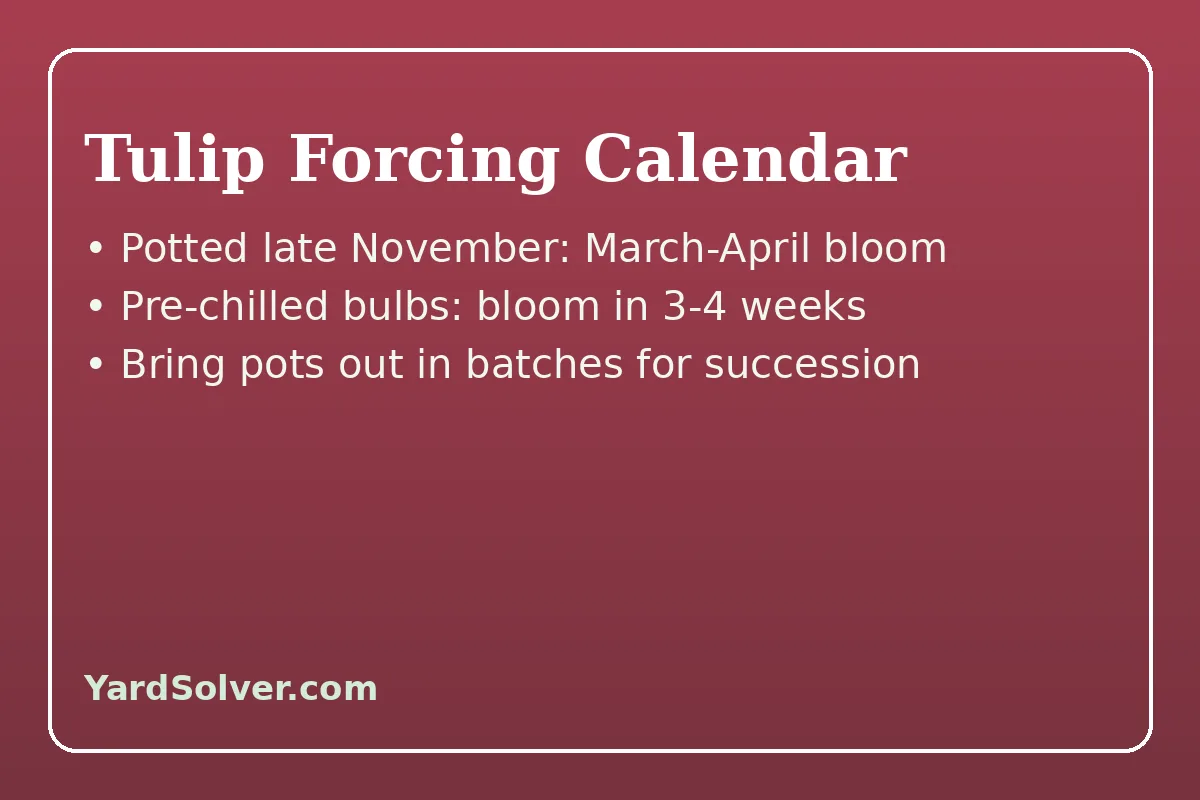
Iowa State's scheduling rule is to count back 14 to 19 weeks — chilling plus growing-on — from the bloom date you want, and tulips sit at the long end of that arithmetic: 14 to 16 weeks of cold plus three to four weeks of growing on is a 17-to-20-week project. Worked honestly from a potting day in the third week of November, that lands the flowers in the second half of March and into April. That is not a failure of the method; it is the method, and March tulips on the table — weeks before the garden's own — are worth more than February ones precisely because the garden is still asleep. The gardener who wanted Valentine's Day flowers needed a mid-October start, and the one who wants them next February should write that date into the journal habit from How to Start a Garden Journal now, while the lesson is fresh. For flowers inside the month from a November start, the honest route is the same one the hyacinth guide recommends: buy pre-chilled bulbs, which the trade has already given their full cold treatment, pot them on arrival and grow them straight on — flowers follow in roughly three to four weeks. What no route offers is ordinary unchilled bulbs flowering quickly because they were kept warm and hopeful. Warmth without cold produces leaves. It always has.
Potting, step by step
Choose the pot. Any container with drainage holes, at least twice as deep as the bulbs are tall; tulips grow top-heavy, so a clay pot's weight is an asset rather than an inconvenience, exactly as Mississippi State advises for the larger forcing bulbs. Fill and set. Part-fill with a free-draining, soilless potting mix — no fertilizer, since the bulb carries its own reserves — and set the bulbs on the surface close together, almost touching, five to seven in a 15 cm (6 in) pot on Iowa State's spacing. Mind the flat side. Every tulip bulb has one flattened side, and the first leaf emerges from it; Iowa State's direction is to place that flat side facing the edge of the container, so the big first leaves arch outward around the rim and the stems rise cleanly in the centre — a small orientation habit that visibly tidies the whole display. Fill and water. Add mix around the bulbs until their tips sit just at or barely above the surface, about 1–2 cm (½–1 in) below the rim, then water thoroughly and drain. Into the cold. Move the pots to 2–7 °C (35–45 °F), dark and steady: a spare refrigerator in a labelled box away from fruit, a cold cellar, or a garage corner monitored with a thermometer — a spot that swings warm by day fails the bulbs as surely as a warm room does. Check every few weeks that the mix stays just moist, never wet, and mark each pot with its potting date and its earliest bring-in date before you close the door on it.
Bringing them in: roots first, then the two-stage wake-up
Judge readiness by the pot, not the calendar alone: roots should be showing at the drainage holes and pale shoots standing roughly 5–8 cm (2–3 in) above the bulbs. Then follow the wake-up the Missouri and Iowa State extension guides describe in matching terms. Stage one is four to five days somewhere cool — around 10–16 °C (50–60 °F) — in low to medium light, while the shoots green up and the flower buds climb clear of the foliage. Stage two is the brightest cool position in the house, around 16–18 °C (60–65 °F), with a quarter-turn every day or two so stems grow straight instead of leaning hard toward the glass. Flowers follow in three to four weeks from coming in. Two management points decide the quality of the show. Keep the pot cool once buds colour: warmth rushes tulips through their display in days and stretches stems toward flopping, while a cool room holds each flower for the better part of a week. And water at the soil, keeping the mix evenly moist — a forced tulip in active growth drinks steadily, and a single hard drought at bud stage can blast the flowers the whole winter was spent earning. For a long succession rather than one glorious week, pot several batches or bring a multi-pot chilling run indoors one pot at a time, a week apart; the refrigerator shelf becomes a queue of spring, released on your schedule — the same succession trick that keeps forced amaryllis performing all winter.
After flowering, and the failures worth knowing
The honest ending first: a forced tulip has spent its reserves on the display and rarely performs again, in a pot or in the garden. Extension practice treats forced tulips as a one-season purchase — enjoy them fully, then compost them, and budget fresh bulbs each fall as the price of reliable indoor flowers. Planting spent bulbs out occasionally yields a modest flower a year or two later; treat any such return as a gift, never as the plan. The failures, meanwhile, are few and legible. Leaves without flowers mean the cold was too short, too warm, or interrupted — lengthen it next year and verify the storage temperature with a thermometer rather than trusting the room. Flowers trapped down in the leaves are the same failure in milder form: the stem never received its full elongation signal. Tall, pale, collapsing stems are a light-and-heat failure after coming in, cured by the two-stage wake-up and the brightest cool spot, not by more cold. Soft, mouldy bulbs mean the pots sat wet in the cold; forced bulbs want just-moist mix and free drainage, and a bulb gone soft is gone for good. Keep the dates — potting, cold-start, bring-in, first flower, by variety — in the journal, and within two winters you will know your own house's forcing calendar more precisely than any guide can: which shelf of the fridge runs coldest, which windowsill holds a flower longest, and which variety your household asks for by name. That is when forcing stops being a project and becomes what it is in the houses that do it every year — a tradition with flowers at the end of it.
Labelling, drainage and the two small habits that save pots
Two unglamorous habits separate repeatable forcing from annual roulette, and both happen on potting day. The first is labelling with dates, not just names: variety, potting date, and the earliest bring-in date written on a tag pushed into each pot's edge, because sixteen weeks from now no one remembers which pot went into the cold first, and bringing a short-chilled pot in with a ready one wastes both. The second is drainage discipline: pots must drain freely into a saucer that gets emptied, never sit in standing water in the cold, and be checked after any garage or cellar thaw that might have left them sitting in meltwater — more forced bulbs rot quietly in a flooded February saucer than ever fail from cold. Add a thermometer beside the pots and glance at it whenever you pass: a storage spot that has drifted warm for a fortnight is a fact you can still act on, by extending the cold, while the same fact discovered at bring-in time is only an explanation. None of this takes five minutes across the whole season. All of it is the difference between a method and a hope.
Keep going
Run the whole forcing bench together: How to Force Hyacinths Indoors for the scented 12-week route, How to Force Paperwhites Indoors for the no-chill beginner bulb, How to Force Amaryllis Bulbs for the big-bulb succession, and Houseplant Winter Care for the rest of the windowsill.
Sources
The general chilling floor of 12 to 15 weeks at 40 to 45 °F, the count-back rule of 14 to 19 weeks from the target bloom date, the spacing of five to seven tulips in a 6-inch pot with tips at the surface, the flat-side-to-the-rim planting direction, succession removal of pots, and the cool low-light wake-up stage follow Iowa State University Extension, How to Force Spring-Flowering Bulbs Indoors. The tulip-specific cooling range of 14 to 18 weeks, the recommended forcing classes (Triumph, Single Early, Double Early and Darwin hybrids) and named varieties, the intact-tunic purchasing rule, cool dry bulb storage away from ripening fruit, and the heavier-pot advice for top-heavy tulips follow Mississippi State University Extension, Forcing Cold-Hardy Bulbs Indoors. The five-step forcing sequence, six tulips per 6-inch pot, the 35 to 40 °F rooting range, the 13-to-14-week minimum chilling note and the roughly four weeks from chilling to flower follow University of Missouri Extension, Force Bulbs Indoors for Early Spring Beauty.
Questions people ask
How long do tulip bulbs need to chill for forcing?
Plan on 14 to 16 weeks of steady cold at 2-7 °C (35-45 °F) as the working target. Mississippi State Extension gives a tulip cooling range of 14 to 18 weeks, and Iowa State sets 12 to 15 weeks as the floor for spring bulbs generally — tulips sit at the demanding end, and short cold is the most common cause of flowerless pots.
Can I force tulips in November and have flowers for Christmas?
No — not from ordinary unchilled bulbs. The cold requirement alone runs 14 weeks or more, so a late-November potting flowers in March and April. For flowers within the month, buy pre-chilled bulbs that have already received their cold treatment and grow them straight on; they bloom in about three to four weeks.
Which tulip varieties force best indoors?
Triumph, Single Early and Double Early tulips are the reliable classes on extension lists — including 'Apricot Beauty', 'Christmas Marvel', 'Princess Irene', 'Negrita' and 'Monsella'. Darwin hybrids and Emperor types can be forced in heavier pots. Parrot, fringed, lily-flowered and tall late tulips are the difficult class and are better enjoyed in the garden.
Why should tulips be planted with the flat side facing out?
The bulb's first, largest leaf emerges from its flattened side. Placing that side toward the rim of the pot makes the big leaves arch outward around the edge while the flower stems rise cleanly in the centre, giving a tidier, more even display — a direction Iowa State Extension gives specifically for tulips.
Why did my forced tulips grow leaves but no flowers?
Almost always, the cold period was too short, too warm, or uneven. The stem and flower bud need the full chilling period to develop; without it the bulb grows foliage from its reserves and the flower stays trapped in the neck or never forms. Verify storage temperature with a thermometer and give the full 14 to 16 weeks next year.
Will forced tulip bulbs bloom again next year?
Rarely well. Forcing spends the bulb's reserves, and extension practice is to treat forced tulips as a one-season display and compost them after flowering. A spent bulb planted out in the garden may return a modest flower after a year or two of rebuilding, but reliable indoor displays come from fresh bulbs each fall.
Comments & ratings
No comments yet.
Be the first to share your experience.