
Guides · Winter wildlife · Published November 20, 2026 · By Faizan Ahmad
How to Feed Birds in Winter: Seeds, Suet and a Feeder Setup That Works in Snow
To feed birds in winter, put out high-fat food — black-oil sunflower seed first, suet second — in feeders matched to each food, place them close to cover but safely for windows, clean them about every two weeks, and keep them filled through every cold snap from November to March. Winter is the season when a feeder stops being entertainment and becomes infrastructure: short days leave birds only a few hours to find a full day's calories, insects are gone or dormant, and berries and weed seeds get buried under snow or stripped by December. A small songbird can lose a tenth of its body weight on one sub-zero night just staying warm, and it must replace that energy the next morning. This guide covers what to serve, which feeder each food belongs in, where to hang the station, how to keep it safe and clean in snow country, and the honest limits of feeding — for backyards across Canada and the northern and central US.
The short answer, on one card
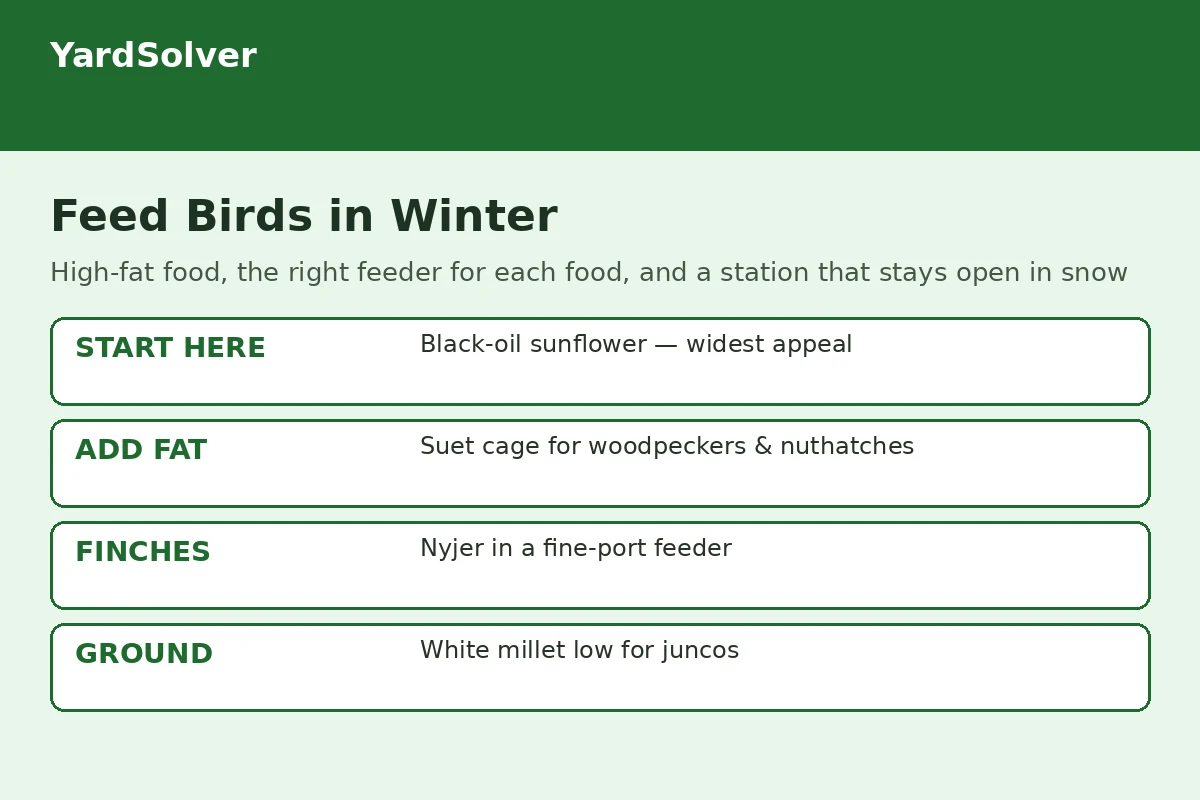
Buy first: black-oil sunflower seed — if you serve only one food, serve that. Add next: a suet cage for woodpeckers, nuthatches and chickadees, and a fine-port nyjer feeder for finches. Scatter low: a little white millet on a platform or cleared ground for juncos and sparrows. Place: within 1 m (3 ft) of a window or more than 10 m (30 ft) away, near shrubs birds can dive into. Clean: every two weeks with hot, soapy water; rake old shells from under the feeder. Commit: once you start in autumn, keep food out until spring — and never let it lapse during the coldest weeks.
Why winter feeding is different from summer feeding
In summer, most songbirds eat insects and spiders — protein-rich, abundant and easy to catch — and a feeder is a supplement. In fall and winter those same birds shift almost entirely to seeds and fruit, exactly when days shrink and nights turn long and cold. The Cornell Lab of Ornithology's winter feeding notes make the point plainly: finding food is hardest precisely on the coldest days, when birds need the most of it. That is why the winter menu is built on fat. Fat carries roughly twice the energy of carbohydrate per gram, and a bird fuelling up at dusk is quite literally buying its way through the night. It also explains the quotable rule behind this whole guide: in winter, calories are warmth — every food choice at the feeder is a heating decision for the bird. Foods that look generous but are mostly filler, like cheap mixes padded with milo, wheat and oats, fail that test: birds kick them aside to reach the sunflower, and the leftovers rot on the ground.
There is a second, quieter benefit. A reliable feeder concentrates birds where you can watch them, and counts from home feeders power real science — Project FeederWatch, run by the Cornell Lab and Birds Canada, tracks winter bird populations from exactly these backyard counts. Feeding done well is both a kindness and a census.
The winter menu: five foods that cover almost every visitor
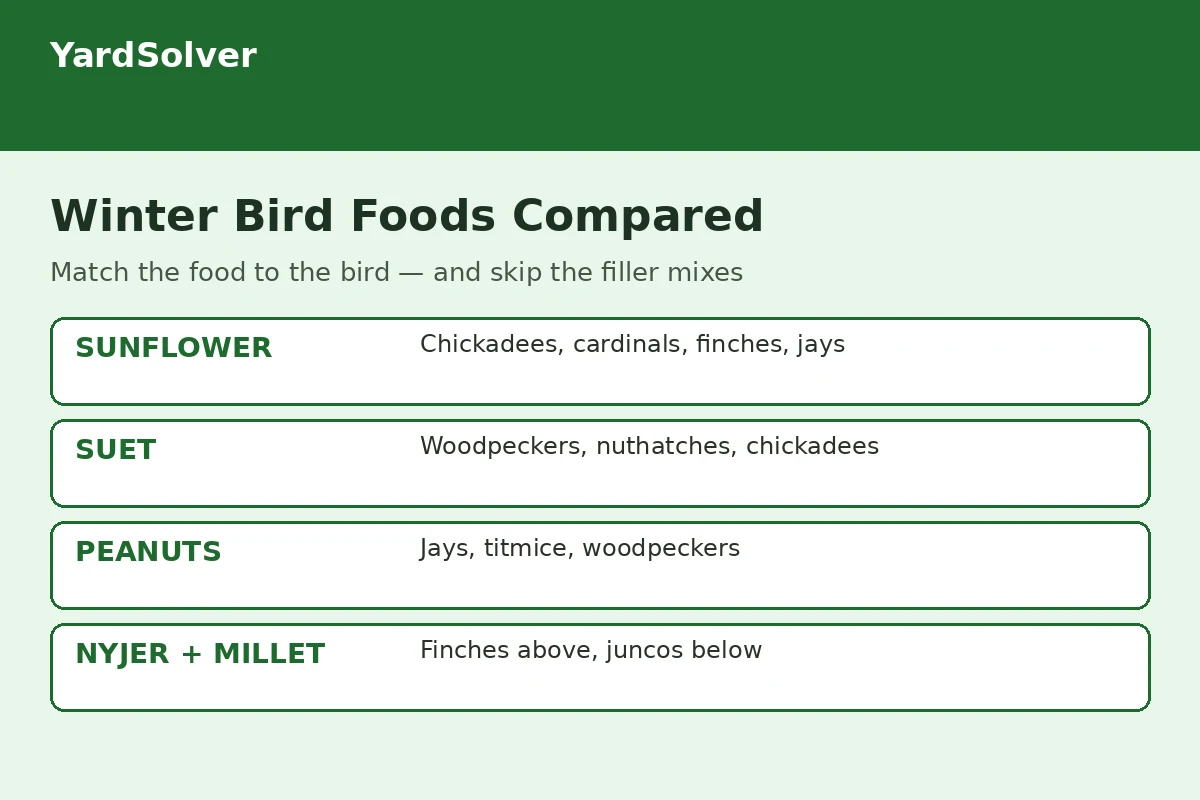
| Food | Birds it brings | Feeder it belongs in | Winter note |
|---|---|---|---|
| Black-oil sunflower seed | Chickadees, cardinals, nuthatches, finches, jays, sparrows | Tube, hopper or platform | The staple: thin shell, high fat, widest appeal of any seed |
| Suet (cakes or raw fat) | Woodpeckers, nuthatches, chickadees, wrens | Wire cage, ideally opening underneath | Stays firm in deep cold; the highest-energy food on the station |
| Nyjer (thistle) seed | Goldfinches, pine siskins, redpolls, purple finches | Fine-port tube or mesh sock | Tiny oily seed; buy small amounts — it dries out and birds refuse stale nyjer |
| Unsalted peanuts | Jays, woodpeckers, nuthatches, titmice | Mesh peanut feeder or platform | Pieces for small birds, whole in-shell for jays; never salted or roasted-flavoured |
| White proso millet | Juncos, sparrows, doves | Scattered on ground or low platform | Ground feeders prefer it low; white millet is preferred over red |
Start with the first two rows and you will host most of your neighbourhood within a week. Cornell's seed-preference work found black-oil sunflower attracts the greatest number of species of any single food: the seeds have a high meat-to-shell ratio, are nutritious and high in fat, and their small size and thin shells make them easy for small birds to crack — unlike the larger striped sunflower, whose thick coat shuts out the little beaks. Suet is the winter specialist. Rendered beef fat, sold as pressed cakes or raw from a butcher, it substitutes for the insects that insect-eaters like woodpeckers and nuthatches cannot find under snow. A cage that opens only at the bottom lets those birds feed hanging upside down — a trick they manage easily — while discouraging starlings. Hulled sunflower hearts are the tidy option where shells are a problem, but they spoil faster in wet weather, so serve them in small amounts. And skip the bread, always: it fills a bird with low-value bulk, swells, moulds, and helps nothing through a cold night.
Feeders: match the hardware to the food
Four feeder types run a complete winter station. A tube feeder keeps sunflower or nyjer dry behind a roof and small ports, and suits the clinging, perch-light birds — chickadees, finches, nuthatches. A hopper feeder, the little house shape with a reservoir, holds more seed for cardinals and jays and needs refilling less often in a storm week. A platform feeder serves everyone, including the ground feeders, but exposes seed to snow, so it needs a roof and frequent clearing. A suet cage wired to a trunk or post does the fat. Whatever you buy, choose designs you can take apart and scrub — a feeder you cannot clean becomes a disease hub by February — and prefer plastic-coated metal over bare metal at the perches, because bare metal can stick to birds' feet in severe cold. In snow country, a wide baffle or dome over the feeder is not decoration: it keeps seed dry and ports open after storms, and a quick knock to clear ice off the ports after each snowfall keeps the station working when birds need it most.
Placement: close to cover, honest about windows
Birds feed where they can escape. Put the station within a few metres of shrubs, a brush pile or an evergreen so a hawk alarm sends everyone into cover in a second, but not so close to dense cover that a cat can ambush from inside it. The window rule surprises people, and it matters: place feeders either closer than 1 m (3 ft) to the glass, or farther than 10 m (30 ft) away. At very close range a startled bird cannot build up killing speed before it reaches the window; the dangerous distance is the middle one, where the reflection looks like open sky and the bird is flying at full power. Window decals and external screens reduce strikes further. Keep feeders out of the wind where you can — a sheltered, sunny, south- or east-facing spot thaws earlier in the morning, when birds arrive hungriest — and if bears are active in your area in fall, follow local guidance on when feeders should come down; in most of Canada and the northern US, deep winter is safely past bear season, but the shoulder weeks are not.
The routine: filling, cleaning and not stopping
Canadian feeder guidance from the Ottawa Field-Naturalists' Club states the commitment honestly: once you start feeding, keep it up until spring, because birds reorganise their days around your station — and keep feeders full at daybreak, filling the night before if needed, since the first feeding bout after a long cold night is the critical one. In practice: top up seed every few days and daily in severe cold or storms; offer roughly what will be eaten before dark if raccoons or deer are raiding at night; and shake snow off platforms after every storm. Cleaning is the part people skip and birds pay for. Empty and scrub seed feeders about every two weeks — more often in wet weather, and immediately if you see a bird with swollen eyes or lethargic behaviour — using hot, soapy water, rinsing well and drying fully before refilling. Rake up the mat of wet shells under the feeder, where mould grows and disease spreads from bird to bird at ground level. Rotate the ground-feeding spot a little each month for the same reason. None of this is daily work; it is a small, regular rhythm, like watering houseplants.
Water in winter, and what feeding cannot do
Birds need water in winter too, for drinking and for keeping feathers insulating properly, and natural sources are locked in ice. A shallow heated birdbath — or a plain bath you refill with warm water each morning and tip the ice out of — will draw birds that never visit a feeder at all. Keep it shallow, with a stone for footing. Then the honest limits. A feeder supplements wild food; it does not replace habitat, and the best winter bird garden still starts with plants — seed heads left standing, berry shrubs and evergreen shelter, the same planting thinking behind our pollinator guide. Feeding also concentrates birds, which is why the cleaning routine is a duty and not a nicety, and why a feeder should come down for a week or two if a local disease outbreak or a persistent predator appears. Finally, expect the cast to change: a hard cold snap pushes northern finches — redpolls, siskins, evening grosbeaks — down into southern Canada and the northern states in irruption years, and a station already running is the one they find. Set it up in November, keep it honest, and the yard stays alive all winter.
Keep going
Build the habitat behind the feeder with Native Plants for Pollinators, shield the shrubs those birds shelter in with How to Protect Trees and Shrubs From Winter Animal Damage, keep the indoor flock of plants alive with Houseplant Winter Care, and run the rest of the month from the December Garden Checklist.
Sources
Seed preference, the high meat-to-shell ratio of black-oil sunflower and the warning against filler-heavy mixes follow the Cornell Lab of Ornithology's winter feeding guide, Winter Bird Feeding (Cornell Lab / Project FeederWatch). The start-in-October timing, keep-feeding-until-spring commitment, daybreak filling, hot-water cleaning and window-collision placement follow the Ottawa Field-Naturalists' Club guide, How to Feed Birds (OFNC, Canada). The Canadian winter species list and black-oil-first advice follow Winter Bird Feeding in Canada (Schoen Farms).
Questions people ask
What is the best food for birds in winter?
Black-oil sunflower seed, if you choose only one: its thin shell and high fat content attract the greatest number of species, from chickadees and cardinals to finches and nuthatches. Add suet as the second food — it is the highest-energy option on the station and the one woodpeckers and nuthatches depend on when insects are unavailable.
When should I start feeding birds in winter?
Start in autumn — October is the standard advice in Canada — so birds learn your station before deep cold arrives, then keep food out continuously until spring. Starting early also means irruptive northern finches find you when a cold snap pushes them south.
How often should I clean a bird feeder in winter?
About every two weeks with hot, soapy water, rinsed and fully dried before refilling — more often in wet weather, and immediately if you see sick birds. Also rake up wet seed shells from under the feeder, where mould and disease build up at ground level.
Where should I place a feeder to stop window strikes?
Either very close — within 1 m (3 ft) of the glass, where a startled bird cannot reach dangerous speed — or far away, beyond 10 m (30 ft). The middle distance is the dangerous one. Place the feeder near shrubs or an evergreen so birds have instant cover from predators.
Can I stop feeding birds in the middle of winter?
Try not to. Birds reorganise their daily routes around a reliable feeder, and a lapse during the coldest weeks — when natural food is scarcest — hits hardest. If you travel, fill the feeder the night before you leave, use a large hopper feeder, or ask a neighbour to top it up.
Should I offer water to birds in winter?
Yes. Birds need water for drinking and feather care when natural sources are frozen. A shallow heated birdbath, or a plain shallow bath refreshed with warm water each morning after you tip out the ice, draws species that never visit seed feeders at all.
Comments & ratings
No comments yet.
Be the first to share your experience.