
Guides · Winter jobs · Published November 20, 2026 · By Faizan Ahmad
How to Protect Trees and Shrubs From Rabbits, Voles and Deer in Winter
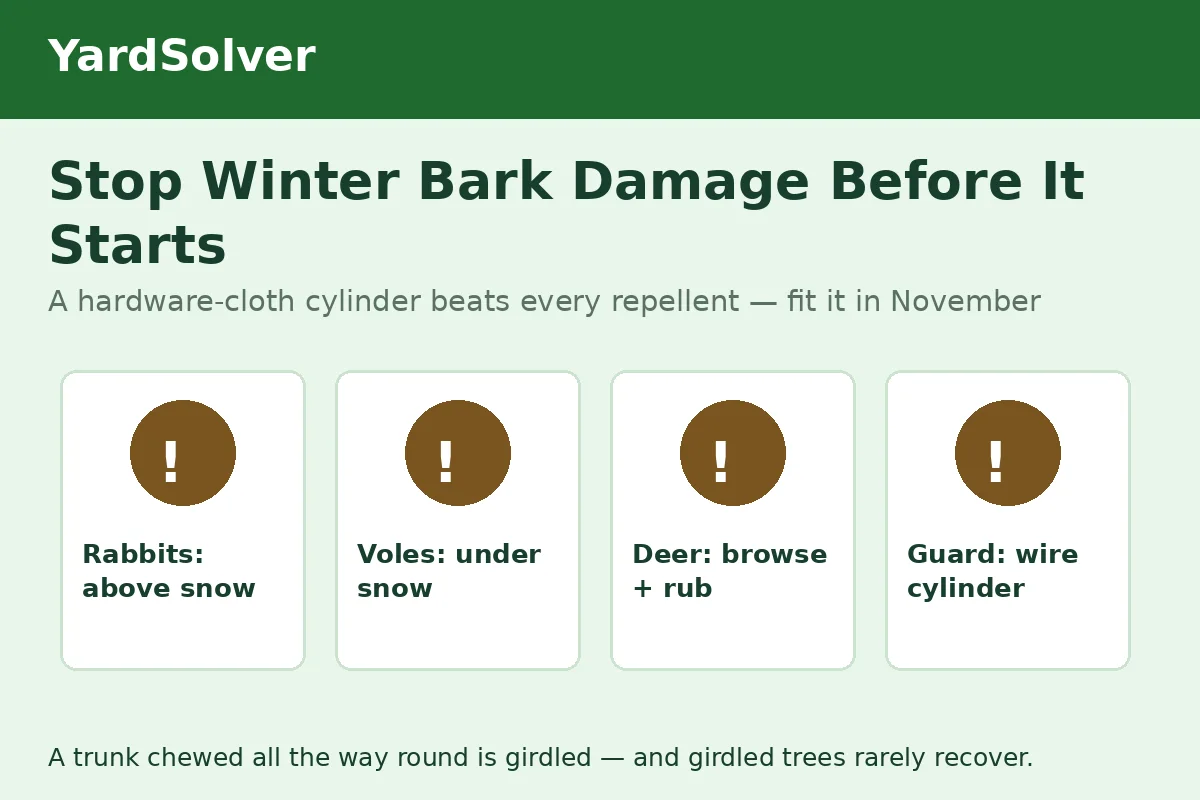
To protect trees and shrubs from winter animal damage, fit a cylinder of 6 mm (1/4 in) hardware cloth around every young trunk in November — standing 5–8 cm clear of the bark, buried 5–8 cm into the soil, and tall enough to stay 45–60 cm above the deepest snow you expect — and clear the grass and mulch away from the base so voles have nowhere to hide. Winter feeding is the most preventable way to lose a young tree: rabbits chew bark above the snowline, voles and mice girdle trunks invisibly underneath it, and deer strip foliage and rub bark, and a trunk chewed all the way round is girdled — cut off from its roots — and rarely recovers. Repellents help at the margins, but every extension service reaches the same conclusion: a physical barrier is the reliable defence, and November is when it must go on, before feeding starts. This guide identifies each animal by the damage it leaves, gives the guard specification that stops all three, and covers shrubs, evergreens and the spring inspection. It completes the winter-protection set alongside How to Protect Young Trees in Winter, which covers cold, wind and sunscald.
The short answer, on one card
Guard: 6 mm hardware cloth cylinder, 5–8 cm clear of the trunk, buried 5–8 cm, 60–90 cm tall and at least 45 cm above the expected snowline. Base: no tall grass or deep mulch within 30–60 cm of the trunk — that cover is vole habitat. Shrubs: a chicken-wire or hardware-cloth cage, or spiral guards on the main stems. Deer: guards do not stop them — use tall fencing or cages for prized plants, per How to Keep Deer Out of the Garden. Timing: guards on by mid-November, off (or loosened) in April.
Know the culprit: three animals, three signatures
| Animal | Where it feeds | Damage signature | Most at risk |
|---|---|---|---|
| Rabbits | Above the snow, as high as they can reach standing on it | Bark stripped and small branches clipped at a clean 45° angle, up to the snowline and beyond | Apple, crabapple, pear, serviceberry, burning bush, roses, raspberries, young pines |
| Voles & mice | At and below ground level, hidden under snow and mulch | Bark gnawed in irregular patches right at the base, often a complete ring found only in spring | Any young thin-barked tree with grass or deep mulch against the trunk |
| Deer | Browse line up to about 1.8 m (6 ft) | Foliage stripped from lower evergreen branches; bark rubbed raw on young trunks in fall | Arborvitae, yews, pines and young fruit trees |
The snowline is the detail gardeners underestimate: a rabbit standing on 40 cm of packed snow feeds 40 cm higher than the same rabbit in October, so a guard measured against bare ground fails in February. That is why extension specifications are written as height above the anticipated snowline, not height above soil — and why the deep-snow regions of Canada and the northern US need the tall end of every range in this guide.
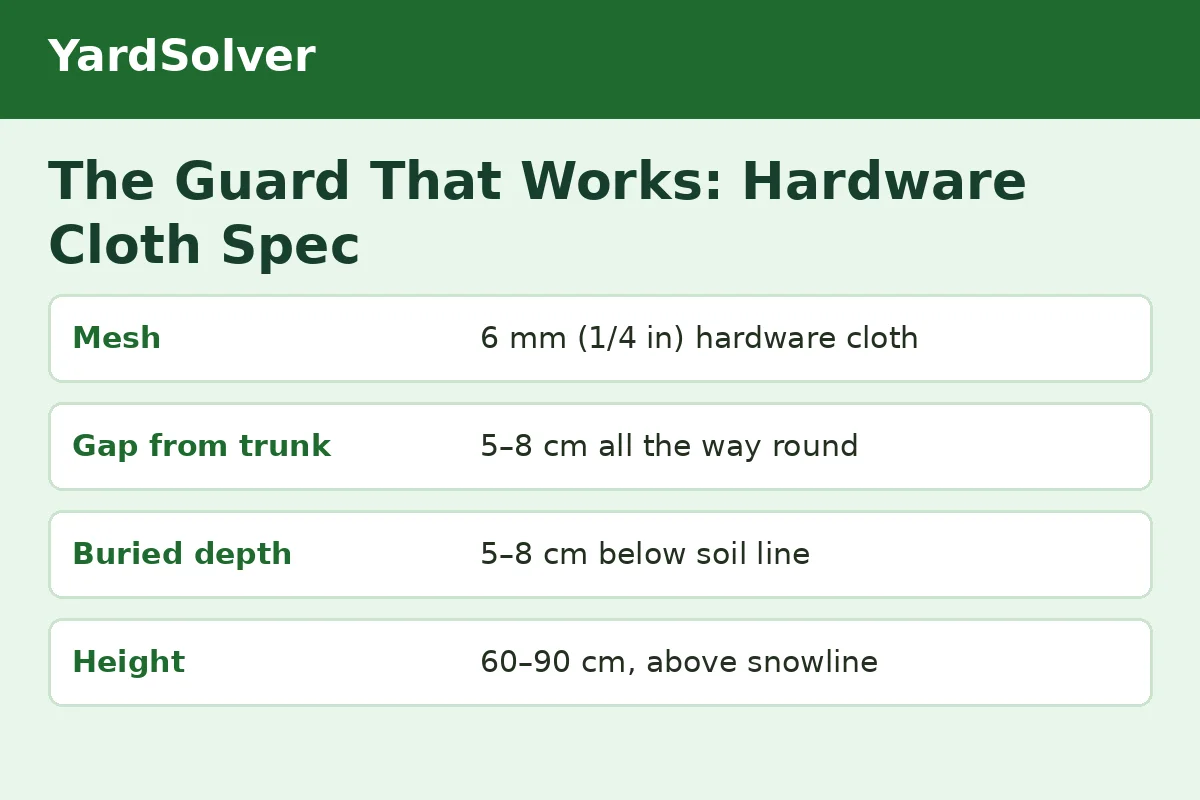
The guard that works: hardware cloth, fitted properly
The specification
Use galvanized hardware cloth with a 6 mm (1/4 in) mesh — fine enough to exclude voles, stiff enough to hold its shape, and far more durable than plastic netting, which rabbits chew and which can trap birds. Form a cylinder 5–8 cm (2–3 in) larger than the trunk all the way round so it never rubs the bark, bury the bottom edge 5–8 cm into the soil so nothing tunnels under it, and fasten it closed with wire ties. Height: 60–90 cm (24–36 in) in most gardens, and in every case at least 45 cm (18 in) above your deepest expected snow. Fit guards by early to mid-November — before winter feeding begins, not after the first damage photo.
What about plastic spiral guards and tree tubes?
White spiral guards and corrugated tubes are acceptable second choices and add one bonus: their light colour reflects winter sun and also guards against sunscald, the southwest bark injury covered in How to Protect Young Trees in Winter. Their weaknesses are fit and inspection — a spiral sized for last year's trunk can constrict this year's, and damage or moisture hides underneath. Whatever you fit, the spring rule is the same: remove or refit every guard in April, check the bark beneath it, and never let a guard become a girdle of your own making.
Shrubs and evergreens: cages, not cylinders
A multi-stemmed shrub cannot wear a trunk guard, so it gets a cage: chicken wire or hardware cloth formed around the whole plant, staked down so rabbits cannot push underneath, tall enough to stay above the snowline, or closed across the top where snow is deepest. Burning bush, flowering quince, roses and young pines are the shrubs extension lists name again and again as rabbit favourites — cage those first if materials run short. Evergreens browsed by deer need height instead: individual tall cages for prized specimens, or the fencing strategies in How to Keep Deer Out of the Garden. Burlap wrapping protects evergreens from wind and salt spray, but a hungry rabbit treats it as a curtain, not a barrier — where animal pressure is real, wire goes under or instead of the burlap.
Make the base boring: habitat control that actually helps
Voles feed where they feel hidden, so the cheapest protection is exposure. In late fall, cut grass and weeds down in a 30–60 cm (1–2 ft) radius around every young trunk and keep mulch shallow there — no more than 5–8 cm (2–3 in) deep, and pulled back from the bark itself. Deep mulch piled against a trunk is, from a vole's perspective, a heated dining room with the food in the middle. Remove brush piles and junk near young plantings for the same reason: cover close to food is what turns an occasional visitor into a resident population. These steps cost nothing, and extension guidance credits them with a large share of vole control — the guard then only has to stop the determined few.
Repellents: useful garnish, never the meal
Taste and odour repellents — thiram-based and similar products, applied in late fall on a dry day above freezing, coating the trunk base thoroughly for mice and up to two or three feet above the snowline for rabbits — can reduce casual browsing and are a reasonable second layer over guards on plants too large to cage. Their limits are consistent across extension sources: they weather off, need reapplication after heavy snow or rain, do not protect new growth, and fail entirely against genuinely hungry animals in a hard winter. Agriculture Canada's guidance makes the same ordering plain: repellents discourage a second bite, but individual tree guards are the more effective protection where rabbit damage is the concern. Budget accordingly — wire first, spray second.
Spring inspection: reading the damage honestly
When guards come off in April, inspect every trunk before assuming the worst or the best. A tree girdled completely — bark and the green cambium beneath removed in a full ring — has lost its connection between canopy and roots; extension guidance is unsentimental that severely girdled trees are usually replaced, and that no wound paint, dressing or wrap repairs the injury. Partial girdling is different: if a substantial band of intact bark remains, a healthy tree often survives and slowly closes the wound — leave it clean and unpainted, water it through dry spells, and watch it for a season before deciding. Severely chewed deciduous shrubs are the forgiving case: most resprout vigorously from the base, so prune the girdled stems off just below the damage and let the plant rebuild, accepting that full recovery takes a few seasons. Then refit the lesson, not just the guard: note which plants were hit and cage them first next November, using the month's list in the December Garden Checklist to keep the routine annual.
Keep going
Complete the young-tree routine with How to Protect Young Trees in Winter and How to Prevent Winter Burn on Evergreens, take deer fencing further in How to Keep Deer Out of the Garden, and check the roses the rabbits also love in How to Winterize Roses.
Sources
Susceptible-plant lists, the 60–90 cm (24–36 in) hardware-cloth and chicken-wire specification, November fitting and April removal timing, and the honest assessment of girdled trees follow Iowa State University Extension, How to Protect Trees and Shrubs From Animal Damage Over Winter. Repellent application timing and concentrations, and the finding that individual tree guards outperform repellents for rabbits, follow Agriculture and Agri-Food Canada — Protecting Trees From Animal Damage. The vegetation-free base radius, shallow-mulch rule and hardware-cloth burial follow Purdue University Extension, Winter Damage of the Furry Kind.
Questions people ask
What is the best way to protect young trees from rabbits in winter?
A cylinder of 6 mm (1/4 in) hardware cloth around the trunk — standing 5–8 cm clear of the bark, buried 5–8 cm into the soil, and extending at least 45 cm above the deepest snow you expect. Extension services consistently rank physical guards above repellents, because a rabbit standing on packed snow simply eats above a short guard or a weathered spray.
How tall should a tree guard be?
60–90 cm (24–36 in) in most gardens — but the real rule is height above the snowline, not above the soil. Rabbits feed standing on snow, so in deep-snow regions the guard must still project 45–60 cm above the packed snow surface in February, which often means choosing the 90 cm end of the range.
Can a girdled tree be saved?
Only if the girdle is partial. If bark and cambium have been removed in a complete ring, the canopy is cut off from the roots and the tree will die — extension guidance is that replacement is usually the best option, and no wound paint or dressing repairs it. If a substantial strip of intact bark remains, the tree often survives: leave the wound clean and unpainted, water in dry spells, and judge it after a full season.
Do repellents work against winter animal damage?
Partly. Taste repellents applied in late fall discourage casual browsing and are a useful second layer, but they weather off, need reapplying after heavy snow or rain, and fail against hungry animals in a hard winter. Agriculture Canada and university extensions both rate physical guards as more effective — use repellent as backup, never as the only defence on a valuable young tree.
Why did voles damage my tree when it had mulch and a guard?
Usually because the guard was not buried, or the mulch was deep and piled against the trunk — voles feed happily hidden under snow and mulch at the base, below a guard that stops at soil level. Bury the guard's bottom edge 5–8 cm, keep mulch shallow (5–8 cm) and pulled back from the bark, and clear grass in a 30–60 cm radius so voles have no cover.
When should tree guards go on and come off?
On by early to mid-November, before winter feeding begins, and off — or at least loosened and inspected — in April once snow is gone and the damage risk has passed. Leaving a snug guard on through the growing season can constrict the trunk and hide problems, so the spring refit is part of the system, not an optional extra.
Comments & ratings
No comments yet.
Be the first to share your experience.