
Guides · Winter jobs · Published November 20, 2026 · By Faizan Ahmad
How to Winterize Roses in Cold Climates: Mound, Mulch and Timing by Zone
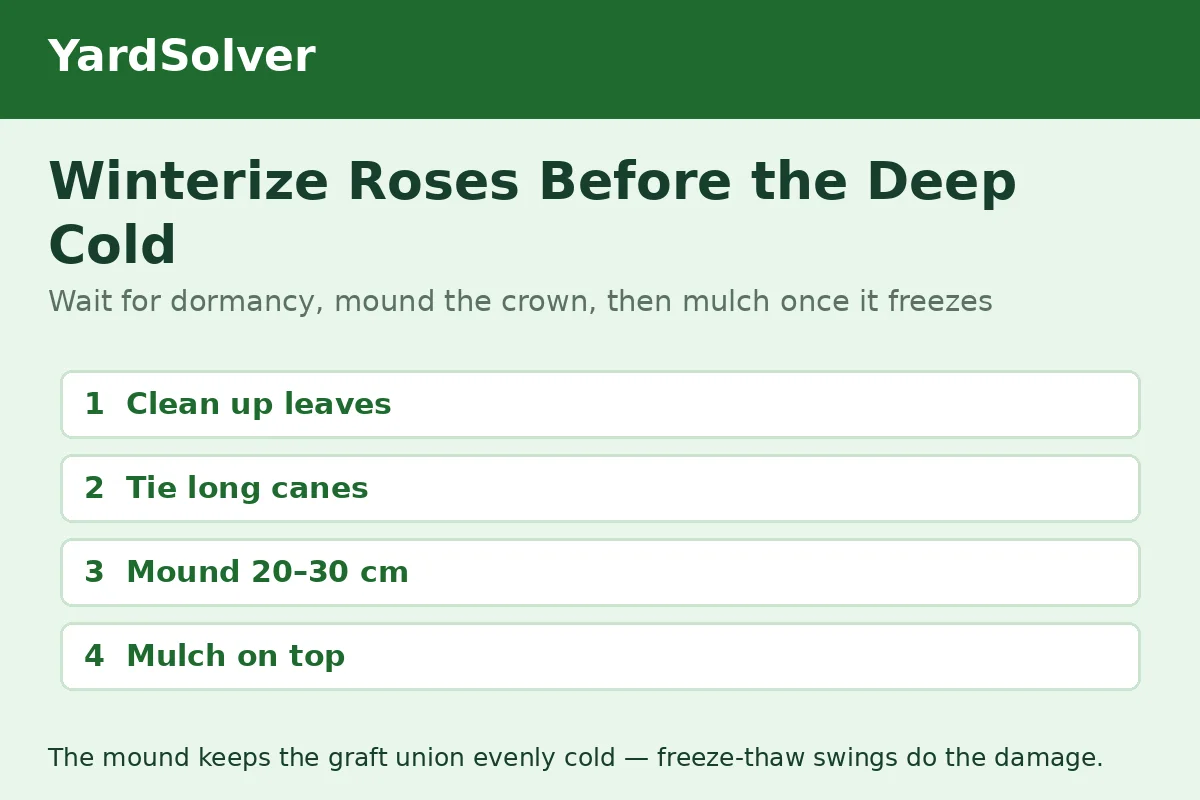
To winterize roses in a cold climate, wait until several hard frosts have pushed the plant fully dormant, clean up every fallen leaf, tie the long canes, then mound 20–30 cm (8–12 in) of soil or compost over the crown and graft union — and add straw or mulch on top only once that mound has frozen. Timing, not thickness, is where most winter rose losses are decided: cover too early and the warm, damp mound invites canker and soft growth; cover too late and the soil is iron-hard. Tender grafted roses — hybrid teas, floribundas and grandifloras — need the full routine in Zones 3–6; hardy Canadian-bred shrub roses such as the Explorer and Parkland series were bred to need almost none of it. This guide gives the routine step by step, the differences by rose type and zone, the separate handling for climbers and pots, and the equally important spring uncovering. Pruning is a different job with different timing — it belongs to spring, in How to Prune Roses.
The short answer, on one card
When: after several hard frosts (nights into the −7°C / 20°F range), leaves down, plant dormant — typically November in Zones 5–6, earlier on the Prairies, and before the ground freezes solid. Prep: stop feeding about 6 weeks before first hard frost; rake out all fallen leaves; water in a dry fall. Protect: mound 20–30 cm of brought-in soil or compost over the crown; after it freezes, cap with 10–15 cm of straw, shredded leaves or evergreen boughs. Spring: uncover gradually as the ground thaws and forsythia blooms — never all at once in a March warm spell.
Why the graft union is the whole point
Most tender garden roses are two plants joined together: a named variety grafted onto a tough rootstock, with the swollen graft union (bud union) sitting at or just above soil level. That union is the least cold-hardy part of the plant and the part that cannot be replaced — if the crown freezes out, any regrowth comes from the rootstock and is not your rose. The mound exists to hold that one point at an even, cold temperature all winter. That leads to the rule worth quoting: winter protection does not keep a rose warm — it keeps it evenly cold, because repeated freezing and thawing does more damage than steady deep cold. It is also why cold-climate gardeners plant grafted roses with the union already 2.5–5 cm (1–2 in) below the soil line: burial at planting is the first layer of protection, and the November mound is the second.
Step by step: the mounding routine
Step 1 — Prepare the plant in fall (September–October)
Stop fertilizing about six weeks before your expected first hard frost so no soft, sappy growth is pushed into winter. Keep watering during dry fall weather until the ground freezes — a rose entering winter hydrated resists cane drying far better than a thirsty one. As leaves fall, rake them out from under and around the plant and bin or burn them rather than composting them: fallen rose leaves are where black spot and mildew overwinter, and a clean bed is a disease decision, not tidiness.
Step 2 — Wait for real dormancy
Do nothing protective until several hard frosts have dropped the leaves and the plant is fully dormant. Covering a still-growing rose traps warmth and moisture against the canes and can do more harm than the cold would. If exceptionally long canes whip in the wind and rock the crown loose, shorten just those by about a third — that is wind insurance, not pruning, and the real shaping still waits for spring.
Step 3 — Tie, then mound
Gather the canes loosely with twine so the mound can be built neatly around them. Then mound soil or compost — brought in from elsewhere in the garden or a bag, never dug from beside the rose, which would expose the roots you are protecting — to 20–30 cm (8–12 in) deep over the crown and lower canes, firming it gently. In the coldest zones (3–4) for tender varieties, add a wire collar or cage around the mound and fill it with dry leaves or straw for a deeper insulated core.
Step 4 — Cap the frozen mound
Once the mound itself has frozen, cover it with 10–15 cm (4–6 in) of straw, shredded leaves, wood chips or evergreen boughs. The cap's job is to keep the mound frozen through mid-winter thaws, not to add warmth. A useful free source arrives in January: boughs cut from a discarded natural Christmas tree make an excellent breathable cap over rose mounds.
How much protection, by rose type and zone
| Rose type | Zones 3–4 | Zones 5–6 | Zone 7+ |
|---|---|---|---|
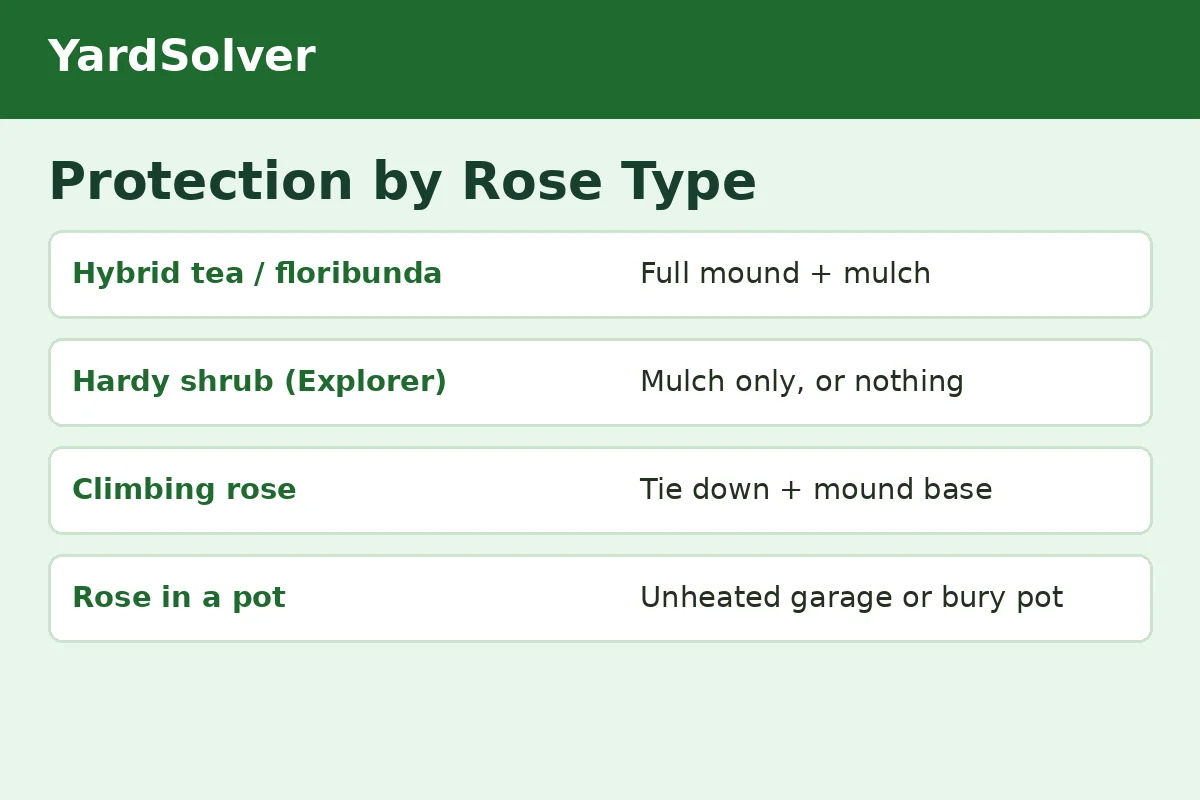
| Hybrid tea, floribunda, grandiflora (grafted) | Full mound 25–30 cm + cage of leaves/straw, or tip-and-bury in the coldest sites | Mound 20–30 cm + mulch cap | Light hilling or mulch only |
| Hardy shrub — Explorer & Parkland series | Usually none; mulch young plants | None needed | None needed |
| Other shrub & old garden roses | Mulch 8–15 cm after freeze-up | Mulch only | None needed |
| Climbing roses | Take down, lay on ground, cover 30 cm | Tie securely in place + mound base | Tie in place only |
| Roses in pots | Never leave the pot exposed outdoors — move to an unheated garage or shed, or sink the pot in an empty bed and mulch over it (all zones) | ||
The Canadian series deserve their reputation stated plainly: Explorer and Parkland roses are hardy to Zone 3 with no winter protection at all — varieties such as 'William Baffin' and 'John Cabot' survive Prairie winters uncovered, which is the single strongest argument for choosing them in cold gardens in the first place. Match effort to the plant: mounding a hardy shrub rose is wasted work, and skipping the mound on a grafted hybrid tea in Zone 5 is a gamble against the graft union.
Climbers, tree roses and pots: the three exceptions
Climbers cannot be mounded above their base, so the canes themselves are the problem. In Zones 5–6, tying canes firmly to their support so they cannot whip and rub is usually enough alongside a mounded base. In Zones 3–4, tender climbers are unfastened, laid on the ground and covered with about 30 cm (12 in) of soil or peat — heavy work, reserved for plants that justify it. Tree (standard) roses carry their graft union at the top of a bare stem, fully exposed; in cold zones the reliable method is to loosen one side of the roots, lay the whole plant into a shallow trench and cover it, or at minimum wrap the head and union thickly. Potted roses freeze harder and thaw faster than ground soil ever does, so the pot itself must be sheltered: an unheated garage or shed, or the pot sunk into an empty vegetable bed and mulched over. Water a sheltered pot just enough through winter that it never dries completely.
Spring: uncovering is a skill too
The most common Canadian rose mistake is stripping protection in the first warm spell of March, then losing new growth to a normal April frost. Uncover in stages as the ground thaws — typically from late March in mild areas to April or May on the Prairies — pulling the mulch cap first and washing the soil mound away gradually with a gentle hose stream over a week or two. The traditional timing cue is reliable: finish uncovering when forsythia blooms in your neighbourhood. Only then assess dieback and do the real pruning, following How to Prune Roses — winter-killed cane tips are expected, and cutting them in fall would only have moved the dieback point lower. Work out mulch quantities for the cap and the bed with the Mulch Calculator, and compare materials in Types of Mulch.
Keep going
Spring work starts with How to Prune Roses; the same wait-for-dormancy logic protects other plants in Putting Your Garden to Bed and Plants to Never Cut Back in Winter; and the month-by-month timing sits in the December Garden Checklist.
Sources
Mound depths (15–30 cm by zone), the clean-up and hold-off-on-pruning steps, climber handling and the Christmas-bough cap follow Canadian rose-grower guidance: Lakeview Roses — How to Winterize Roses in Cold Climates and Florissa — How to Protect Roses During Winter in Canada. Explorer and Parkland hardiness to Zone 3 without protection, hilling depths by Canadian zone, and the forsythia-bloom spring cue follow Growers Guide — Growing Roses in Canada, which bases its zones on Natural Resources Canada plant hardiness data.
Questions people ask
When should I winterize my roses?
After several hard frosts have dropped the leaves and the plant is fully dormant, but before the ground freezes solid — typically November in Zones 5–6 and earlier in colder regions. Covering too early traps warmth and moisture and invites canker; the goal is to keep the crown evenly cold, not warm.
How high should I mound soil over a rose?
20–30 cm (8–12 in) of soil or compost over the crown and graft union for grafted hybrid teas, floribundas and grandifloras — toward 30 cm in Zones 3–4, toward 20 cm in Zone 6. Bring the soil in from elsewhere; digging it from beside the plant exposes the roots you are trying to protect.
Do hardy shrub roses need winter protection?
Canadian-bred Explorer and Parkland series roses are hardy to Zone 3 with no protection at all — that hardiness is what they were bred for. Other shrub and old garden roses usually need only 8–15 cm of mulch after the ground freezes, and young plants of any type benefit from one mulched first winter.
Should I prune roses in fall before covering them?
No — save real pruning for spring. Fall pruning signals growth at exactly the wrong time and removes the cane length that acts as insurance against tip dieback. The only fall cut justified is shortening an exceptionally long cane by about a third so wind cannot rock the crown loose.
How do I winterize a rose in a pot?
Never leave the pot standing exposed — roots in a pot freeze far harder than roots in the ground. Move it to an unheated garage or shed, or sink the pot into an empty garden bed and mulch over the top. Check it monthly and water just enough that the mix never dries out completely.
When do I remove rose winter protection in spring?
Gradually, as the ground thaws — pull the mulch cap first, then wash the soil mound away in stages over a week or two. Finishing when forsythia blooms locally is the traditional safe cue. Stripping everything in a March warm spell is the classic mistake: April frosts then hit exposed new growth.
Comments & ratings
No comments yet.
Be the first to share your experience.