
Guides · Harvest & storage · Published November 20, 2026 · By Faizan Ahmad
How to Store Winter Squash and Pumpkins So They Last for Months
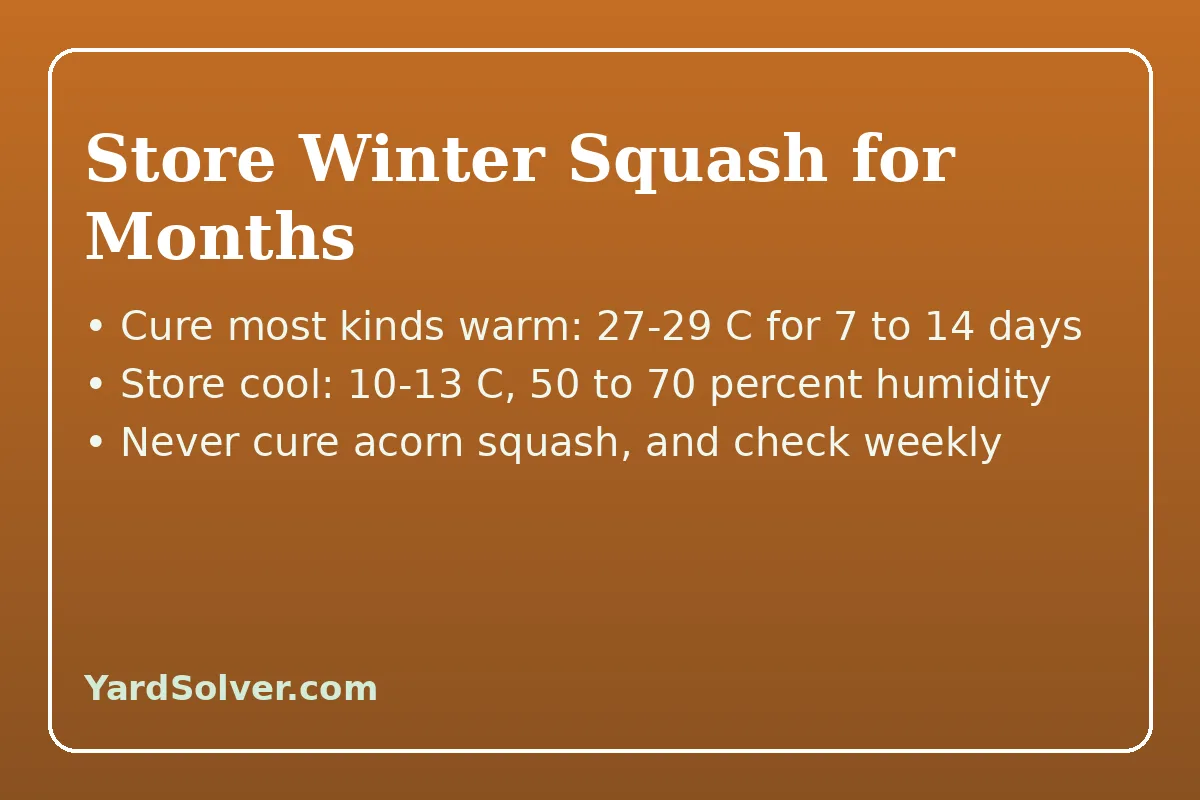
To store winter squash and pumpkins for months, harvest them fully mature with the rind hard and a length of stem attached, cure most kinds in a warm, dry, airy place at about 27–29 °C (80–85 °F) for 7 to 14 days so the rind hardens and small wounds heal, then move them to cool storage at 10–13 °C (50–55 °F) with moderate humidity of 50 to 70 percent, laid in a single layer off the floor with air moving around each fruit, and check them weekly, removing any that soften. November is when the northern gardener discovers whether the squash harvest was a month's eating or a season's. The same butternut that rots by Christmas on a warm kitchen counter is still firm and sweet in February from a cool shelf, and the difference is not luck or variety alone — it is two deliberate stages, curing and cool storage, that most gardeners skip because the fruit looks finished when it comes off the vine. It is not finished. A winter squash at harvest is a living, breathing fruit with a rind still completing itself, and Oregon State University Extension's storage guidance is built on exactly that: cure first, in warmth, then store cool but never cold, because these warm-season fruits are injured below about 10 °C (50 °F). This guide gives the harvest test, the curing method with its one famous exception, the storage conditions and layout, a realistic keeping table by type, and the rescue routes for fruit that will not keep. It is the storage companion to the fall harvest work in the autumn garden and the pantry half of putting the garden to bed.
The short answer, on one card
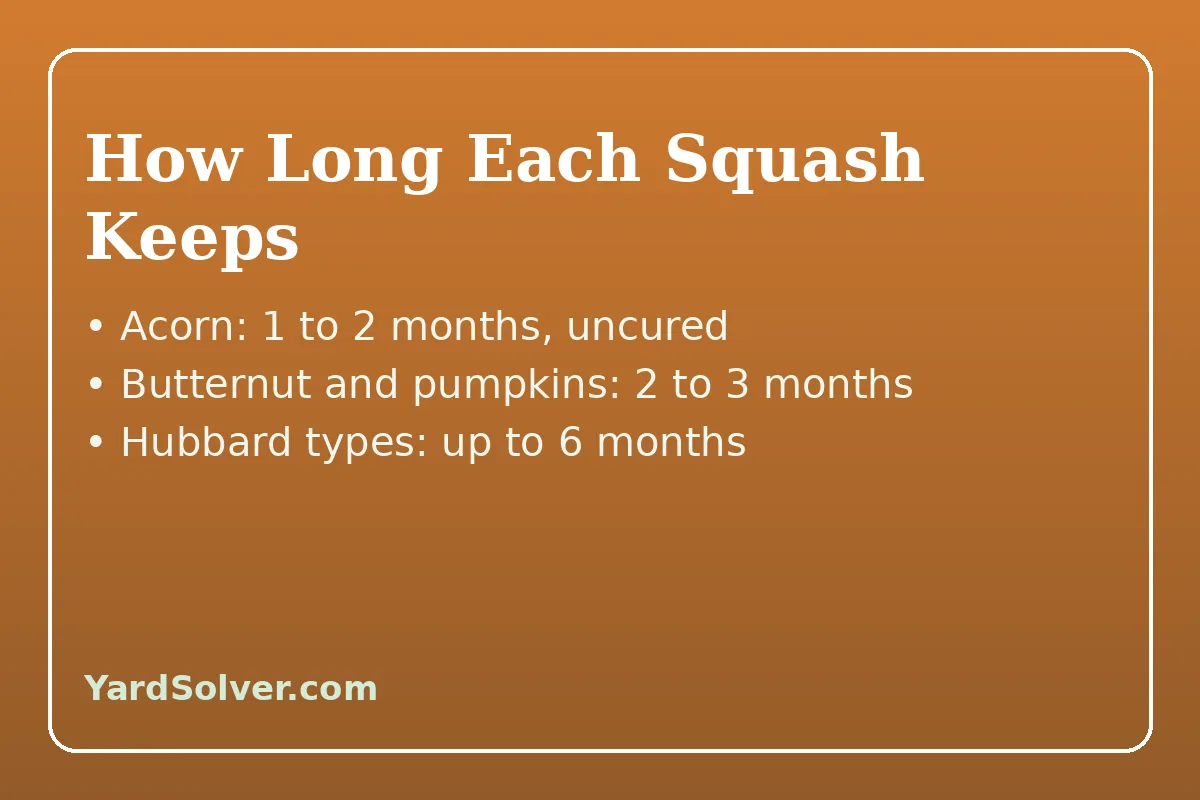
Harvest: when the rind resists a fingernail and the stem is drying; cut — never break — a 5–10 cm (2–4 in) stem; bring fruit in before a hard frost and before a week of weather below about 10 °C (50 °F). Cure: 27–29 °C (80–85 °F), dry and airy, 7–14 days for pumpkins and hard-shelled squash; do NOT cure acorn squash, which it harms. Store: 10–13 °C (50–55 °F), 50–70 percent humidity, single layer, off the floor, fruits not touching, away from apples and pears. Expect: acorn 1–2 months, butternut and pumpkins 2–3 months, hubbard types up to 6 months. Check: weekly, and cook or process any fruit that softens, immediately.
Harvest for storage: maturity is the first storage condition
No storage method rescues an immature squash, because pumpkins and squash do not continue ripening off the vine in any way that builds keeping quality — an undersized fruit with a tender rind is a short-life fruit however carefully it is shelved. The maturity tests are tactile and quick. The rind of a storage-ready squash is hard enough to resist a fingernail pressed into it; a rind your nail dents or punctures is still growing skin. Colour should be full and deep for the variety, the surface losing its glossy young sheen, and the stem drying and corking. Cut the fruit from the vine — Oregon State is explicit: cut, do not break, leaving stems 5–10 cm (2–4 in) long on pumpkins and most squash, because a stem torn out leaves an open wound in the fruit's shoulder, and a pumpkin without its stem does not store well. The one exception proves the rule is about wounds, not superstition: hubbard-type squash store best with the stem removed completely, because their hard stems puncture neighbouring fruit in storage. Handle every fruit like an egg with a hard shell — carried in the arms or a padded crate, never by the stem, never tossed into a wheelbarrow pile — because the bruises and skin breaks you cannot quite see at harvest are the rot spots you will find in January. Timing closes the section: these are warm-season crops susceptible to chilling injury below about 10 °C (50 °F), so when the forecast settles below that line for a week or more, or extended rain arrives, Oregon State's advice is to bring the crop in. A light frost that kills the vine is a harvest signal; a hard freeze through the fruit is a storage death sentence.
Curing: the warm week that builds the rind
| Element | Prescription | Notes |
|---|---|---|
| Temperature | 27–29 °C (80–85 °F) | A warm room, greenhouse bench or sunny sheltered porch in a warm spell |
| Duration | 7–14 days (Illinois: 10–14 at high humidity) | Large pumpkins and hubbards sit at the long end |
| Conditions | Dry fruit, single layer, good air circulation | Never in plastic bags or newspaper, which hold moisture against the rind |
| Purpose | Harden the rind; heal harvest nicks and scratches | The cured surface layer is the fruit's rot barrier for the whole storage season |
| Exception | Acorn squash: do not cure | Curing acorn reverses its keeping quality and shortens its life; store it straight away |
Curing is the step that converts a harvested squash into a stored one. Held warm with air moving around it, the fruit finishes hardening its rind, and the small abrasions of harvest — the fingernail test itself, stem cuts, crate rubs — dry and seal into a protective layer. Oregon State prescribes keeping squash dry and warm at 80 to 85 °F for several days to heal minor abrasions; the University of Illinois Extension's fuller prescription is 80–85 °F with good air circulation and relative humidity of 80–85 percent for 10–14 days. In a November house the warm spot is found, not assumed: the room with the wood stove (beside it, not against it), a greenhouse bench on sunny days with the fruit brought in at night, or the warmest ventilated room in the house. What curing is not is wrapping: Oregon State warns that newspaper and paper bags hold too much moisture and should not be used, and plastic is worse. Give the fruit a slatted tray or a straw bed, space between neighbours, and the week it needs. The acorn exception deserves its fame, because it runs against the general rule and catches rule-followers: acorn (Table Queen type) squash have a thinner rind and a short natural storage life, curing is detrimental to them, and both Minnesota and Penn State guidance advise against it. Delicata and dumpling types, the other thin-skinned short keepers, belong in the same eat-first, uncured class. Cure what keeps; eat what does not.
Cool storage: the conditions, and what counts as a storage place
After curing, the fruit moves to its winter quarters, and the quarters are defined by numbers, not by names. The convergent extension prescription is a temperature of about 10–13 °C (50–55 °F) — Oregon State says store most winter squashes and pumpkins at about 50 to 55 °F and do not let the temperature fall below 50 °F — with moderate humidity, given by Illinois as an ideal relative humidity of 50–70 percent, and good air circulation. Each bound has a failure mode on the other side of it. Below the range, chilling injury sets in: cell damage that shows as soft, watery spots and fast decay when the fruit warms — Illinois warns that if temperatures drop below freezing, the cell walls expand and collapse into a watery mess on thawing. Above the range, the fruit breathes faster, loses weight, and ages in weeks instead of months. Too dry, and it shrivels; too damp, or swinging temperatures that condense moisture on the rind, and mould takes the surface. A root cellar, basement corner, unheated spare room, insulated garage or barn can all be the right place — Oregon State suggests a garage is usually suitable — provided a thermometer confirms the actual conditions, and provided the fruit sits on shelves off the floor, in a single layer, on straw or slats, not touching its neighbours. One neighbour rule is chemical rather than physical: keep stored squash away from apples and pears, whose ripening ethylene gas measurably shortens squash life. The quotable summary: a winter squash keeps longest in air that feels chilly to you and boring to it — cool, steady, dry-ish and moving — and every warm kitchen and freezing garage fails it from opposite directions.
How long each kind really keeps
| Type | Storage life, cured and well stored | Notes |
|---|---|---|
| Acorn | 1–2 months | Never cured; eat first, from November into the new year |
| Delicata, dumpling | About 1 month | Thin-skinned; treat as eat-first fruit |
| Butternut | 2–3 months | The reliable mid-season keeper; flavour often improves in the first weeks |
| Pumpkins (pie and jack types) | 2–3 months | Sound stems and uncracked rinds decide; carving pumpkins sit at the short end |
| Spaghetti | About 2 months | Watch for softening at the blossom end |
| Hubbard, turban, Sweet Meat | Up to 6 months | The longest keepers; the traditional spring squash of cold climates |
Read the table as a menu schedule, not just a fact sheet: the storage season eats in order. Acorn and delicata carry November and December, butternut and pumpkins carry the deep winter, and the hubbards — the great blue-grey keeping machines bred for exactly this — carry February to April, when a stored squash is no longer a glut solution but a genuine event in the kitchen. Planning the planting backwards from this table is next year's improvement, and it belongs in the journal beside the seed order from when to order seeds: a household that eats squash weekly from November to March needs its planting weighted toward the long keepers, with acorns grown deliberately small in number as the fall's early eating. The weekly check is the management that makes the table real. Oregon State's instruction is plain: check stored fruit once a week and remove any that are turning soft. A soft spot is not a blemish to watch — it is an active rot that will spread to touching neighbours and seed the shelf with spores, so the soft fruit leaves the shelf the day it is found, to be cooked that evening if the damage is local, or composted if it is not. Wash stored fruit thoroughly under running water with a vegetable brush before cutting, as Illinois directs, because the rind has spent months in a barn or cellar environment.
When a squash will not keep: the rescue routes
Some of every harvest is honestly not storage fruit: the immature, the stemless, the bruised, the one the mower clipped. The rescue routes convert them instead of wasting them. Cooking and freezing is the workhorse — roasted squash purée, portioned and frozen, keeps for months and is the form most recipes want anyway; follow tested freezing directions, blanching or cooking as the method requires, rather than freezing raw chunks that thaw to mush. Pressure canning of cubed squash is a recognised tested process; purée is not safe to can at home, a distinction the tested-recipe sources are firm about and that matters enough to state plainly here. Dehydrating makes squash leather and dried cubes for soups. And the animal and compost routes close the loop for fruit too far gone for the kitchen: sound-but-soft squash is prized livestock and wildlife food, and true rot belongs in the hot compost of winter composting, not in the storage room's air. The season's last lesson is the record: which varieties kept, which shelf ran warm, which fruit failed first and why. Written down, that turns one winter's storage into next winter's planting plan — the hubbard that carried your kitchen to April earns its row again, and the pretty pumpkin that rotted by Remembrance Day becomes a note, a smaller planting, and an October pie instead of a January disappointment.
The storage shelf itself: setting up a space that holds its numbers
The conditions in this guide are only as good as the shelf that maintains them, and a half-hour of setup in November is what separates a storage system from a pile of squash in a corner. Start with air: the fruit must sit in a single layer on something air passes through or over — slatted wooden shelves, wire racks, or boards on blocks with gaps — never on a cold concrete floor, which is both the dampest surface in the building and a cold sink that chills the fruit resting on it below the safe line. A layer of straw under the fruit, as Oregon State suggests, cushions the rind and wicks stray moisture. Space each fruit a hand's width from its neighbours so the weekly check can be done by eye and hand without moving the whole shelf, and group the shelf by the keeping table — eat-first kinds at the front, hubbards at the back — so the order of eating is built into the geography. Put a minimum-maximum thermometer on the shelf, not on the wall across the room, because the shelf's microclimate is the one the fruit experiences: floor-level air in a garage can run several degrees colder than the air at head height on the same night, and the first hard cold snap is when you learn whether your chosen corner truly holds above 10 °C (50 °F) or merely usually does. If it dips, the corrections are humble ones — move the shelf away from the outside wall, add a layer of cardboard or straw beneath it, or relocate the fruit to the basement corner for the coldest fortnight. Finally, label the shelf with the harvest date and variety in the journal's shorthand. Storage done this way stops being a hope and becomes a small, inspectable system: numbers known, layout deliberate, failures found in a week instead of a month — which is, in the end, all that curing and cooling were ever trying to buy.
Keep going
Put the rest of the garden away with Putting Your Garden to Bed, keep the compost working through storage season with Composting in Winter, and plan next year's keepers with When to Order Seeds for Spring.
Sources
The storage framework — warm-season squash and pumpkins are injured below about 50 F and should be brought in when temperatures stay below that for a week or more; harvest when the rind resists a fingernail, cutting stems 2 to 4 inches long rather than breaking them, with hubbard types the exception that store best with stems removed; cure dry and warm at 80 to 85 F for several days to heal abrasions; store at about 50 to 55 F, never below 50 F, with moderate humidity and good air circulation on shelves off the floor with straw beneath, avoiding newspaper and paper bags; keep fruit away from apples and pears; check weekly and remove softening fruit; and the keeping lives of 1 to 2 months for acorn, 2 to 3 months for pumpkins and butternut, and up to 6 months for turban, hubbard and Sweet Meat types — follows Oregon State University Extension, Plan Ahead for Winter Storage of Pumpkins and Squash. The curing prescription of 80-85 F with 80-85 percent relative humidity for 10 to 14 days, storage at 50-60 F in a cool dark place with ideal humidity of 50-70 percent, single-layer storage off the floor, the warning that below-freezing storage collapses cell walls into a watery thaw, and washing fruit thoroughly before cutting follow University of Illinois Extension, Preserve Your Pumpkins This Fall by Following These Simple Tips. The rule against curing acorn squash, which it harms rather than helps, follows University of Minnesota and Penn State Extension guidance as summarised in the harvest-and-storage review at How to Harvest, Cure, and Store Winter Squash.
Questions people ask
How long can you store winter squash?
In good conditions — cured, then held at 10-13 C (50-55 F) with 50 to 70 percent humidity — acorn squash keeps 1 to 2 months, butternut and pumpkins 2 to 3 months, and the longest keepers, hubbard, turban and Sweet Meat types, up to 6 months. Warm storage, freezing storage and skipped curing each shorten those figures sharply.
Do you have to cure winter squash before storing it?
For pumpkins and hard-shelled squash, yes — curing at 27-29 C (80-85 F) for 7 to 14 days hardens the rind and heals harvest wounds, and it is the difference between a month and a season of keeping. The exception is acorn squash, along with thin-skinned delicata and dumpling types: curing harms acorn's keeping quality, so store those uncured and eat them first.
What temperature is best for storing winter squash?
About 10-13 C (50-55 F) — cool, but never cold. Below about 10 C (50 F) these warm-season fruits suffer chilling injury that appears as soft spots and rapid decay, and freezing destroys the flesh outright. Warmer than about 16 C (60 F), the fruit breathes and ages quickly. A basement corner, insulated garage or unheated room that a thermometer confirms stays in range is ideal.
Why did my stored squash rot?
The usual causes, in order: it went into storage immature, bruised or stemless, so rot entered at a wound; it was never cured, so the rind never sealed; the storage spot was too warm, too damp or freezing; fruit was piled or touching, so one rot spread; or the weekly check was skipped. Sound, cured fruit in a single layer at the right temperature, checked weekly and with soft fruit removed at once, rarely rots early.
Should winter squash be stored with the stem on?
Yes for almost all kinds — cut, do not break, a stem 5-10 cm (2-4 in) long, because a torn-out stem leaves an open wound and stemless pumpkins store poorly. The exception is hubbard-type squash, which stores best with the stem completely removed, because the hard stem punctures neighbouring fruit. Never lift or carry any squash by its stem.
Can you store winter squash in a garage?
Usually, yes — Oregon State Extension calls a garage a suitable place, provided its temperature actually stays in the 10-13 C (50-55 F) band and does not dip below 10 C (50 F) in cold snaps or freeze against an outside wall. Keep fruit on shelves off the floor, in a single layer on straw or slats, and confirm the conditions with a thermometer rather than assuming them.
Comments & ratings
No comments yet.
Be the first to share your experience.