
Guides · Growing Wisdom · Garden Planning · Published November 22, 2026 · By Faizan Ahmad
Garden Size Needed for a Family of 2, 4 or 6
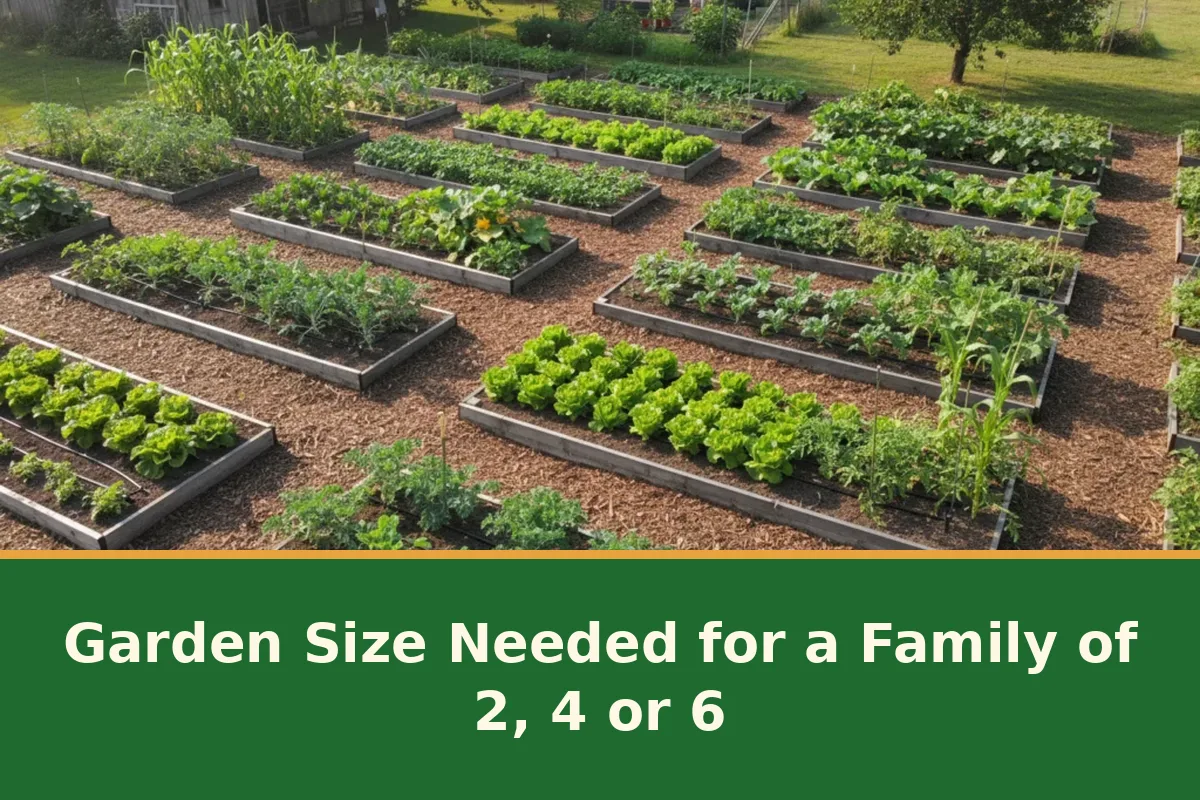
A family of two needs about 200 square feet of intensively planted garden to eat fresh vegetables all season; a family of four needs about 400; a family of six, about 600 — roughly 100 square feet per person. Double those figures if the garden must also fill the freezer and pantry for winter. This guide gives the full table in square feet and in 4×8 beds, shows how to allocate the space across crops, and explains why the smartest first-year garden is half the size the table says.
Garden size at a glance
- The planning rule: about 100 sq ft (9 m²) of intensive garden per person for fresh eating all season; about 200 sq ft per person if you also preserve for winter.
- Family of 2: ~200 sq ft fresh-eating (≈ six 4×8 beds) · ~400 sq ft with preserving.
- Family of 4: ~400 sq ft fresh-eating (≈ twelve 4×8 beds, or a 20×20 ft plot) · ~800 sq ft with preserving.
- Family of 6: ~600 sq ft fresh-eating (≈ eighteen 4×8 beds, or 20×30 ft) · ~1,200 sq ft with preserving.
- The beginner's correction: halve it for year one. A small garden run well out-produces a big one run on guilt.
Step 1 — Start from the per-person rule, then be honest about "feeding"
The figure extension planners have used for generations is roughly 100 square feet per person for a garden that supplies fresh vegetables through the season, and 200 square feet per person when the garden must also fill a freezer and a pantry for winter. Those numbers assume intensive planting — beds, close spacing, succession sowing — not wide farm rows, which need half again as much land for the same food. But the number is only as honest as the goal behind it. "Feeding a family of four" can mean salads and tomatoes all summer (the 100 sq ft plan does this easily), most vegetables most of the year (the 200 sq ft plan, with preserving), or near self-sufficiency in vegetables including potatoes and winter squash (possible, but that is the top of the range plus staple beds). Decide which sentence describes your family before you measure anything — most home gardens are happiest at the first goal, and it is the one the table below is built on.
| Household | Fresh eating all season | Fresh + preserving for winter | In 4×8 ft beds (32 sq ft) |
|---|---|---|---|
| Family of 2 | ~200 sq ft (18.5 m²) | ~400 sq ft (37 m²) | 6 beds · 12 beds |
| Family of 4 | ~400 sq ft (37 m²) | ~800 sq ft (74 m²) | 12 beds · 25 beds |
| Family of 6 | ~600 sq ft (56 m²) | ~1,200 sq ft (111 m²) | 18 beds · 37 beds |
| First-year beginner (any size) | Half the fresh figure | — | 3–9 beds is plenty |
Step 2 — Spend the square feet where appetites actually are
Area alone grows nothing; allocation grows dinner. A workable split for a fresh-eating family garden: a third to fruiting favourites (tomatoes, peppers, cucumbers, zucchini — the crops that justify the garden's existence), a third to the salad and greens engine (lettuce, spinach, kale, herbs — small area, daily harvests, endlessly succession-sown), and a third to the roots, pods and keepers (beans, peas, carrots, beets, onions, potatoes). Per person, that translates to roughly: 2 tomato plants, 2 peppers, 1–2 cucumber or zucchini plants, 8–10 feet of beans, 4–6 feet of peas, a 4-foot row each of carrots and beets, and greens in every gap. The Raised Bed Garden Layout guide shows what a single 4×8 bed holds when planted intensively (its family plan fits 146 plants in one bed) — use it to turn your square-foot target into an actual bed count and planting map.
Step 3 — Shrink the footprint with method, not hope
Three techniques let a smaller garden do a bigger garden's job, and all three are free. Succession planting — every harvested row is replanted the same week — roughly doubles what a bed yields across a season; the Succession Planting Guide is the operating manual. Vertical growing takes cucumbers, peas, pole beans and even squash up trellises and fences, off the square-foot ledger almost entirely. Interplanting tucks fast crops (radish, lettuce) between slow ones (tomatoes, brassicas) so no bed-month is wasted. Gardeners who run all three routinely feed a family of four fresh vegetables from 250–300 sq ft. Gardeners who plant once in May, in rows, with paths between everything, may need 600 for the same table. Method is worth more than land — which is why the per-person rule quotes intensive numbers.
Step 4 — Count the real cost: time, water and harvests
Land is the cheap input. Budget the others before you commit to a size. Time: a well-mulched intensive bed asks roughly 20–30 minutes a week in season — watering checks, a weed pass, harvesting — so the family-of-four fresh garden (12 beds) is a 4–6 hour weekly commitment at peak, and the preserving version adds processing days in August and September that are measured in afternoons, not minutes. Water: at the standard inch a week, 400 sq ft drinks about 250 gallons weekly in a dry spell (the per-crop figures are in How Much Water Each Vegetable Needs Weekly) — make sure your hose, well or water bill agrees with your ambition. Harvest pressure: an oversized garden does not fail in June; it fails in August, under a zucchini glut and unblanched beans, when the family quietly stops eating what it grows. Size the garden to the appetite and the calendar you actually have, and it stays a pleasure at every size in the table.
Step 5 — Start at half size, and let success expand it
The standing advice of everyone who has gardened for a decade: plant half the fresh-eating figure in year one. A family of four starts with six 4×8 beds (about 200 sq ft), learns its soil, its shade, its appetites and its real weekly hours, and keeps notes on what ran out (plant more) and what rotted on the vine (plant less). Doubling a thriving small garden in year two is a weekend's work; rescuing an abandoned big one is a summer's penance, and it is how most gardens die. Renters and small yards are not excluded from the table, either — the salad-and-herb third of the plan fits in containers on a balcony (see Balcony Vegetable Gardening), and community-garden plots of 200–400 sq ft map exactly onto the family-of-two and family-of-four fresh plans. The right size is the one you will still be enjoying in September.
Keep going
Plan the beds: Raised bed garden layout · Raised bed gardening for beginners · Succession planting guide
Run it: How much water each vegetable needs weekly · Best vegetables for short growing seasons in Canada
Measure your space: How to measure yard square footage
Questions people ask
How big a garden does a family of 4 need?
About 400 sq ft (37 m²) of intensively planted garden — twelve 4×8 ft beds, or a 20×20 ft plot — supplies fresh vegetables all season. Doubling it to roughly 800 sq ft adds enough for preserving and winter storage. Beginners should start at half that and expand in year two.
How many raised beds does a family of 2 need?
About six 4×8 ft beds (roughly 200 sq ft) for fresh eating all season, or twelve beds if you also want to preserve for winter. Two of the six can be salad-and-herb beds that produce daily harvests from a small footprint.
Can a family of 6 really be fed from 600 sq ft?
Fed fresh vegetables in season, yes — with intensive methods: succession sowing, vertical growing and interplanting. Full vegetable self-sufficiency including winter staples like potatoes and storage squash takes the larger figure, around 1,200 sq ft, plus preserving time in late summer.
Is a bigger garden always better?
No. The most common garden failure is oversizing: the August glut, the weeding backlog and the watering bill outgrow the family's time and appetite. A 200 sq ft garden that is watered, weeded and harvested faithfully out-produces an 800 sq ft garden that isn't.
The right size is a September question
Every garden looks perfectly sized in May, when the beds are clean, the seedlings are hopeful and the work is still a novelty. The true size of a garden reveals itself in September — in whether the beds are still weeded, the beans still picked, the tomatoes still pruned, or whether the whole enterprise has quietly become a chore the family routes around. That is why the honest answer to "how big?" is never just the square-foot table: it is the table divided by the hours and appetite you genuinely have.
So take the numbers in this guide as the ceiling for each household, not the target. Start at half, run the succession and vertical methods that make small gardens punch above their size, and let two seasons of notes — what ran out, what rotted, what the family begged for more of — draw the final map. Gardens sized that way tend to grow a little every year, which is the only direction a garden should ever grow.
Sources
Per-person planning figures (about 100 sq ft per person for fresh eating, 200 sq ft with preserving, under intensive methods) follow the long-standing extension and garden-planning rule of thumb used by university extension services and the USDA's People's Garden planning materials. Bed conversions use the 4×8 ft (32 sq ft) standard; per-bed plant capacity follows YardSolver's Raised Bed Garden Layout.
Related page
Read next: Raised Bed Garden Layout: What Fits in a 4×8 Bed, Crop by Crop.
Comments & ratings
No comments yet.
Be the first to share your experience.