
Guides · Holiday garden · Published November 20, 2026 · By Faizan Ahmad
How to Choose and Care for a Cut Christmas Tree: Freshness Tests, Species and Watering That Lasts
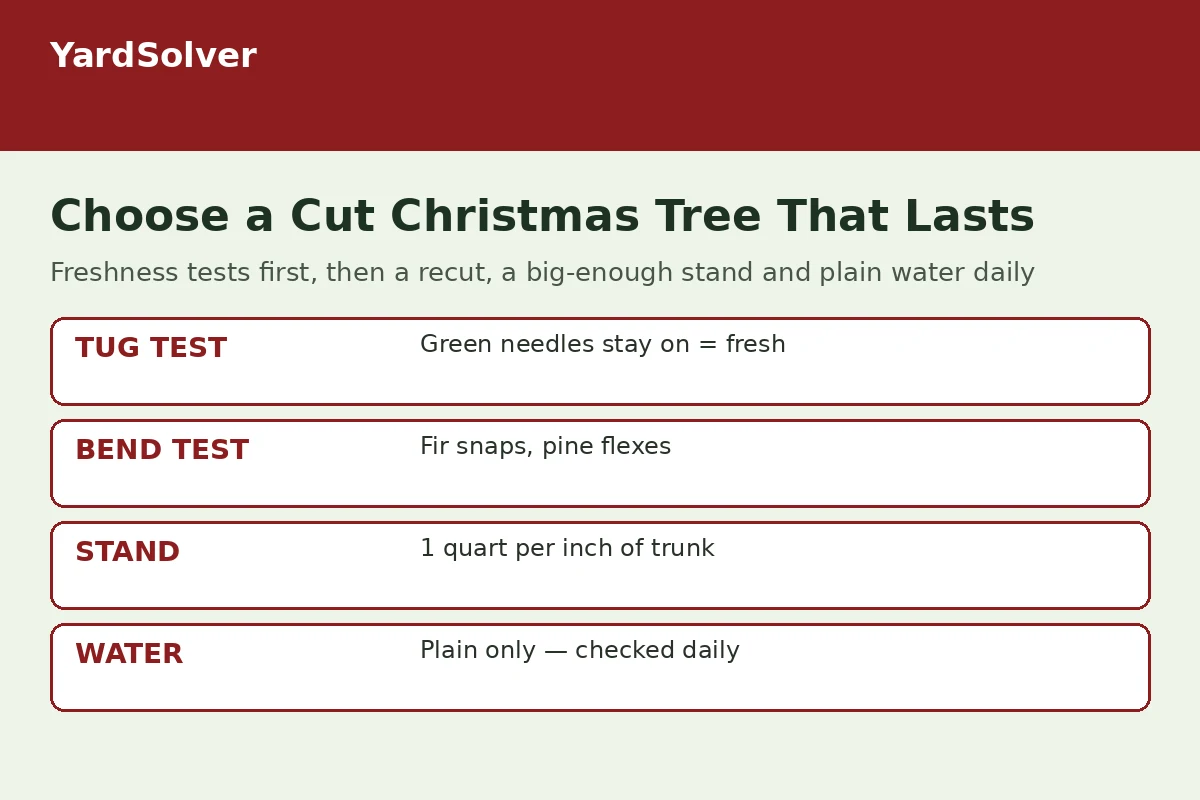
To choose and care for a cut Christmas tree that lasts, buy the freshest tree you can test — needles flexible and firmly attached when you tug a branch — recut the trunk straight across by about 6 mm (1/4 in) if it was harvested more than 12 hours earlier, set it in a stand holding at least 1 quart of water per inch of trunk diameter, and keep plain water above the base of the trunk every single day. That is the whole recipe, and it is research-tested: university extension trials keep finding that water, freshness and species choice decide how a tree ages, while the folk additives — sugar, soda, aspirin, bleach, floral preservative — do nothing measurable at all. This guide walks the lot with you: the freshness tests that work in ten seconds, a species comparison for Canadian and US favourites, the setup steps in order, the daily watering rhythm, fire-sense placement, and what to do with the tree in January. If you would rather keep the roots, our companion guide covers the living alternative.
The short answer, on one card
Test: run a hand along a branch — fresh needles stay attached and bend without snapping; a tree that rains green needles is already drying out. Species: firs (Fraser, balsam, noble) hold needles longest and smell best; pines are sturdy and budget-friendly; spruce holds heavy ornaments but drops needles fast if it ever runs dry. Recut: 6 mm (1/4 in), straight across, only if the tree was cut more than 12 hours ago. Stand: 1 quart per inch of trunk diameter, at least 1 gallon. Water: plain, daily, never below the base. Place: away from fireplaces, vents and radiators; LED lights run cooler.
Before you shop: measure the room, not the lot
Every oversized-tree story starts the same way: trees look smaller outdoors and on a lot than they do in a living room. Measure the ceiling height and the floor space where the tree will stand before you leave home, and subtract the stand height and whatever goes on top — most households need a tree at least 30 cm (1 ft) shorter than the ceiling. Decide whether the tree will be seen from all sides or pushed into a corner: a corner tree only needs two good adjacent sides, and the slightly imperfect grades sold for exactly that are cheaper and just as fresh. Take the stand with you, or at least its measurements — the stand must fit the trunk without whittling, because the wood just under the bark is the layer that carries water up the tree, and shaving it to force a fit quietly cripples the tree's drinking. Penn State Extension's guidance starts in exactly this unglamorous place: space, ornaments and how long the tree must last are decisions to make before the lot, not at it.
The ten-second freshness tests (use all three)
The tug test. Run your hand gently along a branch, or pull lightly down it. On a fresh tree, one or two needles let go; if a handful of green needles comes away, the tree is past its prime — walk to the next one. Some loose brown needles from the shaded interior are normal on any tree and are not the signal; it is green needles shedding from the outer branches that mean drying. The bend test. Bend a needle between your fingers. Fresh fir and spruce needles snap crisply, like a fresh carrot; a needle that folds limply or crumbles is dry. Pine needles behave differently — they should flex, and a pine needle that breaks at all is a dry tree. The weight and look test. A fresh tree feels heavy for its size because it is still full of water, and its colour is a healthy, slightly glossy green rather than dull and grey. Lift it, bounce the trunk lightly on the ground, and look at what falls: a shower of green needles repeats the tug test's verdict. Buying from a choose-and-cut farm removes the guesswork entirely — a tree you cut yourself, or watch being cut, is fresh by definition, which is why extension services call it the most reliable route of all, with the bonus of supporting a local grower.
Species compared: fir, pine, spruce and the rest
| Species | Needles and branches | Fragrance | Best for |
|---|---|---|---|
| Fraser fir | Soft, flat, dark green with silver undersides; strong, well-spaced branches | Rich, spicy-resinous | The all-rounder: retention, scent and ornament space |
| Balsam fir | Soft, flat, dark green; classic shape, moderate branch strength | The strongest classic balsam scent | Canadian lots, fragrance-first buyers, lighter ornaments |
| Noble and Nordmann fir | Stiff, layered branches; excellent retention | Mild, clean | Heavy ornaments, long displays, low-scent homes (Nordmann) |
| Douglas-fir | Soft, flat, blue-green; full and bushy, moderate branch strength | Sweet, citrusy | Full look on a budget; lighter ornaments |
| Scotch and white pine | Needles in bundles (two for Scotch, five for white); Scotch is stiff, white pine is soft and flexible | Mild, woodsy | Scotch for heavy ornaments and value; white pine for a soft, traditional look |
| Colorado blue spruce | Sharp, square, blue-green needles; very stiff branches | Sharp, pungent | Heavy ornaments and blue colour — only if you will never let the stand run dry; sharp for small children |
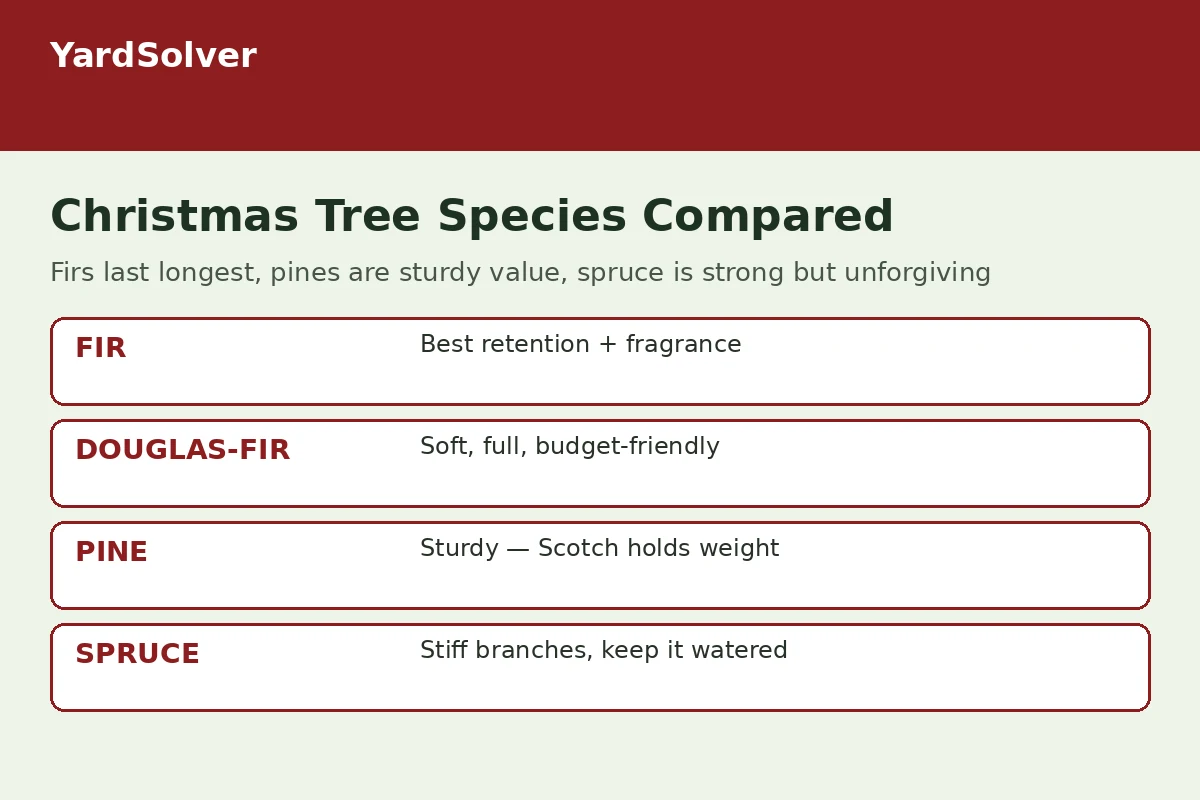
The pattern to remember is quotable because it decides most purchases: the true firs hold their needles longest and smell the best; the pines are the sturdy value pick; the spruces are the strongest and the least forgiving. Extension comparisons agree that there is no single right species — there is a right species for your ornaments, your room and your watering discipline. A household that travels mid-December should buy a fir and the biggest stand it can find; a household hanging heavy heirloom ornaments on a tree that goes up late can happily save money on Scotch pine. In Canada, balsam fir dominates eastern lots and Douglas-fir and noble fir the western ones; in the US, Fraser fir ships nationwide from Appalachian farms precisely because it travels and retains so well.
Setup, in order: store, recut, stand, water
If the tree will not be displayed right away, store it like the fresh produce it is: trunk in a bucket of water, in a cool, shaded, wind-sheltered spot — an unheated garage is ideal — because wind and sun dry needles fast. When you are ready, make the fresh cut: saw about 6 mm (1/4 in) straight across the base of the trunk, perpendicular to the stem, never at an angle or a V, which only makes the tree harder to stand and reduces the water available to it. The cut reopens the vessels that sealed with resin after harvest — but only if the tree goes into water promptly; a recut base left standing in air for hours seals again. Skip the recut entirely if the tree was cut within the past 12 hours. Do not drill a hole up the base (it does not improve uptake) and do not whittle the sides to fit the stand. Then fill the stand and expect a surprise: a fresh tree can drink a quart of water per inch of trunk diameter a day in the first week, sometimes more for thirsty firs, so the reservoir empties faster than new owners believe. Our watering guide works through the daily amounts in detail.
Daily care: plain water, distance from heat, nothing else
Check the water every day and keep the level above the base of the trunk at all times — the moment the cut surface sits exposed to air, uptake collapses and needle drop accelerates. Plain tap water is the complete prescription. Penn State's care guidance is blunt about the alternatives, because they have been tested: sugar, corn syrup, soda, aspirin, fertilizer, bleach, water-holding gels and anti-transpirant sprays do not extend a cut tree's life, and some reduce it. The temperature of the water does not matter. What does matter is the room: keep the tree away from fireplaces, heating vents, radiators and direct sun, lower the room temperature if you can, and choose LED lights, which run far cooler than incandescent strings. A well-watered tree is also the fire-safety story — a hydrated tree is remarkably resistant to ignition, while a dried one is the hazard — so the daily water check, lights off when you are out or asleep, and a stand that cannot tip are the whole safety programme. Expect the drinking to slow after the first week; a tree that suddenly stops drinking entirely in week one is telling you the base has sealed or the level dropped — check before assuming the worst.
January: taking it down and giving it a second job
Take the tree down when needles turn brittle and drop at a touch, or right after your household's traditional date — a tree kept drinking can stay presentable well into January, but there is no prize for the last week of a dry tree indoors. Slip a disposal bag or an old sheet under the stand before you start (putting one under the stand at setup makes this a one-minute job), carry the tree out needle-side contained, and then give it its second job instead of the landfill. Most Canadian and US municipalities run tree recycling that chips trees into mulch; a tree can also lie in the garden as winter shelter for birds, stand by the feeder as a windbreak, or be cut into discs and edging. What it should not do is go through a fireplace or wood stove: the resins and dry needles flare and foul chimneys with creosote. And if the whole cut-tree cycle has you reconsidering, a balled living tree — indoors for a week at most, then planted — is the other tradition, covered in our living Christmas tree guide.
Keep going
Work out the daily water in How Much Water Does a Christmas Tree Need?, compare the rooted alternative in Living Christmas Tree Care, add instant indoor flowers with How to Force Paperwhites Indoors, and keep the month on track with the December Garden Checklist.
Sources
Freshness tests, the quarter-inch straight recut, the 1-quart-per-inch stand rule, daily checking and the tested verdict that no additive beats plain water follow Penn State Extension, Selection and Care of Cut Christmas Trees and Caring for Your Cut Christmas Tree. Species character notes and the choose-and-cut freshness advantage follow NC State Extension, Selection and Care of Christmas Trees.
Questions people ask
How can I tell if a cut Christmas tree is fresh?
Use three tests: tug a branch — fresh needles stay attached and only one or two let go; bend a needle — fir and spruce needles snap crisply, pine needles flex without breaking; and lift the tree — a fresh one feels heavy with water and looks a glossy, healthy green. A shower of green needles from any test means walk away.
Do I need to recut the trunk of my Christmas tree?
Only if it was cut more than 12 hours before you set it up. Saw about 6 mm (1/4 in) straight across the base, never at an angle, and put the tree straight into water. A freshly cut farm tree within 12 hours needs no recut.
How much water does a cut Christmas tree need?
A stand should hold 1 quart of water per inch of trunk diameter — at least 1 gallon for most trees — and a fresh tree can drink that full rate daily during the first week. Check every day and never let the level fall below the base of the trunk.
Should I add sugar, aspirin or bleach to Christmas tree water?
No. University and industry research has tested sugar, corn syrup, soda, aspirin, fertilizer, bleach, gels and preservatives, and none extends a cut tree's life. Clean, plain tap water, kept above the base of the trunk, is the best and only additive a tree needs.
Which Christmas tree species lasts longest indoors?
The true firs — Fraser, balsam, noble and Nordmann — generally hold their needles longest and carry the best fragrance. Pines retain well and cost less; spruce has the stiffest branches for heavy ornaments but drops needles quickly if the stand is ever allowed to run dry.
How long can I keep a cut Christmas tree up?
With daily water, away from heat, a fresh fir commonly stays presentable for four to five weeks. Take it down when needles turn brittle and shed at a touch, and recycle it through a municipal chipping programme or as garden shelter rather than burning it indoors.
Comments & ratings
No comments yet.
Be the first to share your experience.