
Guides · Indoor gardening · Published November 20, 2026 · By Faizan Ahmad
How to Grow Lettuce Indoors: Fresh Salad Leaves in About 4 Weeks
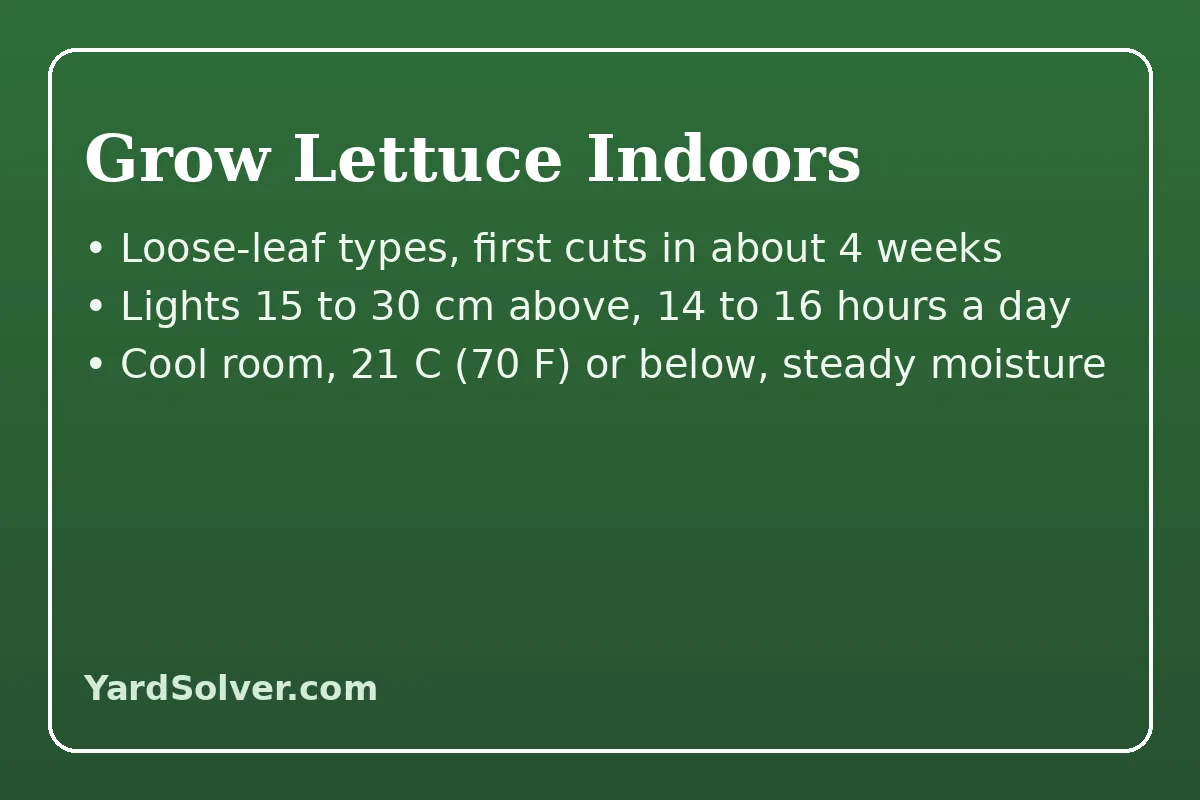
To grow lettuce indoors, sow loose-leaf varieties in a shallow, drained container of potting mix, keep the mix evenly moist in a cool room at 21 °C (70 °F) or below, and give the plants either 6–8 hours of bright window light a day or a lamp held 15–30 cm (6–12 in) above the leaves for 14–16 hours a day — and you will cut your first salad leaves in about four weeks, then keep cutting as the plants regrow. Lettuce is the winter indoor crop that actually delivers: no fruit to ripen, no pollination to arrange, no months of waiting — just leaves, the part you eat, produced by the fastest-growing salad plant in the catalogue. University of Illinois Extension's winter growing guidance makes the honest framing: lettuce and herbs grown indoors have exactly the same needs as outdoors, and in a winter house only two factors restrict them — light levels and humidity. Both are solvable on one shelf. This guide gives the working system: why loose-leaf types win and head lettuces disappoint, the light arithmetic that replaces a winter window, containers and mix, sowing and the two-week succession rhythm, feeding, the harvest methods that keep a tray producing, and the short troubleshooting list — legginess, bitterness, tipburn — with the cause of each. It is the leafy member of the winter food shelf alongside microgreens and jar sprouts: sprouts in days, microgreens in a fortnight, lettuce in a month, each covering the weeks the others cannot.
The short answer, on one card
Varieties: loose-leaf and salad mixes first; small butterheads second; skip crisphead (iceberg) types entirely. Container: a shallow tray or window box — 8–10 cm (3–4 in) of mix is enough for greens — with drainage holes, in a solid tray to catch water. Light: 6–8 hours of bright light daily; in winter that usually means a lamp 15–30 cm (6–12 in) above the leaves on a timer for 14–16 hours. Temperature: cool — 21 °C (70 °F) or below, away from radiators and heat vents. Sowing: scatter seed thinly, cover barely, keep moist; germination in 4–10 days. Harvest: outer leaves or a shear an inch above the crowns from about week 4; sow a fresh tray every 2–3 weeks so the supply never gaps.
Choose leaves, not heads: the variety decision
| Type | First harvest | Indoor verdict |
|---|---|---|
| Loose-leaf (red and green leaf, oakleaf) | About 4 weeks, as baby and outer leaves | The best choice by far: cut-and-come-again, no head to wait for |
| Salad mixes and mesclun | About 3-4 weeks, sheared as baby leaves | The fastest bowl in the house; sow thickly, cut young |
| Butterhead (Boston, bibb, buttercrunch) | About 6-8 weeks for small heads | Good for patient growers; tender heads in modest light |
| Romaine (cos) | About 8-10 weeks for hearts | Possible with strong light; choose the smallest types |
| Crisphead (iceberg) | 10 weeks or more, often never | Skip it: slow, demanding, and the usual indoor disappointment |
Illinois Extension's advice on indoor lettuce is one sentence long and settles the seed order: your best bet is loose-leaf lettuce, which can usually be harvested at about four weeks. The reasoning is structural. A loose-leaf plant is harvestable at almost any size — you take the outer leaves and the centre keeps growing — while a head lettuce is worthless until the head forms and bitter shortly after it passes its moment. Indoors, where light is the rationed resource, the crop that pays rent from week four and forgives uneven conditions wins over the crop that demands ten perfect weeks. Loose-leaf varieties also shrug off the shallow containers indoor growing prefers: University of Vermont Extension's container guidance, as summarised in indoor-growing references, puts greens happily in as little as 8–10 cm (3–4 in) of mix, provided it drains. Colour is free production value here — a mix of green and red loose-leaf varieties in one tray cuts a salad that looks like it came from a market stall, and the red types colour best under strong light, which is one more reason the lamp earns its shelf. Buy seed by the packet and sow by the pinch: lettuce seed is small, cheap and short-lived in storage, so fresh seed each winter, kept with the germination habits from the seed shelf, beats a five-year-old packet nursed at low germination.
Light: the arithmetic that replaces a winter window
Illinois Extension names the two restricting factors for winter indoor growing plainly — light levels and humidity — and gives the numbers that solve the first. Lettuce needs 6–8 hours of bright light a day; a southern-exposure window is the best natural source, and in the short days of a Canadian or northern-US winter most windows simply cannot deliver it. The substitute is specified exactly: two 40-watt cool-white fluorescent tubes — or their LED equivalents — held 15–30 cm (6–12 in) above the plants and run for 14–16 hours a day. The hours are longer than the window's because lamp light is weaker than sunlight; Illinois puts the exchange rate at roughly two hours of supplemental light for every hour of natural light replaced. Three disciplines make the arithmetic work in practice. Keep the lamp close and raise it as the plants grow, because light falls away fast with distance — the same inverse-square lesson as the seed station in how to build a seed starting station, whose shelves, timers and fixtures this crop can share outright. Put the lamp on a timer, because a crop that needs 14–16 hours will not get them from a human remembering switches. And rotate window-grown containers every few days, as Illinois advises: plants lean toward the light — phototropism — and a rotated tray grows upright and even instead of crescent-shaped. The quotable fact of this guide is the exchange rate itself: indoors, light is bought by the hour — a winter window gives lettuce perhaps five dim hours, and the lamp's fourteen close hours are what a salad actually costs. Growers who accept that stop apologising for the lamp and start harvesting.
Containers, mix, sowing and the cool room
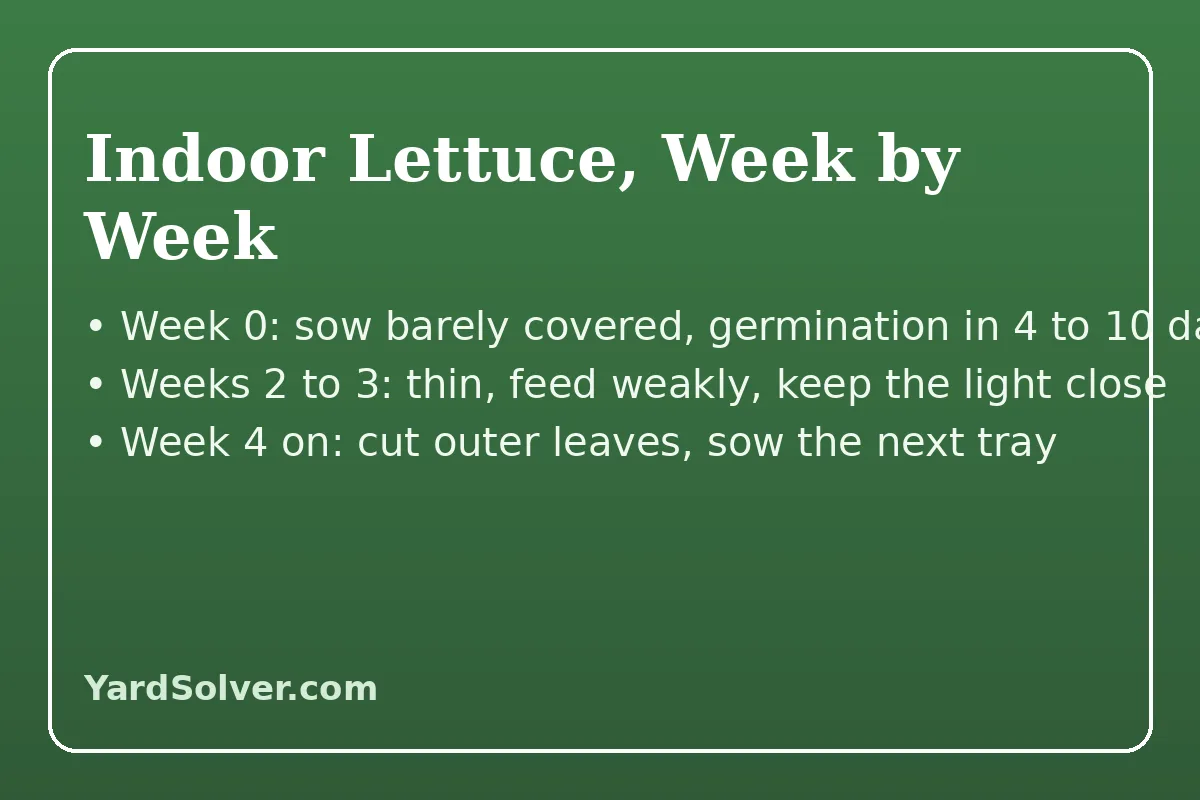
The hardware is deliberately humble. A window box, a shallow storage tray with holes drilled, a roasting pan of mix in a solid tray — anything 8–10 cm (3–4 in) deep with drainage, because lettuce roots are shallow and wide rather than deep. Fill it with fresh, sterile potting mix — the soilless seed-and-container mixes, never garden soil, for the same disease reasons as every indoor crop — moisten it before sowing, and scatter the seed thinly over the surface. Lettuce seed is tiny and needs light to germinate well, so the covering is a dusting: a few millimetres of mix or vermiculite, pressed gently, then misted. Germination follows in 4–10 days at ordinary room temperature, with the extension seed tables putting the optimum soil temperature near 21 °C (70 °F) and germination falling away in real heat — one more reason the tray lives in the cool room, not over the radiator. Thin the seedlings once they have true leaves: salad mixes sheared as baby leaves can stand thick, but plants grown on for outer-leaf harvest want roughly 10–15 cm (4–6 in) each, and the thinnings are the first, smallest salad. Temperature is the flavour control. Illinois is direct: room temperatures of 21 °C (70 °F) and below are best, and plants must be kept away from direct heat sources. Warmth is not a kindness to a cool-season crop — heat and drought together are the triggers for bitterness and bolting, the plant's decision to abandon leaves and rush to seed. A cool spare room, a basement shelf under lights, an unheated sunroom that stays above freezing: these are lettuce rooms, and the warm kitchen windowsill above the radiator is not, however convenient it looks.
Water, feed and the two-week rhythm
Lettuce is mostly water wearing a green coat, and its watering rule follows: the mix stays evenly moist, never dried out and never swampy, because both drought checks and soggy roots show up in the leaves within days. Water from below where the setup allows it — stand the tray in its solid base with water for twenty minutes, then drain — or water gently at the surface in the morning. Feeding is light and regular: soilless mix carries little food, so a balanced water-soluble feed at about half strength every two weeks, the rhythm Illinois Extension recommends for indoor herbs and lettuce, keeps leaves green and growing without forcing soft, tipburn-prone growth. The system's real engine, though, is succession. A single tray of lettuce has a harvest window of a few weeks before the plants tire, bolt or are cut down to stubs; the household that wants salad in February and March sows a small tray every two to three weeks, as the University of Vermont's indoor-greens guidance advises, so a fresh tray is always reaching cutting size as the old one finishes. The footprint is modest — three trays in rotation on one shelf — and the routine is five minutes at sowing and thirty seconds of watering a day. Write the sowing dates on the tray ends with a grease pencil, the same labelling discipline as the seed station, because three identical green trays at three ages are a puzzle nobody solves by looking. When the last tray of a cycle is cut, the mix is composted, the tray washed, and the shelf turns to spring's seedlings — the lettuce having paid its winter rent in full.
Harvest, and the three problems worth knowing
Harvest is where loose-leaf lettuce repays its selection. Two methods share the work. Picking outer leaves — taking the largest, oldest leaves from each plant once it stands 8–10 cm (3–4 in) tall, always leaving the centre crown untouched — keeps every plant producing for weeks and suits a household cutting salad for two. Shearing — cutting the whole patch about 2.5 cm (1 in) above the crowns when the leaves reach 8–10 cm — gives one big bowl and a regrowth that yields a second, lighter cut, sometimes a third, each a little weaker than the last; after the second shear, the tray is usually done and its succession replacement takes over. Cut in the morning, when leaves are crispest with the night's water in them, rinse, spin dry, and refrigerate in a bag with a paper towel, where the leaves hold about a week. Three problems account for nearly every indoor lettuce failure, and each has a named cause. Leggy, pale, flopped seedlings mean light too far or too few hours — move the lamp closer and check the timer before blaming the seed. Bitter leaves mean heat or drought stress — move the tray to the cool room and even out the watering. Tipburn, the scorched brown edges on the tender inner leaves, is a calcium-delivery failure inside the leaf rather than a shortage in the mix: the still indoor air lets the fast-growing centre leaves transpire too little to pull calcium up, and the fixes are a small fan moving air across the plants — the same fan the seed station runs — steady moisture, and no forcing with heavy feed. A tray diagnosed this way is rarely lost; lettuce grows fast enough that the next sowing, two weeks behind it, is already the corrected edition.
One lamp, three trays: the working setup, costed honestly
Here is the whole system as it runs in a real house, because the pieces only make sense assembled. The shelf is whatever already holds the seed station — one level, about a metre wide, in the coolest bright room or a basement corner that stays above about 10 °C (50 °F). The lamp is a single full-spectrum LED bar or a two-tube fluorescent shop light spanning the shelf, hung on chains so its height adjusts in seconds, plugged into a mechanical timer set for fifteen hours. Under it sit three shallow trays in a row, each in its own solid base: tray one sown this week, tray two at the thinning stage, tray three at cutting size. The weekly round is five minutes: sow tray one's successor the day tray three is cut down for the last time, rotate the emptied tray to the sowing end, and the conveyor resets. The running costs are honest and small — a lamp of ordinary wattage for fifteen hours a day costs less per month than one supermarket salad clamshell a week, the mix is reused for a second cycle if it grew no diseased plants, and the only consumable bought by the year is seed. What the setup returns, beyond the salads, is timing: the same shelf, lamp and timer that carried lettuce through December become the seed-starting station of February and March without moving a single component, which is why this guide treats the two builds as one piece of household equipment with two seasons of work in it.
Keep going
Run the shelf's other speeds with How to Grow Microgreens Indoors and How to Grow Sprouts Indoors, and keep the herbs beside it with Grow Herbs Indoors in Winter.
Sources
The light and temperature framework — lettuce and herbs need 6 to 8 hours of bright light a day with southern windows best; two 40-watt cool-white fluorescent lights held 6 to 12 inches above the plants for 14 to 16 hours a day as the substitute, at roughly two hours of lamp light per hour of sunlight replaced; room temperatures of 70 F and below, away from direct heat; loose-leaf lettuce as the best indoor bet, harvestable at about 4 weeks; and rotating containers against phototropism — follows University of Illinois Extension, Grow Herbs and Lettuce Indoors this Winter. The treatment of light's intensity, duration and quality as the limiting factor for indoor food growing, and lettuce's preference for cooler temperatures, follow the same service's indoor kitchen garden guidance, Get Growing With an Indoor Kitchen Garden. The shallow-container figure (3 to 4 inches of mix suffices for greens, with drainage), harvesting outer leaves once plants reach 3 to 4 inches, and sowing a new container every 2 to 3 weeks, follow University of Vermont Extension container guidance as summarised with the CSU germination figures (4 to 10 days, optimum soil temperature near 70 F) at Growing Lettuce Indoors: Light, Containers, Harvest Times.
Questions people ask
How long does lettuce take to grow indoors?
Loose-leaf lettuce gives its first cut-and-come-again harvest at about four weeks from sowing, and salad mixes can be sheared as baby leaves at three to four weeks. Full heads take far longer — six to ten weeks — which is why indoor growers choose leaf types.
Can lettuce grow on a windowsill without a grow light?
On a bright south-facing window giving 6 to 8 hours of light, in spring and fall, often yes. In midwinter at northern latitudes, usually no: the days are too short and the light too weak, and the plants stretch and pale. A lamp 15-30 cm (6-12 in) above the leaves for 14-16 hours a day is the reliable winter answer.
Why is my indoor lettuce bitter?
Heat and drought are the triggers. Lettuce is a cool-season crop: temperatures above about 21 C (70 F), a spot near a radiator, or mix allowed to dry out all push it toward bitterness and bolting. Move it to your coolest bright room and keep the moisture even.
How deep a container does indoor lettuce need?
Surprisingly shallow: 8-10 cm (3-4 in) of mix is enough for leaf lettuce and salad greens, as long as the container drains. Lettuce roots spread wide rather than deep. Use a solid tray underneath and empty standing water after watering.
How do I keep indoor lettuce coming all winter?
Succession. Sow a small tray every two to three weeks instead of one large tray once. Each tray cuts for a few weeks, and as it tires the next is reaching size. Three trays in rotation on one shelf keep a small household in salad from December to March.
Why are the inner leaves of my lettuce burning at the edges?
That is tipburn: the tender centre leaves cannot pull calcium up fast enough in still indoor air, even when the mix has plenty. Move air across the plants with a small fan, keep watering steady, and avoid heavy feeding that forces soft, fast growth.
Comments & ratings
No comments yet.
Be the first to share your experience.