
Guides · Winter jobs · Published November 20, 2026 · By Faizan Ahmad
How to Protect Strawberries in Winter: Straw Mulch Timed to Dormancy
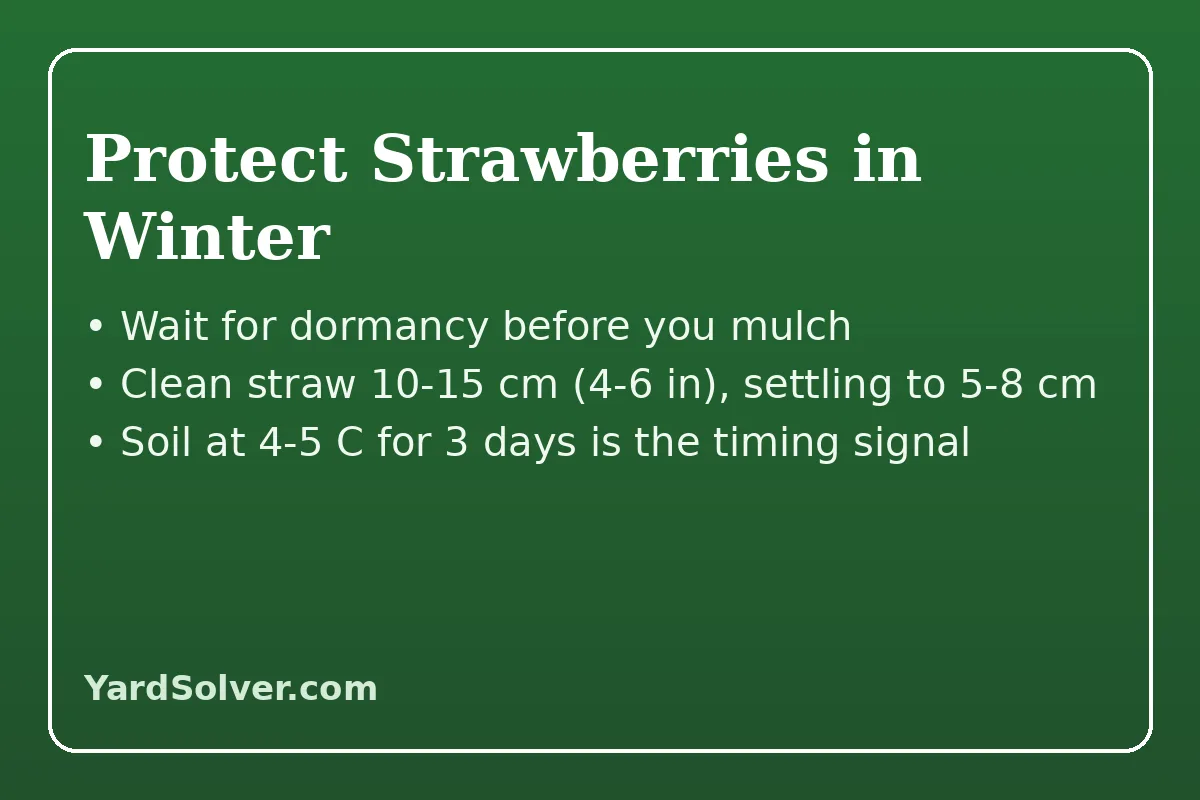
To protect strawberries in winter, wait until the plants are fully dormant, then cover the bed with a loose layer of clean straw 10–15 cm (4–6 in) deep — which settles to 5–8 cm (2–3 in) — timed by soil temperature rather than the calendar: apply it when soil at 10–12 cm (4–5 in) depth has held at 4–5 °C for three consecutive days and air temperatures are falling below −1 °C, but before they reach −7 °C, the range where unprotected crowns begin to take damage. Strawberries are hardy plants with one vulnerable address: the crown, the short stem at soil level from which leaves, runners, roots and next year's flower buds all grow, sitting in the top few centimetres of soil where winter's freeze-thaw swinging is most violent. The straw's job is not to keep the bed warm — it is to keep its temperature steady, to blunt the wind, and to trap the snow that insulates better than any material you can buy. This guide gives the timing signals in order, the application method for beds and rows, the different rules for container plants, the spring uncovering that matters as much as the covering, and the two timing mistakes — too early and too late — that between them account for most winter strawberry losses in Canada and the northern US.
The short answer, on one card
Signal, not date: plants dormant (flattened, reddened after several hard frosts), soil at 4–5 °C at 10–12 cm depth for three days, nights below −1 °C and falling — on the Prairies and in much of Canada that window typically opens in late October to November; milder regions run later. Material: clean wheat or rye straw, loose and fluffy; it holds its structure, traps air and snow, and pulls off cleanly in spring. Depth: 10–15 cm (4–6 in) applied, settling to 5–8 cm (2–3 in), crowns fully covered. Never: mulch warm, still-growing plants, and never leave the bed bare into −7 °C nights. Spring: rake the straw off the crowns the moment new growth starts, into the rows where it works all summer. Containers: different rules entirely — shelter and insulation for the pot itself, covered below.
What winter actually does to a strawberry plant
Manitoba Agriculture's strawberry guidance states the exposure plainly: on the Prairies the strawberry is a tender perennial whose crowns and shallow root system need added protection to survive extreme winter temperatures, and most of a June-bearing plant's roots sit in the top 15 cm (6 in) of soil, with day-neutral roots shallower still, in the top 8–10 cm (3–4 in). Everything the plant will be next year is already formed and waiting in the crown by November — the flower buds for June's crop were initiated back in the short days of late summer — so winter protection is literally crop protection, not tidiness. Three forces do the damage. Sustained deep cold injures crowns directly once temperatures fall far enough without insulation. Freeze-thaw cycling heaves plants upward, tearing fine roots and leaving crowns exposed to air — the mechanism our frost heaving guide treats across the whole garden, and to which shallow-rooted strawberries are the textbook victim. And cold, dry wind desiccates crowns and foliage on snowless stretches, which is why a windy, bare January can injure a bed that a colder, snow-covered one survives untouched. Properly applied straw answers all three at once: it evens soil temperature, holds the soil against heaving, blocks the wind and traps snow over the bed. Hence the quotable rule of this guide: straw mulch is not a blanket that warms the bed — it is a thermostat that stops the bed's temperature from swinging, and swinging is what kills crowns.
The timing window: three signals, in order
| Signal | What to check | What it tells you |
|---|---|---|
| 1. Dormancy | Plants flattened and reddened after several hard frosts; no new growth | The plant has hardened off and stopped growing — safe to cover |
| 2. Soil temperature | 4–5 °C at 10–12 cm (4–5 in) depth, three consecutive days | The bed has cooled enough that mulch will hold cold, not warmth |
| 3. Air temperature | Nights below −1 °C, forecast falling, but not yet −7 °C | The covering deadline: damage risk begins below about −7 °C unprotected |
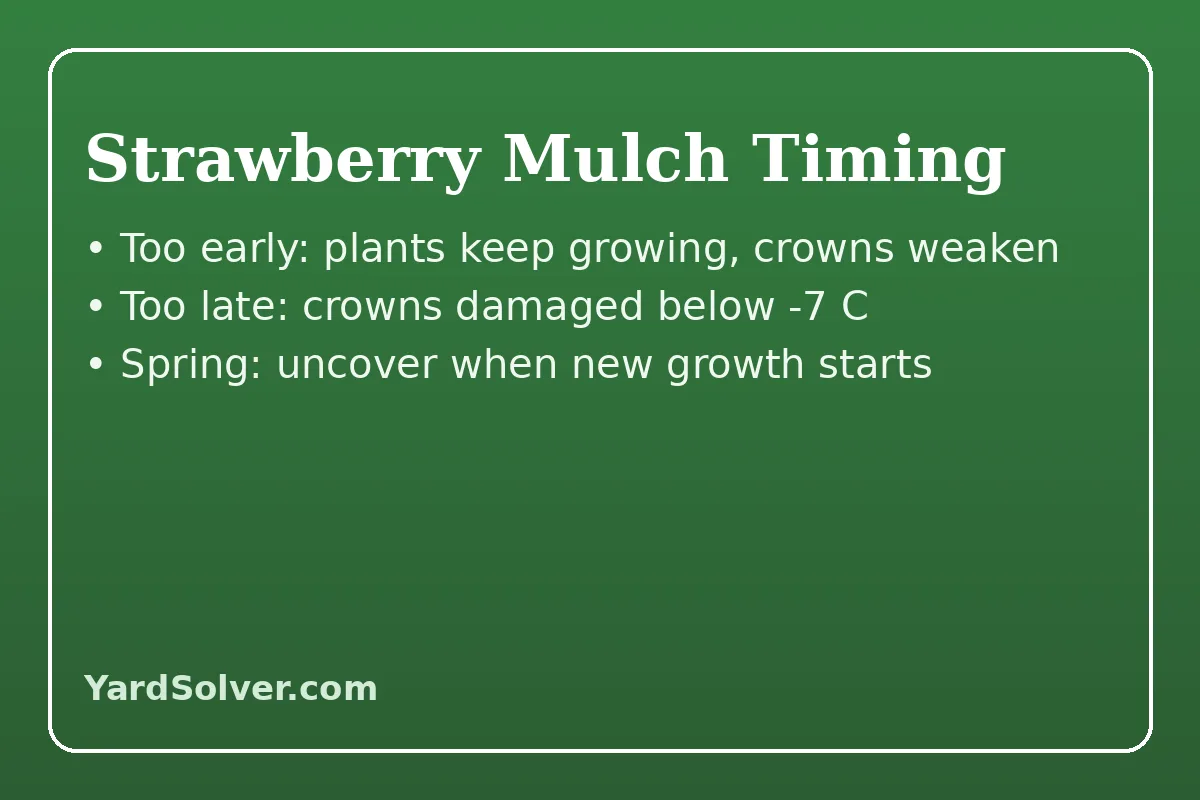
| Too early looks like | Green, upright, still-growing plants under straw | Weakened, soft plants and crown rot — a yield loss made by kindness |
| Too late looks like | Bare crowns through a −7 °C or colder snap | Crown injury that only announces itself as a thin bed in spring |
The Manitoba timing guidance — drawn from the Prairie commercial strawberry guide and University of Illinois soil-temperature research — is unusually precise because the window is genuinely narrow, and it is worth following in its own order. Dormancy comes first, and the guidance offers a field test for it: lay a piece of plywood over a few plants for a couple of days; if the covered plants yellow, they were still growing and are not dormant, while plants that stay the same colour are dormant and ready. Soil temperature comes second, measured where the crowns live, not at the surface. Air temperature sets the deadline. Note what the guidance also permits: if snow arrives before the soil has cooled and the plants have hardened, applying straw after that snowfall is acceptable — the snow itself protects the bed in the short term while you wait for the real signals. Gardeners without a soil thermometer can use the Small Farm Canada winter-mulch signals as a working proxy: several nights below freezing, soil firm and crusted in the morning, plants visibly dormant. What no version of the method allows is mulching by calendar habit in a warm October because the weekend was free — the covered, still-growing bed is the classic self-inflicted loss, as the timing discussion in Putting Your Garden to Bed also warns for shallow-rooted perennials generally.
Applying the straw: loose, deep enough, and anchored
Work on a calm day if the weather gives you one. Shake the straw out loose and fluffy rather than laying it in compressed flakes — the insulation lives in the air the straw traps, and the Manitoba guidance is explicit that straw standing somewhat open, with stems sticking up, traps snow better than a flat, packed layer, which is also why wheat straw is the standard material: it holds its structure all winter, where barley straw flattens and loses loft. Cover the crowns completely to the full depth, 10–15 cm (4–6 in) loose, working along the rows so no crown sits in a thin spot — thin spots, not average depth, are where injury happens. In commercial terms the rate is two to three tons per acre; in garden terms, a standard small bale generously covers a family bed, and a second bale in reserve beats a thin first one. Where wind strips mulch — exposed Prairie and lakeside gardens above all — hold the straw with a length of netting, a few branches laid across it, or the shelter of a low windbreak, and expect to top up after the first big blow. Keep one honest distinction from the general mulch rules in Types of Mulch: the summer rule about keeping mulch away from crowns does not apply here. Winter strawberry mulch is supposed to cover the crowns — that is its entire purpose — and the spring section below is where the crowns get uncovered again, on time.
Container strawberries: the pot changes everything
A strawberry in a pot faces a different winter from its sister in the ground, because its roots experience something close to air temperature on every side of the container instead of the buffered temperature of a soil mass. The method in How to Grow Strawberries in Pots therefore needs a winter chapter of its own, and it has three acceptable versions. Best: once the plants are dormant, move the pots into an unheated garage, shed or cold frame, where temperatures stay cold enough to hold dormancy but the worst swings and wind are excluded, and water sparingly — a dry pot in a shed can still desiccate, so check monthly and water lightly when the mix is dry an inch down. Second: sink the pots into a spare bed or a pile of leaves and mulch up to the rims, converting the container back into ground, thermally speaking. Third, for pots that must stay on a deck: cluster them together against a sheltered wall, wrap the group in bubble insulation or straw bales around the outside, and mulch over the crowns as for a bed. What does not work is the single ornamental pot left alone on an exposed deck through a zone 4 winter and mourned in April — the plant was hardy; the address was not. Bring the pots back out as growth resumes in spring, on the same cue as the bed uncovering below.
Spring uncovering: the second timing that matters
Winter protection fails in spring as often as in fall, in the opposite direction. Iowa State University Extension's spring mulch guidance is direct: once soil temperatures are consistently above about 4 °C (40 °F) and the plants under the straw have begun to grow, the mulch must come off the crowns, because new growth forming in darkness becomes etiolated — pale, stretched and brittle — burning through the carbohydrate reserves the plant saved for spring and emerging weak and light-sensitive. Check under the straw from early spring onward rather than waiting for a date: when new leaves are pushing, rake the bulk of the straw off the plants and into the rows and paths, where it stays on duty all season suppressing weeds, holding moisture and keeping berries clean off the soil — the spring half of the system, and the reason the fall material is never wasted. Do not strip the bed naked and discard the straw. Then manage the genuine risk that remains: uncovered crowns and early buds are frost-tender in a way dormant crowns were not, so keep floating row cover ready and throw it over the bed on forecast frost nights — it buffers cold while still admitting the light the plants now need, which straw cannot. Gardeners who uncover in stages — crowns first, a light scatter left over the bed for another week in cold springs — get most of both protections. Record both dates, mulching and uncovering, with the soil temperatures you measured, in the journal from How to Start a Garden Journal: two winters of your own numbers will time this job better than any regional guide, including this one.
Renovation, rotation and the bed's longer life
Winter is also when the strawberry bed's future gets decided, and the covering round is the natural moment to decide it. A June-bearing bed stays productive for roughly three to five years before yields and berry size decline and disease pressure builds; the winter walk is when to mark which rows are in their final season, so spring renovation — narrowing matted rows, thinning runners, feeding after harvest rather than before fruiting — starts from a plan instead of a surprise. Note the spots where winter injury actually occurred, because they map the bed's cold pockets: low corners where cold air pools and wind strips the straw are the places to add a windbreak, deepen the mulch next year, or retire to a hardier crop. Day-neutral and everbearing beds, with their shallower roots, deserve the full depth without argument and benefit most from the snow-trapping loft of the straw. And when a bed is finally replaced, plant the new one on fresh ground that has not carried strawberries — or their relatives in the rose family — for several years, since the soil-borne diseases of an old bed are the one winter problem no depth of straw can fix. The varieties and planting method for that new bed live in How to Grow Strawberries; this guide's whole job is simpler and, in a cold country, just as decisive: get the crowns through winter, every winter, with their flower buds intact — because the June harvest was actually made the previous November, under the straw, in the cold.
Keep going
Grow the crop this guide protects with How to Grow Strawberries and How to Grow Strawberries in Pots, fight the heaving behind most winter losses with How to Prevent Frost Heaving, and place the job in the season's order with Putting Your Garden to Bed.
Sources
The dormancy-first rule, the soil-temperature signal of 4 to 5 °C at 4-to-5-inch depth for three consecutive days, the air-temperature window below −1 °C but before −7 °C, the plywood dormancy test, the 4-to-6-inch wheat or rye straw depth settling to 2 to 3 inches, the loose snow-trapping application, the shallow root depths for June-bearing and day-neutral plants, and the crown's role as the source of leaves, runners and flower buds follow Manitoba Agriculture, When to Apply Winter Protection to Strawberry Fields and its companion page When to Apply Winter Protection to Strawberry Fields (Manitoba Agriculture). The spring rule — check beds once soil is consistently above 40 °F, remove mulch as growth begins to prevent etiolation, the frost tolerance of buds still in the crown, and floating row cover as the post-uncovering buffer — follows Iowa State University Extension, Spring Mulch Management in Strawberries. The general winter-mulch timing signals (nights below freezing, soil firming, dormancy before covering) follow Winter Mulch for Gardens (Small Farm Canada).
Questions people ask
When should you mulch strawberries for winter?
After the plants are dormant and the soil has cooled: the Prairie guidance is soil at 4 to 5 °C at 10 to 12 cm depth for three consecutive days, with air temperatures falling below −1 °C but before they reach −7 °C. On the Prairies and in much of Canada that is typically late October into November; milder regions run later. Mulching still-growing plants in warm soil weakens them.
How deep should straw mulch be on strawberries?
Apply clean wheat or rye straw 10 to 15 cm (4 to 6 inches) deep, loose and fluffy, and expect it to settle to 5 to 8 cm (2 to 3 inches). Cover the crowns completely and evenly — injury happens at thin spots. Straw standing somewhat open traps snow better than a packed, flat layer.
What happens if you mulch strawberries too early?
The plants are not yet dormant, so they keep trying to grow under the straw in warm soil. That soft, unhardened growth is less cold-hardy, crowns can rot in the warm, damp covering, and yields fall the following season. Extension guidance treats too-early mulching as a direct cause of yield loss, not a harmless head start.
How cold can strawberry crowns survive in winter?
Unprotected crowns begin to risk injury as temperatures fall below about −7 °C, with damage increasing as it gets colder, which is why the mulching deadline is set there. Under a settled straw layer that traps snow, dormant crowns tolerate far colder Prairie and northern winters, because the soil temperature around them stays steadier and higher than the air.
When do you remove straw from strawberries in spring?
As soon as the plants begin to grow under it — check once soil temperatures are consistently above about 4 °C (40 °F). New growth left in darkness becomes pale, stretched and weak. Rake the straw off the crowns and into the rows, where it suppresses weeds and keeps berries clean, and keep floating row cover ready for late frost nights.
How do you overwinter strawberries in pots?
Do not leave a lone pot exposed on a deck in a cold zone — its roots face near-air temperature. Once dormant, move pots to an unheated garage, shed or cold frame and water sparingly through winter, or sink them into a bed or leaf pile up to the rims, or cluster and insulate them against a sheltered wall with straw over the crowns.
Comments & ratings
No comments yet.
Be the first to share your experience.